

On 30 August 2026, Badung authorities dismantled three illegal, non-permanent structures built on the sidewalk of Jalan Teuku Umar Barat in Kerobokan Kelod.
What happened on Jalan Teuku Umar Barat in Kerobokan Kelod on 30 August 2026
Badung Satpol PP and the Environmental and Sanitation Agency (DLHK) cleared three structures following the inaugural Badung First Car Free Day trial in Kerobokan Kelod. The structures had been used as a food stall, a saddle-repair business and a second-hand clothing seller.
According to Badung’s official statement, Regent I Wayan Adi Arnawa identified dilapidated and illegal structures using public facilities while inspecting the Car Free Day trial. Officials said the buildings interfered with pedestrian and public-facility functions; Satpol PP and DLHK then removed the structures and debris.
The Car Free Day itself ran from 06:00 to 09:00 WITA along less than one kilometre of Jalan Teuku Umar Barat. It was an initial trial subject to evaluation, not an announced permanent road closure. The event was also paired with a streetscape programme: DLHK planted 200 tree seedlings along the route, while the Regent said he had asked Badung’s PUPR agency to design additional or wider pedestrian facilities. The announced visual improvements extended toward the Petitenget intersection, with no construction budget or completion date supplied.
This was not the first reported action in this corridor. Badung described the 30 August operation as its third clearance there, including that day’s action. That history matters for people considering a home, shop space or land near the route: visible roadside occupation should not be treated as proof that the arrangement is accepted or permanent.
Why Badung removed sidewalk structures under the public-order rules
The immediate issue was use of the sidewalk. Under Badung Perda No. 7/2016, effective from 12 April 2016 and still listed as in force, sidewalks are intended only for pedestrians, and the local government is directed to control their use for pedestrian safety and comfort. The regulation also assigns Satpol PP responsibility for enforcing public-order rules. See the regulation listing at JDIH Badung.
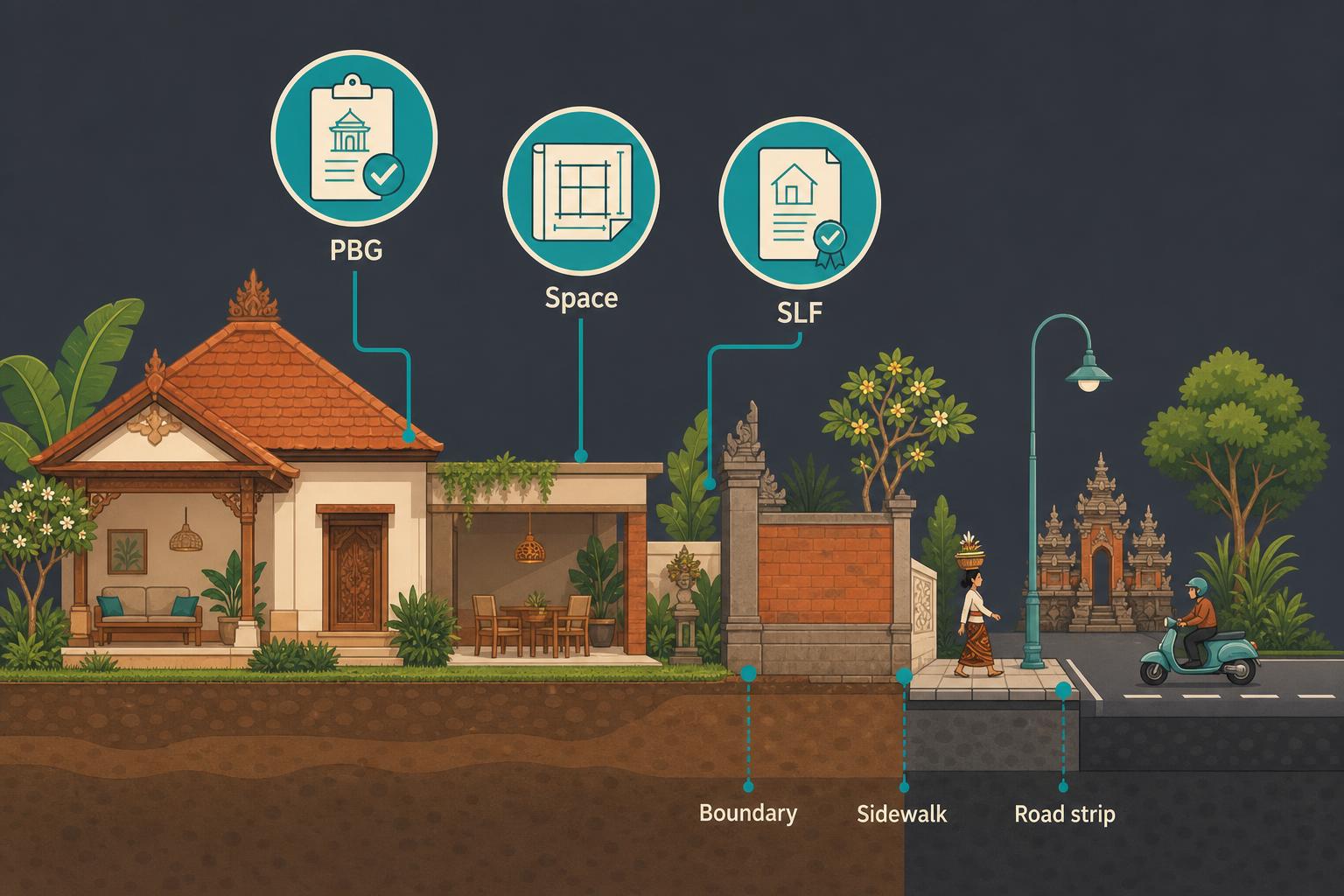
For property due diligence, the important distinction is between land that appears usable and land that is actually part of the property. Perda No. 7/2016 defines ruang milik jalan, or road right-of-way, as land outside the road’s functional area that remains within the road corridor, including space for possible future road widening.
In plain terms, a verge, paved frontage, sidewalk edge or apparent access strip may serve a property day to day without being private land that an owner can build on, fence off, market as parking or lease to a tenant.
The action was described as persuasive and humane. Owners were allowed to remove stock and valuables before demolition. In its 30 August statement, Badung said one owner had been summoned to attend Satpol PP on 31 August for clarification and coaching, while two other owners had not yet been located and would be followed up. The statement did not confirm attendance or a subsequent decision on 31 August.
How Kerobokan renters should check access, parking and frontage before signing
A clearance of three small sidewalk structures does not mean a nearby residence is unsafe to rent. It does mean that renters should look beyond the gate and pool when a listing relies on roadside space for daily living.
At an in-person viewing, walk the exact route you would use on foot, by scooter and by car. Do it rather than accepting “easy access” as a listing phrase. Check these practical points:
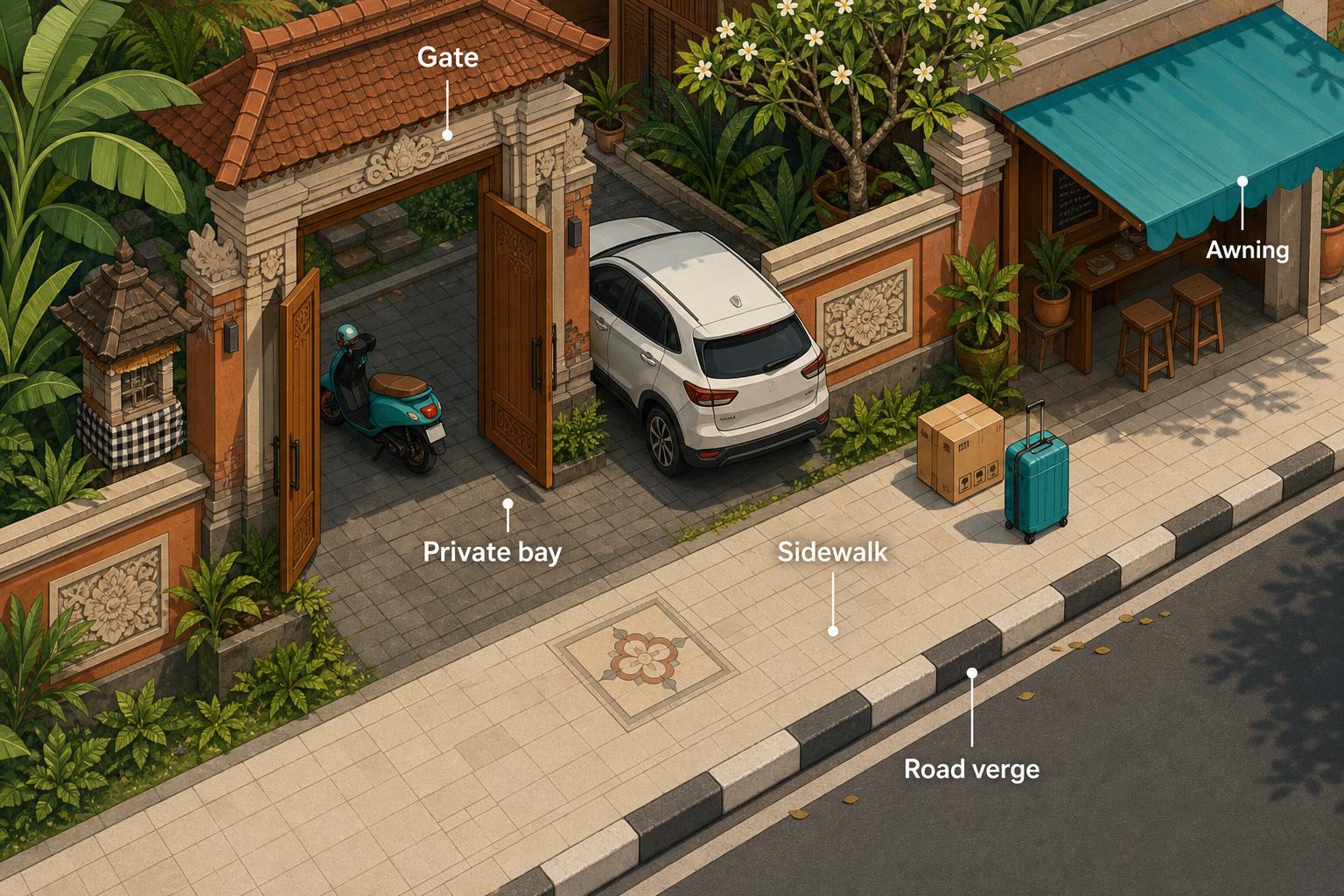
- Gate-to-road route: Is the entrance reached entirely through the property’s own access, or does it depend on crossing, parking on or using a sidewalk or verge?
- Vehicle space: Ask where cars and scooters are meant to stand. Separate a dedicated bay inside the boundary from informal roadside space.
- Pedestrian route: Check whether you can enter without blocking a footpath, and whether a stroller, luggage or deliveries would fit through the actual entrance.
- Built additions: Notice guard posts, kiosks, awnings, ramps, storage sheds and extensions at the frontage. Ask whether they are included in the rental and who bears responsibility if they must be altered or removed.
- Written terms: If parking, access or a frontage structure affects your decision, describe it precisely in the rental agreement rather than relying on a verbal assurance.
Take dated photos and video of the approach, gate, parking position and any shared lane during the viewing. This is useful evidence of what you were shown, but it is not proof of land rights or approvals.
For renters comparing homes, the most useful first screen is often the listing’s stated amenities, house rules, minimum stay and location details.
Kerobokan is close to several high-demand long-stay areas, but do not use rent elsewhere as a valuation of a particular Kerobokan frontage. A disrupted parking arrangement or uncertain access is a property-specific issue that should be assessed separately from an area-level comparison.
What a Kerobokan buyer should verify about boundaries, PBG and road corridors
For a buyer, the August removal is a prompt to investigate the exact footprint being sold. It is especially relevant when the advertised plot, driveway, commercial frontage or parking layout seems larger on the ground than the boundary documents suggest.
Before committing to a purchase, ask the seller or authorised representative for the documents and explanations that identify what is private, what is a shared access arrangement, and what forms part of the public road corridor. Have an appropriately qualified professional review documents and the site; this article is not legal advice.
- Match the documents to the ground. Compare the stated boundary and access with walls, fences, paving, drains, gates and structures you see during a site visit.
- Identify roadside additions. Do not assume a paved apron, informal parking edge or structure near a sidewalk transfers with the property.
- Review building approvals. Perda No. 7/2016 prohibits constructing a building without an IMB. In current national building-approval practice, the relevant term is PBG rather than IMB. SIMBG guidance says an IMB issued before PP No. 16/2021 remains valid where the building has already been constructed and has not changed; absence of a newer PBG alone does not prove an unchanged older building is illegal.
- Ask about later work. A villa may have an original structure plus a newer kitchen, roofed terrace, staff room, shopfront or access alteration. Treat each later addition as a separate item to clarify.
- Check fitness for use. SIMBG guidance describes the Sertifikat Laik Fungsi (SLF) as the local-government certificate declaring a completed building fit for use.
SIMBG states that a PBG application requires spatial-utilisation approval and environmental documents as prerequisites. That does not let a buyer independently validate a site from a brochure, but it makes PBG and underlying spatial documentation relevant questions when reviewing extensions or additions. A building approval is not a substitute for checking permitted land use. The SIMBG system is the national reference point for this approval framework; PBG and SLF applications use SIMBG and are processed by the relevant regency or city authorities for the building’s location.
Badung’s current district spatial plan is Perda No. 4/2025 on the 2025–2045 RTRW, effective from 21 April 2025 and replacing the 2013–2033 RTRW. A buyer should therefore avoid treating old planning assumptions as sufficient for a current transaction.
What hosts and landlords near Kerobokan should review after the clearance
Hosts and landlords should not present roadside space as a rental feature unless they can accurately explain the arrangement. That includes “private parking,” a food stall, a reception point, a security post, storage or a tenant’s outdoor seating area near a footpath.
A sensible immediate review is to compare the live listing, the rental agreement and the physical property. Remove claims that overstate a frontage, and state clearly when parking is shared, limited or off-site. If an extension is material to the booking, avoid vague descriptions such as “extra building” or “commercial-ready”; identify what the renter can actually use.
Ensure any agreed access or parking limitation is disclosed before the guest commits, rather than becoming a dispute after arrival.
Hosts considering a compliant long-term listing can review Livuma’s hosting information before publishing. Account activation requires identity verification, legal details and an Indonesian bank account before paid bookings can be accepted; it does not replace a host’s responsibility to ensure the property description and use of space are accurate.
Is this the start of a wider North Kuta crackdown or permanent Car Free Day?
There is no official source reviewed that announces a scheduled wider crackdown across North Kuta or a continuing Kerobokan enforcement programme. On 30 September 2026, Badung cleared six warung on Jalan Gatot Subroto Barat in Kerobokan Kaja, near the Badung–Denpasar boundary, standing over drains within the road right-of-way. This was a separate operation from the August clearance in Kerobokan Kelod. Officials reported written warnings and a seven-day opportunity for voluntary dismantling before that operation; this does not establish a universal seven-day entitlement for every clearance. The September action confirms additional roadside enforcement, but not a scheduled North Kuta-wide campaign linked to the August operation. It is reasonable to see the action, the prior enforcement history, the Car Free Day trial and the proposed pedestrian-facility work as signs that streetscape and public-space compliance may receive attention. It is not accurate to describe a wider campaign as confirmed.
Likewise, the Badung First Car Free Day on 30 August was an initial trial subject to evaluation. On 1 September, Badung’s transport-agency head said it was not held routinely every Sunday and would be evaluated following traffic-congestion complaints. No reviewed source establishes an approved recurring timetable as of 9 November 2026. It should not yet be treated as a permanent weekly closure, a guaranteed future amenity, or a basis for promising tenant footfall.
Penalty reporting also needs care. The official statement did not specify which article it intended to apply, and Perda No. 7/2016 provides different maximum penalties for different offences. Readers should not assume a single penalty applies to every structure or situation.
What has not changed for Kerobokan property renters and buyers
The 30 August action did not announce a new ban on renting in Kerobokan, a new ownership rule, a new building-permit system or a confirmed North Kuta-wide enforcement timetable. It cleared three non-permanent sidewalk structures on one named road corridor under existing public-order rules.
It also did not prove that every roadside building, driveway, shopfront or parking area in Kerobokan is illegal. Each property depends on its own boundaries, road-corridor position, building history, approvals and actual access arrangements.
For renters, the practical response is to inspect and document how you will enter, park and use the frontage before signing. For buyers, it is to make boundary, road right-of-way, PBG and later additions part of transaction due diligence. Those are ordinary checks, but the Kerobokan clearance makes them harder to skip.
Checking a Kerobokan rental’s access and parking through Livuma
- Compare the listing. Search Livuma’s live inventory by area, rental type and amenities. Read photos, house rules and booking conditions alongside any parking description; these do not prove boundary rights.
- Read the terms and secure the request. Review the payment schedule, deposit rules, deadlines and cancellation logic before committing. Secure the request before the host sees it with a card reservation or a held Indonesian bank-transfer prepayment. If declined, withdrawn or expired, the reservation is released or the prepayment refunded in full automatically.
- Check the frontage before confirming. The host answers within a limited window. For eligible monthly or yearly rentals, “view property first” secures only a small deposit. Coordinate the viewing and clarify access and parking in-app. After viewing, pay the rest in-app to confirm, with no deadline or automatic confirmation, or cancel for free for a full deposit release or refund.
- Keep the record and check in. Complete guest identity verification before the rental agreement is issued. The platform generates agreement details and receipts for supported bookings. Confirm arrival or report a problem in-app; a problem holds the host’s payout while resolved. Payout is not released until successful check-in under the booking’s terms.