

Approximately Rp2 trillion has been allocated for Bali’s proposed electric tram, according to KAI—but that does not put an airport–Canggu service on the departure board. On November 5, 2026, KAI president director Bobby Rasyidin announced the government allocation following a meeting with President Prabowo Subianto.
The announcement gives residents a concrete funding figure to follow. The subsequent November 10 update is equally important: route-alignment studies were still needed, construction was a future target, and the estimated delivery period covered both proposed phases.
For anyone renting, hosting or buying along the airport–Legian–Canggu corridor, the distinction matters. Future connectivity deserves attention, but today’s housing decision still needs to work without the tram.
Rp2 trillion is an announced allocation, not proof the tram is fully financed
Approximately Rp2 trillion is the allocation Rasyidin announced on November 5, 2026, as reported by ANTARA’s report on the Bali electric tram project. This is an attributed government-funding announcement, not independently verified evidence that the money has been disbursed.
That distinction is useful rather than merely technical. An allocation announcement tells residents that funding has been publicly discussed at a specific scale. It does not, by itself, show that every delivery requirement has been funded or completed.
The practical reading is:
- Supported: KAI’s president director publicly stated that the government had allocated approximately Rp2 trillion.
- Not established by that statement: the project is fully financed from planning through passenger operation.
- Not established: construction has started or a particular home will receive convenient station access.
Renters should therefore separate the transport announcement from any claim that a higher asking rent is justified by an imminent service. Buyers should make the same separation when reviewing a sales presentation.
The amount is a reason to monitor the project, not a property valuation. No quantified property-price or rental uplift can be substantiated from the supplied plans. If someone attaches a premium to “future tram access,” ask what evidence supports the connection between the proposed corridor and that particular address.
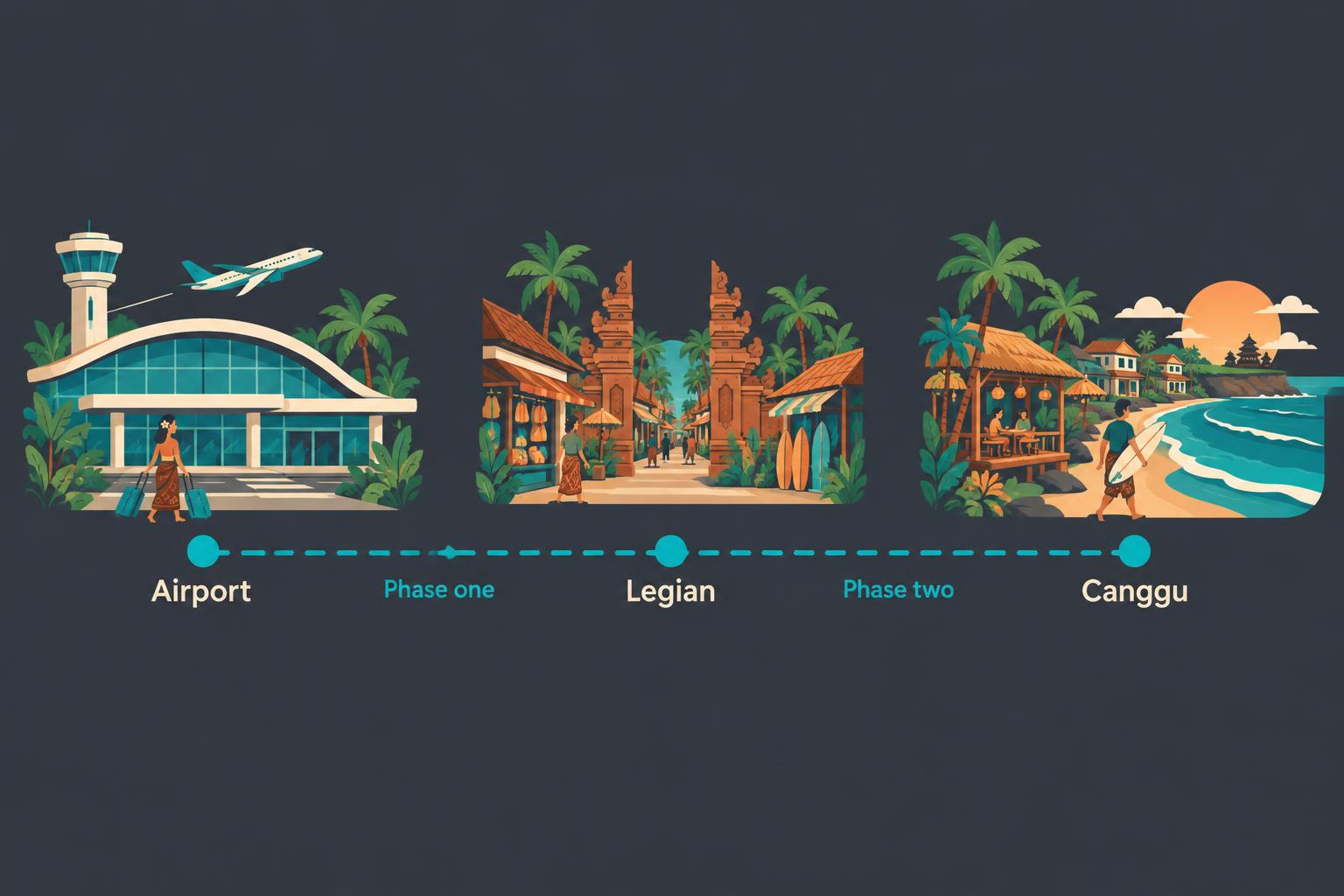
Two proposed phases put Legian before Canggu
Two phases were described in the November 5, 2026 announcement: Ngurah Rai Airport to Legian first, followed by an extension from Legian to Canggu. That sequence is more informative for residents than treating “airport–Canggu tram” as a single opening event.
| Proposed phase | Connection announced | What residents should take from it |
|---|---|---|
| Phase one | Ngurah Rai Airport–Legian | The initial proposed connection does not extend to Canggu. |
| Phase two | Legian–Canggu | Canggu access depends on the extension, not simply the airport section. |
A milestone on the airport–Legian section should not automatically be read as an equivalent milestone for Canggu. When following future announcements, check whether they concern the initial section, the extension or the whole corridor.
The same care applies at neighbourhood level. “On the proposed corridor” and “conveniently connected to a station” are different claims. A property can be in a named destination area without having a practical walking route to the eventual service.
For a renter, the useful question is whether the home works for everyday journeys before the extension exists. For a host, it is whether guest information accurately describes transport that guests can actually use. For a buyer, the route sequence should sit alongside ordinary checks on the property—not replace them.
Keep airport access separate from the rest of your routine, too. Even a useful future airport connection would not establish how easily a particular address serves work, shopping or other regular journeys.
Two to three weeks of alignment work still remained in the November update
Approximately two to three weeks of route-alignment studies were still required when Rasyidin spoke on November 10, 2026. According to detikFinance’s construction-status report, field surveys were complete, but alignment work remained.
That puts the announcement in a specific planning context. Completed field surveys are progress; they are not the same thing as a settled route with confirmed property-level access.
Residents should avoid converting the estimated study period into an automatic approval date. A statement that work requires approximately two to three weeks does not establish what decisions will follow, or when those decisions will be published.
- For station-access claims: request a published access map rather than relying on a marker added to a property advertisement.
- For nearby construction claims: ask for a notice identifying the affected location and work scope.
- For opening claims: look for a passenger-service announcement, not a survey or planning update.
These are different kinds of evidence. A survey update can explain why the project is moving forward without answering whether construction will affect your lane or whether a stop will be walkable from your front door.
If you are viewing a home, record the current entrance, road approach and pickup arrangements. That gives you a practical baseline against which to assess any later published alignment, rather than trying to reconstruct the situation from promotional descriptions.
Early 2027 is a construction target, not a passenger opening date
Early 2027 was KAI’s hoped-for construction start in the November 10, 2026 update. In that same report, Rasyidin estimated two to three years for both phases. Neither statement is a guaranteed date for carrying passengers.
The distinction prevents a common reading error: taking a proposed start and an estimated duration, then presenting an inferred opening year as official. There is no need to calculate an opening date that the evidence does not guarantee.
| Milestone or estimate | Reported position | What it does not establish |
|---|---|---|
| November 5, 2026 allocation announcement | Approximately Rp2 trillion, according to KAI | Funds disbursed or complete project financing |
| November 10, 2026 survey update | Field surveys complete; alignment studies remained | A final station-access plan |
| Early 2027 construction target | KAI hoped to begin construction | Work already underway |
| Two-to-three-year duration estimate | Estimate covering both phases | A guaranteed passenger opening date |
For renters, this means the lease should suit the transport conditions you can assess now. Do not assume the tram will arrive during your tenancy or solve an inconvenient commute before renewal.
If transport uncertainty affects how long you want to commit, consider the trade-offs in monthly versus yearly rental contracts in Bali. The relevant issue is your flexibility, not a speculative countdown to tram operation.
Hosts should also keep future plans separate from current amenities. A proposed service belongs in carefully qualified local context, not in a description that implies guests can use it during their stay.
The September agreement left practical delivery requirements ahead
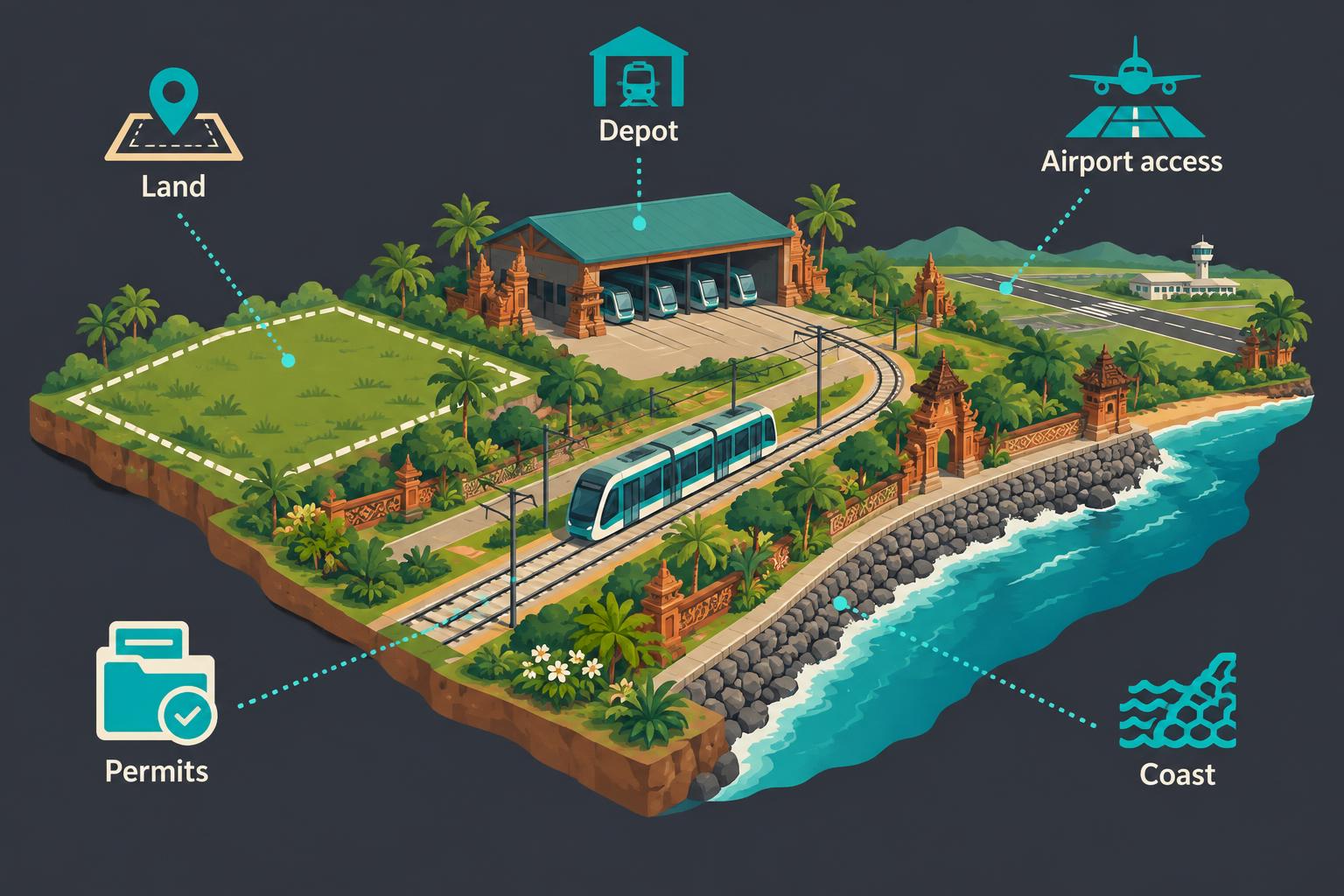
September 1, 2026 marked an earlier confirmed milestone: Bali’s provincial government, Badung Regency and KAI signed a joint agreement on railway development. Badung’s account of the agreement and proposed tram described it as an initial step requiring further cooperation arrangements and feasibility work.
Badung’s September 2 announcement also identified support needed for implementation, including:
- Land acquisition and depot land.
- Coastal reinforcement.
- Airport-route access.
- Permits.
These requirements help explain why an agreement and an allocation are not interchangeable with a construction milestone. The project involves physical access, land and approvals as well as vehicles and funding.
For a resident near the proposed corridor, the sensible next question is not “Will my road definitely be disrupted?” It is “Has any published notice identified work affecting this address?” The supplied information does not establish property-specific construction impacts.
Before committing to a home, ask the owner or manager whether they have received relevant access or works notices. Request the document rather than an informal assurance. Absence of a notice is not a guarantee that nothing will change, but it prevents speculation from becoming a supposed fact.
Our separate article on how Badung road projects can affect renters provides a related context for thinking about access during local works. Those projects should not be confused with confirmed tram construction.
The September battery-tram proposal does not establish doorstep access
September 2, 2026 is the date of the provincial announcement describing a battery-electric tram that would not require overhead electricity cables along its route. Bali’s provincial government also said development would involve customary villages and corridor businesses, including hotels and accommodation providers.
The proposed technology explains something about the system’s intended form. It does not establish the final position of stops, how passengers would reach them, or the effect on a particular property’s value.
Those distinctions matter when an attractive tram illustration appears beside a home advertisement. A vehicle concept is not a station map. An area name is not a walking route. Consultation is not a promise that every accommodation provider will have direct access.
Before accepting a property-level connectivity claim, ask:
- Is the stop shown on a published plan, or only on a marketing graphic?
- Does the claimed access depend on the airport–Legian section or the Canggu extension?
- Is there an identifiable pedestrian route from the property?
- Is the seller discussing a possibility, or presenting it as a current benefit?
The answers may remain unknown. That is a valid outcome, and more useful than a confident assumption.
Buyers should keep transport prospects separate from the wider checks covered in buying a house in Bali as a foreigner. A possible future connection does not resolve questions about the property itself, and the supplied plans do not substantiate a specified investment return.
As of November 13, road transport remains the basis for an airport-access check
November 13, 2026 is the check date for the airport’s official transport information. Its public transport page lists taxis and designated Grab and Gojek passenger lounges—existing road-based options that residents can use when assessing airport access today.
The tram announcement is not evidence that a tram service is available. For a move or booking now, start with an actual journey to the property, not a projected rail journey.
A practical address check should cover:
- Airport arrival: understand the pickup arrangement for the road-based option you intend to use.
- Property approach: check the route to the entrance, rather than stopping the assessment at the neighbourhood name.
- Everyday travel: test the journeys that will determine whether the home suits your routine.
- Future claims: keep proposed tram access clearly separate from transport available now.
Hosts can apply the same principle to arrival instructions: describe current pickup and access arrangements accurately, and label future transport plans as proposals. Buyers can treat the tram as a development to monitor without assigning it an unsupported premium.
The decision rule is straightforward: choose a home that works with today’s access, then reassess when published milestones establish what has changed. The announced allocation matters, but the evidence residents need next is more specific—alignment decisions, construction progress and eventually confirmed passenger-service details.