

Healthcare and insurance for expats in Bali involves a trade-off between domestic coverage, private-hospital access and protection beyond Indonesia—not simply finding the cheapest premium. This comparison will settle which coverage route fits your work status, length of stay and medical needs, and what to check before relying on it.
Your named options are BPJS Kesehatan/JKN, Indonesian private health insurance, international expat health insurance and travel insurance. They are not interchangeable, and participation in BPJS can be compulsory for qualifying foreign workers even when they also hold private cover.
| Option | Main role | Decisive limitation |
|---|---|---|
| BPJS Kesehatan/JKN | Indonesian social health coverage for eligible participants | Eligibility, referral rules and participating facilities; no overseas treatment |
| Indonesian private health insurance | Commercial cover whose benefits and network you select | Hospital access, exclusions and geographic scope depend on the contract |
| International expat health insurance | Health cover designed for living abroad | Countries covered, benefits and evacuation terms still need checking |
| Travel insurance | Protection designed primarily for trips | Do not assume it remains suitable when Bali becomes your home |
Healthcare and insurance for expats in Bali: BPJS eligibility
BPJS eligibility is the starting point, not an assumption attached to being an expat. Foreign nationals working in Indonesia for at least six months must participate in the social-security system. That requirement does not establish blanket access for every tourist or foreign resident.
Employees should ask their employer to confirm registration, the contribution arrangement and whether their membership is active. A private insurance card does not answer those questions.
Foreign self-employed applicants have a more specific route. Article 90 of the BPJS membership-administration guidelines specifies:
- An ITAS valid for at least one year.
- At least six months’ presence in Indonesia.
- At least six months working outside an employment relationship.
If you hold an investor, retirement or remote-worker permit, ask BPJS to confirm your applicant category before making a budget dependent on JKN. Do not substitute the name of your stay permit—or property ownership—for an eligibility decision.
Private insurers have a different gatekeeping process: ask whether they accept your residence situation, medical history and intended coverage dates. The practical comparison is therefore not always BPJS versus private insurance. For a qualifying worker, it may be mandatory BPJS plus whatever additional protection the private policy provides.
Travel insurance versus expat health insurance for living in Bali
Choose according to whether Bali is a trip or your home. Cigna distinguishes travel insurance, typically intended for short trips, from expat health insurance intended for longer stays or living abroad. The products should not be treated as substitutes without checking their wording.
For travel insurance, describe your actual circumstances to the insurer: where you normally live, how long you intend to remain away and whether you are already abroad. Ask for written confirmation that the policy fits that situation, rather than relying on a sales page mentioning Bali.
For Indonesian private or international expat cover, compare the healthcare you expect to use while living here:
- Does the quotation include outpatient appointments or only inpatient care?
- How are ongoing prescriptions and existing conditions treated?
- Are maternity, dental care and screening included, optional or excluded?
- What happens at renewal if you remain in Indonesia?
These are questions, not benefits that every resident policy provides. An international label does not make every treatment eligible, and a domestic policy should not be dismissed without examining its actual benefits.
For someone relocating indefinitely, start with resident health cover. For a visitor returning home after a defined trip, start with travel cover. Then test the policy against the facts of the stay.
BPJS referrals versus private hospital access in Bali
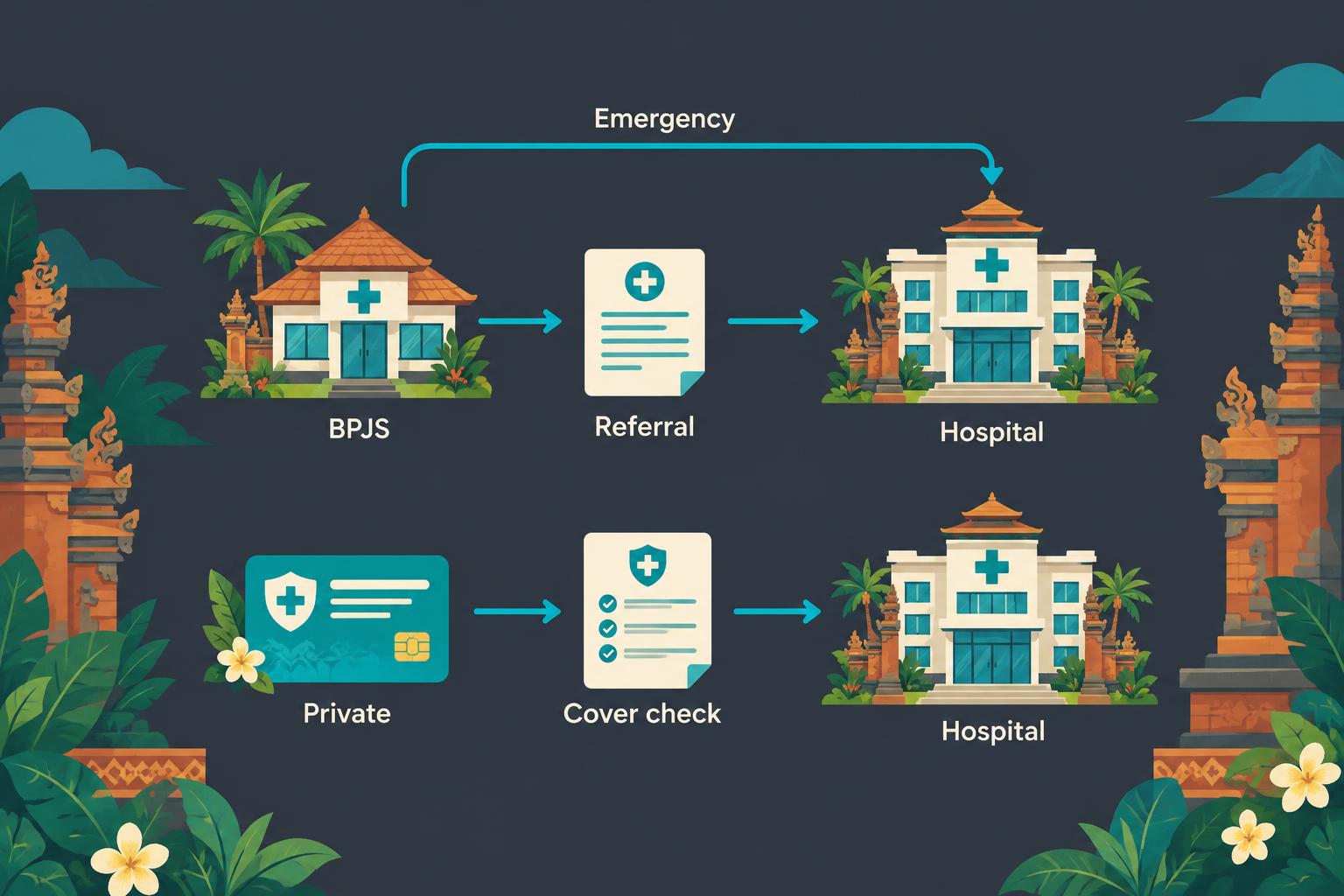
BPJS ordinarily follows a primary-care and referral pathway; private cover requires a separate check of hospital and benefit access. Under JKN, care generally starts with primary care and progresses through medically indicated referrals. Emergencies are an exception allowing direct hospital attendance.
Treatment at facilities without a BPJS agreement is ordinarily excluded, again with an emergency exception. A hospital being private, well known or convenient does not establish that your planned treatment there is covered by JKN.
With private insurance, check the hospital against your exact product, not just the insurer’s brand. Then check whether the department, doctor and treatment fall within the policy and whether authorization is required.
- For BPJS: confirm your registered primary-care facility and how to obtain referrals.
- For private cover: ask the insurer which Bali facilities it supports for your plan.
- For either route: identify a suitable emergency-care option near your home and understand how payment will work.
BIMC and Bali International Hospital are named private-care options to investigate, not recommendations that either is covered by your insurance. Bali International Hospital’s opening also does not remove the need to verify the specific services you need.
Build a care plan around your address and medical requirements. Keep a routine-care option and an emergency option in your phone, along with your insurer’s assistance contact and membership details. Do not wait until admission to discover that the hospital you chose and the policy you bought do not match.
Healthcare and insurance for expats in Bali: compare total costs
Compare premium, personal contribution and accessible funds—not premium alone. BPJS has published contribution figures; private insurance requires a personalized quotation. Age, destination, geographic coverage, medical history and selected benefits all affect private pricing.
| Cost item | Published figure or comparison rule | How to use it |
|---|---|---|
| BPJS payroll contribution | Reporting dated 1 January 2026 lists 5% of salary/wages: 4% employer and 1% employee | Confirm the applicable payroll calculation with your employer |
| BPJS self-paying contributions | BPJS’s 7 March 2026 statement listed Class I at Rp150,000, Class II at Rp100,000 and Class III participant payment at Rp35,000 after a Rp7,000 subsidy, monthly | Historical published rates, not a confirmed November quotation for your foreign-applicant category |
| Indonesian commercial-policy co-payment | Where the regulated co-payment feature applies: 5%, capped at Rp300,000 per outpatient claim and Rp3 million per inpatient claim | Check whether the product has this feature and any agreed annual deductible |
| International or travel policy | Obtain a personal quotation and benefit schedule | Compare matching territories, benefits, exclusions and excesses |
The commercial-insurance rules changed: OJK’s POJK 36/2025 framework took effect on 22 March 2026, replacing SEOJK 7/2025. Advice presenting the earlier mandatory 10% co-payment as the current rule is outdated.
Under the replacement framework, insurers must offer products without risk-sharing. Where the co-payment feature applies, the prescribed share and caps above matter; an agreed annual deductible may also apply. Do not assume this Indonesian framework describes every overseas-issued policy.
OJK also permits premium or contribution reviews and resets no more than once annually. That is not a promise of unchanged renewal premiums.
Keep treatment prices in context. Bali International Hospital advertised its Bali Classic screening package at Rp3.4 million as of 11 November 2026. That is a named screening package, not a GP consultation price or an emergency-care budget. Ask the provider for a treatment-specific estimate instead of building your plan around unrelated package prices.
Cashless hospital billing versus paying first and claiming later
“Cashless” is a billing arrangement that still needs approval, not an unconditional promise that you will pay nothing. BIMC states that direct insurer billing depends on a guarantee of payment and asks patients to confirm coverage with its insurance desk before treatment. Its hospital insurance information is a useful reminder that a partner list alone is not authorization.
The U.S. State Department warns that Indonesian hospitals and doctors often request payment or substantial deposits before service or admission. It also notes that patients bear transfer costs between hospitals. Insurance and immediately accessible money therefore solve different problems.
Before planned care, ask the insurer and hospital:
- Is this treatment covered at this facility under my exact policy?
- Who obtains the guarantee of payment, and has it been received?
- What deposit, deductible, co-payment or excluded charge remains mine?
- If I pay first, which invoices, medical records and claim forms are required?
Keep your policy details and assistance number accessible offline. For an emergency, seek urgent care rather than delaying while comparing reimbursement procedures; involve the insurer as soon as practical.
Our guide to paying in Bali with cash, cards and QRIS covers the wider payment setup. For hospital care specifically, confirm accepted methods directly and maintain a backup way to pay.
Indonesia-only cover versus overseas treatment and evacuation
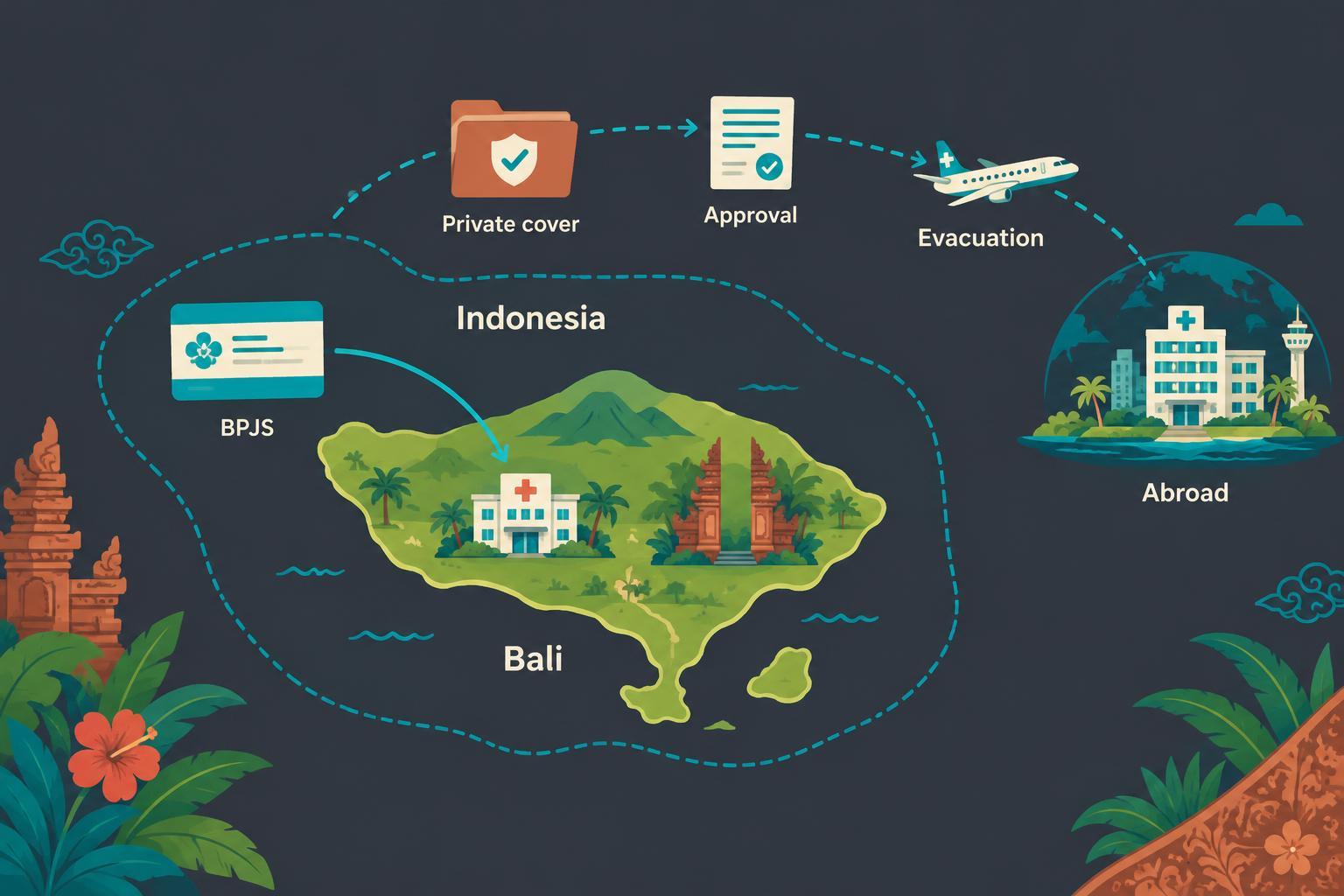
BPJS does not cover treatment outside Indonesia. If overseas treatment matters to your plan, you need to evaluate a private policy separately rather than treating JKN as an international safety net.
Indonesian private insurance and international expat insurance must both be checked for their actual geographic scope. Ask whether the countries where you expect treatment are covered, including your home country, and whether planned treatment and emergencies are handled differently.
Medical evacuation is another separate check. The UK government’s Indonesia health advice warns that evacuation can cost tens of thousands of pounds and recommends insurance covering treatment and repatriation alongside accessible funds.
Ask the insurer to explain:
- Who decides that evacuation is medically necessary.
- Who authorizes and arranges the transfer.
- How the destination facility is selected.
- Whether repatriation is included separately from evacuation.
- How ground transfers and treatment after arrival are handled.
Do not read “international” as permission to book any flight or hospital and recover the cost later. Obtain the authorization procedure before you need it.
For an expat who wants domestic routine care but protection against a major overseas transfer, compare the combined benefits carefully. Supplementary cover is useful only if it fills the gap you identified; holding several policies does not by itself explain who will authorize or pay a particular claim.
Scooters, diving and ongoing health needs: compare exclusions
The best policy on paper can be the wrong policy for your Bali routine. Scooter use, diving, regular medicines and existing conditions deserve explicit answers before you buy.
Australian government advice for Indonesia warns that motorbike claims may be denied when riders are unlicensed or have the wrong vehicle category. Renting a scooter does not establish insurance coverage. Ask about motorbike cover and licence requirements separately; if you will not ride, our guide to living in Bali without a scooter helps you plan that alternative.
The same advice tells divers to verify diving cover and the location and quality of decompression facilities. The existence of a chamber in Bali does not mean your policy will pay for treatment there. Check your planned activity against the wording, not just an “adventure” label.
For regular healthcare, request written answers about existing conditions, repeat prescriptions and any waiting periods or benefit limits. Check medicine legality independently: an overseas prescription does not make every medicine lawful to bring into Indonesia, and some cannabis-derived products, including CBD, are prohibited. See the separate guide to moving to Bali with prescription medication.
Insurance also does not replace prevention or urgent treatment:
- Rabies occurs in Indonesia; seek immediate medical assistance after animal bites or scratches, including dog or monkey exposures.
- CDC’s 7 August 2026 Level 2 Zika notice reported cases in travellers returning from Bali and advised precautions against mosquito bites and sexual transmission; it remained listed when checked on 11 November 2026.
Use these risks to ask better coverage questions, not to diagnose yourself or delay medical help while checking a claim.
Who should choose BPJS, Indonesian private, international or travel cover?
Choose the route that matches your legal category and actual life in Bali. Use these decisions rather than a generic “best expat insurance” ranking:
- Qualifying foreign employees: confirm compulsory BPJS participation through your employer. Add private cover when you need benefits or access beyond that pathway.
- Self-employed foreigners pursuing BPJS: establish eligibility directly against the membership requirements before counting on JKN. Buy suitable alternative cover while eligibility remains unresolved.
- Residents focused on treatment in Indonesia: compare Indonesian private health policies against your preferred facilities, outpatient needs and total personal costs.
- Residents needing treatment across countries: choose international expat health cover with the required territories and benefits explicitly included. Check evacuation and repatriation separately.
- Visitors on a defined trip: choose travel insurance that accepts the actual trip, activities and residence circumstances. Do not use a short-trip assumption for a relocation.
Before paying, collect the policy wording, benefit schedule, exclusions, hospital-access procedure and emergency contact details. Before treatment, confirm coverage and payment authorization. That combination—not the insurer’s name alone—is what makes your Bali healthcare plan usable.