

Bali’s island-wide “Bali 100 Persen Memilah Sampah” implementation push began on July 1, 2026, making waste separation at the source an immediate practical issue for households, rentals, villas and apartments.
The change matters because rubbish is no longer just a housekeeping detail to discover after moving in. A tenant needs to know where organic waste goes, which waste a collector will accept, whether separate bins are supplied and whether the local banjar or desa adat has its own rules. For a villa owner or apartment manager, those questions become part of how the property is equipped and operated.
This is not a new rule invented overnight. Bali already had source-based waste-management provisions under Bali Governor Regulation No. 47 of 2019. But the July 1 programme turns the focus to province-wide implementation across homes, banjars, markets, hotels and offices. The result is simple: treat the waste setup as a property feature worth checking before you commit to a home.
Bali 100 Persen Memilah Sampah started on July 1, 2026
On June 10, 2026, Indonesia’s Environment Ministry and the Bali Provincial Government declared Bali a national pilot for Bali 100 Persen Memilah Sampah, or “Bali 100 Percent Waste Sorting,” with island-wide implementation required from July 1, 2026. The official announcement requires waste to be separated where it is generated across households, banjars, markets, hotels and offices. The ministry’s announcement frames the initiative as an island-wide implementation and enforcement push.
For rental residents, “at the source” means the point where waste is first discarded: the villa kitchen, apartment bin area, kost shared space, office pantry or household compound. It is not enough for a property to have one mixed rubbish bin at the gate if the local system requires waste to arrive separated.
The July programme follows Governor’s Circular No. 09 of 2025, titled Gerakan Bali Bersih Sampah. That circular took effect on April 2, 2025. It required source-based waste management across public and private offices, villages and kelurahan, desa adat, businesses, hotels, malls, restaurants, cafés, schools, markets and places of worship.
It also set January 1, 2026 as the implementation deadline for villages, kelurahan and desa adat, and separately for hotels, malls, restaurants, cafés and other businesses. In other words, a renter seeing new bins or stricter collection instructions in 2026 is seeing a more visible rollout of an existing policy direction, rather than Bali’s first-ever attempt at sorting waste.
The local framework matters particularly in a rental market where homes can sit inside very different neighbourhood systems. A standalone villa, a managed apartment building and a room in a rumah kos may all have different collection arrangements even when they are a short distance apart.
Bali household waste sorting uses three streams, with a separate hazardous-waste question
For homes and rentals, Circular No. 09 of 2025 directs villages, kelurahan and desa adat to separate household waste into three practical streams:
- Organic waste
- Inorganic waste
- Residual waste
The circular also directs those local authorities to arrange separate, scheduled collection for organic, inorganic and residual waste. So the useful move-in question is not merely “Do you recycle?” Ask which streams are collected, on what days, and where each stream must be placed before collection.
Do not read the three-stream household model as a complete answer for every item in the house. Government Regulation No. 81 of 2012, Article 17, sets a national baseline assigning sorting responsibilities to every person at the source, managers of designated areas and facilities, and regency/city governments. It specifies at least five categories: hazardous/B3-containing waste, biodegradable waste, reusable waste, recyclable waste and other waste. The national regulation therefore should not be interpreted as saying that three ordinary household bins alone resolve hazardous household waste.
That distinction is important when a property manager hands over a simple three-bin setup. It may be the local practical arrangement for ordinary waste, but it does not automatically tell you what to do with every special or hazardous item. Ask the manager, landlord or local collection contact for the accepted stream and disposal route rather than adding it to a bin by assumption.
Where you are comparing rental homes, waste arrangements are worth noting beside other day-to-day conditions such as access, furnishings and house rules. On Livuma’s live rental listings, guests can filter homes and review listing details including amenities, minimum stay, house rules and booking conditions before sending a request. Use a viewing or in-app chat to ask the property-specific waste questions that a listing does not answer.
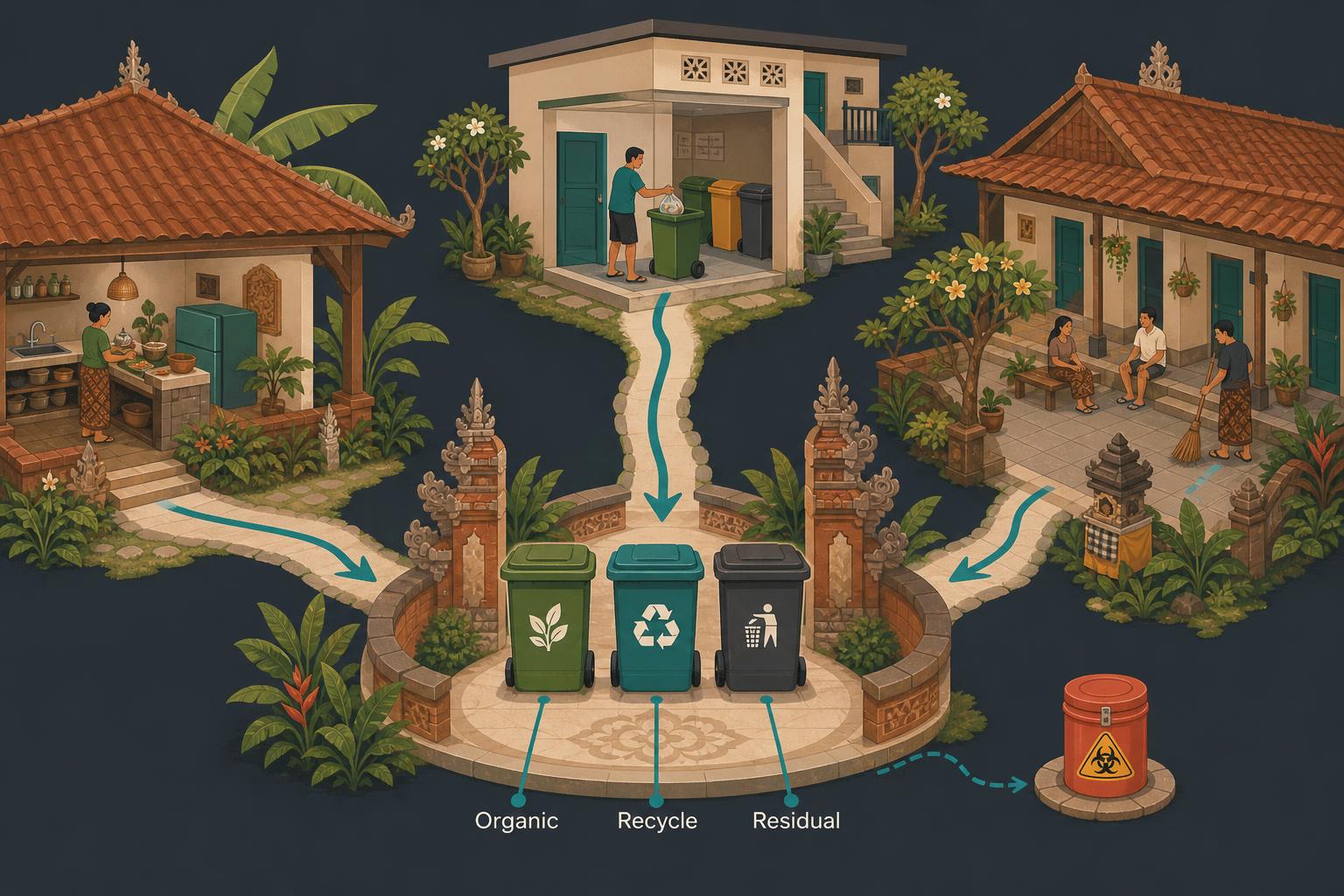
How Bali’s waste-sorting rule affects tenants, villa hosts and property buyers
Tenants in villas, apartments and kost
A tenant’s immediate responsibility is to follow the waste system that operates at the home and in its local community. Before move-in, find out whether bins are inside the unit, in a shared compound or at a collection point; whether the property expects residents to manage organic waste on site; and whether collection is separated and scheduled.
Do not assume the owner’s cleaner, security team or gardener is responsible for sorting everything after the fact. Clarify who takes bins to the pickup point, who replaces liners or containers, and what happens if collection is missed. For a room in a shared kost, ask whether the house manager has a shared-bin system and how new residents are instructed to use it.
There is evidence that rollout is reaching renters directly: on August 5, 2026, Desa Gulingan reported distributing waste containers to new arrivals and rumah kos residents as part of household sorting implementation. That is a useful reminder that the practical rules can be delivered through the local community, not only by a landlord.
Villa owners, hosts and apartment managers
Property managers have a more operational role. Government Regulation No. 81 of 2012, Article 17(3), requires managers of designated residential, commercial and other areas or facilities to provide area-level waste-sorting facilities. The regulation’s manager-facility requirement is not a standalone obligation applying identically to every individual rental landlord.
For a host, the practical work is to make the system visible: provide suitable containers, give the resident clear instructions, establish who handles collection, and confirm the arrangement with the relevant village, banjar or collection provider. A written house rule can be useful, but it must match the collection system that actually serves the property.
Businesses face the clearest stated enforcement consequences. Circular No. 09 of 2025 provides for review and/or revocation of business permits and public naming of non-compliant hotels, malls, restaurants and cafés. Those measures are directed at businesses, not individual household renters. A private tenant should not confuse business-permit enforcement with a stated household-tenant penalty.
Buyers and long-term owners
For buyers, waste sorting is a due-diligence question about the property’s ongoing operation and its relationship with the local community. Ask whether the area has containers, collection arrangements, organic-waste treatment and a local pararem or village rule. A house that appears ready to occupy can still require a new owner to arrange the everyday system.
When reviewing a home for purchase, add waste infrastructure and local collection arrangements to the practical questions you ask about the compound. Browse Bali properties for sale separately from rental bookings: rental booking payment protections and rental documents do not apply to property sales.
Questions to ask about waste collection before signing a Bali lease
Ask these questions before you pay or commit, preferably during a viewing and again in writing if the answer affects how you can use the home:
- Which bins are already provided? Confirm whether the home has separate containers for organic, inorganic and residual waste.
- Where is organic waste handled? Ask whether it is collected separately, treated at the property, or taken to a designated local point.
- What are the collection days? Confirm the schedule for each stream, rather than assuming all bins go out together.
- Which items will the collector not accept? This matters for items outside the ordinary household streams, including hazardous waste.
- Who is responsible in a shared property? Establish whether the tenant, cleaner, building team, owner or kost manager takes waste to the collection point.
- Is there a banjar, desa adat or village rule? Ask for the applicable instructions, including any local pararem.
- What happens during a missed collection? Know the temporary storage arrangement before a full bin becomes a neighbourhood issue.
The 2025 circular assigns village heads responsibility for village regulations and bandesa adat responsibility for pararem concerning source-based waste management and single-use-plastic limits. That makes a local answer more useful than a generic promise that “waste is included.”
For a monthly or yearly rental, ask for these practical points before payment alongside the ordinary terms on rent, utilities, deposit and handover. Livuma shows a booking-specific payment schedule, deposit or balance rules, deadlines, cancellation rules and refund logic in the interface before you commit; use in-app chat with the host to keep any agreed property-management arrangements on record.
If waste collection is one of several move-in questions, pair it with the wider checks in what a monthly rental in Bali actually includes. The aim is not to turn rubbish into a deal-breaker by default, but to avoid discovering an unworkable daily routine after keys change hands.
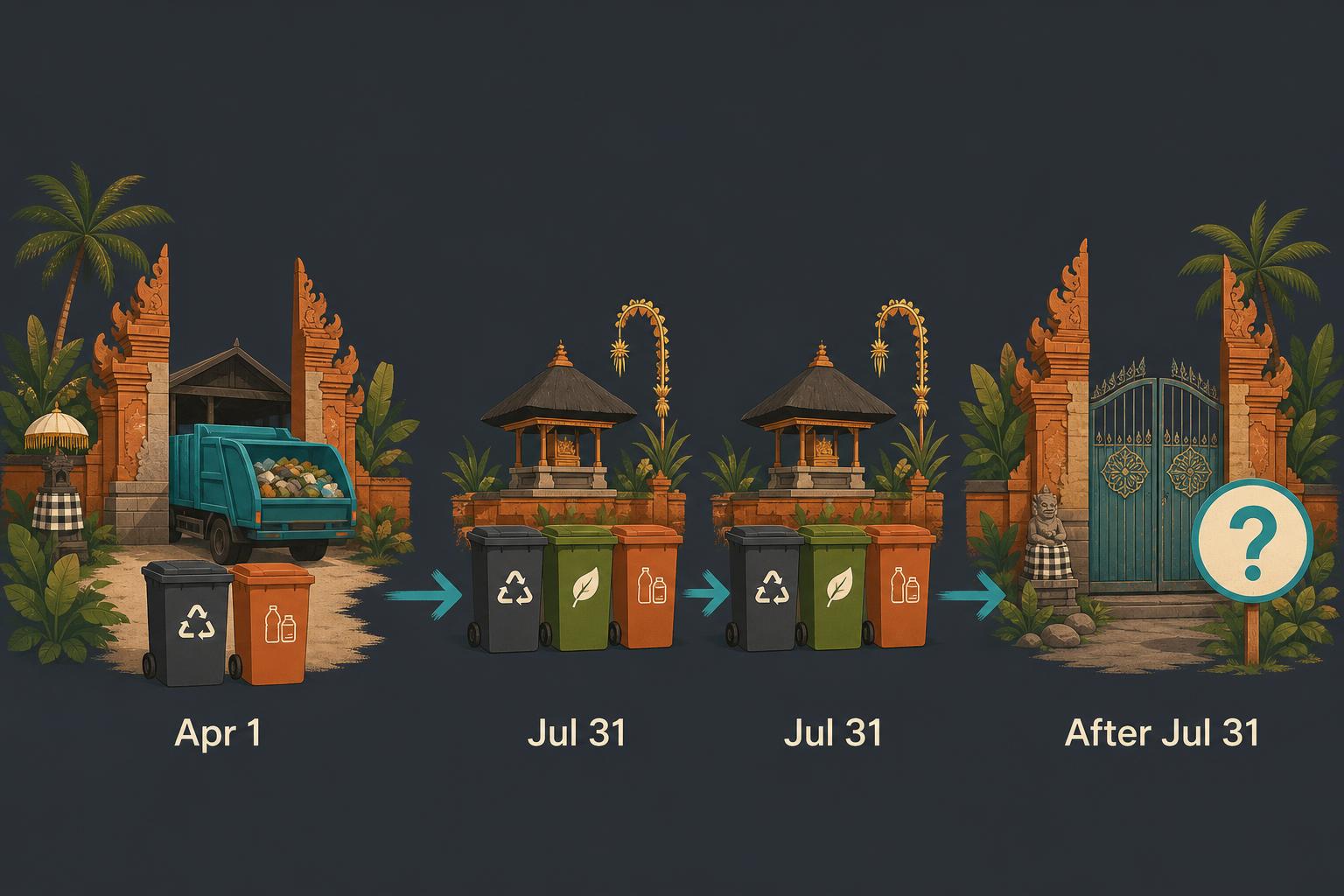
What remains unclear after the July 2026 waste-sorting rollout
The policy direction is clear: source separation is required, and local authorities are expected to provide facilities and scheduled collection. The island-wide operational picture is less uniform. Collection practices, accepted waste streams, container availability and local enforcement can differ because villages, kelurahan and desa adat have a central implementation role.
Landfill operations are also an area where renters and owners should avoid confident assumptions. On June 9, 2026, the Environment Minister explicitly distinguished ending open dumping from closing a landfill, saying Suwung could remain open for waste already sorted and processed. That clarification does not establish its complete current acceptance rules. Following an October 22 inspection, the Environment Ministry’s October 24 update reported continuing leachate leakage and called for urgent completion of Suwung’s wastewater-treatment infrastructure. As of November 9, 2026, the reviewed recent official material does not establish the landfill’s complete current waste-acceptance rules or daily operating hours; the October update concerns pollution controls, not collection eligibility.
Provincial authorities also announced August 1, 2026 as the date for ending open dumping. However, stopping open dumping is not the same as closing a landfill, and that announcement should not be treated as proof that every landfill achieved compliance that day, that Suwung stopped accepting all waste or as a substitute for checking how a particular local collection route currently operates. Ask the property manager or local authority what the current arrangement is for that address.
Badung provides one sign of how enforcement can affect ordinary households: its published collection policy, effective April 27, 2026, schedules organic collection on Monday, Thursday and Saturday, and inorganic/residual collection on Tuesday, Friday and Sunday. Unsorted waste or waste presented outside its schedule will not be collected and becomes the responsibility of the relevant village or kelurahan. Confirm the current collection days and any no-collection day for the address: this is not a Bali-wide calendar, but it shows why unsorted waste can become a collection problem rather than an abstract environmental rule.
What Bali’s 100% waste-sorting requirement has not changed
The July 1, 2026 programme has not made every Bali rental subject to one identical bin layout, collection calendar or local procedure. The province-wide direction sits alongside village, kelurahan and desa adat implementation, so the property-level arrangement still needs to be confirmed.
It has not turned the practical three-stream household model—organic, inorganic and residual—into a settled disposal instruction for hazardous household waste. The national framework identifies a broader minimum set of categories, so residents should seek a specific local instruction for items outside ordinary household sorting.
It has not announced the stated business-permit consequences as penalties for individual household renters. The circular’s review, revocation and public-naming provisions are directed at specified businesses.
Finally, it has not removed the need to ask questions before moving. Whether you are looking at an apartment, villa or kost, waste handling is now part of the practical property conversation: bins, organic-waste treatment, pickup days, accepted streams and the local rules attached to the address.
Checking a Bali rental’s waste arrangements through Livuma
- Compare the property details. Search Livuma’s live rental inventory by area, rental type and amenities, then read the house rules and booking conditions for waste instructions.
- Read the terms before committing. The payment schedule, deposit or balance rules, deadlines, cancellation rules and refund logic are shown up front.
- Secure the request. Before the host sees it, reserve the amount on a card or make an Indonesian bank-transfer prepayment held by Livuma; if declined, withdrawn or expired, it is released or refunded in full automatically. On approval, a card reservation is charged and the booking confirmed, except under the viewing-first option below.
- Check the setup before confirming a viewing-first booking. For eligible monthly or yearly rentals, subject to host and property, “view property first” secures only a small deposit so you can check bins and collection arrangements at an in-person or virtual viewing. Afterwards, pay the rest in the app to confirm, with no deadline or automatic confirmation, or cancel for free for a full deposit release or refund.
- Keep the answers on record. Use in-app chat with the host to clarify pickup days, organic-waste handling and shared-property responsibilities.
- Confirm arrival or report a problem. Reporting a problem in the app holds the host’s payout while it is resolved. Payout follows successful check-in under the booking’s terms, automatically about 24 hours later, never while a reported problem is open.