

More than Rp2.9 trillion is the stated investment behind Badung Regency’s two linked road programmes, marked by a joint ceremonial groundbreaking on July 27, 2026. That scale matters because this is not one isolated shortcut: it combines a northern connection intended to take pressure off Canggu and Tibubeneng with South Kuta works around the Jimbaran–Uluwatu and Siligita corridors.
For people choosing a Bali rental or assessing a home purchase, the immediate change is construction risk rather than a proven reduction in travel time. Access, noise and roadside conditions may change near active works. Over the longer term, alternative routes could change how residents weigh locations in Canggu, Berawa, Umalas, Kerobokan, Pecatu and the Nusa Dua/Siligita corridor—but no official dataset yet measures effects on rents, sale prices, occupancy or door-to-door journeys.
The joint ceremonial groundbreaking occurred on Monday, July 27, 2026, after physical work was already recorded in June. Here is what is known as of November 9, 2026, what remains a government target, and how to make a housing decision without treating a future road as a present-day amenity.
Rp2.9 trillion shows Badung is pursuing two connected congestion projects, not a single Canggu shortcut
Badung identifies the Jalan Lingkar Selatan (JLS, or South Ring Road) and the Berawa–Umalas–Kedampang–Teuku Umar Barat shortcut as two linked programmes with stated investment of more than Rp2.9 trillion, according to the regency’s announcement of the July 27, 2026 groundbreaking. The stated policy aim is to create alternative routes, relieve pressure on main roads and improve access to homes, public services, tourism destinations and economic centres.
Those are objectives, not completed results. A renter should therefore separate the two geographies rather than assume that any new road work benefits every south-Bali commute.
| Programme | Known 2026–2027 scope | Resident areas most relevant |
|---|---|---|
| JLS and Simpang Siligita works | 10.89 km | South Kuta, Pecatu, Nusa Dua/Siligita corridor |
| Semer–Teuku Umar Barat road | 4.77 km | Canggu, Berawa, Umalas, Kerobokan and western Denpasar connections |
The funding picture needs similar care. PT SMI’s October 30, 2025 announcement records a Rp2.83 trillion regional-financing agreement with Badung, covering nine strategic road sections totalling 11.8 km in Kuta Utara and Kuta Selatan. July reporting also described a more-than-Rp2.9 trillion package with different components. Without a project-by-project budget document, it is not sound to describe either financing figure as the exclusive budget for these two schemes. See PT SMI’s financing announcement for the broader nine-road package.
For a buyer, the useful question is not “will this road raise values?” There is no evidence yet to quantify that. Ask instead whether the property’s day-to-day access depends on a road likely to be under construction, and whether its value case still works if the planned connectivity takes longer than expected.
July 27, 2026 marks a groundbreaking date—not a date that either route became usable
The projects held a joint ceremonial groundbreaking on July 27, 2026. That date confirms the programme’s public launch stage, not the first physical work: Badung’s June 25 inspection already recorded road-bed formation in Semer and Subak Kedampang. It does not establish that residents can use a finished new route.
That distinction is important in rental advertising. A property described as “near the new road” may be near an active alignment, a future access improvement, or neither. Before committing, ask the host or manager to show the actual route from the property to the places you use most. Do it at the time of day that matters to you, rather than relying on a map pin or an expected completion date.
- Ask which entrance you would use during the works.
- Ask whether the property has received notices about changed local access.
- Check whether noise reaches bedrooms, outdoor work areas or a pool terrace.
- For a monthly or annual stay, request a viewing where the property and host allow it, and check any deposit and cancellation terms first.
When comparing homes through Livuma’s live rental listings, filters can narrow choices by area, rental type, stay length, price, bedrooms and amenities before you arrange a viewing. Listings also show availability, minimum stay, house rules and booking conditions, which helps distinguish a workable home from an attractive location pin.
For owners and hosts, this is the moment to describe access plainly. Do not market an unconfirmed opening as a current commuting advantage. State the property’s present access route, what is known locally about nearby works, and what remains unknown.
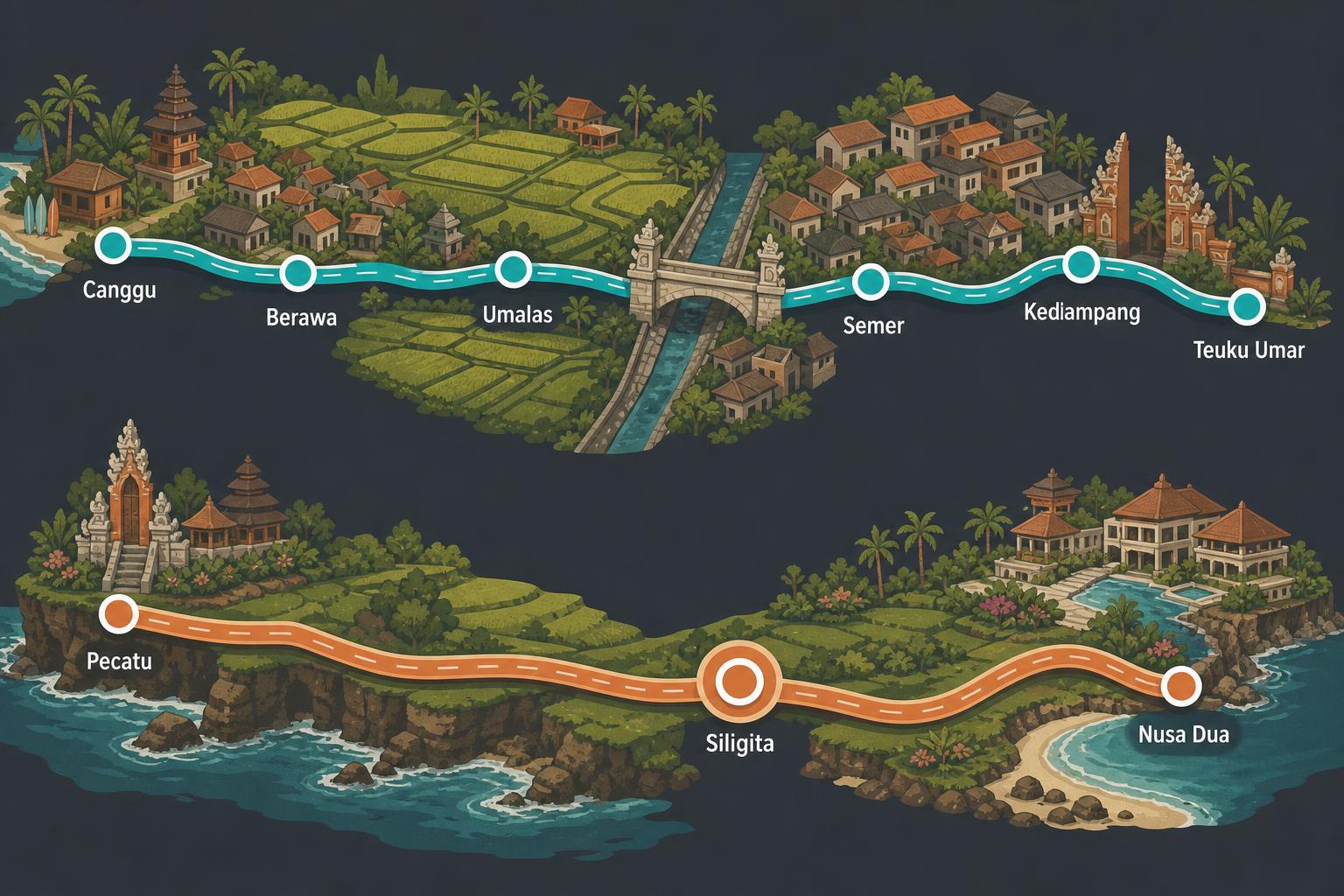
10.89 km places the South Ring Road story in South Kuta, with Siligita—not Berawa—as its Nusa Dua link
JLS plus Simpang Siligita improvements are listed at 10.89 km for the initial 2026–2027 scope, according to Badung; this is not the length of the entire planned southern network. The JLS works are concentrated in South Kuta, including the Labuan Sait–Pedati section and the Pura Kulat–Labuan Sait alignment in Pecatu. The launch ceremony took place at JLS Segment 4 in that area, not in Berawa or Umalas.
This matters for anyone reading broad headlines about “Badung roads.” The relevant infrastructure component for the Nusa Dua/Siligita corridor is widening and junction work around Siligita. It is not the Berawa–Teuku Umar Barat shortcut. Similarly, a resident in Pecatu or a renter considering long-term rentals in Uluwatu should follow JLS developments, not expect the northern shortcut to solve their local access. Bali Post’s September 27 report describes the Siligita (PDAM) junction package as an approximately 400-metre-long, 3.5-metre-wide addition for a continuous left-turn lane toward Jalan Dharmawangsa—not a total road width of 3.5 metres. Its contract dates from August 26, with 120 calendar days for implementation, an allocation of more than Rp2.4 billion and completion targeted for December 2026. Following a November 1 inspection, the regent reiterated the December target for the Siligita and Imam Bonjol junction-widening works. The inspection identified a PDAM water pipe obstructing work at Siligita, with agreement reported to accommodate it beneath the road; completion had not been established.
Reported design details describe the JLS main route as 24 metres wide, with 3-metre sidewalks on each side. That says something about the planned scale, but it does not tell a future tenant how quiet, fast or convenient a particular villa lane will be. Small approach roads, driveway position and the route to daily destinations still matter.
Reporting from the July 27 launch gave an end-2027 completion target for the Jimbaran–Uluwatu JLS/Lingkar Barat route, while the official announcement gives a broader 2026–2027 construction period. Treat that as a reported schedule, not a guarantee. A tenant signing an annual agreement in South Kuta should assess the home for its current access and accept any future road benefit as uncertain upside. For additional local context, read about the permanent Pecatu traffic-route changes.
4.77 km creates a northern corridor intended to distribute Canggu traffic through Umalas, Semer and Kedampang
The Semer–Teuku Umar Barat road is listed at 4.77 km in Badung’s 2026–2027 initial scope. The northern corridor is described by the regency as connecting Canggu, Berawa, Banjar Umalas, Seminyak, Kedampang and Teuku Umar Barat, with the aim of distributing traffic away from congested Canggu and Tibubeneng.
In practical terms, this is the route most relevant to households whose regular trips cross between the Canggu–Berawa side and Umalas, Kerobokan, Semer or Teuku Umar Barat. It does not mean every Canggu resident will experience the same benefit. The usefulness of any alternative route depends on where a home sits relative to its entrances and on the final traffic arrangements, neither of which can be reduced to one area-wide promise.
| If you live near | What to check now | What cannot yet be assumed |
|---|---|---|
| Berawa or Canggu | Your current route toward Umalas, Semer and Denpasar | A measured future travel-time saving |
| Umalas or Kerobokan | Access to the corridor and nearby construction activity | Lower rent or higher rental demand |
| Semer or Subak Kedampang | Driveway access, drainage and nearby work areas | A published closure or truck-route timetable |
| Seminyak | Whether your routine actually uses the northern connection | That the project changes every Seminyak journey |
Badung’s June 25 field monitoring recorded road formation and bridge preparations in Semer, and road formation plus retaining-wall works in Pengubengan/Subak Kedampang. These are the types of activity that can affect nearby access while work is underway. They are not, however, a published schedule of closures, diversions, working hours, construction-truck routes or noise controls. Separately, the PUPR head’s June 29 account dates the Subak Sari–Umalas corridor contract to May 12, 2026, with 210 calendar days allowed for completion. The reported budget ceiling of more than Rp74 billion covers construction and improvements through Subak Sari/Batu Bolong, Umalas and Semer, not the whole northern programme.
For rentals, save written answers to access questions in the same chat thread as the listing discussion. Keeping arrangements on the record can be useful when a promise about access, a viewing or move-in timing needs to be checked later.
A December 2026 target makes the northern shortcut a factor to monitor, not a finished amenity to price in
In its inspection report published June 26, 2026, Badung expressed hopes of completing the Semer works, including the bridge, and Pengubengan/Subak Kedampang works by December 2026. A later August 24 ANTARA report recorded the regent’s target to finish the initial approximately 4.7 km Canggu–Berawa–Umalas–Seminyak–Kedampang–Teuku Umar Barat connection by late December 2026. This is a construction-completion target, not a confirmed public-opening date. No subsequent opening confirmation was located in this refresh as of November 9, 2026.
A sensible rental decision has two versions of the same plan. First, calculate whether the home works with today’s routes, current noise conditions and present local services. Second, consider whether a completed connection would make the location more convenient later. Do not let the second plan compensate for problems in the first.
- Visit once during the period you normally travel or work from home.
- Drive or ride the actual route to your recurring destination.
- Ask what construction activity is visible or known immediately around the property.
- Read the proposed rental term for early-exit, renewal and access-related arrangements.
- Keep the listing details, messages and final agreement together.
The same discipline applies to a purchase. A future route may alter neighbourhood desirability, but the reviewed official releases do not quantify the effect on property prices in Berawa, Umalas, Kerobokan or Canggu. Buyers comparing locations can browse properties for sale in Canggu, but should conduct their own due diligence on access, title, permitted use and the immediate surroundings rather than treating a road announcement as an investment forecast.

Compare a road announcement with live housing choices
A road announcement does not establish current rental availability or show what the new route will do to rents. Compare live rental inventory against present-day access rather than treating expected connectivity as an existing amenity.
Renters should avoid making a rushed decision based on a single infrastructure headline. A home on the more convenient side of a future corridor may suit one routine, while a quieter home with a different route may suit another. Compare several currently available homes and record how each one performs against your own recurring journeys.
| Housing consideration | What to compare now | What a road announcement cannot establish |
|---|---|---|
| Availability | Homes available for your actual dates | Whether a particular home will remain available |
| Monthly budget | The quoted rent and agreed payment terms | A measured future rent change |
| Daily access | The route from each home to recurring destinations | A guaranteed journey-time saving |
| Construction exposure | Visible works and current access near the property | A property-specific disruption timetable |
Current asking prices and availability should be checked for the individual homes under consideration. They should not be used to infer a road-related price effect without measured evidence.
For a wider comparison, review the September 2026 Bali rental market report. If budget is the first constraint, compare the actual room format and rules as carefully as the road location; Canggu kost listings can provide a separate starting point from whole-home rentals.
Zero published route-specific diversion schedules means residents should plan for uncertainty, not predict disruption dates
The reviewed research as of November 9, 2026 does not provide an official route-specific published schedule for lane closures, diversions, working hours, construction-truck routes or noise mitigation on the Berawa–Umalas–Kedampang corridor. This absence is one of the most important facts for residents: disruption is plausible where construction is active, but a precise timetable cannot be responsibly stated.
That uncertainty changes how to negotiate and how to host. A renter should not demand a promise that a host cannot verify; instead, ask for the current facts at the property, document them and choose a term length that matches your tolerance for change. A host should update the listing if access conditions materially change and avoid fixed claims about completion timing.
The road programme could eventually reshape routines across distinct parts of Badung. Today, its clearest housing lesson is simpler: inspect the access you are renting or buying now, identify which of the two projects is actually relevant to it, and treat every completion date and market effect as conditional until evidence replaces expectation.