
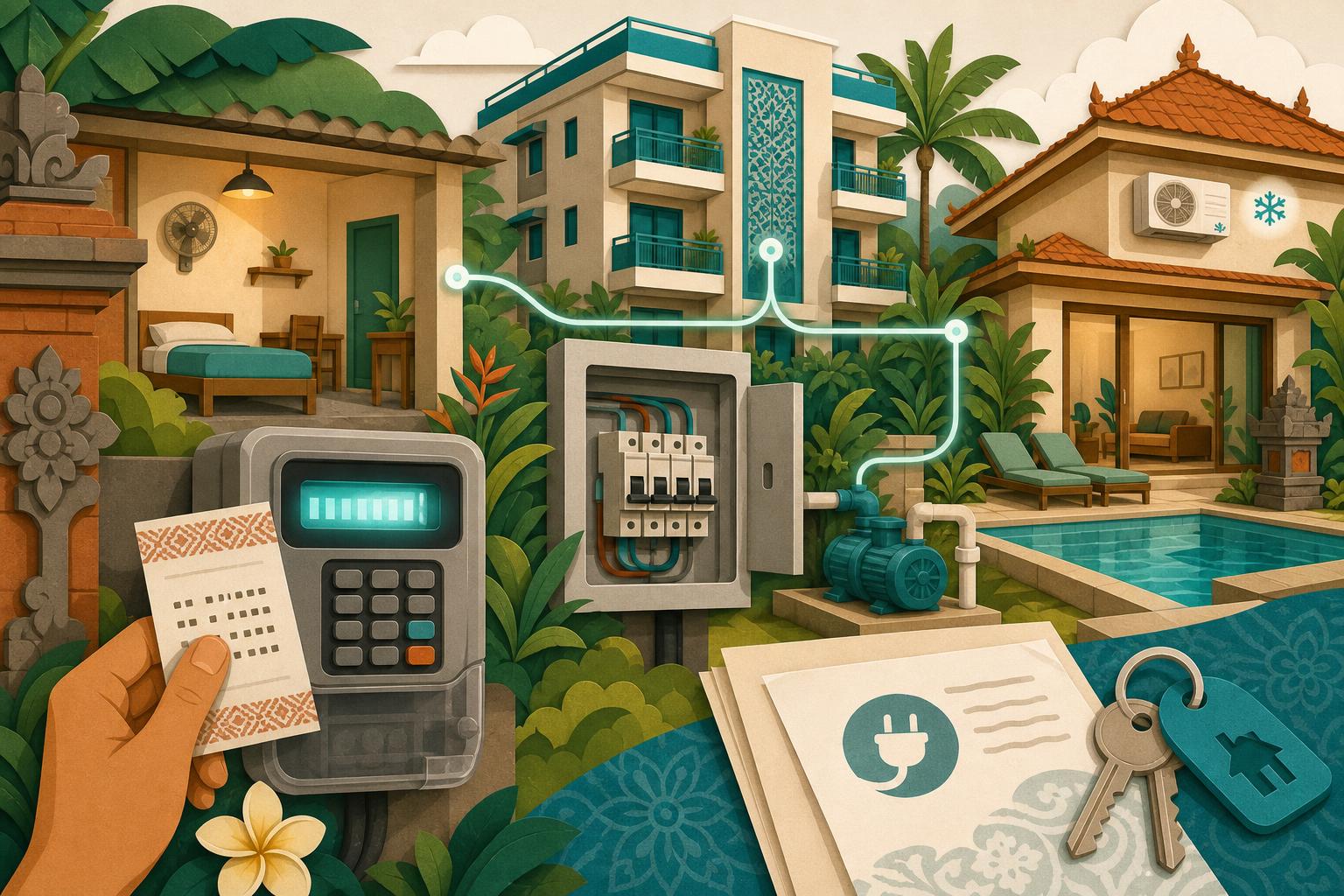
The expensive mistake is accepting a Canggu villa advertised as “electricity included,” then receiving a large extra charge after the first month because the pool pump, three AC units and a private sub-meter were never discussed. By then, the landlord has the readings, the keys are in your hand, and the agreement says nothing useful.
Electricity is a routine part of living in Bali, but the system can feel unfamiliar if you are used to a monthly utility direct debit. A home may use PLN’s prepaid token system, a postpaid monthly bill, or a landlord’s shared-meter arrangement. The practical question is not simply “How much is electricity?” It is: which meter serves this home, what tariff and capacity apply, who pays, and how is use recorded?
This guide explains the checks that matter for villas, apartments and kost rooms. It uses Q4 2026 reference tariffs as planning tools, not permanent Bali-wide prices: PLN’s non-subsidised tariffs are ordinarily reviewed quarterly, and the applicable rate depends on the meter’s class and contracted capacity. As verified on 9 November 2026, PLN confirmed that all 13 non-subsidised and 24 subsidised tariff categories remain unchanged for October–December 2026. A quarterly review does not necessarily produce a price change. The quarterly review rule is set out in Permen ESDM 7/2024.
The screen says 12.4, and you think you only have Rp12.40 left
This is the classic first encounter with a PLN prepaid meter. The number on its screen is usually remaining kWh, not remaining rupiah. PLN’s Listrik Pintar service works by buying electricity in advance; the meter’s available energy balance then falls as the property consumes power.
That distinction matters because a token purchase is not a wallet top-up. You buy a rupiah amount, but the result is a quantity of electricity after the applicable tariff and local electricity tax have been accounted for. Payment-channel administration charges also affect the total you pay; follow the actual receipt rather than assuming fees are always charged outside the token’s nominal purchase value.
For example, PLN’s January 2026 illustration showed that a Rp100,000 token purchase for a 1,300 VA household could result in roughly 63–65 kWh, rather than a simple Rp100,000 divided by the energy tariff. The exact kWh delivered should be checked on your own receipt and meter because local tax treatment can differ; payment-channel charges also affect the total you pay.
- kWh measures energy used or remaining.
- VA is the property’s contracted power capacity: it affects what can run at one time and can affect the tariff band.
- Rp is what you spend buying a token or paying a bill.
Before moving furniture in, wake the meter screen, photograph the displayed balance, and ask the owner or manager what each screen reading means. A screenshot from the last token receipt is useful too. PLN confirms that prepaid users can monitor their remaining kWh at any time through the meter.
For a useful reference point, the Q4 2026 household tariff for 1,300 VA and 2,200 VA is Rp1,444.70/kWh, while R-2 households at 3,500–5,500 VA and R-3 households at 6,600 VA or above are Rp1,699.53/kWh, before applicable taxes and charges. Confirm the meter’s actual class instead of assuming that a larger villa has the same rate as a studio. A 900 VA prepaid meter could have the subsidised Rp605/kWh tariff or the nonsubsidised 900 VA-RTM Rp1,352/kWh tariff; capacity alone does not identify the rate. A B-2 business master account at 6,600 VA–200 kVA has a Q4 2026 reference tariff of Rp1,444.70/kWh, rather than the residential R-3 rate. See the published PLN tariff schedule for the relevant bands.
You bought a PLN token, but the lights are still running on yesterday’s balance
Buying and entering a prepaid token are separate actions. A payment channel provides a 20-digit voucher code; the physical meter must receive that code before the kWh is credited. This is easy to miss when the token is bought by a housekeeper, agent or landlord rather than by the person watching the meter.
- Copy the property’s meter number from the meter face or PLN record. Do not rely on a number typed into an old chat.
- Buy a token through an available PLN channel, such as PLN Mobile, a bank channel or an online payment point. Check the available purchase values and administration fee in your chosen channel; Rp20,000 is not a universal minimum.
- Keep the receipt. It should show the purchase amount and the resulting energy information.
- Enter the voucher code on the prepaid meter keypad.
- Press the meter’s confirmation or Enter key.
- Wait for the meter to show the credited kWh, then photograph the updated display if the home is shared.
After a PLN Mobile payment, PLN says the token code is shown in the app and sent to the registered email. Save both until the new balance appears. If a code will not load, do not repeatedly guess at keys or blame the meter without records: retain the receipt, photograph the screen, and use PLN’s support route.
A direct token meter is often the cleanest arrangement for a renter because you can see your own balance and purchases. When browsing long-term Bali rentals, check the listing details for whether electricity has its own PLN meter, is included, or is charged separately; clarify the arrangement with the host before committing.
The villa’s AC trips whenever you boil a kettle
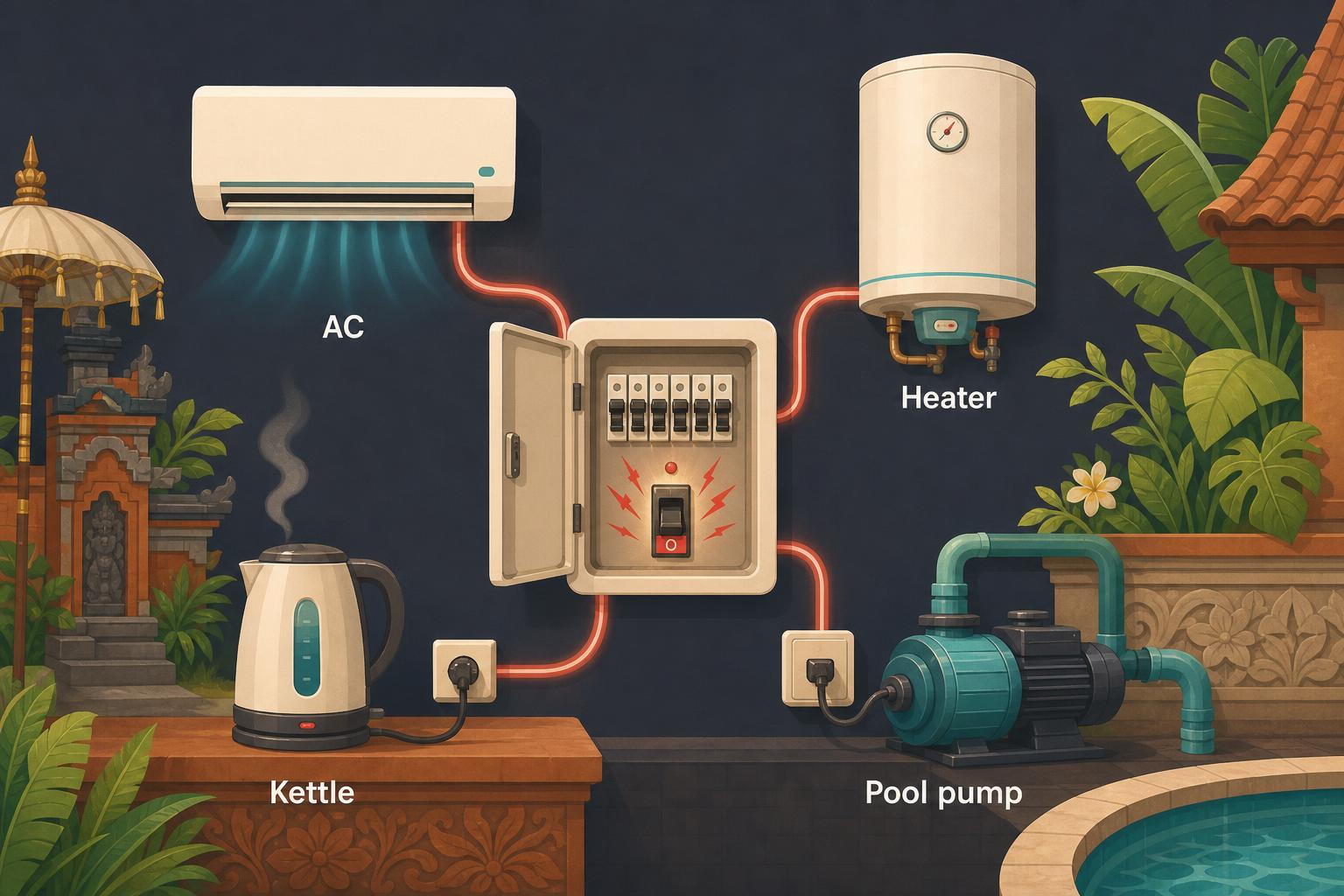
Low remaining kWh and insufficient capacity are different problems. A meter can have plenty of prepaid electricity left but still trip because too many high-load appliances are running together. In Bali rentals, that often becomes apparent when AC is running in several rooms and someone turns on a water heater, kettle, induction cooker or pool pump.
Ask for the contracted capacity in VA in writing before you commit. Then test the combinations that reflect your routine, rather than only switching on lights during a daytime viewing. A compact kost room may have modest needs; a work-from-home apartment may combine AC, a desk setup and kitchen appliances; a villa may add pumps and several cooling zones.
- Turn on the AC units you would normally use.
- Run the water heater if it is part of the home.
- Boil a kettle or test the induction cooker.
- Ask when the pool pump operates and whether it shares the same supply.
- Check the breaker for heat, damage or repeated tripping.
If a breaker trips during normal, agreed use, establish whether it is a capacity issue, a defective appliance or faulty internal wiring. Do not accept an informal answer such as “just do not use both” unless that limitation genuinely works for your household and appears in the rental terms.
PLN Mobile supports power-change applications and fault or complaint reports, but a tenant should first know whose PLN account is attached to the property. For an outage, meter problem or service complaint, PLN says reports can be made through PLN Mobile or PLN 123 using the customer ID or meter number, or a location pin.
The agent quotes one price per kWh, but will not show the PLN bill
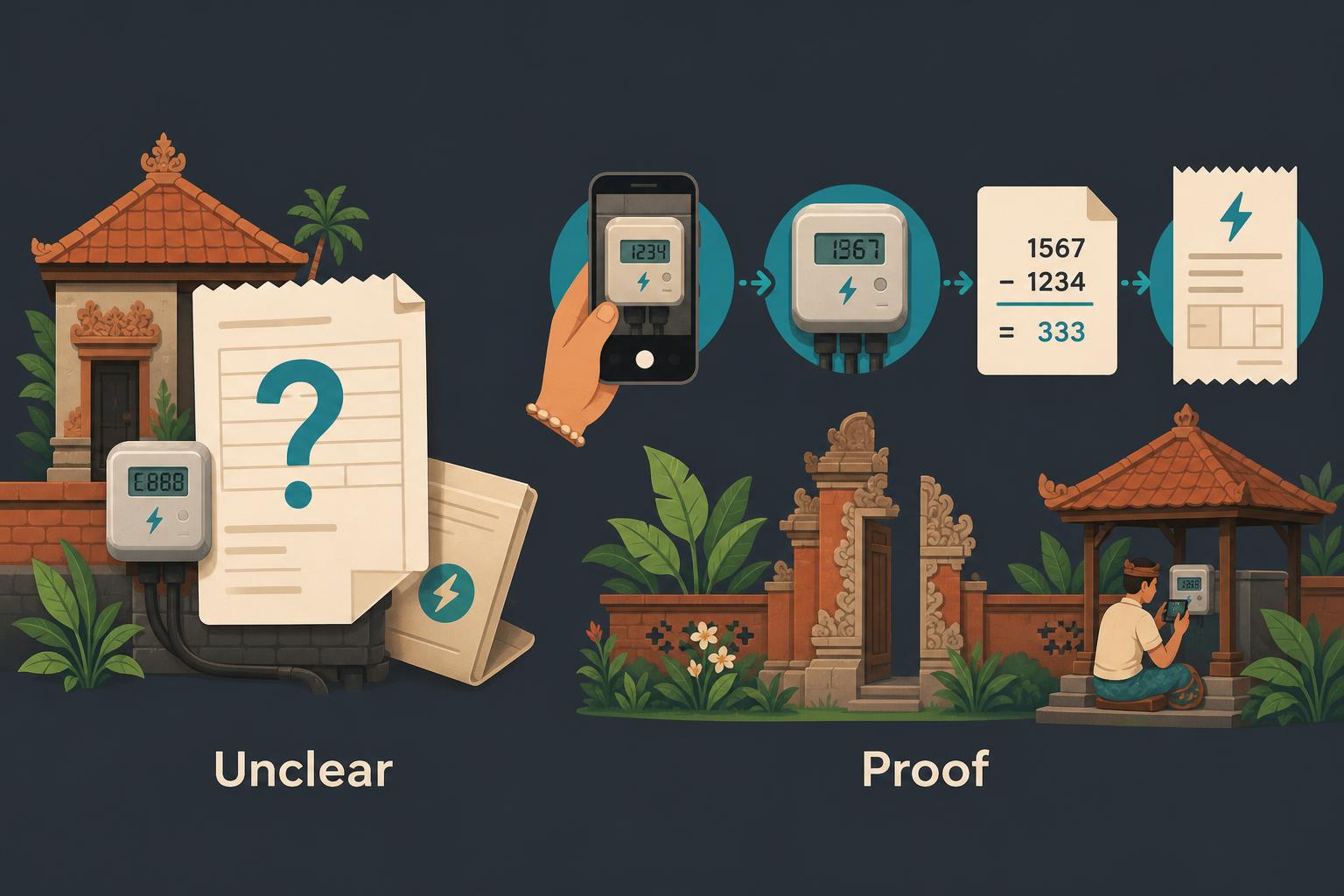
Shared meters and private sub-meters are not automatically wrong. They are common where several rooms occupy one compound, where a kost has individual sub-meters, or where a guesthouse-style building has one master PLN account. The issue is whether the calculation is transparent.
There is no single verified national figure in the available sources that creates one universal lawful per-kWh ceiling for a landlord’s private sub-meter charge. So a rate materially above the relevant PLN tariff, plus disclosed local tax and documented administration costs, is a reason to ask for evidence and put the answer on record—not automatic proof that the arrangement is unlawful.
Request these items before agreeing to a shared-meter setup:
- Opening and closing sub-meter readings, with dated photographs.
- The exact billing period.
- The formula used to calculate your charge.
- The master meter’s tariff class and VA capacity.
- Any local electricity tax and administration items.
- A copy or screenshot of the master PLN bill or token receipt.
Local tax cannot safely be guessed as one Bali percentage. National rules treat prepaid electricity purchases as taxable value for PBJT electricity tax, while the applicable rate is set locally within that framework. The ordinary electricity PBJT rate is 7% in Badung and 10% in Denpasar; the former Denpasar 5% street-lighting tax is not a current reference. Check the charge actually shown for the property’s location rather than applying a number from another regency.
If the owner cannot identify the meter, tariff, billing period or source bill, the real problem is not the rate alone—it is that you cannot audit the charge. This is particularly important in a Canggu kost room, where individual rooms may be billed from a larger building supply.
Your “included electricity” turns out to have an invisible monthly limit
“Electricity included” can mean three very different things. It may be truly included without a stated limit. It may mean the landlord pays the direct PLN bill but later charges heavy use. Or it may include a fixed kWh or rupiah allowance, with the renter paying excess. None of these is clear enough when it is only a listing caption or WhatsApp message.
| Arrangement | What must be written down |
|---|---|
| Tenant pays PLN directly | Meter number, customer ID, tariff class, capacity, and which party handles faults or reconnection. |
| Included without a limit | That electricity is included, which equipment is covered, and whether any exception exists. |
| Included with an allowance | The allowance in kWh or Rp, how usage is measured, the excess formula, billing date and evidence provided. |
| Shared meter or sub-meter | Opening and closing readings, tariff basis, tax and administration items, and master-bill evidence. |
The clause should also separate failures from misuse. State who pays for a meter fault, defective internal wiring, a breaker trip caused by installation problems, AC or pool-pump faults, PLN reconnection charges and tenant-caused damage. A renter should not become responsible for a failing pool pump merely because it happens to increase the electricity reading.
For supported rental bookings on Livuma, booking-specific payment schedules, deposits or balance rules, deadlines, cancellation rules and refund logic are displayed before the guest commits; the platform also generates digital rental agreement details and receipts from the listing, booking terms and verified guest details. That does not replace checking utility wording, but it gives both sides a clearer record than an undocumented verbal promise.
You budgeted for a room, then rented a pool villa with villa-sized consumption
Electricity cost follows equipment and habits more closely than the label “Bali rental.” A room, one-bedroom apartment and three-AC villa should not be expected to have comparable monthly use. AC runtime, thermostat setting, insulation, occupancy and pool-pump scheduling can all change the result substantially.
The following are consumption-planning scenarios, not Bali averages and not quotes for a particular home. They use the confirmed Q4 2026 reference energy tariffs before local tax and payment-channel charges.
- Basic kost room: about 90 kWh/month, or Rp130,023/month at the 1,300/2,200 VA reference energy tariff.
- One-bedroom apartment: about 300 kWh/month, or Rp433,410/month at that same reference tariff. This scenario assumes one 0.7 kW AC used eight hours daily plus 4.4 kWh/day of other loads.
- Air-conditioned villa: 861 kWh over 30 days, or Rp1,463,295.33 at the 3,500 VA+ household reference energy tariff. The scenario uses three 0.8 kW AC loads for eight hours daily, a 0.75 kW pool pump for six hours daily and 5 kWh/day of other loads.
For context, rental budgets differ sharply by property and area. Electricity should be treated as a separate line item unless the agreement says precisely otherwise; compare homes by their equipment, meter arrangement and utility terms, not by rent alone.
PLN’s official explanation of how prepaid tokens convert to kWh is the better starting point for checking your own receipt than an online “Bali electricity calculator.”
The postpaid bill arrives after you have already handed over the keys
Postpaid electricity reverses the prepaid logic: you consume first and pay later. PLN describes postpaid bills as monthly usage, generally accessible around the 2nd or 3rd of the following month, with the contractual payment deadline on the 20th. Meter readings and physical verification underpin the bill. For designated nonsubsidised residential classes, a minimum bill of 40 × connected capacity in kVA × the applicable kWh tariff applies, so low occupancy does not necessarily eliminate the bill. Postpaid customers can also submit photographed readings through SwaCAM/Catat Meter in PLN Mobile, generally from the 23rd to the 27th each month; this reporting window is not the bill-payment deadline.
This creates a handover risk. If you leave on the 28th and the next bill is issued after you are gone, a landlord may have to estimate your share unless the move-out reading is documented. The same issue applies at move-in, when an existing unpaid bill may be confused with your usage. PLN’s contractual guidance permits temporary disconnection after the payment deadline, so check outstanding account charges separately from your new consumption.
At both handover points, make one shared record:
- Photograph the meter face, serial or meter number, reading, breaker condition, date and time.
- Record the PLN customer ID, tariff class and contracted VA capacity.
- Note whether the meter is direct PLN, prepaid, postpaid, master-metered or a private sub-meter.
- Confirm who will receive and pay the next bill.
- Agree how any part-month use will be calculated.
Postpaid PLN customers can be charged a customer security deposit, known as Jaminan Langganan; PLN says prepaid customers do not have this deposit. That is another reason to distinguish the account holder’s PLN obligations from a tenant’s obligations under the lease.
When arranging a monthly or yearly rental, Livuma offers “view property first,” subject to the host and property: secure only a small deposit, then confirm after an in-person or virtual viewing by paying the rest in the app, with no deadline or automatic confirmation, or cancel for free and have the deposit released or refunded in full. Use that opportunity to inspect the actual meter and electrical panel, not just the villa’s interiors.
The meter stops working, and everyone says it is someone else’s problem
Electrical trouble is easier to resolve when you separate the utility supply from the home’s internal equipment. A meter error, local outage, damaged breaker, failed AC and pool-pump fault may look similar from inside a dark house, but they may belong to different parties.
Keep a small move-in file containing meter photographs, receipts, the owner or manager’s contact, PLN customer ID, meter number, and a copy of the electricity clause. If the problem occurs, record the screen, breaker position and affected appliances before resetting anything repeatedly.
For PLN-side complaints, official guidance names PLN Mobile and PLN 123. A report can use the customer ID or meter number, or a location pin. For internal wiring or appliances, follow the agreement’s repair allocation and keep the discussion in writing.
Most disputes become expensive because the basics were never captured: whose meter, whose bill, which tariff, which reading, and whose repair. Get those five answers before your first night under the AC.
For a wider move-in record beyond utilities, read what to check before signing a Bali rental contract. It complements—not replaces—the meter-specific checks above.
Checking rental electricity terms through Livuma
- Find and compare. Search Bali rentals on Livuma by area, rental type, price and amenities. Read house rules and booking conditions for electricity inclusions or limits.
- Review terms, then secure the request. Check payment schedules, deposit rules, deadlines and cancellation terms. Before the host sees the request, secure it with a card reservation or a held Indonesian bank-transfer prepayment. If declined, withdrawn or expired, the reservation is released or the prepayment refunded in full automatically.
- Check the meter before confirming where available. The host answers within a limited window; approval normally charges the card reservation. For eligible monthly or yearly rentals, “view property first” secures only a small deposit. Check capacity, readings and equipment during the viewing; then pay the rest in the app to confirm, with no deadline or automatic confirmation, or cancel for free for a full deposit release or refund.
- Keep utility answers on record. Use in-app chat to clarify allowances, sub-meter formulas and repair responsibilities. Complete guest identity verification before the agreement is issued; supported bookings receive digital agreement details and receipts from the listing, booking terms and verified guest details.
- Record arrival. Photograph opening readings and confirm check-in in the app, or report a problem. Host payout follows successful check-in under the booking’s terms, automatically about 24 hours afterward, never while a reported problem remains open.