

At an ordinary weekday breakfast in Bali, one table pays by card at a polished Canggu café, another leaves a few notes beside an iced coffee, and a nearby warung customer simply settles the price shown. None of those choices automatically signals bad manners. Tipping in Bali is generally optional, and the useful skill is reading the bill, the setting and the relationship rather than importing a fixed percentage from home.
There is no located national Indonesian rule requiring customers to tip in restaurants, spas, taxis or everyday services, and no authoritative Bali-wide survey that establishes one normal amount. A thoughtful tip can be appreciated; it should not become an assumed second charge or a substitute for fair pay.
Is tipping expected in Bali? The short answer for visitors and long-stay residents
No: tipping is not a compulsory part of paying for everyday services in Bali. It is best understood as an optional thank-you for good, difficult or especially personal service.
That matters because Bali contains very different service settings within a small area. A traveller ordering room service at a large hotel in Nusa Dua, a resident collecting nasi campur at a neighbourhood warung in Denpasar, and a family employing a regular gardener in Sanur are not participating in the same arrangement.
- Expected by law: no general customer tipping requirement was located for these services.
- Often appreciated: a voluntary, proportionate thank-you after helpful service.
- Already on the bill: check whether tax and/or service charge has been added before leaving anything extra.
- For regular household staff: agree wages, duties, working time, leave and holiday arrangements separately from discretionary gifts.
A useful default is simple: pay the agreed price first, then decide whether an additional amount feels appropriate to the service you actually received. Do not assume every worker expects a US-style percentage, and do not make a staff member explain or defend a venue’s service-charge policy to you.
Restaurant bills in Bali: how tax, PBJT, service charge and tips differ
The line items on a Bali restaurant receipt can look similar but mean different things. Treating them as one combined “tip” is the quickest way to overpay accidentally or misunderstand where money goes.
Canggu and Seminyak cafés
At many internationally oriented cafés and restaurants, the receipt may list a tax line and may also list service charge. Qualifying food and drink supplied by restaurants, cafés, warungs and similar venues, including dine-in and takeaway sales, fall within regional taxation rather than national VAT/PPN under PMK No. 70/PMK.03/2022, effective since 1 April 2022; national law allows the regional PBJT rate to be set up to 10%. The national tax framework distinguishes this local tax from a gratuity.
“Tax” or “PBJT” is a government levy where properly charged. It is not money voluntarily left for staff. The actual food-and-drink PBJT rate is established by local regulation. Check the applicable local rate rather than treating an 11% or 12% restaurant charge as automatically being national VAT. The Directorate General of Taxes explains the distinction between regional restaurant taxation and national VAT.
Hotel restaurants in Nusa Dua and central Kuta
A service charge is different again. Under Ministry of Manpower Regulation No. 7/2016, uang servis is an addition to a pre-set tariff for service in hotel businesses and hotel restaurants and is classified as non-wage income. Hotels and hotel restaurants are not universally obliged to apply it, but where that regulation applies, 95% of service-charge proceeds must be distributed to workers, with 3% allocated to loss/breakage and 2% to staff development. The regulated worker formula allocates 50% as equal shares, with the remainder based on seniority and performance. See the Ministry’s service-charge regulation for its specific scope.
Do not extend that rule automatically to every standalone restaurant or privately staffed villa with a “service” line. Article 21 of the regulation also preserves service-charge arrangements already implemented in non-hotel restaurants and other tourism businesses where agreed by employers and workers, so the distribution of a standalone venue’s service charge cannot be assumed from the receipt alone. A combined tax-and-service percentage is not a single government tax.
Warungs in Ubud, Sanur and local neighbourhoods
A local warung may show one final price, with no service charge and no expectation that customers calculate a percentage. Rounding up or leaving change can be a friendly gesture, but it is not an obligation. If a bill already lists both tax and service charge, any extra cash is strictly optional—not an expected second payment.
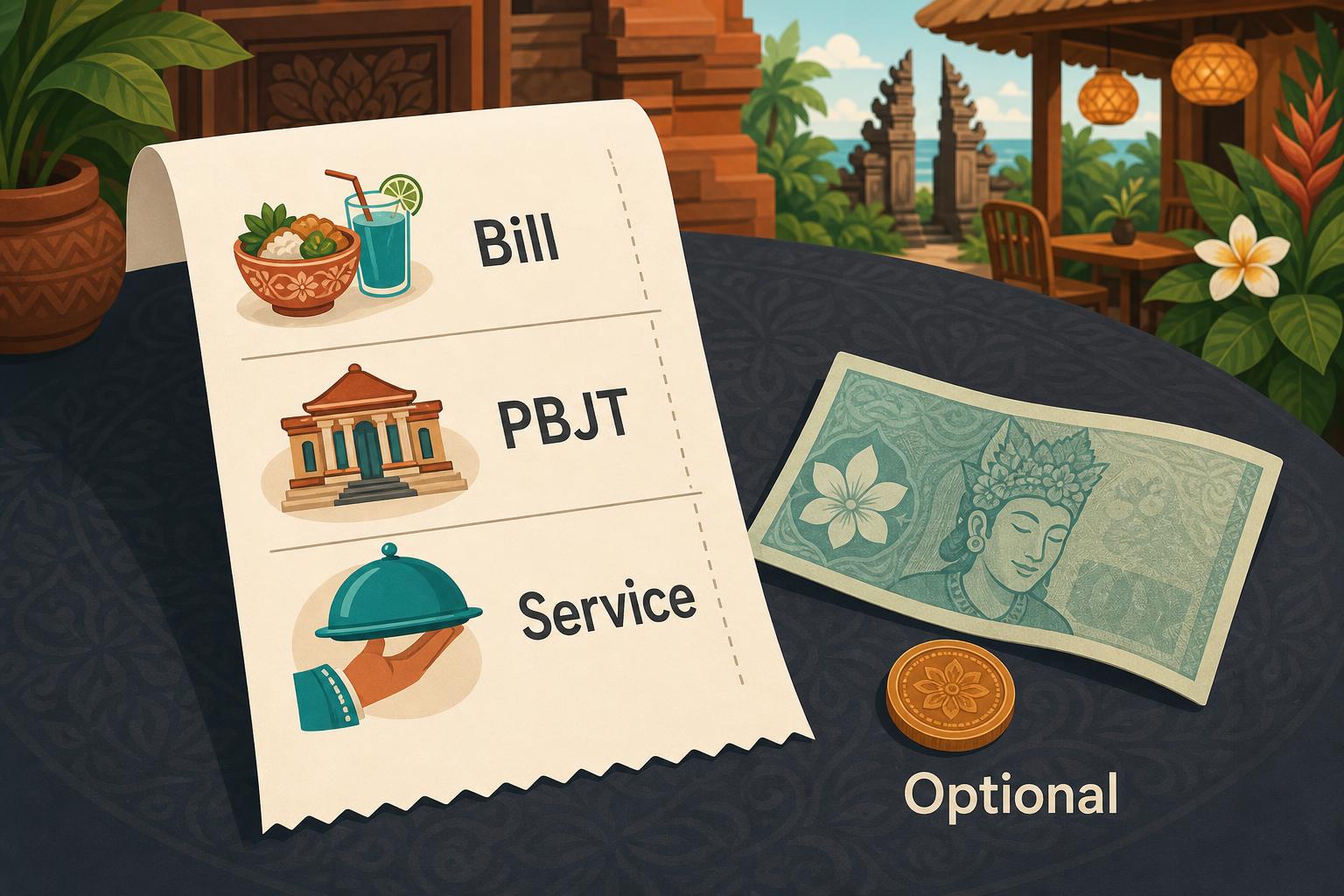
How to read a Bali restaurant or hotel receipt before adding a tip
Pause for ten seconds before tapping “pay.” This avoids the common mistake of seeing a higher total and assuming staff have already received a particular amount.
- Find the menu subtotal. This is the pre-added price of food, drinks or the booked service.
- Look for “Tax” or “PBJT.” This is a compulsory government levy where correctly charged, not a voluntary reward for service.
- Look for “Service” or “Service charge.” Ask politely if you want to understand a venue’s policy, especially outside a hotel setting.
- Decide separately about a tip. Only after reading the first three lines should you consider cash, rounding up, or no additional payment.
The distinction is practical at a hotel breakfast buffet, a Seminyak dinner venue and a Ubud spa café alike: a service charge is a bill item set by the business; a tip is your own optional decision. If you want your extra cash to go to a particular person, hand it to them directly where that is appropriate and permitted.
For a group meal, asking “Is service already included?” is clearer than asking a server whether they personally receive it. The first is a neutral question about the bill. The second can put an employee in an uncomfortable position.
How much to tip Bali drivers, GoJek riders and delivery workers
No official Gojek or Grab consumer guidance located for this research sets a Bali-specific “appropriate” rupiah range. The following are therefore flexible editorial examples, not customary standards or compulsory amounts.
GoJek and Grab rides around Denpasar and Canggu
For a ride or delivery where service was helpful or conditions were difficult, an optional Rp5,000–10,000 is a reasonable example to consider. That could include careful help with bags, a difficult pickup point, heavy rain, a long wait caused by you, or a delivery involving awkward access. It is also completely acceptable to pay the agreed app price without adding a tip.
Use the app where possible. Gojek permits tips during an active ride, order or delivery and after completion, provided the booking was paid with GoPay and sufficient GoPay balance remains; it says drivers receive 100% of the tip after completion. The rating/tipping feature is unavailable for Blue Bird taxi trips. Gojek’s tip guidance also explains how a customer who has rated a completed transaction can request an additional tip through transaction history and help.
Grab describes tips as optional and appreciated rather than mandatory. Its post-trip option remains available in trip history for up to 72 hours after a completed trip. Grab’s Indonesia instructions confirm that timing and specify OVO-paid trips; check the live app rather than assuming tipping is available for cards or other payment methods. Its terms effective 8 July 2026 also permit an optional preset tip, where available, added after service unless you change or remove it.
Private drivers for Ubud, Uluwatu or east-Bali day trips
A private driver relationship is more personal than a short app ride: the driver may be managing timing, stops, luggage and changing plans over a full day. There is no reliable official or representative Bali survey establishing a standard tip. If you choose to give one after a full day, Rp50,000–100,000 is a flexible optional example, not a requirement.
Clarity before the day starts is more valuable than a vague promise to “take care of it later.” Confirm the booked rate, route, waiting time, parking, tolls where relevant, meals, overtime and any changes to the itinerary. A tip should recognise genuine extra help, not repair an unclear booking.
What to tip at Bali spas, salons, tours and casual counter services
Spas and beauty services vary sharply between a hotel spa in Jimbaran, a central Ubud treatment room and an independent salon in Kerobokan. There is no authoritative Bali standard for therapist tips.
- Spa therapist: Rp20,000–50,000 is a flexible optional example for a treatment you found excellent, particularly where you are thanking the therapist directly.
- Warung or casual counter service: Rp0–10,000 is a flexible optional example; leaving no extra money is normal.
- Tour guide or activity staff: consider whether an added service charge, pooled arrangement or pre-agreed package already applies before offering cash.
- Salon staff: follow the same principle: settle the displayed bill, then make an optional direct gesture only if you genuinely want to.
Do not assume a spa’s service charge reaches the therapist, and do not assume it does not. Ask the reception desk whether a pooled-tip policy exists. If the venue says tips are pooled, use the designated method rather than quietly bypassing it; if it permits direct cash, a simple “terima kasih” is enough.
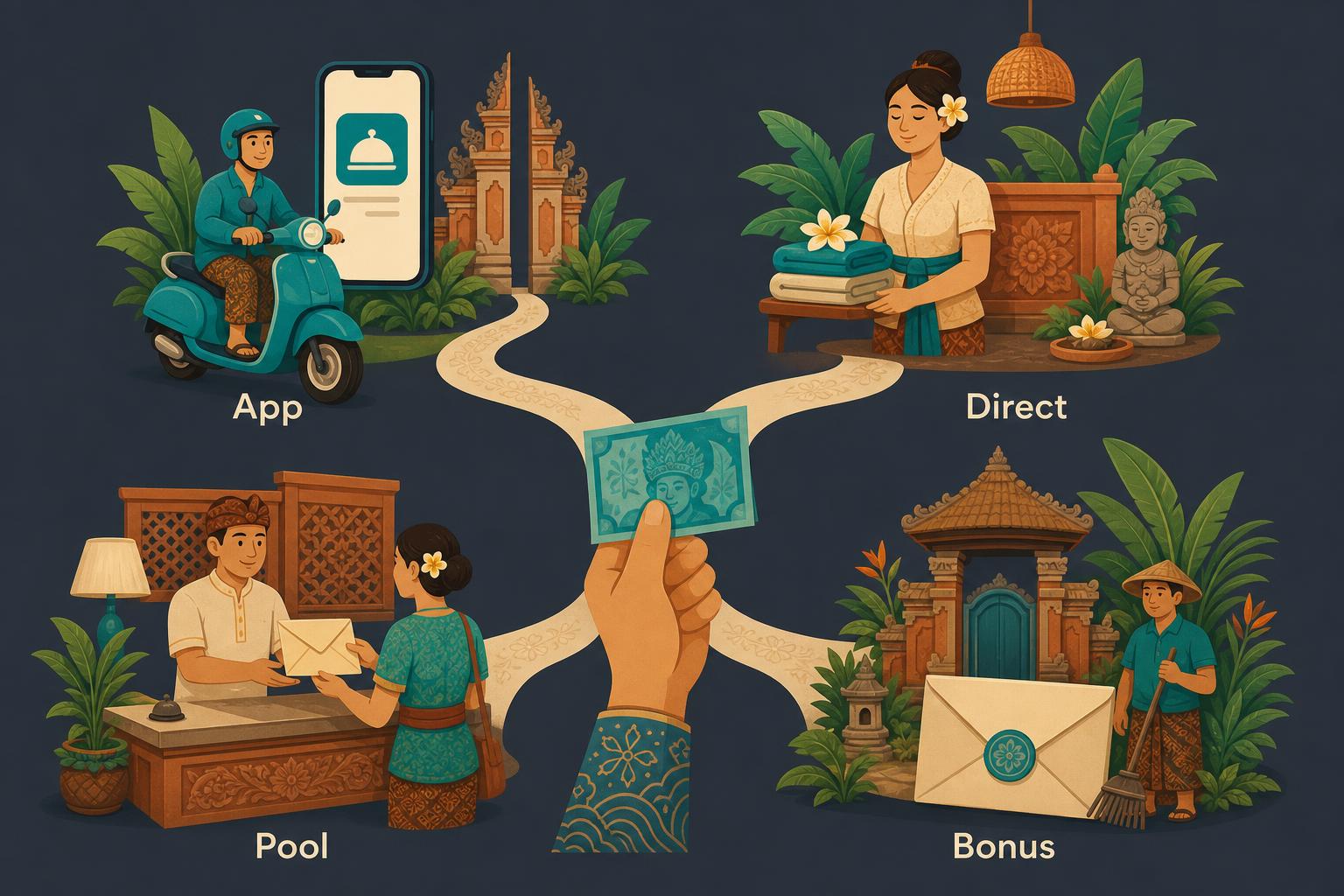
Villa housekeeping, security and gardeners: tipping is not a wage system
Long-term living changes the question. A one-off checkout tip for a cleaner is different from managing an ongoing employment relationship at a villa or house in Pererenan, Sanur or Ubud.
For villa or hotel housekeeping at checkout, Rp20,000–50,000 per cleaner—or a clearly labelled pooled envelope—is a flexible optional editorial example, not a regulated rate or verified customary average. Ask the villa manager first whether pooled tips are permitted and how they should be labelled. Do not leave unmarked cash where it can create confusion about its intended recipient.
For regular gardeners, security personnel, drivers or cleaners, no reliable Bali-wide tip benchmark was located. A transparent, pre-agreed periodic bonus or holiday allowance is usually more respectful than unpredictable daily cash. It allows both sides to know what is being offered and when.
Indonesia’s Law No. 2 of 2026 on Protection of Domestic Workers has been in force since 30 April 2026. It recognises domestic workers’ wages as compensation set by agreement or employment contract, rather than something dependent on tips. It also recognises a right to THR, a religious holiday allowance, alongside wages and other employment protections. Read the published text of Law No. 2/2026 before treating a holiday payment as an informal gift. Wages and THR must follow the agreed amounts and payment timing; THR is payable in money, and the law itself does not establish a universal rupiah amount. Verify applicable requirements before settling THR amounts and timing.
The law also addresses humane working hours, rest, agreed leave, social security, healthy food, safe conditions and suitable accommodation for full-time workers. A tip cannot replace any of those arrangements.
Setting fair household pay and holiday bonuses for a Bali home
For a household arrangement, put the practical terms in writing from the beginning. This protects the staff member and gives the household a shared reference when routines change.
- monthly or periodic wage and payment date;
- specific duties, including whether shopping, pet care, pool checks or guest support are included;
- working days, hours, breaks and overtime arrangements;
- leave, illness and replacement arrangements;
- THR or any separately agreed holiday bonus, including timing;
- meals, transport, accommodation or other agreed provisions for full-time staff.
Bali’s provincial minimum wage is Rp3,207,459 per month from 1 January 2026, while the provincial tourism minimum for stated accommodation and food/drink hotel classifications is Rp3,267,693. Tourism-area references also differ: Badung is Rp3,791,002.57, Denpasar Rp3,499,878.78, Gianyar Rp3,316,798.48 and Tabanan Rp3,287,678.87 from the same date. These are useful context, but Law No. 2/2026 provides for further rules on domestic-worker wage amounts and timing; do not assume the Bali UMP or UMK automatically fixes every directly hired household worker’s pay.
If you are choosing a long-term home where staff are included or offered separately, ask exactly what is included before booking. When reviewing rental listings, clarify whether cleaning is included, how often it happens and who employs the cleaner.
For more detail on separating included services from rent, see what a monthly Bali rental actually includes.
Cash, QRIS and app tips: respectful ways to say terima kasih in Bali
The most respectful method depends on whether the service is individual, platform-based or managed by a workplace.
| Situation | Best first option | Why it helps |
|---|---|---|
| GoJek or Grab ride/delivery | In-app tip after completion, where available for your payment method | Creates a clear transaction record and uses the platform’s tip feature. |
| Individual driver or therapist | Cash handed directly | A direct “terima kasih” makes the recipient and purpose clear. |
| Hotel, villa or managed spa team | Ask about the pool policy | A manager can confirm whether pooled cash is permitted and how it is distributed. |
| Regular household employee | Documented bonus or THR arrangement | Keeps wages and agreed benefits separate from a discretionary gift. |
QRIS can be useful for paying businesses, but do not assume a QRIS payment includes a tip unless the merchant makes that explicit. Similarly, do not give cash to a supervisor and assume it will reach a particular worker. Ask first.
Small rupiah notes are practical for an individual thank-you. Rupiah is the appropriate practical currency for Bali tips; Bank Indonesia’s rules cover domestic cash and non-cash transactions by residents and non-residents, subject to specified exceptions. Avoid making a performance of the amount, particularly in front of colleagues or other customers. The gesture should be clear, not awkward.
Bali tipping mistakes that make everyday service uncomfortable
Most tipping errors are not about generosity; they are about assumptions.
- Adding a percentage automatically: Bali does not operate on one universal tipping code, so check the receipt and setting first.
- Calling tax a staff tip: PBJT is a government levy, not a gratuity.
- Assuming every service charge reaches staff: the hotel-service-charge rules have a defined scope; standalone venue arrangements should not be presumed.
- Using tips to compensate for vague household pay: agree pay, conditions and THR or bonuses directly and separately.
- Leaving pooled cash without instructions: ask whether the property, spa or hotel permits it and how staff receive it.
- Feeling obliged after ordinary service: a friendly thank-you and prompt payment are enough when you do not wish to tip.
Residents who build a regular routine at the same café, laundry, villa or warung often find that consistency and courtesy matter more than trying to replicate a foreign tipping rule. Pay what was agreed, communicate changes early and reserve extra money for situations where you sincerely want to recognise it.
The practical Bali rule: read the bill, keep tax and service charge separate from a voluntary tip, use app tips for app work where possible, and treat regular household support as employment with agreed pay and benefits—not a stream of informal gratuities.