
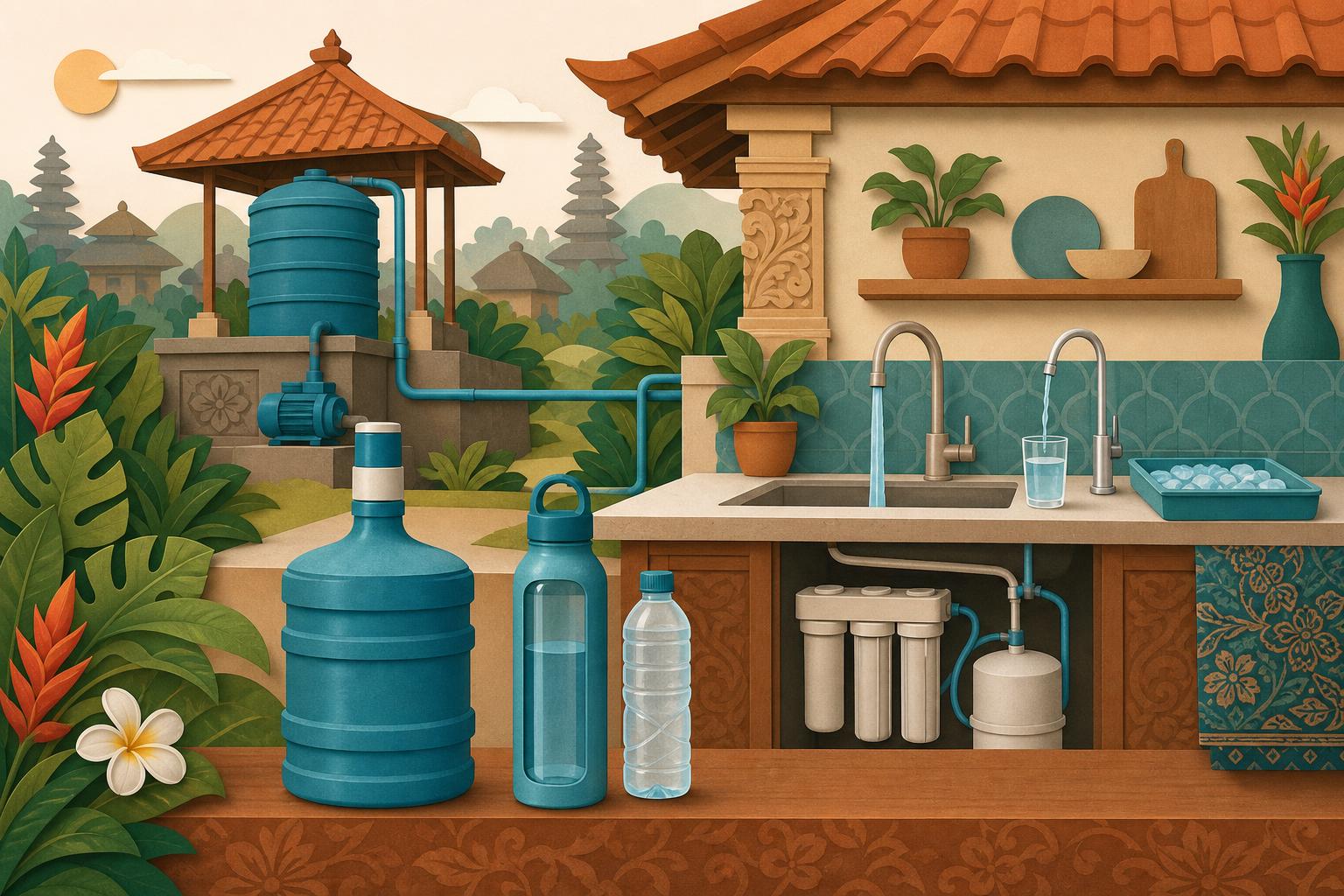
In Bali, the convenient choice is rarely to drink straight from the kitchen tap: the real decision is whether to rely on reusable gallons, a documented home treatment system, or factory-sealed bottled water.
This guide settles what to use for drinking, cooking, ice and brushing teeth, then shows how to assess the water setup in a villa, apartment or kost before you settle in.
Can you drink tap water in Bali without a filter?
Do not treat a Bali property’s tap water as drinking water unless the landlord can document its source, treatment, maintenance and recent test results. There is no island-wide public dataset that verifies water quality at individual villa or apartment taps, so a confident answer for one property cannot be applied to the next.
Indonesia defines drinking water as water, treated or untreated, that meets health requirements and can be consumed directly. That is a standard to demonstrate, not an assumption attached to a tap. The current standard requires both E. coli and total coliform to be 0 CFU per 100 mL, and it applies to piped, non-piped and communal systems alike. A PDAM connection, private well or other source is not, by itself, proof that the water is potable. Read the relevant Indonesian drinking-water standard before interpreting a landlord’s claim that water is “safe.” Permenkes 2/2023 was promulgated on January 12, 2023, replacing Permenkes 492/2010 and 736/2010. Effective March 11, 2026, Permenkes 3/2026 partially repealed it, retaining Articles 12, 21, 23, 29, 32, 39 and 45 together with its annex, including the microbiological standard.
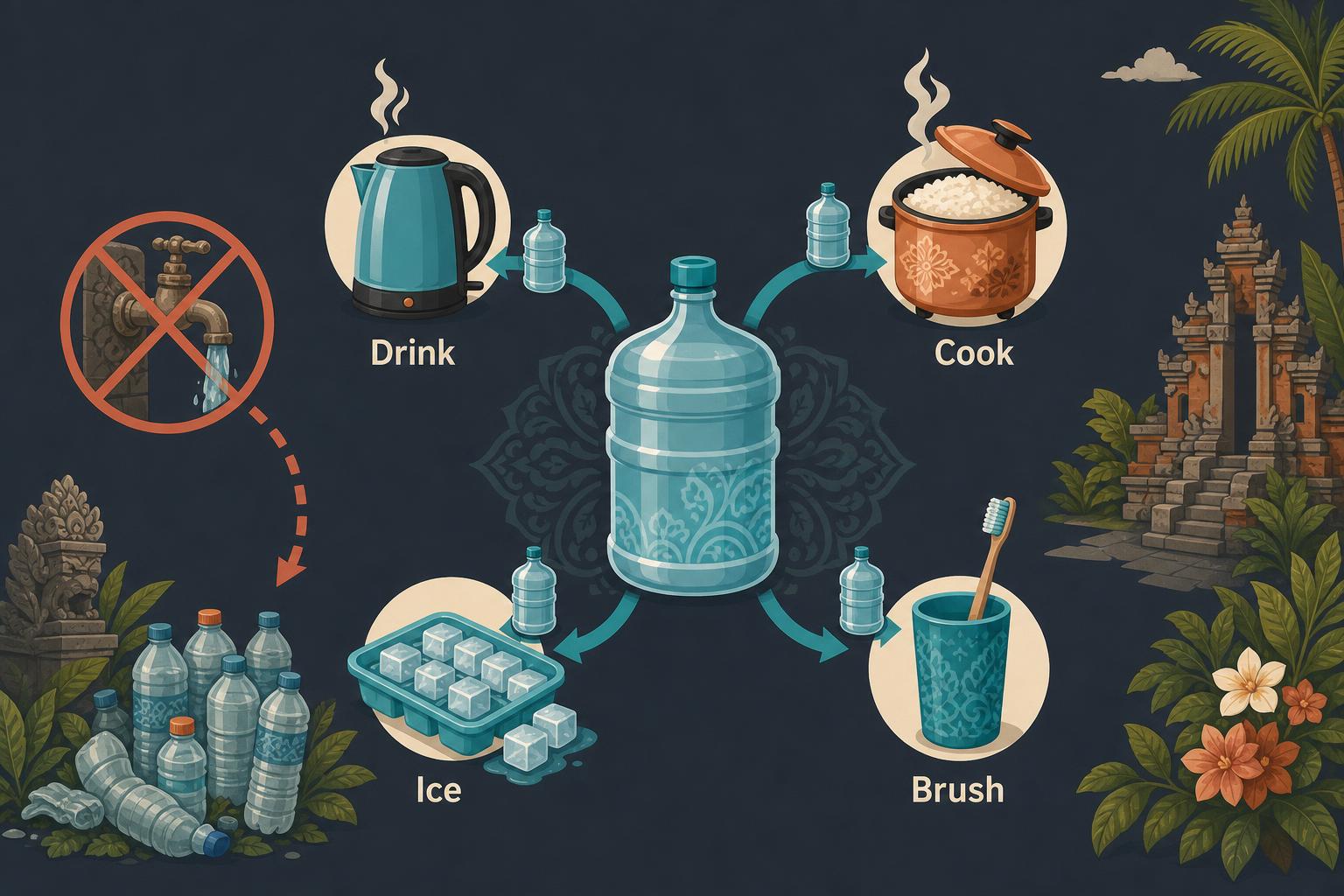
For a new arrival or a renter without property-specific evidence, use water from a known drinking-water source. CDC advice for destinations where tap-water safety is uncertain is to use unopened factory-sealed bottled water or adequately disinfected water for drinking, cooking, beverages, ice and brushing teeth.
That does not mean tap water has no role in daily life. It is commonly used for showers, laundry and washing floors. Use safe water to rinse fruit before peeling and vegetables before cooking. The dividing line is ingestion: use verified drinking water whenever water will be swallowed, frozen into ice or used to prepare food. See the CDC’s food and water precautions.
Why Bali water quality differs between villas, apartments and neighbourhoods
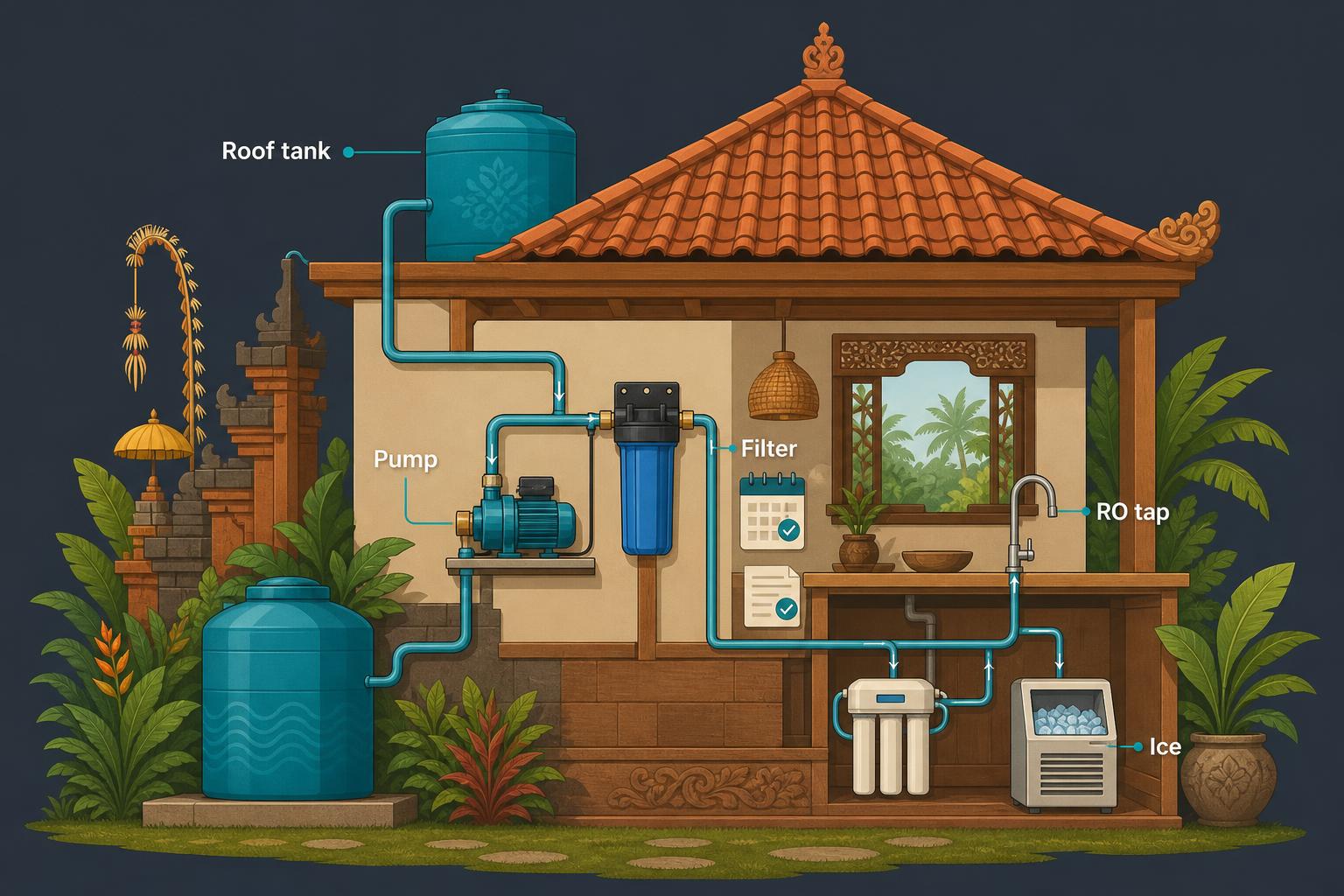
A home’s water experience depends on its source and the route water takes before it reaches your tap. Ask whether the property uses PDAM water, a private well, trucked water, rainwater or a combination. Then ask whether water passes through a pump, ground tank, roof tank, whole-house filter, under-sink system or a separate reverse-osmosis storage tank.
This matters in every part of Bali. A house in Canggu can have a different setup from a nearby villa; an Ubud rental can use a different arrangement from an apartment in Denpasar; and two units in one complex may have different maintenance histories. Do not infer water quality from the area name, building age, rent or how clear a tap runs.
Bali’s March 2025 Susenas household survey, published in a BPS table updated on July 30, 2026, illustrates why packaged water is part of ordinary household life: 53.72% of Bali households used branded packaged water or refill water as their main drinking-water source, including 95.10% in Denpasar and 77.69% in Badung. Those categories describe a main source, not the safety of any individual tap, but they explain why gallons, refill shops and delivery are routine household infrastructure.
For a private-well home, CDC guidance recommends testing at least annually, with additional testing after flooding, repairs or a change in colour, taste or smell. This is practical guidance, not an established Bali statutory testing interval. But do not use appearance as a pass/fail test: harmful germs and chemicals may not change water’s taste, smell or appearance. Cloudiness, sediment, odour, discolouration, low pressure and an intermittent pump are still useful move-in observations because they justify testing and landlord follow-up.
When comparing long-term rentals across Bali, make water source, drinking-water provision and filter servicing part of your first host questions.
Drinking, cooking, ice and brushing teeth: which water should you use?
Use the stricter standard when water could enter your body. Ice deserves the same care as drinking water: it melts into the drink, and CDC advises avoiding it unless you are reasonably sure it was made from safe water.
| Daily use | Best default when tap safety is undocumented | What to verify at home |
|---|---|---|
| Drinking and tea or coffee | Reusable gallon, documented treated tap or factory-sealed water | Source, recent test, treatment and service record |
| Cooking rice, pasta, soup or baby food | Use drinking-quality water | Do not assume boiling fixes every possible issue |
| Ice and cold drinks | Use drinking-quality water only | Check ice maker and fridge line connect to treated water |
| Brushing teeth | Use drinking-quality water | Keep a gallon or bottle by the basin if needed |
| Showering, laundry and cleaning | Household tap water | Report sediment, odour or pressure problems |
Boiling is useful in a limited situation. Bringing water to a rolling boil for one full minute, or three minutes above 6,500 feet, disinfects it against common enteric pathogens. Cloudy water should first be filtered through a clean cloth, paper towel or coffee filter, or allowed to settle so the clear water can be drawn off. Let the water cool before use. Boiling does not solve chemical contamination; suspected fuel or toxic-chemical contamination requires a different water source. That makes boiling an emergency or short-term microbial-control step, not a substitute for understanding a property’s water source. See the CDC’s boiling guidance and emergency water-safety guidance for the limits of boiling and other methods.
Refill depots, 19 L gallons and small bottles: the everyday Bali water comparison
For most long-term residents, reusable gallons are the practical middle ground between safety, convenience and waste. You can use a branded 19 L gallon through a retailer or delivery arrangement, or refill a reusable container at a local depot air minum (DAM). A small stock of factory-sealed bottles remains useful for travel days, guests or a temporary move-in period, but it is an inefficient main household system.
Indonesia’s Permenkes 11/2025 replaced the relevant 2024 health-sector licensing framework on October 3, 2025. Drinking-water depots, classified as KBLI 11052, are among the businesses required to hold a Sertifikat Laik Higiene Sanitasi (SLHS), the local-government hygiene-sanitation certificate. Ask to see its current SLHS, and ask how it inspects, cleans, rinses and sanitises customer gallons. These are practical questions grounded in the current SLHS requirements, not an awkward request. Annex F.1 requires depots to inspect customer containers, reject those unsuitable for reuse, and correctly rinse, wash and/or sanitise containers before reuse. Delivery is permitted, but depots must not hold ready-to-sell stocks of water already filled into containers. Containers and caps supplied by the depot must be plain and unbranded; this is not a blanket ban on customers bringing branded containers. Depots must not apply seals or shrink-wrap, so depot-filled water is distinct from factory-sealed branded water.
| Option | Best for | Trade-off |
|---|---|---|
| Refill depot gallon | Residents able to check the depot’s hygiene documentation and container handling | Quality depends on the specific depot and clean-container practice |
| Branded 19 L gallon | Simple recurring home supply with a reusable vessel | Delivery availability and pricing vary by area |
| Factory-sealed small bottles | Arrival days, travel and backup supply | High plastic use and much higher cost per litre in the cited example |
| Under-sink treated tap | Households ready to maintain a correctly specified system | Requires testing, cartridge changes and verification of claims |
AQUA Home Service quotes approximately Rp19,000 per gallon and an empty container from approximately Rp34,000, with regional variation. Container purchase is separate from recurring water exchanges. Four 19 L gallons provide 76 L, enough for one person using roughly 2 L a day for drinking, at approximately Rp76,000 using that water-price reference. It is a baseline reference, not a verified Bali-wide price or delivery quote as of November 10, 2026; confirm the first-purchase total and container or exchange basis with the seller.
For contrast, a Badung listing showed factory-packaged AQUA 330 mL bottles at Rp2,500 before VAT. Reaching 60 L a month would take about 182 bottles and cost about Rp455,000 before VAT at that historical listed price, not a verified current quote. Reusable gallons and a personal bottle are generally the more practical everyday habit, as well as better aligned with Bali’s restrictions on single-use plastic waste. Bali provincial-secretary Circular 2/2025, dated January 20, 2025, prohibits plastic-packaged drinking water in provincial-government offices, provincial-owned enterprises and provincial-government schools from February 3, 2025; it is not a universal prohibition on residents buying bottled water.
Under-sink filters versus whole-house filters: what each Bali rental system can do
A filter housing under the sink does not automatically make a kitchen tap safe to drink from. Start with the filter type, its claims and its maintenance record.
Basic carbon filters, including many pitcher and fridge filters, commonly improve taste and odour or reduce some chemicals; they are generally not designed to remove germs. For microbial protection, reverse osmosis (RO), nanofiltration or appropriately rated ultrafiltration are the categories to investigate. Check the actual model rather than relying on labels such as “premium,” “mineral” or “purified.”
- NSF/ANSI Standard 42: aesthetic effects, including taste and odour claims.
- NSF/ANSI Standard 53: specified health-related contaminant-reduction claims; cyst reduction is not automatic, so verify the individual model’s certified claims.
- NSF/ANSI Standard 58: reverse-osmosis systems.
- Whole-house filter: treats water as it enters the property, but its capability depends on the equipment installed.
- Under-sink unit: treats only water from its dedicated drinking tap; it does not make every bathroom and kitchen tap potable.
Check NSF’s standards guidance for the scope of each certification. RO can remove bacteria and some chemicals, including lead, copper, chromium, chloride and sodium, but certification and the specific contaminant claims still matter. It is best reserved for drinking and cooking water rather than treating every litre used for showers, laundry and toilets. Poorly maintained cartridges and housings can allow germs to grow, so a system is only as credible as its maintenance.
Replace pre-filters and membranes according to the manufacturer’s instructions, taking account of use and source-water quality; there is no universal six-month pre-filter or one-to-five-year membrane replacement interval established by the cited CDC guidance. Ask for manufacturer instructions rather than accepting a verbal service promise. The CDC’s home filter guidance is a useful checklist for matching a filter’s certified claims to the problem you need it to solve.
Bali villa and apartment water checklist for move-in day
Do this inspection before you buy a month of small bottles or trust an existing kitchen filter. Take photos of the equipment and save written answers with the rental documents.
- Name the source. Ask whether each tap receives PDAM, well, trucked or rainwater, and whether sources are mixed.
- Request the property’s latest lab report. It should show the sample date and include at least E. coli, total coliform, turbidity, total dissolved solids and relevant chemical parameters.
- Trace the water path. Locate the pump, ground tank, roof tank, whole-house filter, under-sink unit and any RO storage tank.
- Photograph every filter label. Record make, model, cartridge-change dates, invoices and the manufacturer’s replacement schedule.
- Ask about tanks. Confirm when roof tanks, ground tanks and RO storage tanks were last cleaned or sanitised, who pays for future work and who arranges it.
- Run cold water at every tap. Record sediment, colour, odour, pressure and intermittent pump operation. These do not prove contamination, but they are useful evidence for a follow-up.
- Check appliance connections. Confirm that a fridge dispenser, ice maker and filtered kitchen tap connect to the documented drinking-water line, not untreated household supply.
- Set the household routine. Decide where gallons will stand, who orders them, and which tap everyone uses for cooking and toothbrushing.
This check is particularly important in a furnished apartment, where a compact under-sink filter may be easy to overlook, and in a villa with several tanks out of sight. If you are weighing building layouts and service arrangements, this is also worth adding to an apartment rental viewing checklist.
Water supply should be written into the practical tenancy record: who handles tank cleaning, whether a filter is included, and how faults are reported. Use that record alongside the written messages and photos from your move-in inspection.
How to choose a Bali drinking-water setup by length of stay
The right option changes with how long you will live at the property and how much control you have over maintenance.
| Your situation | Choose this | Do this before relying on it |
|---|---|---|
| Days or a short transition | Factory-sealed bottled water | Use it for drinks, ice, cooking and brushing teeth |
| Monthly rental or kost | Branded reusable gallons or a checked refill depot | Establish delivery or inspect the depot’s SLHS and cleaning process |
| Long villa stay with a maintained system | Documented under-sink RO or equivalent appropriately rated treatment | Review test results, model claims, cartridge dates and tank sanitation |
| Private-well home with no current evidence | Reusable gallons while the water is tested and treatment is assessed | Do not rely on the household tap merely because it looks clear |
Do not let a water question become an afterthought after signing. It belongs alongside electricity, Wi-Fi and service responsibilities, which can vary widely between rentals. For a broader view of bills and services, see what a monthly rental in Bali actually includes.
Who should choose gallons, filters or bottled water in Bali?
Choose reusable 19 L gallons if you are staying for a month or longer and the property does not have documented, maintained drinking-water treatment. This is the clearest default for most renters: it separates drinking water from uncertain household supply and avoids making small bottles your daily system.
Choose a local refill depot if you can verify its current SLHS, understand how it cleans your container and are comfortable managing reusable gallons. Do not choose a depot solely because it is the closest option.
Choose a maintained under-sink RO or appropriately rated treatment system if the landlord can show the source, recent test report, exact system, certified claims and service history. This is the best fit for a long stay in a home where you can keep up with maintenance.
Choose factory-sealed bottles for arrival, travel, backup supply or any period when you cannot verify a gallon supplier or home system. They are the most straightforward temporary choice, not the sensible default for a full household month.