

At the end of this Canggu villa rental guide, you should have a shortlist that fits your actual routine, a documented lease arrangement, and a clear handover plan for moving in. Allow one focused day to define your brief and start searching, then give yourself enough time for viewings, document checks, host responses and lease review before committing to a monthly or yearly rental.
The key is to treat a Canggu villa as a home with operating details, not just a set of attractive listing photos. The road outside, water setup, internet, access during rain, who is authorised to rent it out, and the payment schedule can matter as much as the bedroom count.
Phase 1: Start your Canggu villa rental guide with a usable brief
1. Decide how you will use the villa
Write down the routine the property must support before comparing locations or pools. A remote worker may need a quiet desk, dependable connection and room for calls. A couple may care more about separate bedrooms for visitors, a usable kitchen and parking. A family may need safe boundaries, storage and a practical route for daily errands.
Separate non-negotiables from preferences. For example, a locked bedroom, enclosed living area, dedicated workspace or covered parking can be a requirement; a particular tile style is usually a preference. This makes it easier to reject a beautiful but impractical villa quickly.
2. Set a rental ceiling using live listing evidence
Do not rely on claims of a single “average Canggu villa rent.” No official government series was located for Canggu asking rents, signed rents, yields or vacancy rates in the article’s November 2026 research. Use current listing evidence, then compare like with like: stay length, bedroom count, furnishing, pool, enclosed versus open living, and included services all affect the asking price.
The article’s August 2026 listing benchmark has not been verified against a dated internal data export and should not be used as a current price guide. Build your budget from available listings for your intended dates and rental term. Asking prices are not evidence of completed rental agreements or an official Canggu average.
Build your ceiling around the rent plus the costs that the lease says are yours. Ask specifically about electricity, water, internet, pool care, garden care, waste collection, cleaning, repairs and any deposit. “Included” should be written next to the relevant item, not assumed from a conversation.
3. Have this file ready before you contact hosts
| Bring or prepare | Why it matters | Cost or timing to note |
|---|---|---|
| Target move-in and move-out dates | Lets a host confirm availability and quote the right stay length | Check the minimum stay before viewing |
| Monthly rental ceiling | Keeps the shortlist realistic | Compare current asking prices for the same dates, stay length and included services |
| Household and work requirements | Tests bedrooms, desk space, access and house rules | List essentials before the search |
| Identity and contact details | Useful when a host requests a booking or lease file | Keep sensitive documents secure |
| Visa and stay plan | Helps align the rental term with your lawful stay | Visa fees are separate from rent |
Canggu sits in Kuta Utara District, Badung Regency, not Denpasar. That distinction matters when you later need to ask locally about a specific property, address, licensing question or regional procedure. The relevant administrative basis is set out in the Badung Regency regulation.
Phase 2: Use a Canggu villa rental guide to shortlist by daily route
4. Search by the life outside the gate
A Canggu label is not a commute plan. For every candidate, map the routes you will repeat: grocery runs, gym, school or coworking trips, beach visits, airport journeys and late-night arrivals. Visit at the times you expect to use those roads, not only in the middle of a quiet viewing day.
Ask for the exact access route and assess the final stretch yourself. Narrow lanes, construction activity, roadside drainage and the ability to turn or park a car can change how a villa feels after the novelty has worn off. If you will not use a scooter, test whether the address still works for walking, deliveries and car pick-ups.
5. Compare listings on the same terms
Keep a simple comparison sheet with the rent, rental period, deposit, utilities, furnishing, included maintenance, internet arrangement, parking, house rules and earliest available date. A lower headline rent is not automatically a lower total commitment if the tenant takes on services or repair items that another villa includes.
For a broad search, use Livuma’s rental search to filter live homes by area, rental type, price, stay length, bedrooms and amenities. Listings show the availability, minimum stay, booking conditions and house rules so you can remove obvious mismatches before arranging a visit.
6. Keep an alternative housing format in view
If the villa search is forcing too many compromises, consider whether a room or kost better suits your first months in Bali. It can provide a lower-commitment base while you learn your preferred routes and neighbourhood rhythm. Browse Canggu kost and budget-room options if your priority is a simpler monthly setup rather than a private villa.
For renters comparing area-level long-term inventory and pricing context, the Bali long-term rental and sales report explains what marketplace listing data can and cannot show.
Phase 3: Inspect a Canggu villa for ordinary-day reliability
7. View the property in a sequence, not as a quick tour
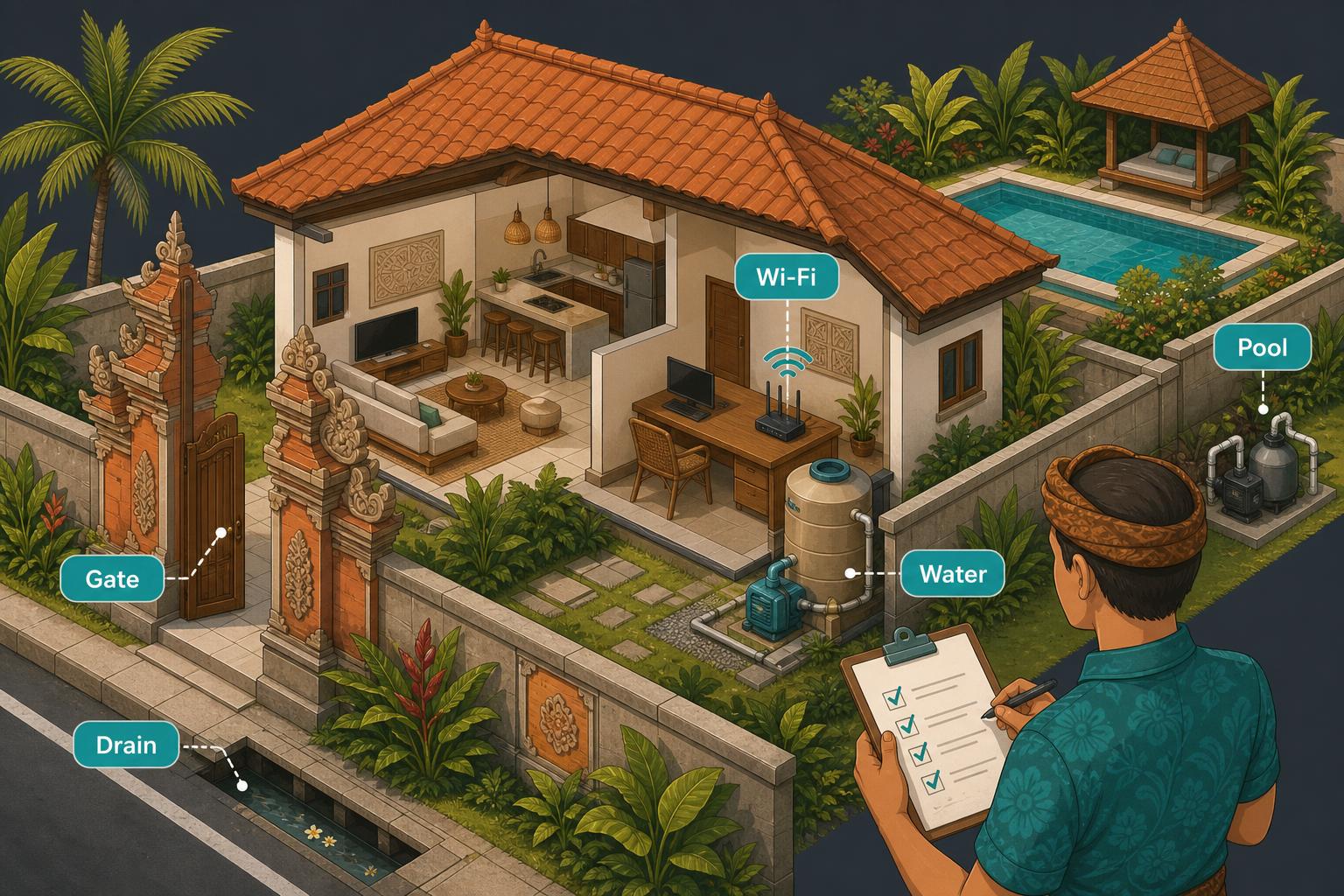
Start outside. Walk from the access road to the gate, check the parking arrangement, and look at drainage around the entrance. Then inspect the villa from roofline to utility points: doors and locks, windows, bedrooms, bathrooms, kitchen, storage, outdoor areas and any pool or garden equipment.
Test what you can during the viewing. Run taps, flush toilets, check shower pressure, open and close doors, look beneath sinks, ask where the electrical panel is, and confirm which rooms have cooling. If the property depends on a pump, water tank, well or other system, ask who handles a failure and how quickly.
8. Check the working setup, not just the décor
Ask what internet service is installed, whether it is included, who holds the account and where the router sits. If remote work is important, test the connection from the actual desk or bedroom where you expect to work. Also check mobile signal, noise at likely call times and whether an open-plan living room will be comfortable in the weather you expect.
Take dated photos and notes with permission. Record existing marks, loose fittings, damaged furniture, pool condition and the meter readings that will matter at handover. This inventory is useful for both sides because it separates pre-existing wear from anything that happens during your stay.
9. Ask what changes between dry weather and rain
A dry-day viewing cannot show every operational issue. Ask whether water enters the driveway, garden, rooms or access lane during heavy rain; where runoff goes; whether the pool overflows; and how rubbish is collected when weather is poor. Ask for a direct answer rather than accepting “no problem” without detail.
Also clarify the maintenance rhythm. Find out who contacts the pool, garden, internet or repair provider, whether workers need access while you are out, and whether any regular services are included in the agreed rent.
Phase 4: Confirm who can lease the Canggu villa and what your stay allows
10. Verify the lessor before you negotiate money
Ask who owns the property or who has authority to lease it, then make sure that person or entity is identified consistently in the agreement and payment instructions. If an agent, manager or family representative is handling the process, ask for the basis of their authority. Keep the property address, names, messages and documents together.
This is also the point to distinguish a residential long-term lease from a plan to run accommodation. Under the OSS classification, a villa operated as tourist accommodation is classified under KBLI 2020 code 55193, converting to KBLI 2025 code 55203, while short-stay accommodation is generally provided daily or weekly. A residential villa lease does not automatically authorise nightly or weekly hospitality activity. Anyone planning to operate a rental business should independently verify the operator’s NIB, classification and property approvals rather than relying on a listing description. Bali also announced closure of new PMA applications through OSS for 18 specified business classifications, including owned/leased real estate, from the third week of May 2026; this is a business-licensing restriction, not a blanket prohibition on foreigners renting homes.
11. Match the lease period to your immigration and tax position
Housing does not create immigration permission. The B1 Visa on Arrival permits an initial 30-day stay with one 30-day extension, up to 60 days in total for eligible nationalities. The C1 tourist visit visa allows an initial stay of up to 60 days and extensions up to a 180-day total; its official initial 60-day PNBP fee is IDR 1,000,000, excluding extensions. Both B1 and C1 prohibit selling goods or services or receiving remuneration for work or business from Indonesian individuals or corporations. Check the official Visa on Arrival eligibility information and the B1 and C1 visa conditions against your own nationality and activity. Since May 29, 2025, stay-permit extension applicants, including VoA holders, must attend immigration for a photograph and interview after applying online, under the extension procedure.
For foreign nationals, Indonesian domestic tax-subject status can arise when you reside in Indonesia, stay more than 183 days in any 12-month period, or are present with an intention to reside. Under PER-23/PJ/2025, a residential lease exceeding 183 days is expressly listed as evidence of that intention; staying fewer than 184 days does not alone settle residency status. Dual-residency cases involving treaty-partner jurisdictions are assessed under the relevant tax treaty. Read the Directorate General of Taxes guidance on foreign-citizen tax reporting and residency and the current residency rules, then obtain advice for your circumstances where needed.

Phase 5: Put the Canggu villa rental agreement and payment sequence in writing
12. Turn every material promise into a lease term
Indonesian Civil Code Article 1320 identifies consent, legal capacity, a certain object and a lawful cause as contract-validity basics. For a cross-border rental involving an Indonesian citizen or Indonesian private institution, Perpres 63/2019 requires Indonesian; where a foreign party is involved, the agreement must also be written in that party’s national language and/or English. It should identify the owner or authorised lessor, the property, the exact rental term, the rent and payment schedule, deposit rules, utilities, repairs, exit conditions and extension terms. Ordinary domestic rental quotations, contract pricing and payments should use rupiah unless a statutory exemption applies, under Bank Indonesia’s currency requirements.
Do not leave operational questions to an informal message thread. State who pays each utility, what happens if a repair is urgent, whether the tenant may sublet or host guests, what furniture remains, what notice is required, and how a deposit is assessed and returned. Attach the condition inventory and meter readings where possible.
13. Pay only against a defined booking or lease record
Before transferring money, reconcile the recipient name, property address, amount, due date and stated purpose with the agreement. Ask for a receipt and retain a complete record of payments. If a request changes—such as a new bank account or a different payment schedule—pause and get the change confirmed in writing by the authorised lessor.
14. Keep landlord tax separate from your rental decision
Income from renting land and/or buildings is generally subject to 10% final income tax on gross rental income, which can include associated maintenance, security, service and facility charges, with the lessor generally self-paying when the tenant is an individual or other non-withholding party. Qualifying corporate or designated tenants instead withhold the tax. This regime does not apply indiscriminately to lodging services, including qualifying boarding-house accommodation. That is a landlord-side compliance matter; it does not make an undocumented surcharge automatically payable by a tenant. If a tax amount is being charged to you, ask for the contractual basis, calculation and receipt before agreeing.
Phase 6: Complete a documented Canggu villa check-in and settle into the lease
15. Do the handover before you unpack
Meet at the villa for a final walkthrough. Count and photograph keys, remotes and access cards; record electricity and water meter readings; photograph the furniture and any existing defects; and test the basics once more. Both parties should retain the same dated inventory and note any repair that remains outstanding.
Confirm the first practical contacts: the authorised lessor or manager, emergency repair contact, internet provider if relevant, and the arrangement for pool, garden or cleaning staff. Ask how access will be arranged before anyone enters the property for scheduled maintenance.
16. Keep the record current through move-in
Save the signed agreement, receipts, inventory, communications and payment confirmations in one folder. Notify the lessor promptly and in writing when something needs repair, using photos or video where useful. This avoids a vague dispute later about when an issue appeared or what was agreed.
A successful Canggu villa rental is usually less about finding the most dramatic property on day one and more about finishing each step in order: a realistic brief, route-based shortlist, thorough viewing, verified authority, specific terms and a careful handover.
Renting a Canggu villa through Livuma
- Search Livuma’s long-term rentals in Canggu by price, stay length, bedrooms and amenities. Compare availability, minimum stay, house rules and booking conditions against your brief.
- Read the payment schedule, deposit or balance rules, deadlines, cancellation rules and refund logic before committing, so the total commitment is clear.
- Pick dates and secure the request before the host sees it with a card reservation or held Indonesian bank-transfer prepayment. Declined, withdrawn or expired requests receive an automatic full release or refund.
- The host answers within a limited window; approval normally charges the card reservation and confirms the booking. For eligible monthly or yearly rentals, “view property first” secures only a small deposit. After an in-person or virtual viewing, pay the rest in the app to confirm, with no deadline or automatic confirmation, or cancel free for a full deposit release or refund. Use in-app chat to agree viewing and move-in details.
- Complete identity verification before the rental agreement is issued. For supported bookings, digital agreement details and receipts are generated from the listing, booking terms and verified guest details.
- Confirm arrival in the app or report a problem, which holds the host’s payout while resolved. Payout is released automatically about 24 hours after successful check-in, never while a reported problem is open; later rent follows the displayed schedule.