

The costliest Bali rental mistake often starts with an ordinary-looking chat: a villa appears available, the agent says another tenant is ready to pay, and a deposit is requested before you have seen the place or established who can lease it. By the time the address, keys, or owner story stop adding up, the transfer has already left your account.
Learning how to spot a Bali rental scam is less about distrusting every host than slowing down at the points where a false listing needs you to act quickly: identity, authority, property access, written terms, and payment. A polished social-media account, a familiar-looking villa photo, or even a real bank account is not enough on its own.
Use the checks below in sequence. If one answer is vague, pause. If several facts conflict, walk away rather than trying to negotiate the risk away.
How to spot a Bali rental scam before you send a deposit
A request for money before a viewing is not automatically fraud. Some genuine long-term rentals are competitive, and some renters book remotely. The problem is a seller or agent who makes payment the substitute for verification.
Watch for a rushed sequence such as: photos arrive, a short video is refused, the person says they are travelling, and a deposit must be transferred immediately to prevent somebody else taking the home. The urgency is doing the work that evidence should do.
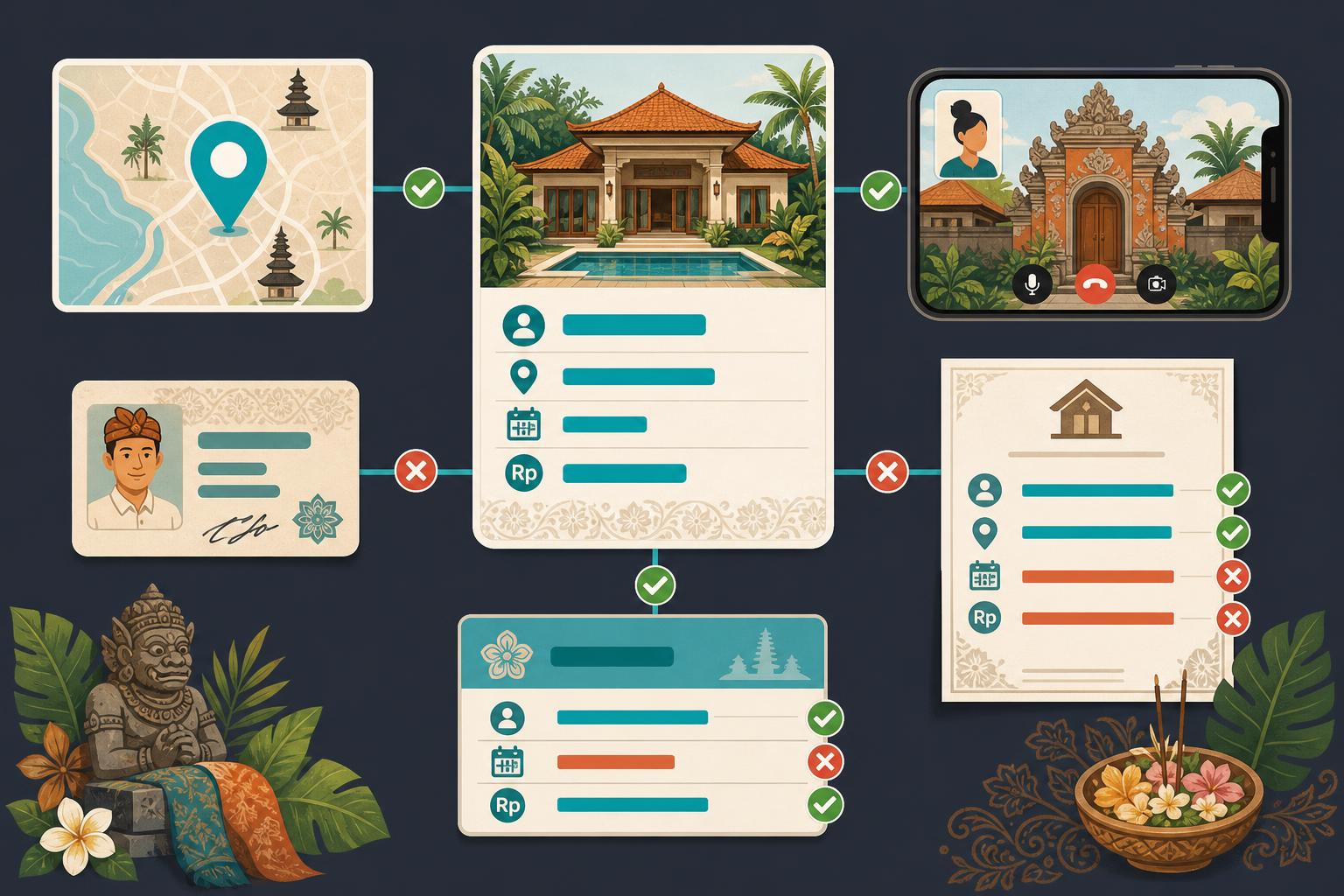
Before transferring any deposit, ask for:
- the full property address and a location you can independently check;
- a live video call from the property, with the person showing requested details such as the entrance, meter, view, or a particular room;
- an in-person or virtual viewing where possible;
- the name of the owner or the person authorised to act for them;
- a written outline of rent, term, deposit, included costs, payment dates, cancellation terms, and handover arrangements.
A live call is useful because it tests access to the actual home at that moment. It does not prove ownership or authority. Treat it as one layer alongside a written agreement and identity checks.
Do not let a claimed deposit become a reason to skip the contract. For the clauses to settle before payment, see this practical guide to monthly versus yearly Bali rental contracts.
How to spot a Bali rental scam when the photos and address look real
Scammers do not need to invent a villa. They can reuse images from an old listing, copy a legitimate property description, or pose as an agent for a home that exists. That is why reverse-searching photos or recognising the road is helpful, but not decisive.
The important question is: can this person demonstrate that they are authorised to offer this particular home for this particular term?
Ask the person advertising it to explain their connection to the property in a way that can be checked. An owner, an appointed agent, a property manager, and a sublessor are different roles. A sublessor should be able to show that their own agreement permits the onward rental; an agent should be able to identify who appointed them.
Then compare the details across the listing, chats, proposed agreement, bank recipient, and viewing. Pause if:
- the address changes between messages;
- the person at the viewing has a different name from the payee, with no clear explanation;
- the stated owner is never named;
- the home shown on a video has different layout, surroundings, or furnishings from the advertised property;
- the advertiser will only communicate through disappearing messages or insists on moving all discussion off the original platform.
On Livuma, guest-host arrangements can stay in in-app chat, while hosts must activate their accounts with identity verification, legal details, and an Indonesian bank account before accepting paid bookings. That is not a substitute for your own viewing and agreement review, but it avoids relying solely on scattered WhatsApp messages.
For a practical long-term search in a high-volume market, compare stated location, photos, minimum stay, house rules, and booking conditions across long-term rentals in Canggu rather than treating one forwarded listing as the market.
The agent says the rent is a bargain, so you must decide today
An unusually low price does not prove a scam, but it is a reason to verify more, not less. A false listing often uses a price that makes a renter fear missing out and accept gaps they would otherwise question.
Compare like with like: a room is not a private villa, a monthly quote may exclude costs, and a property in one part of an area may not resemble another.
Ask why a quote sits far outside comparable options. Ask what is included, whether the rate changes after an initial period, and whether the advertiser is quoting monthly rent, a total lease payment, or only a deposit.
Do not accept these pressure lines as answers:
- “The owner will explain after you pay.”
- “There is no time for a contract.”
- “The price is private, so do not ask questions.”
- “Send a holding transfer now and we will sort out the details later.”
A genuine landlord may have a deadline. They should still be able to state what payment reserves, what happens if the agreement is not signed, and who receives it. For a separate comparison of what a monthly price can contain, read what a monthly Bali rental actually includes.
The listing claims to be run by a PT, but the business cannot be identified
A company name can create confidence, especially when the advertiser uses formal invoices, a branded website, or a business logo. But a company claim is checkable, and a check should be specific.
An Indonesian business's NIB is its official business identity. If an advertiser says a PT, PMA, management company, or accommodation business operates the listing, ask for the exact legal business name and NIB. The official OSS system provides a public NIB search. You can also use AHU Online's company services to check the claimed company name and request company-profile information.
Compare the official result with the name on the agreement, invoice, website, and payment request. A mismatch is a reason to stop and ask for an explanation.
Equally important: a matching company record or NIB does not prove that the company controls the advertised villa, apartment, or kost room. It only helps establish whether the claimed business identity exists. You still need to establish who is authorised to lease the property and whether the terms match the offer.
Be particularly cautious when the advertiser claims a property is for rent but keeps steering the conversation into a “foreign freehold” purchase opportunity. Foreign residential ownership is technical and depends on the registered land right, certificate holder, immigration status, property type, and transaction documents. Article 21(1) of the Basic Agrarian Law reserves individual Hak Milik land ownership to Indonesian citizens; a promise of Hak Milik directly in a foreign individual's name conflicts with that rule. If you are considering a purchase rather than a tenancy, begin with a separate Bali properties-for-sale search and seek independent professional advice on the transaction.
The person sends a certificate scan and says that proves they can rent the villa
A certificate image can be copied, edited, outdated, or unrelated to the home you are discussing. Even an authentic certificate does not, by itself, establish that the person messaging you has authority to sign a rental agreement or receive your money.
For a meaningful property check, distinguish three questions:
- Does the document relate to the correct land or building? Compare location, boundaries, and property details with the home you viewed.
- Who holds the relevant right? A name on a document may be different from an agent, manager, family member, or existing tenant offering the rental.
- What authority does the advertiser have? Ask for the owner connection or appointment, not just a document image.
For higher-value property purchases, an independently chosen PPAT is materially stronger than accepting a seller's scan or PDF. PPATs must check a certificate against Land Office records before preparing a deed for a land or building-right transfer or encumbrance; this is not a mandatory PPAT process for every ordinary rental contract. Official electronic checking is designed to confirm whether physical and legal certificate data match the Land Office database, rather than merely reviewing its appearance.
Renters should not expect unrestricted access to another person's current certificate records through the public Sentuh Tanahku tools. Electronic certificates can, however, be authenticated through their QR codes using Sentuh Tanahku. Existing paper certificates remain valid during the gradual transition. Neither format establishes the advertiser's rental authority, so a screenshot presented in chat should not be treated as final proof.
The payee name is different, and a surprise “government tax” appears at checkout
A different bank-account name can have an innocent explanation: a manager may collect for an owner, or a business may use an authorised account. It should never be unexplained. Ask why the payee differs, who the recipient is, and ensure the written agreement identifies the receiving party and payment purpose.
Before paying, search the account or e-wallet through CekRekening.id. The service lets users check whether an account has previously been reported for suspected fraud. A result showing no report is found is not proof that the recipient or listing is legitimate; a new or unreported account can still be risky. It is an account-screening service, not a property-title verification service.
Also question add-on charges that materialise only after you agree to rent. Rental income from land and/or buildings is generally subject to final income tax at 10% of gross rental value, and the tax base includes related maintenance, security, service, and facility charges, even when covered by separate agreements. This rule has applied since January 2, 2018; it is not a new 2026 tax, and its regime excludes lodging/accommodation income, including rumah kos. That exclusion does not mean all kost income is tax-free. Where the tenant is an ordinary individual who is not an appointed withholding party, the landlord or lessor generally deposits that tax itself. An urgent demand for a private renter to transfer a separate mandatory government “10% rental tax” should therefore be checked against the agreement and tax documentation, not paid on the strength of a chat message.
Use a payment method that leaves clear evidence. Save the recipient name, date, amount, purpose, and receipt. Do not split transfers across unfamiliar accounts simply because the advertiser says it is faster.
You have transferred money and the advertiser has stopped replying
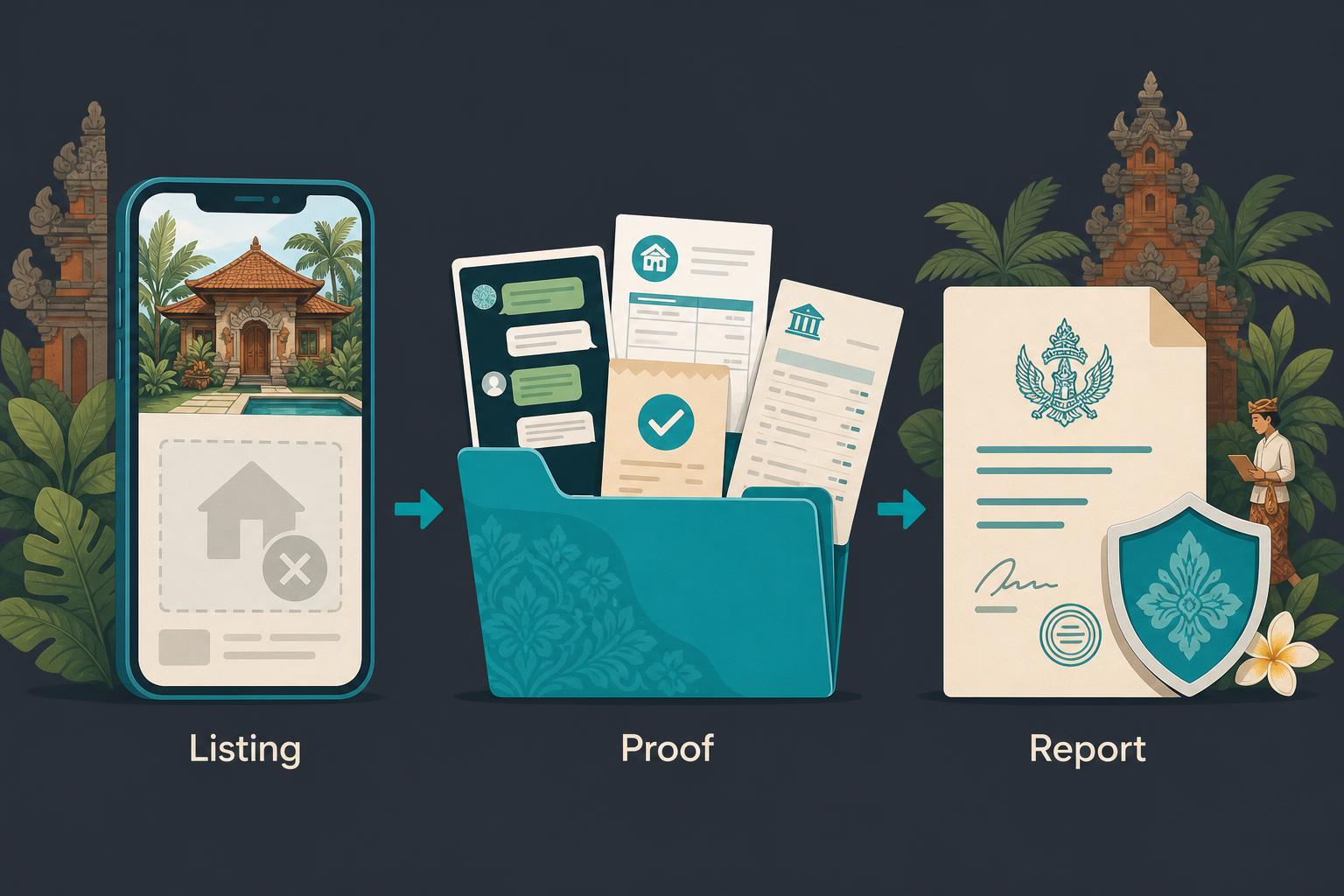
Act quickly, but do not erase the trail by deleting chats or repeatedly changing the story in messages. Preserve the material that can connect the listing, conversation, recipient account, and transfer.
Police guidance for online-fraud victims identifies screenshots, chat histories, invoices or listing material, bank-transfer evidence, and account mutations as relevant evidence for a police report. Make copies while the listing and profile are still visible, including URLs, usernames, phone numbers, dates, and the original advertised price.
Your immediate evidence pack should include:
- the full listing and every version or screenshot you can access;
- chat exports and screen recordings that show the account identity and timestamps;
- the proposed agreement, invoice, certificate images, and voice notes;
- bank-transfer receipts and account-mutation records;
- the property address and any viewing details;
- a simple timeline of what was promised, paid, and then changed.
Report the relevant channel as well as the transaction. Komdigi operates AduanNomor.id for phone-number misuse and AduanKonten.id for scam content on websites, platforms, or social media. Report immediately through the Indonesia Anti-Scam Centre for financial intervention, with supporting documents, and separately file a police report. Include your own and the recipient's account details and the transaction dates, times, and amounts. IASC seeks to secure remaining funds through rapid financial-sector coordination; reporting does not guarantee a refund. For a cybercrime report, use the official Patroli Siber route identified by Polri, not WhatsApp numbers claiming to be an official fraud-reporting service.
Do not pay a second “release fee,” “reversal charge,” or “police verification fee” to someone who says they can recover the money. Notification about recoverable funds comes officially from the bank or payment provider you used, not from IASC or the recipient's financial institution. Preserve evidence, use official reporting routes, and communicate with your bank through its legitimate channels.
The home seems legitimate, but the deal is still too vague to sign
Not every dangerous rental is a fake property. A real home can still produce a dispute when the agreement does not identify the parties, exact property, dates, rent, deposit, included services, repair responsibilities, house rules, and handover condition.
Before signing, make sure the deal answers practical questions that scams exploit later:
- Who gives you keys, and on what date?
- What condition should the home be in at handover?
- Which costs are included and which are billed separately?
- Who may enter for cleaning, maintenance, or viewings?
- What happens if the property cannot be handed over as agreed?
- What evidence will show that you paid and checked in?
Read the proposed terms slowly enough to compare them with the listing and chat. A legitimate rental should become clearer as you get closer to paying, not less clear. If the offer depends on ambiguity, it is not a bargain.
How to avoid Bali rental scams when booking through Livuma
- Compare the listing and terms. Search Livuma's live rental inventory and check photos, pricing, availability, minimum stay, house rules and booking conditions. Before committing, review the payment schedule, deposit rules, deadlines, cancellation terms and refund logic rather than accepting vague promises.
- Secure the request. Use a card reservation, with nothing charged yet, or an Indonesian bank-transfer prepayment held by the platform before the host sees it. Declined, withdrawn or expired requests receive an automatic full release or refund. The host answers within a limited window; approval charges the card reservation and confirms the booking.
- Use viewing and chat records. Where available for monthly or yearly rentals, “view property first” secures only a small deposit. After an in-person or virtual viewing, confirm by paying the rest in the app, with no deadline or automatic confirmation, or cancel for free for a full deposit release or refund. Keep arrangements in in-app chat.
- Keep the agreement and receipts. Hosts complete identity verification, legal details and bank-account setup before paid bookings. Guests complete identity verification before the agreement is issued; digital agreement details and receipts are generated for supported bookings.
- Confirm arrival or report a problem. Report a check-in problem in the app to hold the host's payout while it is resolved. Payout is released automatically about 24 hours after successful check-in, never while a reported problem is open.
Bottom line: the safest response to a Bali rental offer is not a single magic check. Verify the person, their authority, the actual property, the written terms, and the payment destination before money moves. If an advertiser will not support that basic process, keep looking.