

You arrive in Bali on a tourist visa, find a villa you love and pay a long lease before checking whether your stay status supports the life you are planning. Months later, an extension limit, employer requirement or tax-residence question turns what felt like a simple move into an expensive problem.
Last checked: November 10, 2026. Indonesian immigration categories, eligibility and fees can change. Before applying, check the live Directorate General of Immigration category page for your exact visa index, rather than relying on an agent’s shorthand or an old social-media post.
The first distinction is simple but essential: a visa can give you a right to enter and stay without giving you a general right to work locally, sell services in Indonesia, receive Indonesian wages or operate any business you choose. “KITAS” is also everyday shorthand, not one visa type: KITAS means Kartu Izin Tinggal Terbatas, the limited-stay permit card or document. The formal process distinguishes a limited-stay entry visa (VITAS) from the Limited Stay Permit (ITAS) issued on entry for relevant categories.
I only need a few weeks to decide whether Bali suits me
If you are eligible for Visa on Arrival, the B1 Visa on Arrival or e-VOA is the straightforward short reconnaissance option. It allows one entry and an initial stay of up to 30 days, with one extension only for a total maximum stay of 60 days. The official published initial fee remains Rp500,000; confirm the live application charge before paying. No sponsor is required.
It is suitable for tourism, family visits, transit, and attending meetings, incentives, conventions or exhibitions. It is not a lightweight residence permit. A B1 holder cannot sell goods or services or receive compensation, salary or wages for work or business from an Indonesian individual or corporation. Immigration describes changing B1-derived stay status through the bridging-visa mechanism.
Apply before arrival through the immigration e-visa system or designated e-VOA service if available to your nationality. Immigration requires a passport valid for at least six months and a return or onward ticket, subject to specified crew exceptions. The visa’s entry validity and your permitted period after arrival are different things, so check both dates carefully. See the official B1 Visa on Arrival requirements before booking travel.
For a short property-search trip, avoid treating the first attractive listing as a reason to pay immediately. Use the time to compare live Bali long-term rental listings, inspect the address and understand the proposed lease before committing beyond your permitted stay.
I need several months to search for a home, not just 30 days
The C1 tourist visa is usually the more logical visitor route for a person who needs a longer Bali reconnaissance period. It is single entry, gives an initial stay of up to 60 days and can be extended multiple times to a total maximum of 180 days. It can also be converted to an ITAS through an application process, not simply by renting accommodation.
The official initial fee is Rp1,000,000 for the 60-day visa; extensions are additional. Check the application invoice before paying. Sponsorship requirements depend on nationality and travel documents; confirm the requirements for your application with Immigration rather than assuming every applicant needs an agent or sponsor. The visa is valid for entry for 90 days after issue, which is not the same as its 60-day initial stay after arrival.
Immigration lists a passport valid for at least six months, a recent photograph and three months of bank statements showing at least US$2,000 or equivalent. Its listed processing benchmark is five working days after payment is received, but that is an administrative estimate rather than a guaranteed decision deadline.
C1 permits tourism, personal development, tourism-attraction study, cruises, MICE participation, business discussions, negotiations, agreement signing, site inspections and certain medical-related activities. It does not permit selling goods or services, receiving compensation or wages from Indonesian persons or corporations, or appearing as an event speaker. Review the official C1 tourist visa page before applying.
For a two-to-six-month search, C1 can give you time to look beyond one neighbourhood. It does not turn a housing search into permission to take Indonesian employment or bill Indonesian clients. Since May 29, 2025, stay-permit extensions, including VoA extensions, require an immigration-office visit for photographs and an interview; registration and document uploads begin online. See the official extension procedure before planning your appointment.
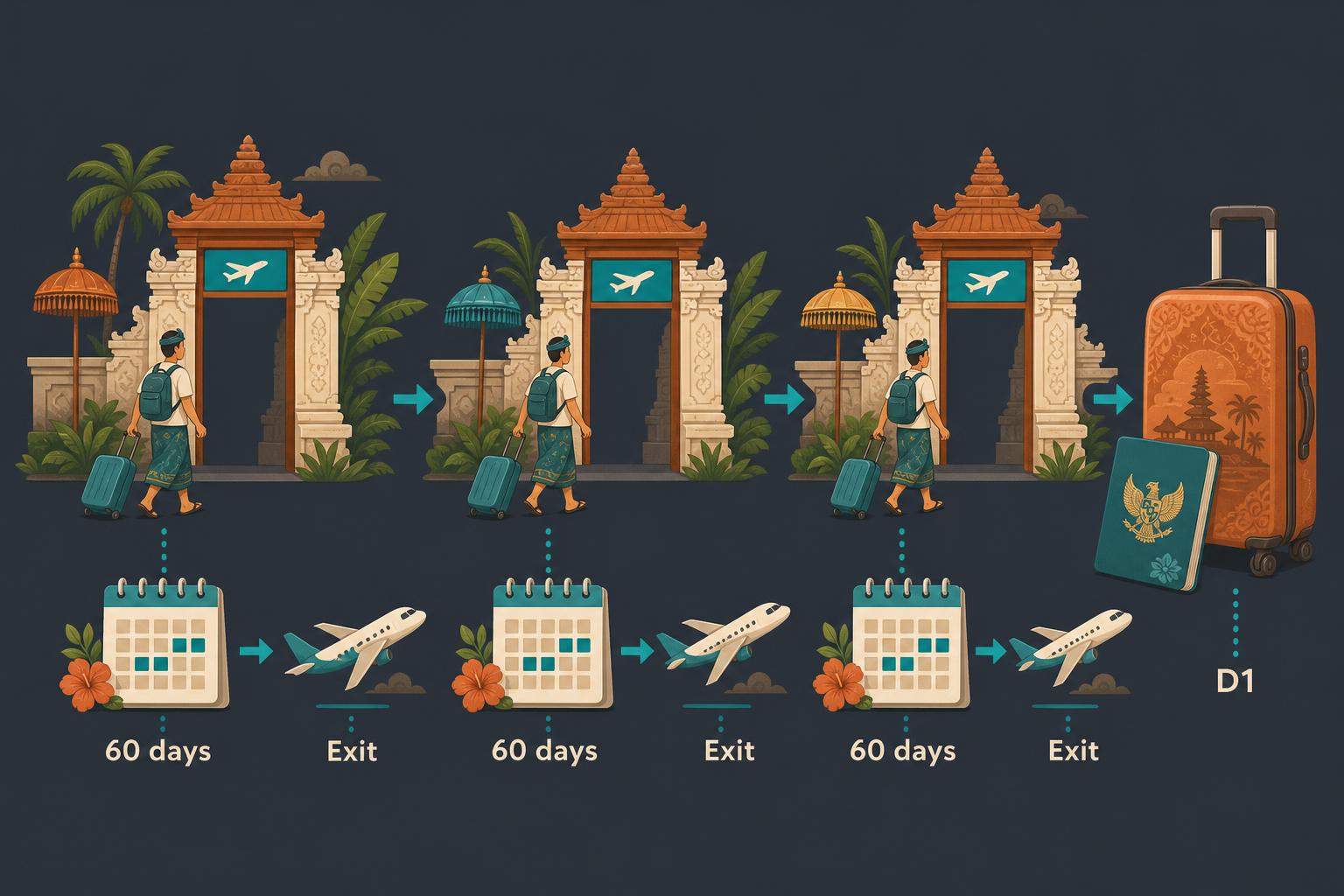
I keep leaving and returning, so surely a multi-entry visa makes me a resident
Frequent arrival stamps can look like a long-term lifestyle, but the D1 multiple-entry tourist visa remains a visitor route, not a residence route. It is available for one, two or five years. Each arrival allows up to 60 days and may be extended to a maximum of 180 days per arrival.
Confirm current D1 fees in the live application system before paying. A sponsor is generally not required, subject to exceptions for nationals of specified countries. D1 may be extended, but it cannot be converted to an ITAS.
That structure can suit a repeat visitor who genuinely travels in and out of Indonesia for tourism or visits. It does not establish a local-work route and does not permit selling goods or services or receiving pay, salary or similar consideration from Indonesian individuals or corporations. If your actual plan is to make Bali your base, identify the ITAS category that matches the reason you are staying rather than relying on repeated tourism entries. The official D1 visa information sets out the current entry and stay rules.
My overseas job pays me, so any Bali visa should let me work online
This is one of the most consequential assumptions a digital nomad can make. Overseas income does not automatically make every visitor visa appropriate for remote work from Bali. The status designed specifically for a qualifying foreign employee is the E33G remote-worker Golden Visa.
E33G permits its holder to live in Indonesia while carrying out duties for a company established outside Indonesia. It grants a one-year stay with multiple-entry permission, can be extended through online registration followed by the required immigration-office visit and may be converted to another stay permit. No sponsor is required, and the official listed total PNBP is Rp7,000,000 for one year.
Eligibility is specific. Immigration requires evidence of annual salary or income of at least US$60,000 and an employment contract with a company established outside Indonesia. Core documents include a passport valid for at least six months, photograph, CV, itinerary, three-month bank statement showing at least US$2,000 or equivalent, foreign-employer contract and income evidence.
The important limit is the job description: E33G authorizes work for the foreign company, not a blanket right to freelance for Indonesian clients, sell locally or run a Bali business. Immigration prohibits working for or receiving payment from Indonesian individuals or legal entities under this route. Its requirements do not clearly confirm eligibility for a self-employed freelancer with multiple clients, a sole proprietorship or no foreign-employer contract. That applicant should verify directly with Immigration before applying. Read the current E33G remote-worker visa criteria.
Also separate immigration from tax. A foreigner can become an Indonesian domestic tax subject by residing in Indonesia, being present for more than 183 days in any 12-month period, or being in Indonesia during a tax year with an intention to reside. The days do not need to be consecutive, and a fraction of a day counts as one day. Remote-work immigration permission does not decide your Indonesian tax treatment. Indonesia’s general income-tax scope includes Indonesian and foreign income; the four-tax-year Indonesian-source-only exception requires specified expertise and conditions, not merely a remote-worker or Golden Visa. Seek Indonesia-specific tax advice before assuming foreign income is outside the Indonesian tax net. See the tax authority’s tax-residence rules and foreign-income provisions.
An Indonesian company wants to hire me, but I already have a KITAS
A residence status is not necessarily work authorization for a particular Indonesian role. If an Indonesian hotel, startup, villa operator or other local employer is hiring you, the appropriate path is generally an employer-sponsored work ITAS, not B1, C1 or D1. Spouse-based residence has distinct work rights and employment requirements, discussed below.
Immigration classifies E23 and related subcategories as sponsored work visas. First ITAS periods may be 180 days, one year or two years, with extensions subject to an overall six-year cap. The Indonesian sponsor or employer must provide application and guarantee letters, and Immigration’s work-visa documentation also requires work authorization from the Ministry of Manpower.
In practical terms, do not accept a local job on the theory that a tourist visa or investor ITAS is “close enough.” The proposed role, sponsor, immigration category and manpower authorization need to align. Holding permission to reside, attend meetings or invest does not automatically authorize every job, local invoice or Indonesian-source wage.

I am married, retired or investing, so the word “Golden” must cover everything
Golden Visa is a programme label covering several separate categories, not one universal visa. The right category depends on why you are in Indonesia and what you will actually do.
I am married to an Indonesian citizen
E31A is the family route for a foreign husband or wife of an Indonesian citizen. It provides one- or two-year stays, is extendable and can be converted to another stay permit. Your Indonesian spouse sponsors the application through an e-visa account. Immigration lists the passport, bank statement showing at least US$2,000 or equivalent over three months, photograph, itinerary, CV and marriage documentation among the required documents.
Confirm current E31A fees in the live e-visa billing system. Crucially, Immigration Law Article 61 allows qualifying foreign spouses holding ITAS or ITAP to work and/or conduct business to support themselves and their families. Employment by a legal-entity employer requires approved RPTKA; Ministry of Manpower guidance distinguishes this from operating one’s own micro or small business. Confirm the requirements for your specific activity.
I am retiring in Bali
E33E is a five-year retiree Golden Visa for foreign nationals aged 55 or older under the May 2, 2025 visa-classification decision; confirm current age eligibility with Immigration before applying. Its listed official fee is Rp13,000,000, and extension registration begins online before the required immigration-office visit. Immigration requires proof of income or pension of at least US$3,000 per month and a commitment to deposit US$50,000 in the applicant’s own account at an Indonesian state-owned bank within 90 days of ITAS issuance. See the official retirement financial requirements.
It allows residence, tourism, visits with friends or family, business meetings, shopping and checking goods at offices, factories or production sites. It is not authorization to take local employment or actively operate a local business beyond those listed business-visit activities.
I am investing in an Indonesian company
E28A is the conventional investor ITAS for investment, business or company-establishment activity, and for acting as a director or commissioner in the company where you invest. It is available for one year at Rp7,000,000 or two years at Rp9,500,000. A sponsor is required, and extension registration is made online by the sponsor before the required immigration-office visit.
There is a major role restriction: E28A requires at least Rp10 billion in shares in the sponsoring company, not a villa purchase of that value. If your shareholding is below that threshold and you hold a director or commissioner role, Immigration says you must apply for a work visa matching that position. Company formation, OSS licensing and sector-specific permissions remain separate from the immigration route. The official E28A investor ITAS page should be checked alongside professional corporate advice.
For higher-value Golden Visa investor options, official materials list five- and ten-year investor stays. Individual E28C thresholds without company establishment include US$350,000 for a five-year stay in qualifying Indonesian government bonds, Indonesian public-company shares or mutual funds, and US$700,000 for ten years. These are investment commitments, not visa fees. Confirm directly with Immigration whether an apartment or flat purchase alternative is currently available under E28C before relying on it; an ordinary villa lease is not an established qualifying investment. The separate five-year Second Home E33 route lists either US$130,000 in an account in the applicant’s own name at a state-owned bank or a qualifying Indonesian apartment or flat worth at least US$1,000,000; an ordinary villa lease does not automatically qualify. E28B company-establishment materials list investment commitments of at least US$2.5 million for five years or US$5 million for ten years. Applicable Golden Visa commitments must be fulfilled within 90 days after ITAS issuance; non-fulfilment can cause cancellation of stay and re-entry permissions. Official E28B/E28C application fees are Rp13,000,000 for five years or Rp19,500,000 for ten years, separate from investment capital. These long stays still do not automatically authorize every local work role. Use the official Golden Visa handbook to identify the precise index.
I signed a long lease, so immigration and tax can wait
A long lease is a housing agreement, not immigration permission. It can, however, matter to your wider residency picture. The tax authority identifies a VITAS or ITAS valid for more than 183 days and a residential lease exceeding 183 days as documents that may evidence an intention to reside. That does not decide an individual tax outcome by itself, but it is a reason to plan visa, tax and lease timing together.
For a practical housing search, compare the tenancy length and payment schedule with the remaining validity of your current status.
For lower-commitment accommodation while your status is being settled, compare available kost rooms in Ubud or other monthly rental options rather than forcing a long lease too early. On supported Livuma rental bookings, payment and cancellation terms are shown before you commit, and host payout is not released until successful check-in under the booking terms. That helps keep the rental record clear; it does not replace immigration or tax advice.
If you are considering a property purchase, do not assume ownership gives you permission to reside. Indonesian citizens alone can hold Hak Milik freehold. Foreign residential ownership has separate immigration-document conditions and may use qualifying Hak Pakai or apartment-unit forms. Qualifying purchases can use immigration documents such as a visa, passport or stay permit; KITAS or KITAP is not universally mandatory. Title, zoning, building approvals, company ownership and rental licensing all need their own due diligence; browse Bali properties for sale only after understanding that a property transaction and a residence status are separate questions.
Which Bali stay status matches my real plan?
| Your situation | Most relevant route | Why it fits | Do not assume |
|---|---|---|---|
| Eligible visitor testing Bali for up to 60 days | B1 VoA/e-VOA | One entry, up to 30 days plus one extension | That it permits Indonesian-source work or indefinite residence |
| Looking for a home for two to six months | C1 tourist visa | Up to 180 days through extensions; can convert to ITAS | That business discussions authorize local paid work |
| Frequent tourism travel with repeated departures | D1 multiple-entry tourist visa | Multiple entries over one, two or five years | That D1 creates residency or can convert to ITAS |
| Salaried employee of a foreign company | E33G remote-worker Golden Visa | One-year stay for qualifying foreign employment | That it covers Indonesian clients or a local business |
| Hired by an Indonesian employer | Employer-sponsored work ITAS | Designed for a sponsored local role | That another KITAS automatically covers the job |
| Married to an Indonesian citizen | E31A spouse ITAS | Family residence route with Article 61 work and business rights | That employment by a legal-entity employer needs no approved RPTKA |
| Retiring at age 55 or older | E33E retiree Golden Visa | Five-year retiree stay with income and deposit requirements | That retirement status permits local employment |
| Establishing or overseeing an Indonesian investment | E28A or qualifying investor Golden Visa | Investment-focused categories and longer-stay options | That investor status covers every director or employee role |
The best answer is not the longest visa or the one with the most attractive name. It is the category whose permitted activity matches your actual source of income, employer, family relationship, investment and expected time in Bali. Confirm the exact index, documents and billing on the official e-visa system before submitting an application.