

This is for Indonesians, foreign residents and overseas buyers trying to understand what a Bali property listing really offers before treating it as an ownership opportunity. It explains the registered rights and contracts you may encounter, but a specific transaction still needs review by an independent Bali-based PPAT/notary and separate legal adviser.
What does an Indonesian property title actually tell a Bali buyer?
An Indonesian property title tells you what registered right exists over a particular plot or unit, who holds it and, for time-limited rights, how long it lasts; it does not simply mean “ownership” in the broad marketing sense. Indonesia’s land-rights framework begins with the Basic Agrarian Law, Law No. 5 of 1960, and current rules for major registered rights include Government Regulation No. 18 of 2021.
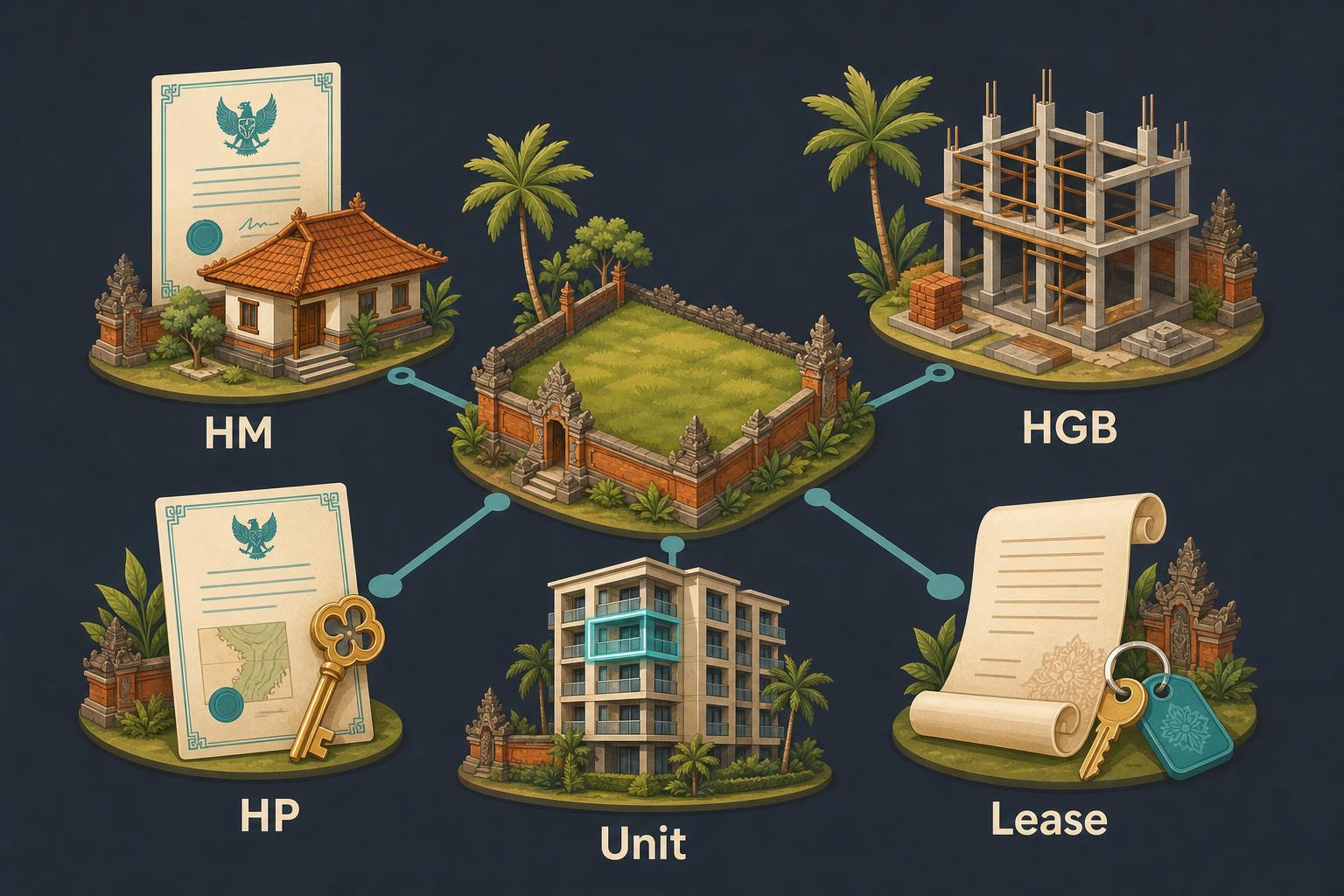
For a Bali buyer, the essential distinction is between a right over land, a right to use land, a right to build on land, ownership of an apartment unit, and a private contract to lease. A villa may be advertised as “freehold,” “foreign ownership,” or “80 years,” yet those phrases do not identify the certificate, holder or contractual terms that decide the legal position.
- Registered right: for example Hak Milik, HGB, Hak Pakai or a strata-unit right.
- Registered holder: the person or Indonesian legal entity named in the land records.
- Land basis and term: especially important for HGB and Hak Pakai.
- Recorded burdens: mortgages, agreements or other encumbrances that need checking.
- Permitted use and documents: separate questions from the title label itself.
Land registration is important because registration of Hak Milik and its transfers or encumbrances serves as strong evidence. Read the underlying documents, not the sales headline, against the Basic Agrarian Law text.
Can a foreigner buy property in Bali under Indonesian law?
A foreigner cannot personally hold Hak Milik land or personally hold HGB, but may be eligible for particular residential rights such as Hak Pakai or a qualifying strata-title unit. The route depends on the buyer, the property type, the registered right and the intended residential use; it is not a universal permission to buy any Bali villa or plot.
For an individual foreigner, PP No. 18 of 2021 requires an immigration document under Indonesian immigration rules for residential ownership. Its explanation indicates that a visa, passport or stay permit can meet that document requirement. Foreign residential ownership is also subject to limits on minimum price, land area, number of parcels or units, and residential use.
In Bali, the ATR/BPN-listed minimum price for a foreigner’s landed house is Rp5 billion, while the minimum for a condominium or apartment unit is Rp2 billion. These figures are part of the foreign-residence framework, not a statement that every property at or above those prices is automatically available to a foreign purchaser.
A buyer comparing routes should first decide whether the goal is a personal residence, an apartment unit, a company-held asset or a fixed-term lease. For the practical purchase sequence beyond title type, see how to buy a house in Bali as a foreigner, then take the proposed structure to independent advisers before paying any deposit.
What is Hak Milik, and why is it called freehold?
Hak Milik, usually shortened to HM, is the strongest and fullest hereditary right an individual can hold over land, and it may be transferred. That is why Bali marketing commonly calls it “freehold,” but the label must never obscure who is legally eligible to hold it.
As of 11 November 2026, Hak Milik may be held by Indonesian citizens and only specifically government-designated Indonesian legal entities. A foreign individual cannot hold Hak Milik land. An Indonesian buyer may therefore encounter a genuine HM certificate when purchasing land or a house, while a foreign buyer must not assume that a property’s “freehold villa” description gives them a personal right to become the certificate holder.
There are also consequences if eligibility changes. A foreigner receiving HM through intestate inheritance, or an Indonesian citizen who loses Indonesian citizenship, must release the right within one year. Otherwise, the right lapses by law and the land reverts to the State, subject to existing third-party rights.
Ask to see the certificate and establish the registered holder before valuing the property. A building, furniture package, management arrangement or polished villa brochure does not convert an HM plot into a foreign-held title. The legal character of the land right remains the starting point for every later question about transfer, financing, construction and exit.
How is HGB different from Hak Milik in Bali?
Hak Guna Bangunan, or HGB, is a right to construct and own buildings on land that is not the holder’s own land; it is not land freehold. An Indonesian citizen or an Indonesian-incorporated, Indonesia-domiciled legal entity may hold HGB, while a foreign individual is not an eligible HGB holder.
The duration depends on the land beneath it. HGB can be granted over State land, Hak Pengelolaan (HPL) land or Hak Milik land. The commonly repeated “80 years” describes maximum stages available for HGB on State or HPL land, but it is not an automatic, prepaid period of ownership. Grant, extension and renewal are separate stages.
| Right and land basis | Initial period | Later stages |
|---|---|---|
| HGB on State or HPL land | Up to 30 years | Extension up to 20 years, then renewal up to 30 years |
| HGB on Hak Milik land | Up to 30 years | Renewal through a new HGB-grant deed over the HM land |
| Hak Pakai on State or HPL land | Up to 30 years | Extension up to 20 years, then renewal up to 30 years |
| Hak Pakai on Hak Milik land | Up to 30 years | Renewal through a new HP-grant deed over the HM land |
Expiry outcomes also vary: HGB over HM returns to the HM holder; HGB over HPL returns to the HPL holder; and subsequent allocation of expired HGB on State land falls under the Minister’s authority. A buyer needs the land basis and remaining term, not merely an advertised total duration. These rules are set out in PP No. 18 of 2021.
Can a PT PMA hold HGB for a Bali property?
An Indonesian-incorporated, Indonesia-domiciled company can be an HGB holder if it meets the statutory eligibility rule, but that is different from a foreign individual personally owning HGB. A PT PMA is a company structure, so the legal holder is the Indonesian company named on the certificate, not its shareholder as an individual.
This distinction matters whenever an agent describes a property as “PT PMA title” or says a foreign buyer can “own HGB through a company.” Those phrases leave several vital questions unanswered:
- Is the company properly established under Indonesian law and domiciled in Indonesia?
- Does the company itself hold the relevant HGB certificate?
- Is the HGB over State land, HPL land or Hak Milik land?
- How much of the current HGB period remains, and what renewal route applies?
- Are there mortgages, recorded agreements or restrictions affecting the asset?
Company ownership also does not make title verification optional. The certificate holder, corporate authority, underlying land basis, approved use and transaction documents still need independent review. Do not reduce a company-held asset to a claim that “foreigners can own freehold through a PT PMA”; that phrase is legally imprecise and can hide the actual right being acquired.
When you are ready to compare sale opportunities, use Bali properties for sale as a starting point for discovery, then request the title information necessary for professional diligence rather than relying on a listing category alone.
What is Hak Pakai, and when can a foreigner use it for a Bali home?
Hak Pakai, or HP, is a right to use and/or take benefits from State land or another party’s land, with its content set by the grant decision or agreement. It is distinct from a lease agreement, and it is the principal registered route discussed for a foreigner’s qualifying landed residence.
Time-limited HP may be granted to Indonesians, Indonesian legal entities, foreign legal entities with Indonesian representation, religious or social bodies, and foreigners. For a foreigner’s landed residence, PP No. 18 of 2021 permits Hak Pakai, including HP created over Hak Milik through a PPAT deed or over HPL through a land-utilisation agreement with the HPL holder.
That does not make HP an unrestricted route to investment land or multiple villas. Foreign residential ownership remains subject to the immigration-document requirement, minimum price, land-area limit, number-of-parcels or units limit and residential-use requirement. The Bali price thresholds listed by ATR/BPN are Rp5 billion for a landed house and Rp2 billion for a condominium or apartment unit.
Ask whether the proposed HP is already registered, what land it sits over, how long remains, and whether the property fits the residential conditions that apply to the intended holder. A foreigner should also distinguish an actual HP proposal from a developer’s informal promise that a future “conversion” will be possible.
Can a foreigner own a Bali apartment with strata title?
A foreigner with the requisite immigration document—a visa, passport or stay permit—may hold Hak Milik atas Satuan Rumah Susun, commonly called HMSRS or SHM Sarusun, for a qualifying residential unit. This is ownership of an individual apartment or condominium unit; the treatment of shared parts, shared objects and shared land depends on the underlying land right.
It is therefore wrong to equate a foreigner’s strata title with direct foreign Hak Milik ownership of the underlying plot. The foreign holder has a registered right to the individual unit, and for units over HGB, the proportional common ownership excludes common land, as specified in Article 188 of Permen ATR/BPN No. 18 of 2021.
PP No. 18 of 2021 describes foreign residential units in buildings standing on HP or HGB over State, HPL or HM land. Its explanation specifically describes units built on HP or HGB in special economic zones, free-trade or free-port zones, industrial zones and other economic areas, including tourism or urban-support areas.
For diligence, request more than a unit brochure. An SHM Sarusun application requires, at minimum, an approved deed of separation or pertelaan, the certificate for common land, a PBG, a certificate of building worthiness (SLF), and developer identity. These documentary requirements are set out in PP No. 13 of 2021. Your adviser should examine the actual project documents and the right beneath the building, not just the phrase “strata title.”
What does “leasehold villa” mean in Bali?
“Leasehold villa” usually describes a contractual lease, not automatically a separate registered title equivalent to Hak Milik, HGB or Hak Pakai. It may involve the statutory Hak Sewa untuk Bangunan, the right to use another party’s land for a building in return for rent, but the actual agreement is decisive.
Indonesian citizens, foreigners domiciled in Indonesia, Indonesian legal entities, and foreign legal entities with Indonesian representation may be holders of Hak Sewa untuk Bangunan under UUPA. Rent may be paid once or periodically, before or after use. Crucially, UUPA does not prescribe a standard 25-, 30- or 50-year Bali villa lease term.
That means an “80-year lease” marketing claim must be unpacked. It may refer to an initial period plus options, a series of agreements, or another proposed arrangement. Before treating it as an asset, read the signed contract for:
- the precise land and building being leased;
- start and end dates, plus the trigger and price for any extension;
- assignment, sale, sublease and mortgage rights, if any;
- rent escalation, taxes and payments due before renewal;
- who owns improvements and what must be handed back at expiry;
- default, termination, dispute and notice provisions.
Interested parties may apply to have a lease over registered land noted at the Land Office, in the land register and/or on the certificate. That mechanism is available, but do not assume every marketed lease has been noted. For a renter’s separate contract checks, read what to check before signing a Bali rental contract.
Why is using an Indonesian nominee for Hak Milik so risky?
A nominee arrangement does not make a foreign buyer the registered Hak Milik owner and carries a direct statutory risk under Article 26(2) of UUPA. If a transaction or act is intended to transfer Hak Milik directly or indirectly to a foreigner, it is void by law; the land falls to the State and payments already received by the seller cannot be reclaimed.
The common pattern is a foreign buyer funding the purchase while an Indonesian friend, partner, employee or “nominee” becomes the registered HM holder. Side agreements may attempt to allocate control, economic benefit or future transfer rights. They do not change the central fact that the Indonesian name on the certificate is the registered HM holder, and they cannot remove the Article 26(2) risk described in the law.
This is not merely an argument about trust between partners. It is a title and enforceability problem. A falling-out, death, family dispute, creditor issue or attempted sale can expose the gap between a private arrangement and the land register; the statutory prohibition adds a more fundamental risk.
If a proposed deal requires a nominee to achieve “freehold for foreigners,” pause rather than treating the extra documents as protection. Ask an independent legal adviser to explain the registered right, the eligible holder and lawful alternatives for your actual purpose. Never treat a nominee package as equivalent to personal foreign Hak Milik ownership.

How can I tell whether a Bali listing’s ownership claim is real?
Test a Bali listing by replacing its marketing language with document questions: what is the registered right, who is the registered holder, what is the remaining term, what land is it based on, and what agreements or encumbrances appear in the records? “Freehold,” “ownership,” “title conversion,” “foreign ownership,” “PT PMA title” and “leasehold” are starting prompts, not legal answers.
Before a transfer or encumbrance deed is prepared, ATR/BPN guidance requires a PPAT to check the original land or strata certificate against Land Office records to confirm consistency of physical and juridical data. The guidance is a reason to insist on a proper certificate check, not a reason to accept a scan, a screenshot or an agent’s summary as conclusive evidence. From 2 February 2026, old written evidence of customary land ownership serves only as guidance for registration, not proof of a land right, under Article 96 of PP No. 18 of 2021.
Ask your independent PPAT/notary and legal adviser to verify:
- the original certificate and Land Office record;
- the seller’s or lessor’s identity and authority to sign;
- the registered right, land basis, expiry date and renewal documents;
- mortgages, encumbrances and recorded lease agreements;
- zoning or use approvals, building approvals and access;
- the exact lease, HGB, HP or strata documentation being transferred or granted.
The PPAT certificate-check requirement is explained in ATR/BPN guidance. A promising villa, plot or apartment may still be unsuitable if the documents do not match the commercial story.
What should I check before paying a deposit for a Bali property?
Before paying a deposit, appoint an independent Bali-based PPAT/notary and a separate legal adviser, then make the payment conditional on the documents and authority they need to verify. Deposits are often paid while the listing narrative is still doing too much work; reverse that order by verifying the underlying right and deal structure first.
For a purchase, establish whether you are acquiring HM, HGB, HP, a strata unit or a company interest, and whether you are legally eligible for that route. For a lease, identify the lessor, term, renewal mechanism, transfer or sublease rights, payment milestones, construction ownership and hand-back obligations. In either case, do not rely on a promise that a title will later be converted or regularised.
If you are deciding that buying is premature, a long-term rental can give you time to learn an area and property type without treating a lease as a substitute for title. You can search Bali long-term rentals on Livuma by area, rental type, stay length, price and amenities. For supported rental bookings, the booking-specific payment schedule, deposit or balance rules, deadlines and cancellation logic are shown before payment; that is useful for rental clarity, but it does not replace property-sale diligence.
Keep every version of the offer, certificate copy, due-diligence request, receipt and executed agreement. A clear paper trail helps your advisers identify whether the final documents actually match what was proposed. For supported rental bookings, Livuma generates digital rental agreement details and receipts from the listing, booking terms and verified guest details so both sides hold a record; this does not apply to property sales.
Which Indonesian property right fits a Bali buyer’s situation?
The right that fits depends on who the buyer is and what they are genuinely acquiring, not on which label sounds most permanent. An Indonesian citizen considering land or a house may encounter Hak Milik; an eligible Indonesian company may hold HGB; an eligible foreign resident may consider qualifying Hak Pakai or a strata unit; and a foreigner domiciled in Indonesia may consider a properly drafted lease.
A simple decision sequence is more reliable than choosing by marketing:
- Define whether the goal is a residence, apartment unit, business asset or fixed-term occupation.
- Identify the buyer or holder: Indonesian individual, Indonesian legal entity, foreign individual or foreign legal entity with Indonesian representation.
- Match that holder to the statutory eligibility of the proposed right.
- Confirm the land basis, remaining term, renewal mechanism and documents.
- Verify the seller or lessor’s authority, encumbrances, use approvals and access independently.
There is no single “best title” detached from those facts. Hak Milik is strongest and fullest for an eligible holder, but it is not personally available to a foreign individual. HGB and Hak Pakai have different land bases and term mechanics. A lease is only as strong as its agreement and the lessor’s authority. Make the registered documents—not the headline—the basis for your decision.