

Electronic land-registration documents have been governed nationally since 20 June 2023, and all Indonesian land offices can now issue electronic certificates. Bali land offices are also part of a newer integrated-transfer rollout that can make digital record checks more visible in a purchase timeline.
What changed in Bali land transfers in August and September 2026?
The important verified change is not a new Bali-only rule that suddenly converted every certificate into an electronic certificate. Permen ATR/BPN No. 3/2023, the regulation governing electronic documents in land-registration activities, has applied nationally since 20 June 2023 and remains the operative rule as of 9 November 2026.
In its 25 October 2026 update, ATR/BPN confirmed that all Indonesian land offices can issue electronic certificates and reported 9,774,933 issued nationally, including new registrations and conversions from paper certificates. This is not a Bali-specific total, and nationwide electronic-certificate availability is separate from participation in PERINTIS.
What is new is the transfer-processing initiative known as PERINTIS 10 Hari. Kepmen ATR/BPN No. 1803/SK-HR.01/VIII/2026 was issued on 12 August 2026 and is in force. The programme initially operated at 17 land offices from 17 August 2026. Reported pilot locations included Badung and Buleleng Regency land offices.
PERINTIS is designed to join up the stages of a rights transfer rather than treating each office as a separate queue. Its advertised target is 10 days across the transaction chain:
- Up to 3 days for BPHTB verification;
- Up to 2 days for deed preparation; and
- Up to 5 days for registration of the transfer at the land office.
That is a coordinated target involving local revenue agencies, PPATs and ATR/BPN; it is not a promise that the land office alone will finish every case in 10 days. Buleleng's revenue agency reported on 7 September 2026 that it had discussed updating its host-to-host system to support integrated transfer processing and data exchange; the announcement did not establish a completed implementation date.
For someone buying a villa, land parcel or apartment interest in Bali, the practical message is simple: ask early how the PPAT will check the land-office record and whether the transaction is being handled through the relevant integrated process. Do not assume that a scanned certificate shared over chat is the final answer.
What electronic certificate checking actually compares before an AJB
An electronic certificate check is a comparison between the certificate's physical and juridical data and the land-office database. It is not merely an upload of a certificate image, and it does not replace professional examination of the transaction. Under Article 21 of Permen ATR/BPN No. 3/2023, the database is authoritative if its data differs from a certificate printout.
Before making a deed for a transfer or encumbrance of land rights or apartment ownership, a PPAT must examine whether the certificate conforms with the land-office registers. The electronic-check guidance makes this a concrete data-matching exercise, not a box to tick after money has changed hands.
For a PPAT-submitted electronic check, the technical guidance calls for location and right-number data, together with validation data such as the NIB, certificate serial number or survey-letter number. It also requires scans of the original certificate, the owner's NIK and relevant authority documents. For electronic certificates, ATR/BPN's May 2026 guidance says PPATs preparing sale deeds must scan the certificate through Sentuh Tanahku and reconcile digital parcel and ownership information with the printed document; the verification secret code is available in the digital certificate, not on the printout.
In practical terms, a buyer should expect the file to connect four things that are often treated separately in informal Bali deals:
- The registered parcel: the applicable identifier—separate parcel and rights numbers on older analog certificates, or the single 14-digit NIB-El on electronic certificates—plus survey or measurement data, location, boundaries and land area.
- The certificate: the original certificate and its identifying details.
- The registered holder: holder name and NIK, checked against the seller's identity.
- The transaction paperwork: the details carried into the AJB and supporting documents.
A mismatch is not something to explain away verbally. Pause and ask the PPAT what the record shows, what document is inconsistent and what must be corrected before the deed is prepared. Discrepancies must be referred back for examination against the land book and electronic records, not accepted solely on the seller's explanation. The digital workflow is useful precisely because it makes discrepancies easier to identify; it does not make a discrepancy harmless.
For a broader explanation of the rights that can appear behind a Bali property listing, read these Indonesian property-title questions answered for Bali buyers. The certificate-checking process confirms record consistency; the underlying right still determines what is being acquired.
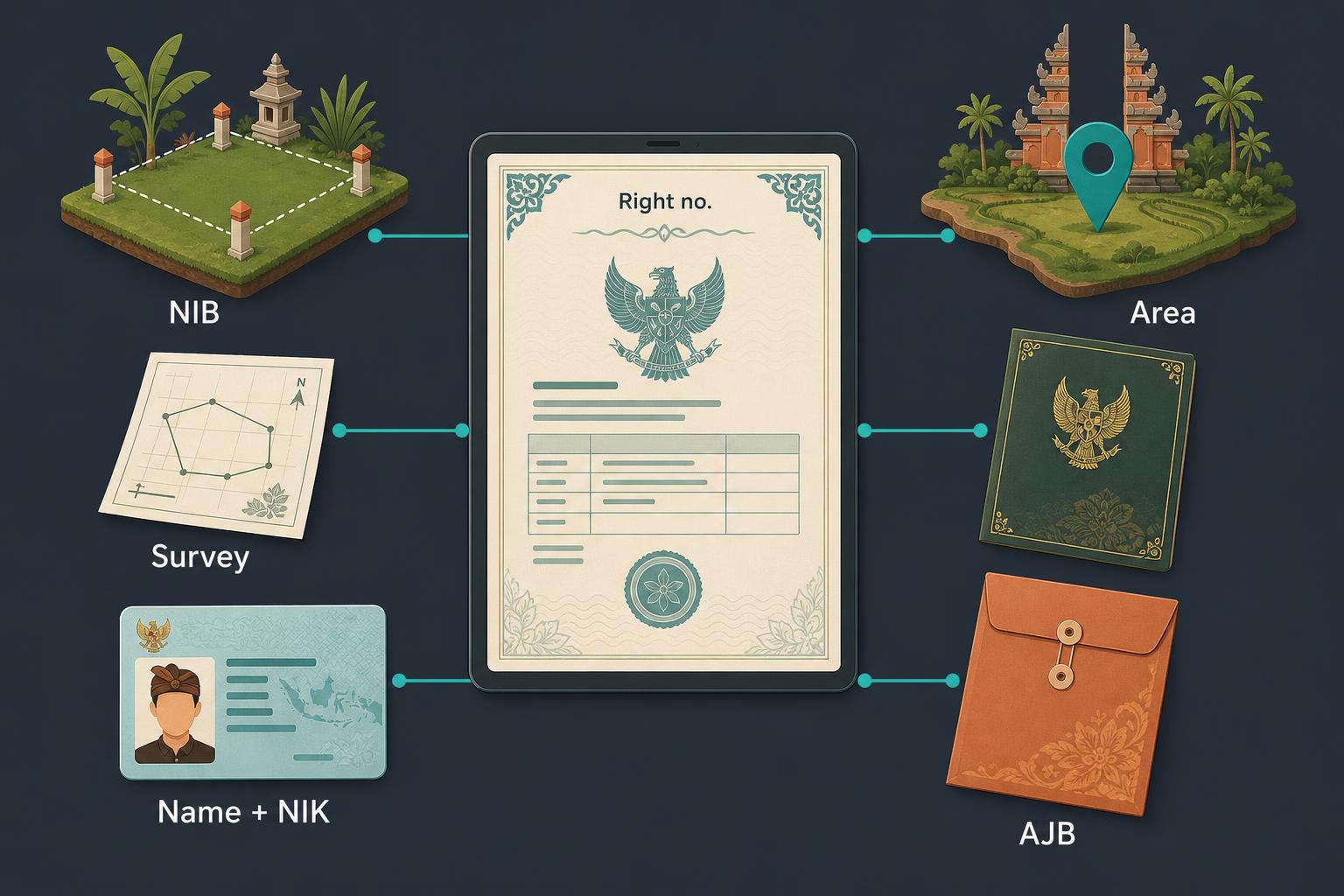
Which certificate and parcel details should a Bali buyer reconcile?
Before signing an AJB, reconcile the same details across the certificate, BPN records, seller identity and transaction documents. Do this before treating an asking price, handover date or deposit arrangement as settled.
- Right number and certificate details: for older analog certificates, confirm that the right number, certificate serial number and original certificate belong together; for electronic certificates, confirm the NIB-El and current certificate edition against the digital record.
- NIB and survey reference: ask the PPAT to use the applicable NIB or NIB-El and the available survey-letter or measurement data in the electronic check. ATR/BPN describes NIB-El as a single 14-digit identifier encoding province, regency/city, parcel number and parcel-location index.
- Location, area and boundaries: compare the registered parcel data with the site being shown to you. A beautiful building, access road or marketing pin does not itself prove the dimensions of the registered parcel.
- Holder identity: compare the certificate holder name and NIK with the seller's identity documents. Where someone signs under authority, make sure the authority documents are included in the review.
- AJB and supporting records: make sure the final transaction documents use the same parcel and holder information that has been checked. The formal check should also cover encumbrances and blocking or seizure annotations; a current electronic-certificate edition alone does not establish clean title because certain annotations can be recorded without a new edition.
This is especially important where a buyer has visited a finished villa but has not yet seen the original certificate or where land and building are being discussed as though they were automatically one legal object. Ask for a written explanation from the PPAT when the description, parcel data or signing party changes during the deal.
A current Denpasar Land Office transfer-by-sale form still lists the original certificate, AJB, current-year PBB document and BPHTB payment proof among its submission documents. Electronic processing has therefore not made the conventional transaction inputs irrelevant; it has added a stronger reason for them to agree with the records.
If you are at the earlier comparison stage, keep sales claims separate from verified documents. You can browse Bali properties for sale, but treat each listing as the start of due diligence, not as evidence of title, boundaries or a seller's authority to transfer.
How electronic checks affect buyers, sellers and lease parties in Bali
Buyers of registered land rights or apartment ownership
Buyers should build the electronic title check into the period before the AJB is made. The key risk is not that a certificate is electronic; it is that a buyer mistakes a document image, a broker's assurance or a familiar villa address for a completed land-office verification.
Foreign buyers should be particularly careful not to infer a new ownership route from a new digital process. Article 21 of the Basic Agrarian Law reserves Hak Milik to Indonesian citizens. A foreigner domiciled in Indonesia may hold Hak Pakai, but electronic certificates do not broaden that substantive entitlement. For a foreign individual or foreign legal entity changing an existing right, Permen ATR/BPN No. 18/2021 permits conversion of Hak Milik or HGB into Hak Pakai; it does not allow the foreign applicant to receive Hak Milik.
Residential ownership involving foreigners also remains subject to statutory restrictions, including limits connected to price, land area, parcel or unit numbers and residential use. A faster or more connected transfer workflow does not remove those restrictions. For a transaction-by-transaction overview of the purchase route, see how to buy a house in Bali as a foreigner.
Sellers and property owners
Sellers should reconcile paper and digital records before marketing a sale or commencing an AJB process. In particular, ensure that the original certificate, holder identity, NIK, parcel location, boundaries, area, applicable NIB or NIB-El and survey information can be consistently presented to the PPAT. Waiting until a buyer has arranged funds is the worst time to discover that a record needs attention.
For rental hosts, this is also a sensible record-management prompt. A lease is not automatically a transfer of a BPN-registered land right. The Basic Agrarian Law treats Hak Pakai as distinct from a lease agreement, so a Bali “leasehold sale” may concern contractual rights rather than an AJB-backed transfer of registered title. Describe the transaction accurately and obtain transaction-specific advice rather than relabelling a lease assignment as a land-rights transfer.
Hosts offering residential rentals can keep the commercial arrangement separate from land-title claims by setting out who is authorised to lease, the property identity and the term clearly. On Livuma, hosts must activate their account with identity verification, legal details and an Indonesian bank account before accepting paid bookings; for supported rental bookings, the platform also generates digital agreement details and receipts.

What should parties do now if PERINTIS applies to their Bali transaction?
Start with the relevant Kantor Pertanahan and PPAT rather than assuming that every Bali regency has the same operational status. PERINTIS expanded to 95 land offices from 24 September 2026, with Denpasar City, Tabanan, Jembrana and Gianyar joining as second-stage Bali offices alongside earlier Badung and Buleleng pilots. ATR/BPN reported 131 participating land offices nationwide on 13 October 2026. Confirm with Kanwil BPN Bali or the relevant land office whether the programme applies to your particular transaction.
Use this short pre-signing sequence:
- Ask the PPAT whether the relevant land office is handling the matter through PERINTIS and what documents are needed for the electronic check.
- Provide original and identity documents early enough for the PPAT to compare the certificate with the land-office database.
- Ask the PPAT to identify any mismatch in parcel, holder or authority data before the AJB is drafted for signature.
- Confirm the BPHTB, deed-preparation and registration steps separately, even if the transaction is expected to follow the 10-day target.
- Keep copies of every submitted and signed document, plus written confirmation of the stage reached.
Do not compress a transaction schedule just because “10 Hari” appears in a discussion. The advertised allocation is three days, two days and five days across different participants. A case that needs records reconciled first is not made ready by the target alone.
What is still uncertain about Bali electronic certificates and PERINTIS?
There is no verified official source for a September 2026 Bali-only legal switch requiring electronic certificates for every new registration, transfer or record update. However, ATR/BPN's national guidance identifies ownership transfers, subdivision, mortgage registration and mortgage discharge among the services that trigger conversion from paper to electronic certificates. Existing paper certificates remain legally valid, and owners face no sanction merely for not converting them. ATR/BPN held a public consultation on a draft amendment to Permen 3/2023 that closed on 21 May 2026, but Permen 3/2023 remains the rule in force.
There is also a meaningful difference between a reported pilot or expansion location and confirmation that a particular case is being processed through the programme. Buyers and sellers should verify the status with the land office that has jurisdiction over the parcel, not with a marketing agent or an online post.
Finally, a reported 10-day objective is not enough information to predict the timing of a specific transaction. It does not reveal whether the documents are complete, whether the parcel and holder data agree, or whether local tax processing, PPAT deed preparation and land-office registration will proceed without queries.
What has not changed under Bali's electronic land-registration process
Electronic land-registration tools have not changed the basic legal nature of Indonesian land rights, foreign eligibility or the need for PPAT-led verification before a transfer deed is made. Hak Milik has not become available to foreigners because a certificate can be checked electronically.
They have not made original certificates, AJBs, current-year PBB documents or BPHTB payment proof obsolete in a sale submission. They have not turned a lease assignment into a registered land-rights transfer. And they have not replaced careful checking of the parcel, the registered holder and the authority of the person signing.
The real change is operational: digital record comparison and integrated handling are becoming more central to how a transfer is prepared and tracked. Treat that as a reason to organise documents earlier and verify data more closely—not as a shortcut around due diligence.