

57.9 million litres of petrol were scheduled for Bali—but that did not mean petrol stations had already received it. Pertamina’s 15 October 2026 announcement covered phased arrivals through 14–17 October. By 2 November, police and Pertamina inspections found normal queues and adequate supplies at four sampled stations, not every station in Bali. For residents deciding whether to commute, organise a school run or move house, that distinction matters more than the headline volume.
Queues were already being reported by 8 October, before AP reported on 14 October that queues had persisted since 11 October, with vehicles spilling onto roads and some stations closed while awaiting deliveries. Officials attributed the disruption to domestic delivery problems rather than exhausted fuel stocks.
As of the 7 November 2026 research check, the latest verified station checks were the 2 November police and Pertamina inspections of four stations in Badung, Tabanan, Gianyar and Denpasar, which found normal queues and adequate supplies. This was not an inspection of every station in Bali. The practical response is to check before travelling, leave flexibility around essential journeys and distinguish a delivery announcement from confirmed availability at your local pump.
Queues reported by 8 October show why a normal journey needs a fresh check
8 October already saw reports of queues, according to ANTARA’s reporting; 11 October should not be treated as the definitive start. AP’s report published on 14 October 2026 described continuing queues. Some stations had temporarily closed while waiting for fuel, while queues at others extended onto surrounding roads.
That reporting establishes a disruption, not a reliable waiting time for every station or a delay forecast for every route. A familiar commute cannot simply be assumed to work as usual, but neither does the evidence show that every journey is affected equally.
| Date | Reported development | What residents should take from it |
|---|---|---|
| 8 October | Queues were already being reported. | Do not rely on a station visit made before the disruption. |
| 13 October | Bali’s provincial government reported that 19.2 million litres of Pertalite arrived at Manggis and Pesanggaran terminals. | Terminal receipts were not confirmation of completed station deliveries. |
| 14 October | AP described continuing queues and temporary station closures. | Check fuel arrangements before essential travel. |
| 15 October | Pertamina announced a phased supply programme of 57.9 million litres covering 14–17 October. | Scheduled arrivals were not confirmation of completed station deliveries. |
| 2 November | Police and Pertamina found normal queues and adequate supplies at four sampled stations in Badung, Tabanan, Gianyar and Denpasar. | The checks indicated improved conditions, not verified availability at every station. |
Energy Ministry official Laode Sulaeman said on 14 October that the problem was a domestic distribution bottleneck, not exhausted supplies or global energy-market turmoil. On 13 October, Governor Wayan Koster attributed queues to delivery-truck congestion and panic buying, while saying stocks at Bali’s storage facilities remained sufficient. These are official explanations, rather than independently established assessments of every part of the supply chain or proof that every station had fuel.
Ombudsman RI’s preliminary investigation identified severe queues during 12–15 October, linked to maritime supply problems, limited terminal reserves and panic buying. It identified an anchor problem on MT Prima XP that delayed berthing by approximately 15.5 hours on 12 October, from 06:30 to 22:00 WITA. AP also reported that strong demand for cheaper Pertalite and panic buying compounded the disruption.
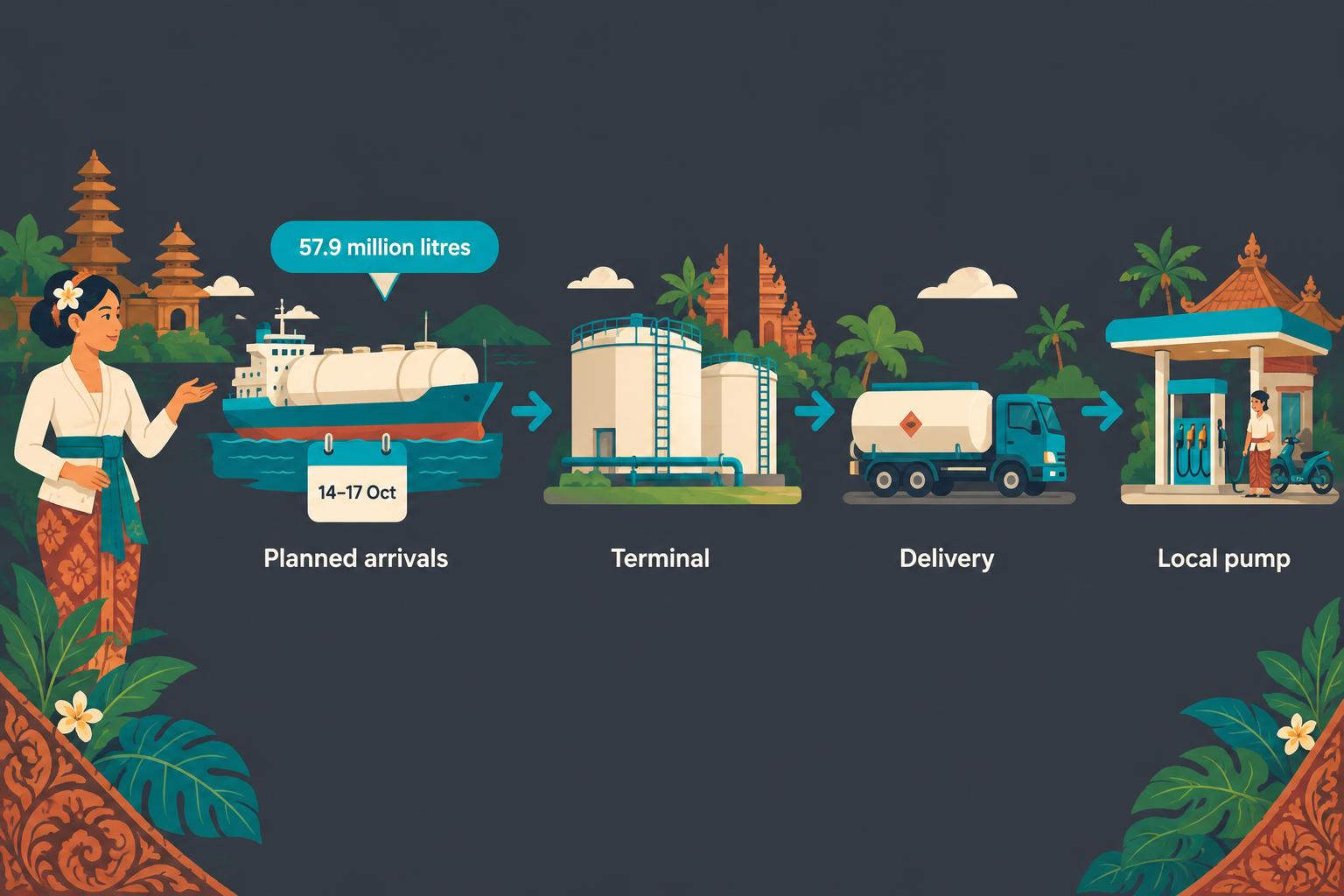
57.9 million litres scheduled does not mean local pumps are replenished
57.9 million litres were scheduled to arrive during 14–17 October 2026, according to Pertamina’s 15 October announcement reported by Databoks. The announced programme comprised 44.9 million litres of Pertalite and 13 million litres of Pertamax.
The key word is scheduled. The announcement described a phased delivery programme. Bali’s provincial government reported that 19.2 million litres of Pertalite arrived at Manggis and Pesanggaran on 13 October, and recorded a further 25 million litres scheduled for 15–17 October. That earlier plan was distinct from the later 57.9-million-litre announcement; neither announcement established the actual delivered volume of its scheduled shipments.
For someone standing beside a nearly empty motorcycle, those are different stages:
- Scheduled supply: a delivery programme has been announced.
- Terminal arrival: fuel reaches the receiving infrastructure.
- Station delivery: the local outlet receives fuel.
- Availability when you arrive: the station can actually serve your vehicle.
Pertamina had already announced 24-hour distribution through Sanggaran on 13 October, following the arrival of MT Klasogun at Benoa that morning, according to ANTARA’s reporting. By 15 October, Pertamina reported both Sanggaran and Manggis operating around the clock, with 108 tanker trucks and 465 crew members deployed. That demonstrates a distribution response, but it is not a promise that any particular station will have a particular fuel when you reach it.
17 October was not a confirmed recovery deadline. It was the end of the announced delivery window, not a guaranteed shipment-completion date. On 19 October, the Energy Ministry ordered reserves increased to 15 days, reporting reserves then averaging approximately 11–12 days. The 15-day figure was a target, not guaranteed stock.
66 round-the-clock stations are an update, not a fuel guarantee
66 petrol stations in Denpasar and Badung were operating 24 hours, according to the Energy Ministry’s 19 October 2026 update. This was an emergency operating arrangement, not a permanent island-wide opening-hours guarantee. Confirm current hours with the station.
An opening-hours notice answers when an outlet is intended to operate. It does not establish which fuel is available, whether a delivery has arrived or how long the queue is. Treating an old screenshot as a live stock report risks an unnecessary journey.
Pertamina’s 15 October statement directed motorists to @pertaminabali for station information. Its 27 October update reiterated Contact Center 135 for fuel-service enquiries or complaints.
Before making a special trip, try to establish:
- Whether the update is current and names the station you intend to use.
- Whether it describes opening hours, an expected delivery or fuel actually available.
- Whether the information concerns the fuel your vehicle needs.
- Whether your driver or transport provider has already secured enough fuel for the agreed journey.
A neighbour’s report can be useful context, but ask when they visited. Avoid circulating an undated message as confirmation of current stock. Likewise, an unanswered call or missing update is not evidence that a station is empty; it simply leaves availability unconfirmed.
Bali’s temporary odd–even subsidised-fuel purchasing policy ended on 23 October, Pertamina confirmed on 27 October. It is not an ongoing November requirement. The October Pertalite policy included limits of 20 litres per car and 3 litres per motorcycle; those historical limits should not be assumed to remain current. Confirm any applicable purchase limits with Pertamina before travelling.

A five-hour account shows the risk to fixed-time journeys—not an average delay
Approximately five hours was the wait described by a hotel worker refuelling her motorcycle in AFP’s reporting published by CNA on 14 October 2026. This was an individual account, not an island-wide average waiting time.
Its practical significance is uncertainty. A refuelling stop that overruns can interfere with a shift, school collection or scheduled appointment. There is no evidence here for adding a fixed amount of time to every journey, so plan around consequences rather than an invented universal buffer.
- For work: tell your employer or team early if refuelling could affect arrival, rather than waiting until you are already in a queue.
- For school runs: confirm who can handle collection if the usual driver is delayed.
- For appointments: ask about rescheduling before committing to a trip with uncertain fuel arrangements.
- For deliveries and services: reconfirm the provider’s ability to reach you, especially when access to the home depends on someone being present.
Combine compatible errands where practical and avoid unnecessary trips made solely to inspect queues. These are planning suggestions based on documented disruption, not claims that every road or service is delayed.
If you depend on transport booked through someone else, ask about their fuel position rather than assuming the booking settles it. For broader household planning beyond this disruption, our article on living in Bali without a scooter considers alternatives to making every routine depend on your own motorcycle.
Rp10,000 and Rp15,950 are dated price references, not proof of stock
Rp10,000 per litre for Pertalite and Rp15,950 per litre for Pertamax at SPBU stations were the Bali prices reported on 2 November 2026 in detik’s provincial price list, citing Pertamina Patra Niaga. Confirm current prices with the outlet.
| Fuel | Bali pump-price reference | Report date | Important limitation |
|---|---|---|---|
| Pertalite | Rp10,000/litre | 2 November 2026 | Not an independently verified quotation for every station on 7 November. |
| Pertamax | Rp15,950/litre at SPBU stations | 2 November 2026 | Not confirmation that the fuel is currently available. |
Keep the price question separate from the access question. Knowing the dated pump-price reference does not tell you whether a station has fuel or whether you can complete a journey without refuelling.
The reviewed material does not establish an island-wide shortage surcharge, a standard increase in driver charges or a measured rise in household transport spending. Those figures should not be invented from the queue reports.
If a driver or moving company changes a quote, ask for the revised total and the reason before accepting. Clarify whether the agreed price covers the complete journey and whether a postponement would change the charge. Retain the written quotation so that a fuel-related scheduling problem does not become a separate disagreement over money.
The 14–17 October delivery window called for flexible handovers, not automatic cancellations
14–17 October 2026 was the announced phased delivery window in Pertamina’s 15 October statement, not a guaranteed completion deadline. The 2 November checks subsequently found normal queues and adequate supplies at four sampled stations. For renters, hosts and buyers, checking local conditions supports contingency planning around journeys; the reporting does not establish that every viewing, move or property handover must be cancelled.
If you have a move scheduled, contact the transport provider and the person handing over the keys before departure. Confirm fuel arrangements, access to the property and what happens if arrival slips. Keep essential medicines, documents and items needed immediately separate from goods that could arrive later.
For rental bookings made through Livuma’s rental marketplace, in-app guest–host chat keeps agreed viewing times and move-in arrangements on the record.
Hosts should distinguish a delayed arrival time from a change to the booked stay. State who will provide access, how the guest should report an arrival problem and whether any separately arranged services need reconfirming.
Agree any booking-date change with the other party rather than assuming a transport delay changes the stay automatically. Keep the revised dates and any payment implications on the record. That handles an agreed booking-date change, not the fuel supply or the moving company’s arrangements.
Buyers travelling to inspections or handovers can apply the same transport checks. The reviewed reporting provides no basis for claiming that the fuel disruption has changed property values or rental prices, and a terminal’s location does not establish better petrol availability in a nearby neighbourhood.
As of 2 November, sampled Bali stations had normal queues and adequate supplies
7 November 2026 is the cutoff for this research check. The latest verified station inspections, on 2 November, found normal queues and adequate supplies at four sampled stations in Badung, Tabanan, Gianyar and Denpasar. These answers preserve the distinction between those checks and island-wide verification.
Has Bali’s October fuel shortage ended?
The latest verified checks, on 2 November 2026, found normal queues and adequate supplies at four sampled stations in Badung, Tabanan, Gianyar and Denpasar. These checks did not cover every station in Bali. Pertamina confirmed that the temporary odd–even subsidised-fuel purchasing policy ended on 23 October. Check current local information before relying on normal service.
Why did Bali have petrol queues in October?
Ombudsman RI’s preliminary investigation identified severe queues during 12–15 October, linked to maritime supply problems, limited terminal reserves and panic buying. It identified an anchor problem on MT Prima XP that delayed berthing by approximately 15.5 hours on 12 October. AP reported on 14 October that strong demand for cheaper Pertalite and panic buying compounded the problem. These were assessments of the disruption, not proof that every station had fuel.
Where can I check which Bali petrol stations are open?
Pertamina’s 15 October statement directed motorists to @pertaminabali for station information, and its 27 October update reiterated Contact Center 135 for fuel-service enquiries or complaints. The Energy Ministry reported 66 stations in Denpasar and Badung operating around the clock on 19 October as an emergency arrangement, not a permanent island-wide schedule. Confirm current opening hours with the station; opening hours alone do not guarantee the fuel you need is available.
Should I postpone moving house during the fuel shortage?
The reporting does not support a blanket recommendation to postpone. Confirm your transport provider’s fuel arrangements and coordinate access with the host or landlord before departure. If the journey cannot be supported reliably, agree a revised plan in writing. Distinguish a later arrival time from a change to the rental’s booked dates.