

Living in Bali without a scooter is possible, but it works best when you choose a rental around your daily routine rather than around an area name. A café-lined street on a map can still mean a narrow lane without a footpath, an awkward luggage pickup, or a grocery run that turns into a car journey.
The workable no-scooter version of Bali is usually a mix of walking for nearby essentials, ride-hailing for point-to-point trips, delivery for heavy shopping, and occasional taxis or a private driver for airport days, rain, groups and longer outings. The key is reducing the number of journeys you need to make.
This guide covers Sanur, Seminyak, Berawa, Canggu, Pererenan, Ubud and Nusa Dua, with an honest focus on address-level walkability. Traffic, rain, construction and driver supply change quickly, so treat app arrival times and route estimates as live information—not a fixed promise.
What living without a scooter in Bali really looks like
Build your week around a small daily radius
A scooter-free routine is easiest when food, coffee, basic groceries, a gym or coworking space, and a safe pickup point sit within a route you would genuinely walk repeatedly. The most useful test is not whether a pin is central; it is whether you can reach your regular morning coffee, lunch, supermarket and evening plans without needing transport every time.
For many long-stay residents, walking handles short errands while cars handle trips between neighbourhoods. Foreign tourists should follow Bali Governor Circular No. 7/2025, which directs them to roadworthy four-wheel transport operating under an official business or rental association. Delivery fills the gap for water, pantry items, laundry supplies and meals when the weather or traffic makes a short journey inconvenient.
Choose convenience over a larger catchment area
A rental that is farther from the main road may feel quieter, but it can make car access, grocery deliveries and late-night pickup less straightforward. Conversely, a property close to a busy road may be easier for transport but noisier and less pleasant to walk from.
Before committing, identify the places you will use several times each week. A beach might matter to you, but so might a minimarket, a proper grocery option, a desk-friendly café, a gym and a place where a car can stop without blocking a narrow lane.
How to judge whether a Bali rental is genuinely walkable
Walk the route, not the map distance
A five-to-fifteen-minute walking radius is a useful practical test, but it must be checked on foot. Look for pavement continuity, uneven surfaces, open drains, road crossings, vehicle traffic and whether the route remains usable after dark. A direct-looking route may require walking on the road or crossing a busy junction.
Do the test between the rental and the places that support your actual lifestyle: food, groceries, gym or coworking, beach if relevant, and an app-car pickup point. If possible, visit in rain as well as dry conditions. Sanur flooding was recorded at addresses on Jalan Danau Tamblingan and Jalan Kesari in January 2025, a reminder to check drainage, entrance height and wet-weather access rather than distance alone.
Check the pickup and drop-off reality
Ask whether a car can turn around, wait briefly and collect luggage at the property. A driver may be able to reach the map pin but still struggle with a narrow gang, a steep entrance or a lane that becomes congested at meal times.
For rentals found through Livuma’s live rental listings, review the listing’s location context, minimum stay, house rules and booking conditions, then ask the host in in-app chat about the exact pickup point, lane width and wet-weather access.
Neighbourhood comparison for a no-scooter lifestyle
Use this as a starting point, not a neighbourhood-wide guarantee
| Area | Best no-scooter advantage | Important limitation | Rental context |
|---|---|---|---|
| Sanur | Beachfront pedestrian corridor and compact active-travel streets | Side streets and drainage conditions vary | Check each address |
| Seminyak | Dense mix of dining, shops and services in selected micro-areas | No verified continuous pedestrian network across all streets | Check each address |
| Berawa | Many daily destinations concentrated in selected pockets | Congestion can make car trips unpredictable | Check each address |
| Canggu | Food, fitness and work options can be close together | Walking routes and crossings differ sharply by sub-area | Check each address |
| Pererenan | Potentially quiet local routine near the right address | No verified area-wide walking or pickup benchmark | Check each address |
| Ubud | Central attractions and services can be close together | Parking and works can obstruct pedestrian space | Check each address |
| Nusa Dua | Managed district has pedestrian-investment evidence | Resort core differs from housing beyond the gate | Check each address |
Match the area to your habits
Sanur and the managed core of Nusa Dua have documented infrastructure for pedestrian-oriented movement. Seminyak, Berawa, Canggu and central Ubud can work very well when you choose a specific cluster of daily destinations, but should not be treated as universally walkable. Pererenan needs especially careful address-by-address checking.
If you need a regular commute across Bali, a no-scooter setup becomes more demanding. The better strategy is usually to live close to where you spend most weekdays, then use transport selectively for social plans and exploration.
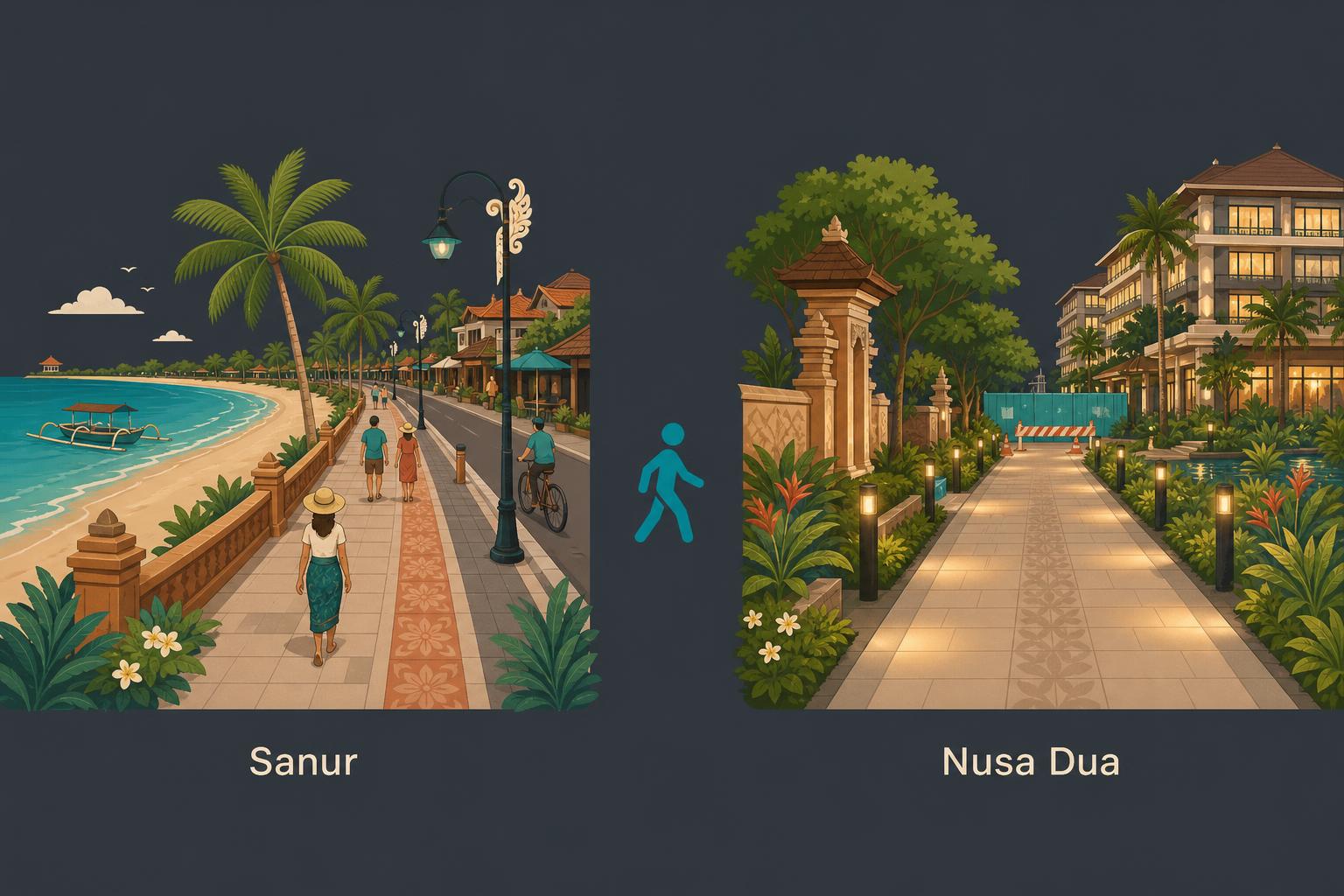
Sanur and Nusa Dua: the clearest pedestrian-oriented options
Sanur suits a routine built around the beachfront and main streets
Sanur has a designated beachfront pedestrian corridor reserved for pedestrians and non-motorized bicycles, and electric bicycles have been prohibited there since April 2023. That makes the waterfront especially useful for walks, beach access and a daily outdoor routine.
The city’s low-emission-area regulation also includes Jalan Danau Tamblingan, Jalan Danau Poso, Jalan Cemara, Jalan Mertasari, Jalan Hang Tuah, the harbour area and several beach-side streets. Implementation is gradual, not an immediate area-wide car ban. However, this does not mean every rental is walkable to a gym, supermarket or café. Jalan Danau Tamblingan has been part of Denpasar’s sidewalk and drainage improvement focus; road, pavement and drainage works from Jalan Danau Poso to Jalan Cemara were reported 67% complete on 26 October 2026, with a contractual completion target of December 16, 2026, so current works and the exact block still matter. Read the city’s Sanur pedestrian-corridor guidance alongside an in-person route check.
Browse long-term rentals in Sanur with daily walking routes in mind, not only bedroom count or pool size.
Nusa Dua is different inside and outside the managed district
The Nusa Dua is a 350-hectare integrated tourism district managed by ITDC, with more than 20 international hotels and about 5,000 rooms as of May 2026. Its managed resort core should be considered separately from residential areas outside its gates.
ITDC’s January 2026 rejuvenation plan includes lighting improvements along 7.5 km of footpaths intended to make routes more pedestrian-friendly at night, within an overall program phased through 2026–2028. That is meaningful infrastructure evidence, but Peninsula Island access, drainage, road and public-space works were still under way in June 2026. Check the immediate route and construction status before assuming a seamless walk. See ITDC’s footpath rejuvenation announcement for the district scope.
Seminyak, Berawa and Canggu: convenience with traffic trade-offs
Seminyak can work when your essentials are on the same few streets
Seminyak often appeals to people who want restaurants, shops, gyms and services close together. Yet there is no verified evidence of one continuous pedestrian network across the entire area. The practical approach is to walk the exact route from the rental to a minimarket or supermarket, café cluster, gym, beach and car pickup point.
Badung’s traffic-management scheme in Seminyak was made permanent by April 2026, which is useful evidence of ongoing traffic pressure rather than evidence that car rides will be quick. Choose a home where your most frequent needs are nearby enough that traffic affects only occasional trips.
A compact room can also be a sensible base for someone who values proximity over space; compare kost options in Seminyak if that fits your stay.
Berawa and Canggu need generous time buffers
Berawa and Canggu can support a walk-and-delivery lifestyle if the rental is very close to the places you use most. But Canggu’s food, gym, beach and work destinations are not automatically connected by comfortable walking routes, and no official dataset supports a universal claim that Batu Bolong, Echo Beach or Padang Linjong is walkable for every daily need.
Badung has identified congestion points in Berawa and Canggu, attributing pressure to increased tourism activity and reporting public complaints. A southern ring road and the Berawa–Umalas–Kedampang–Teuku Umar Barat shortcut broke ground on 27 July 2026, but neither should be treated as an operating solution with a verified completion date. Read the Badung transport update as context for building buffers into deliveries, dinners and airport transfers.
Start with Canggu long-term rentals, then test the exact lane and walking circuit before deciding.
Pererenan and Ubud: address-level decisions matter most
Pererenan should be tested from the front gate
Pererenan should not be labelled broadly walkable. No authoritative source verifies continuous sidewalks, grocery, gym or coworking density, or ride-hailing wait times throughout the area. Some addresses may make a quiet, low-transport routine possible; others will require rides for nearly every errand.
Focus on the route between the rental, food options, beach if relevant, and the nearest main road where drivers can collect passengers safely. Check whether the lane is comfortable after dark and whether deliveries can locate the entrance without calling repeatedly.
Central Ubud is compact, but not friction-free
Central Ubud can be attractive for residents who want shops, cafés, wellness services and cultural sites close together. It also has traffic and pavement constraints. Gianyar’s transport agency conducted parking enforcement in central Ubud in April 2026 to reduce congestion at tourism points, while the regency has noted that illegally parked vehicles can force pedestrians from sidewalks into the road.
Rain and works matter here too. Severe rainfall caused a road collapse on Jalan Ambengan in December 2025, leading to temporary diversions, while underground utility-cable work began in April 2026. For a rental on a narrow lane, assess wet-weather access, vehicle pickup and alternate walking routes. Explore Ubud long-term rentals and use a viewing to inspect the route, where available.

Ride-hailing options when walking is not enough
Motorbike taxis and the guidance for foreign tourists
Gojek lists GoRide and GoCar in Bali, while Grab’s Indonesia terms cover GrabBike and GrabCar. Motorbike taxis serve light, solo point-to-point trips, but foreign tourists should follow Bali Governor Circular No. 7/2025, which directs the use of roadworthy four-wheel transport operating under an official business or rental association. Motorbike taxis are not the right choice for airport luggage, a large grocery order, formal clothing in heavy rain or a group outing.
KP 667/2022, listed by the ministry as in force as of 10 November 2026, sets Zone I motorbike-taxi rates at Rp2,000–Rp2,500 per km with a Rp8,000–Rp10,000 minimum for the first 4 km; Bali is included in Zone I. This is a regulatory reference point only, not a predicted app checkout price. Do not calculate a likely fare by multiplying distance: live demand, platform fees, card-related charges, parking, tolls where applicable and other charges can affect the result.
Use cars for rain, luggage and less stressful journeys
GoCar and GrabCar are the more comfortable choice for wet weather, shopping bags, multiple passengers and routes where a motorbike taxi is impractical. Bluebird is a useful backup: bookings can be made through MyBluebird, phone, WhatsApp, taxi stands or street hailing. Bluebird Prime is available in Bali and advertises a roomier cabin and larger luggage capacity.
GoCar quotes vary with location and time, so there is no universal Bali fare to use for budgeting. Bluebird’s current terms list a Rp30,000 minimum fare in Bali, excluding the platform fee, and a Rp4,000 MyBluebird platform fee for standard Bluebird bookings; Bluebird Prime has a Rp5,000 platform fee. Tolls, parking and other applicable additional charges are the passenger’s responsibility. For GoCar, pre-pickup charges normally fall to the driver unless agreed otherwise; post-pickup tolls and parking are payable by the customer with prior agreement. Obtain live quotes from your exact address at the time you expect to travel. For a private driver, request a written all-in offer that states hours, overtime, fuel, parking, tolls, airport fees, waiting time and vehicle and luggage capacity.
For journeys that fit its corridors, Trans Metro Dewata is another scooter-free option. October 2026 reporting lists a Rp4,400 general flat fare, cashless payment by electronic-money card or QRIS, and corridors including Ubung–airport, Ubung–Sanur and Ubung–Monkey Forest Ubud—not door-to-door coverage across resort neighbourhoods. From 3 November 2026, reported fare integration allows transfers between Trans Metro Dewata and Trans Sarbagita without a second fare within 180 minutes, using one payment account per passenger; a single QRIS payment for several passengers does not qualify. Check current corridor departures before relying on a bus journey.
Delivery apps can replace many scooter errands
Food, groceries and household basics
Gojek lists GoFood, GoMart and GoShop for Bali, alongside transport and delivery services. Grab’s terms cover GrabFood, GrabMart and GrabExpress. These options can make a no-scooter rental much more workable when supermarkets are not a pleasant walk away or when you do not want to carry bulky supplies.
Use food delivery for ordinary meals, but keep a few reliable nearby places for times when a delivery rider has difficulty accessing the lane. For groceries, check whether the rental has enough storage for a less frequent larger order. This reduces the number of short trips that otherwise add cost and time.
Do not treat app availability as a guarantee
Gojek lists GoSend Instant motorcycle delivery in Bali, including Gianyar and Tabanan, and Instant car delivery in Bali, but service-area coverage does not guarantee a prompt driver acceptance in every location, storm or late-night period. Grab also describes drivers and delivery providers as independent third-party partners, so fulfilment can vary with live supply.
Test GoCar or GrabCar, food delivery and Bluebird from the exact rental address at morning, afternoon, dinner and late-night hours. A central map pin is not proof of dependable pickup. Keep a rain backup: a covered waiting point, waterproof bag and a car option for luggage-heavy journeys.
Daily costs: how to budget without inventing a transport figure
Separate rent from variable mobility spending
The cost of a scooter-free lifestyle depends on how often you need transport, not just which neighbourhood you choose. A person who walks to food, work and a gym may use ride-hailing only for social plans and heavy errands. Someone who lives on a narrow lane and travels between districts every day will have a very different transport bill.
Rather than relying on generic fare claims, make a personal test budget. At the times you would normally travel, request app estimates from the rental to your likely work, grocery and social destinations. Repeat after rain or at busier hours. Save the results, then decide whether that location supports your routine.
Compare rental value with the journeys it eliminates
A lower rent can be less convenient if it requires frequent paid trips for food, work, exercise and basic shopping. A more central rental may reduce those journeys, but it still needs a safe walking route and reliable pickup access. The right comparison is not rent alone; it is rent plus the practical cost and effort of daily movement.
Rain, late nights and airport days without a scooter
Plan for wet-weather disruption even in the dry season
BMKG’s September 2026 forecast places rainy-season onset in parts of Bali in November 2026 and most of Bali in December 2026. A delayed onset does not remove the need for a rain plan: BMKG’s 6 November bulletin reported a Bali daily rainfall maximum of 300 mm during 1–4 November. Local conditions can still affect walking, driver acceptance and delivery access.
Choose a rental with a covered entrance or a practical waiting point. Keep a waterproof bag for electronics and documents. On days with luggage or bulky shopping, use a car instead of attempting to combine a motorbike ride with bags and rain.
Make late-night and airport transport a separate test
Do not assume that daytime app availability will match late-night conditions. Test the address at the hours you expect to return from dinner, events or flights. Confirm how drivers find the property, where they can safely stop and whether the final walk from the road is lit and comfortable.
For airport days, favour a car or a taxi with enough luggage space. Bluebird can be booked through several channels, and Bluebird Prime may be worth checking when a larger cabin is useful. Ngurah Rai Airport lists Grab lounges in the international and domestic arrival pickup zones, and Gojek meeting points at the international drop-zone area and domestic arrival hall. Always verify the live price and availability before relying on any option.
A rental checklist for a scooter-free move to Bali
Questions to ask during a viewing
- Can you walk the actual route to food, groceries, a gym or coworking space, beach and a safe pickup point?
- Are pavements continuous, and what happens at crossings, after dark and in rain?
- Can a car enter, turn and wait near the gate?
- Does the entrance or access lane flood, and where does a driver stop during heavy rain?
- Is there enough kitchen and storage space to make grocery delivery practical?
- Which nearby places would you use without taking a ride?
Checks to make before paying a deposit
Run live transport tests from the exact address at several times of day. Compare an app car and Bluebird option. Then place a small delivery order, if possible, to see whether drivers can find the entrance and whether communication is needed.
Keep practical arrangements in writing: pickup directions, access instructions, included items and move-in condition. When comparing live rental inventory, check photos, availability, minimum stay and guest reviews against your daily walking needs.
Living without a scooter is not about avoiding all vehicles. It is about choosing a home that lets you walk for the repetitive parts of life, order what is heavy, and use cars when they genuinely add convenience.