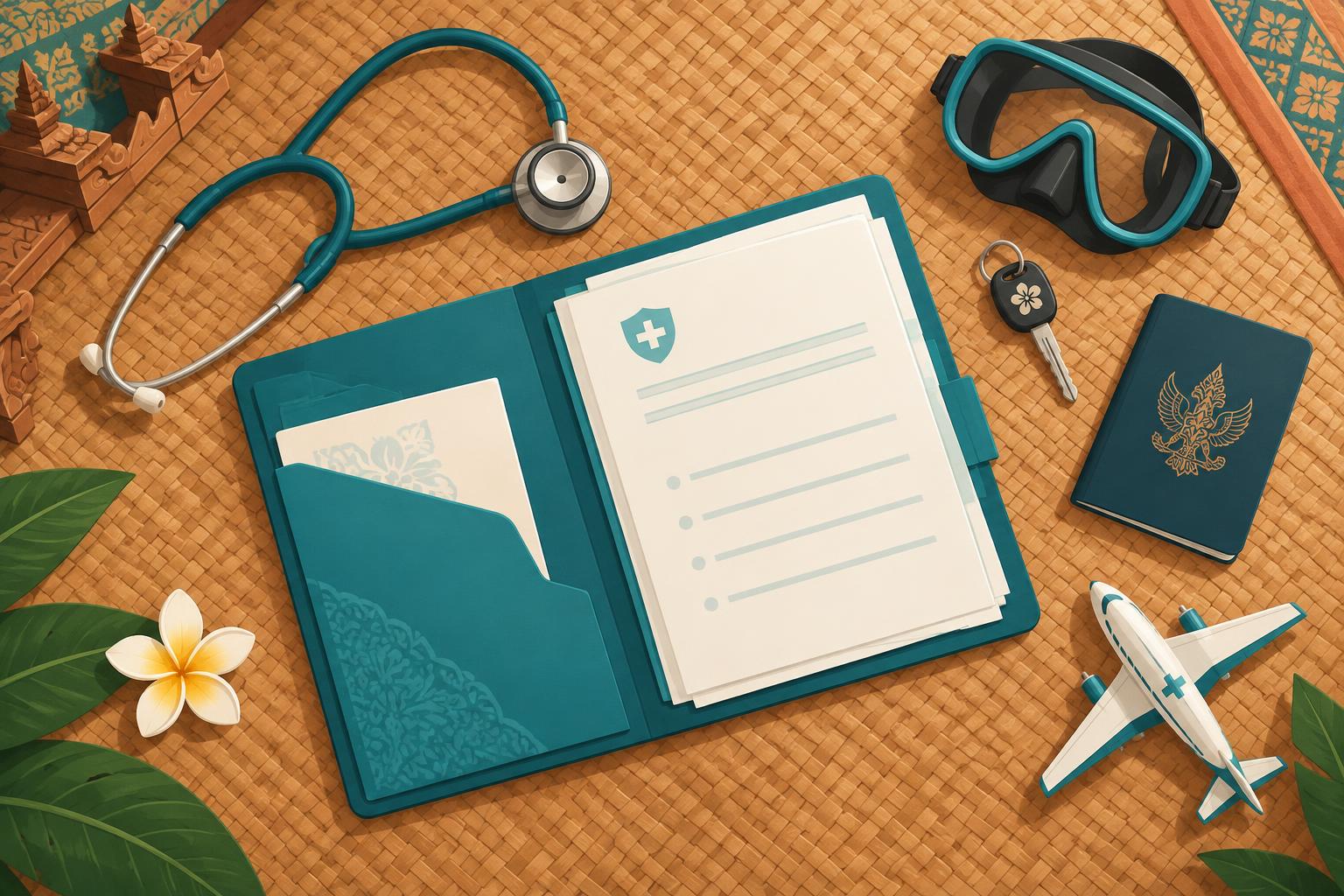

On an ordinary weekday morning in Bali, the household plan is usually breakfast, a school run or a walk to the warung—not an evacuation. Earthquake and tsunami preparation belongs inside that routine: knowing where to shelter, which gate opens and where everyone will go if the coast needs clearing.
The essential distinction: prepare every home for earthquake shaking, and assess tsunami evacuation separately using the actual address and local guidance. Neither a neighbourhood name nor a reassuring property description answers both questions.
Living in Bali means preparing for shaking separately from tsunami inundation
Bali’s earthquake sources include the subduction zone south of the island and the Flores back-arc thrust to the north. A resident’s preparedness plan should therefore not focus exclusively on the southern coastline.
Earthquake exposure concerns shaking and its effects on buildings, furniture and people. Tsunami inundation concerns where seawater could reach. A property outside a mapped tsunami zone still needs suitable construction, secured furniture and a household earthquake plan.
Not every earthquake generates a tsunami. However, coastal residents should respond to natural warning signs or official tsunami warnings rather than trying to decide for themselves whether a particular earthquake can produce one.
This changes what you ask when choosing a home:
- For shaking: what is known about the building’s structural condition, and where can you shelter from falling objects?
- For tsunami exposure: what does the relevant local map show, and which evacuation destination serves the address?
- For everyday readiness: can every household member follow the plan from wherever they normally spend the day?
These questions apply to villa residents, apartment occupants and kost renters alike. A different accommodation type does not remove the need to check the building and understand the surrounding evacuation arrangements.
Checking Bali hazard maps without declaring whole neighbourhoods safe
Start with BNPB’s InaRISK risk-assessment portal for initial screening. It shows hazard coverage, exposed populations and potential losses; it is not a live tsunami-warning service.
Then consult BPBD Bali’s spatial-data directory, which lists tsunami evacuation and siren-location maps alongside other risk information. Ask the relevant local BPBD which evacuation map and instructions apply to your address. Bali Governor Regulation No. 13/2025, effective 27 March 2025, replaced the 2013 tsunami contingency regulation. Its evacuation annex includes BMKG’s 2022 maps for vertical evacuation in Tanjung Benoa and horizontal evacuation in Seririt—location-specific examples, not a single evacuation plan for all Bali.
Map boundaries are not property certificates. The InaRISK Personal disclaimer accessible during research identified its assessment as using 2015 data at 1:250,000 scale. That does not establish the dataset used by every InaRISK product. Its WebGIS disclaimer also excludes legal and civil-engineering use: a screenshot cannot certify a building or settle a property-line safety question.
Sanur, Seminyak and Canggu: compare addresses, not safety labels
The table below illustrates the distinction between choosing an area and checking disaster preparedness. An area name is not evidence of structural quality, tsunami exposure or evacuation access.
| Area | What the area name cannot establish |
|---|---|
| Sanur | Whether the particular doorway lies within mapped inundation coverage or has a workable route. |
| Seminyak | Whether a nearby shelter is the designated destination for that address. |
| Canggu | Whether the building has been structurally assessed or the route remains accessible. |
Do not treat a modern finish or an inland-sounding description as a safety assessment.
When comparing homes through a rental search, establish the actual property address for these checks. A location map is not a hazard assessment or structural inspection.
Building a tsunami evacuation route from your actual Bali doorway
A route is useful only if it connects your home to an appropriate destination and works for the people who must use it. “We’ll head inland” is not a complete plan.
- Confirm the destination. Ask local BPBD about the designated Tempat Evakuasi Sementara, or TES. This may be higher ground or a building accepted as an evacuation location.
- Find the matching route. Read the local evacuation map and follow the relevant tsunami evacuation arrows.
- Walk from inside your home. Include the bedroom exit, stairs, compound gate, lanes and destination entrance—not just the public-road portion.
- Time the walk. Use it to understand your household’s practical needs, not to invent a guaranteed escape window.
- Check difficult conditions. Assess lighting, gate access and whether the route works for limited mobility.
- Resolve obstacles locally. If the route depends on a locked entrance or an unsuitable crossing, ask BPBD for guidance rather than improvising a supposedly safe alternative.
BMKG distinguishes hazard-zone signs, Jalur Evakuasi or Evacuation Route arrows, assembly-point signs and evacuation maps. An ordinary earthquake assembly point is not automatically a tsunami evacuation destination. Neither is an accessible hotel roof.
Plan primarily to evacuate on foot. BNPB advises against using vehicles during tsunami evacuation because congestion can obstruct evacuation. Do not make finding a driver, collecting a scooter or checking fuel a prerequisite for leaving.
Seminyak: a shelter name is the beginning of a route check
BPBD Badung documented earthquake and tsunami training at Shelter Tsunami Seminyak on 22 April 2026, using a Technical Floor Game—a map-based exercise. That is a concrete example of local preparedness, not proof that every Seminyak resident has a suitable route to that shelter. Confirm the destination assigned to your address.
For a home you already occupy, walk the route with the household. For a prospective home, include this walk in your decision rather than postponing it until after moving in.
What to do inside a Bali home when earthquake shaking starts
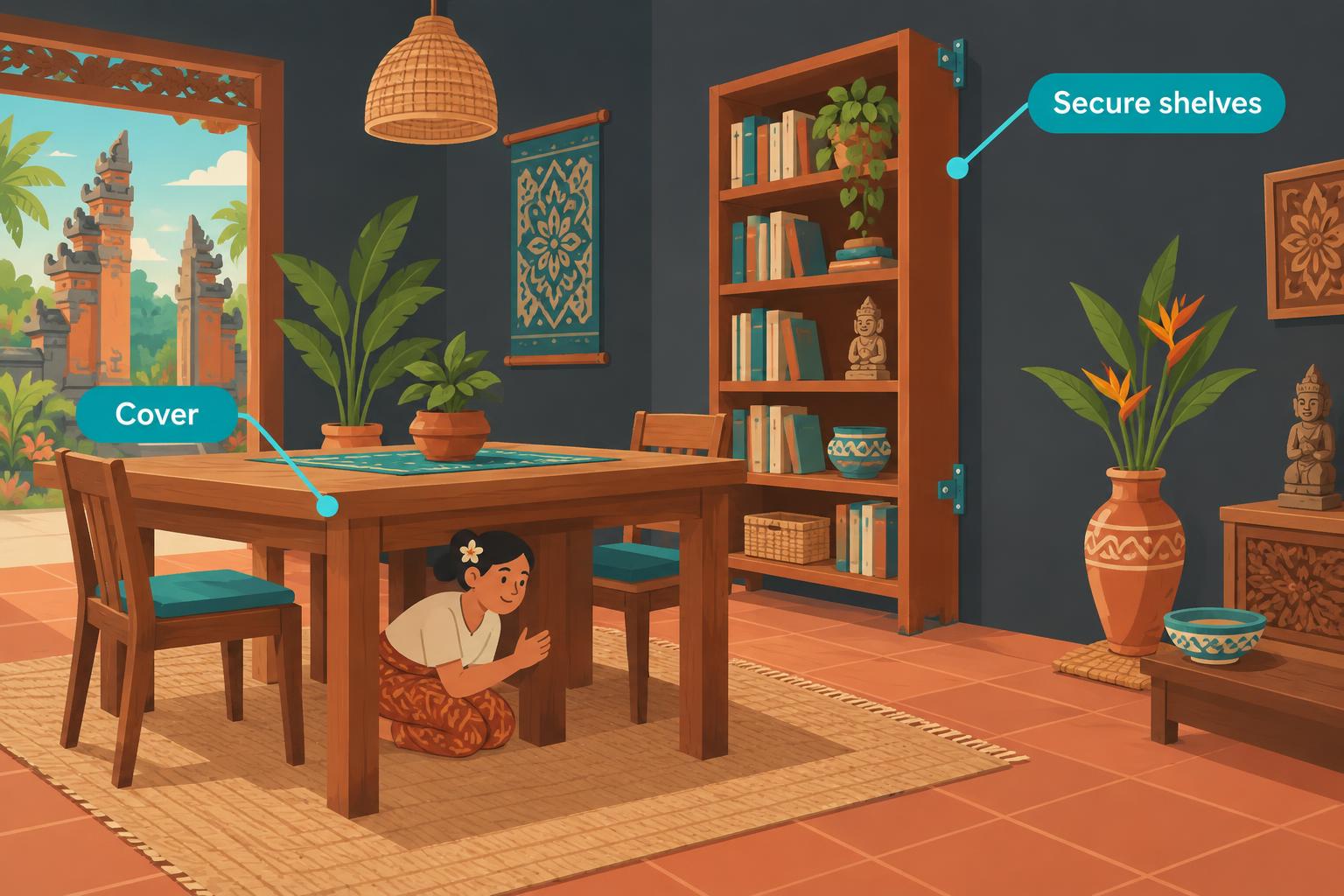
Practise Drop, Cover and Hold On: get beneath sturdy furniture, protect yourself from falling objects and hold on until the shaking subsides. BMKG’s earthquake and tsunami preparedness guidance also includes restraining household furniture and assessing building structure.
Prepare the room before an emergency. Look at shelving, tall furniture and objects that could fall near beds, desks or the place you intend to shelter. In a furnished rental, discuss necessary restraints with the owner rather than assuming the furniture arrangement is fixed.
- Indoors: protect yourself from falling objects and hold your shelter position until shaking subsides.
- Outdoors: move to an open area away from buildings and utility installations.
- After shaking: remain alert for aftershocks.
- Near the coast: if shaking is strong or weak but prolonged, move along the evacuation route as soon as movement is safe.
A building-structure audit is separate from an occupant’s visual check. Ask what assessment exists and seek an appropriate professional assessment where needed; attractive interiors and an absence of obvious damage are not structural certification.
For renters, add these practical questions to your questions for the landlord before paying. Keep questions about gate access, furniture restraints and available building information on the record; a host’s reply does not replace an engineering assessment.
Natural tsunami warnings in Bali mean leaving without waiting for an alert
At the coast, strong shaking or weak but prolonged swaying is a reason to evacuate without waiting for a tsunami bulletin or an evacuation order. Protect yourself while the ground is shaking, then move as soon as movement is safe.
Other natural warnings include sudden unusual sea withdrawal or a loud roar from the sea. Do not approach the shore to investigate or collect evidence.
These are alternative triggers, not stages that must all occur. You do not need to feel shaking, see the sea retreat and hear a siren before acting. Equally, a phone that has not received a notification is not evidence that staying is safe.
BMKG’s published warning actions distinguish:
- AWAS: immediately carry out comprehensive evacuation to higher ground or designated evacuation locations.
- SIAGA: immediately evacuate to higher ground or designated evacuation locations.
- WASPADA: leave beaches, riverbanks and other waterways connected to the sea.
Keep more than one official information channel accessible. BMKG identifies InfoBMKG, its official website and verified BMKG social-media accounts as authoritative earthquake information channels. Familiarise yourself with them before an emergency rather than relying on forwarded screenshots.
Pedungan: sirens supplement natural warnings
BPBD Bali reported on 21 October 2025 that Pedungan’s portable tsunami siren would be activated centrally using BMKG warnings. That illustrates one dissemination mechanism; it does not establish island-wide coverage. The research did not confirm a complete operational siren inventory, so do not assume a siren will be audible inside your home.
Tsunamis arrive as a series of waves. Remain at the evacuation location until authorities declare it safe to leave, rather than returning after the first wave or because the water appears calm.
Preparing a Bali household go-bag and accessible emergency supplies
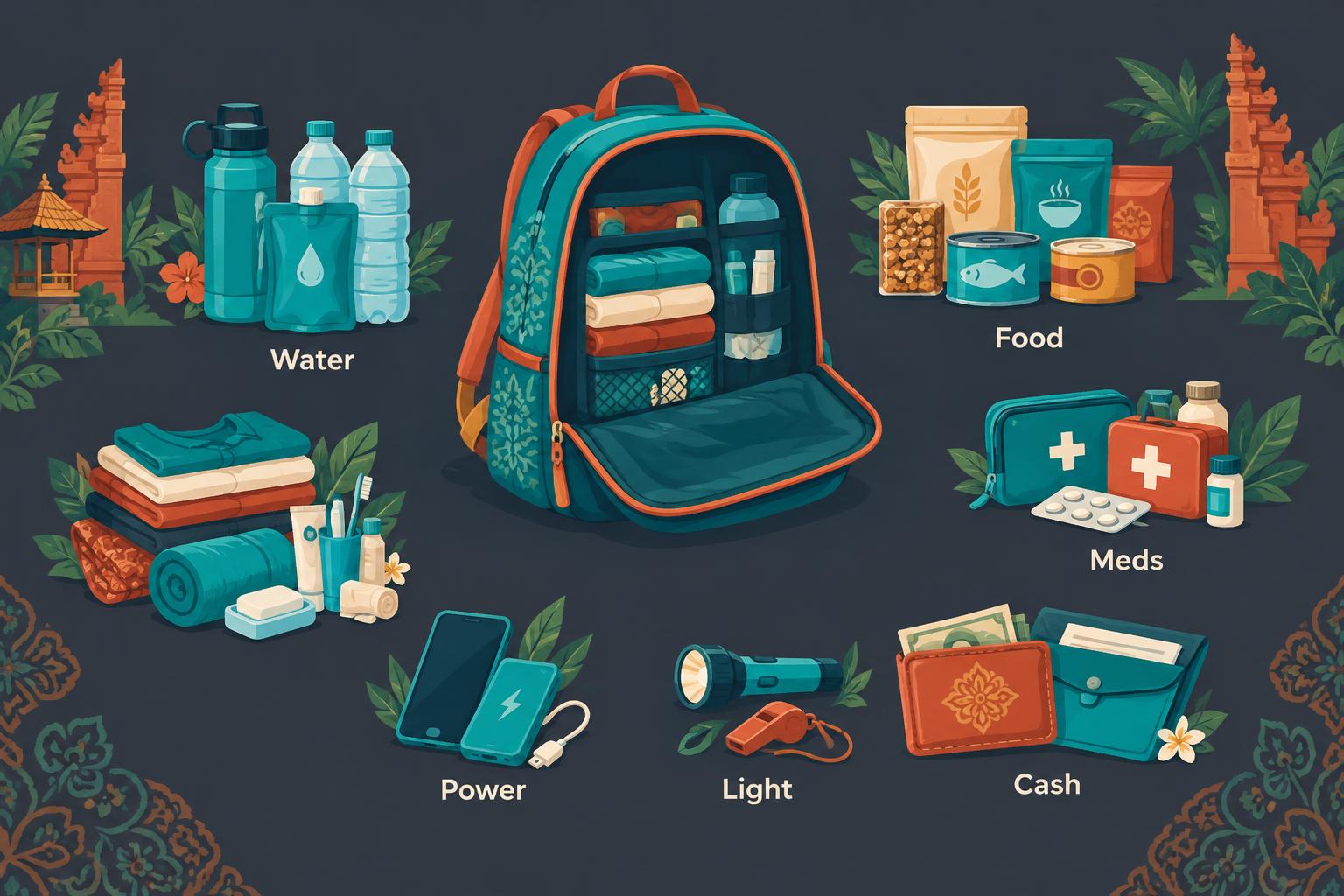
Government guidance recommends supplies for approximately 72 hours. The aim is to support the household during disruption, while keeping the go-bag immediately accessible—not buried behind luggage or stored somewhere you cannot quickly reach.
- Water and food: drinking water and durable food.
- Health: personal medicines and first-aid supplies.
- Daily essentials: clothing and hygiene supplies.
- Records and payment: important documents and cash.
- Light and signalling: lighting equipment and a whistle.
- Communication: communications equipment with backup power.
Adapt the contents to the people who actually live in the home. Check personal medicines and supplies when household needs change, and make sure the person assigned to carry the bag can manage it.
For a shared kost or apartment, distinguish what is inside your room from what depends on common access. A bag beside your door does not solve a locked shared gate. For a larger household, decide who assists each person with limited mobility and rehearse that arrangement.
Emergency supplies should support evacuation, not delay it. Do not turn an immediate coastal evacuation into a packing exercise. Keeping essentials ready is what allows you to leave instead of searching drawers.
Preparedness also belongs in ordinary household conversations: where the bag lives, how backup power is kept available and who knows the evacuation destination. A plan understood only by the most organised resident is fragile when that person is elsewhere.
A source-linked Bali earthquake and tsunami checklist to save
Save or share this list with your household. Its core actions follow BMKG’s earthquake and tsunami safety instructions and BNPB’s disaster preparedness pocketbook; use the InaRISK and BPBD resources above for local map checks.
- ☐ Screen earthquake and tsunami exposure separately; do not use a neighbourhood label as a safety verdict.
- ☐ Ask about the building’s structural assessment and condition.
- ☐ Obtain the relevant local tsunami evacuation map and confirm the designated TES.
- ☐ Learn the difference between hazard signs, evacuation arrows and assembly-point signs.
- ☐ Walk and time the route from your actual doorway through to the destination entrance.
- ☐ Check lighting, gate access and suitability for limited mobility.
- ☐ Plan primarily for evacuation on foot and seek guidance about problematic crossings.
- ☐ Assign assistance for household members who need help.
- ☐ Keep emergency supplies and the go-bag accessible.
- ☐ Secure furniture and objects that could fall.
- ☐ Practise Drop, Cover and Hold On.
- ☐ Keep multiple official BMKG information channels accessible.
- ☐ Leave the coast after a natural tsunami warning without waiting for a siren.
- ☐ Stay at the evacuation location until authorities say it is safe to leave.
- ☐ Join local preparedness drills and revise the household plan when access changes.
Making preparedness fit daily life in Bali, not just move-in day
Your home is only one starting point. Ask about evacuation arrangements wherever household members regularly spend time, and agree how you will reconnect if an event happens while everyone is apart. Do not make returning home to collect possessions part of an immediate coastal evacuation plan.
Use ordinary walks to notice route signs and access changes. A gate that was open during a viewing might need a different arrangement after dark; a route that suits one adult may not suit someone requiring assistance.
There is also a difference between tsunami preparedness and deciding whether to enter the water on a normal beach visit. Keep your everyday Bali beach-safety checks separate from the natural-warning rules that require immediate evacuation.
A home is not a suitable choice for your household if its access arrangements or unresolved evacuation difficulties prevent you from carrying out the plan. That is a judgement about a particular home and your needs—not a declaration that an entire area is unsafe.
Common questions about earthquake and tsunami safety in Bali
Is any Bali neighbourhood completely safe from earthquakes and tsunamis?
Do not assign a blanket safety label to a neighbourhood. Earthquake shaking and tsunami inundation require different assessments. Check the actual address, the relevant local evacuation map, building condition and your household’s route. Being outside mapped tsunami coverage does not remove earthquake preparedness needs.
Should I wait for a siren before evacuating the coast?
No. Strong shaking, weak but prolonged swaying, sudden unusual sea withdrawal or a loud roar from the sea can require immediate coastal evacuation. Protect yourself during shaking, then move as soon as it is safe. A silent siren or missing phone notification is not reassurance.
Can I use any tall hotel as a tsunami shelter?
Do not assume so. Confirm the designated tsunami evacuation destination with local BPBD. A TES may be higher ground or a building accepted as an evacuation location. An ordinary earthquake assembly point or nearby roof does not automatically qualify, and access to the destination must also be checked.
Is InaRISK a live tsunami alert app?
No. InaRISK is a disaster-risk assessment resource, not a live tsunami-warning service. Use it for initial screening, then consult local maps and BPBD guidance. Keep official BMKG information channels accessible, and respond to natural warnings without waiting for an alert.
When can residents return home after a tsunami warning?
Remain at the evacuation location until authorities declare it safe to leave. Tsunamis can arrive as a series of waves, so the first wave passing or apparently calm water is not an all-clear. Follow official instructions rather than returning to inspect belongings.