

New residents often arrive with two conflicting Bali grocery stories in mind: that every meal can be bought cheaply at a morning market, or that a Western-style supermarket will make everyday life exactly like home. Both stories persist because each is partly true in particular neighbourhoods, for particular baskets.
In practice, food shopping is a routine built from several places: a pasar for produce, a small warung for an urgent top-up, a larger store for packaged goods, a water-refill depot for the household jug, and an app when traffic, rain or work gets in the way. Here are the common claims worth checking before you build a Bali food budget.
A single weekly supermarket trip covers every Bali kitchen
Verdict: mostly false. A larger supermarket is useful for packaged staples, cleaning products, toiletries and a more predictable shop. But it is rarely the only useful stop, especially when fresh produce, ready-to-eat food or drinking water are part of the week.
For a long-stay kitchen, divide the basket by what needs consistency and what benefits from buying close to home:
- Supermarket shop: rice, cooking oil, sugar, eggs, sauces, snacks, laundry products, toilet paper and other household essentials.
- Pasar or produce stall: sayur (vegetables), buah (fruit), herbs, chillies, shallots, garlic, eggs and chicken where available.
- Neighbourhood warung: an immediate bottle, packet, ingredient or meal when a full shop is unnecessary.
- Water depot: air minum isi ulang, or refill drinking water, for a reusable galon jug.
Before committing to a home, do a short trial shop from its actual lane rather than judging convenience by the nearest pin on a map. A kitchen with a workable fridge, storage and road access changes how often you need to shop. When comparing homes for a long stay, keep those practical kitchen needs in mind.
What to do with this: establish a repeatable two-part routine in your first week—one larger shop, then nearby fresh and emergency purchases. It is more realistic than expecting one outlet to carry every brand, ingredient and household item you prefer.
Pasar produce is always cheaper, so bargaining is compulsory
Verdict: mostly true on the first part, false on the second. Traditional markets are built around small and medium traders and bargaining is structurally part of the traditional-market model under Indonesia’s trade rules. That makes a pasar a sensible place to compare fresh ingredients, but it does not mean every item, every stall or every customer must negotiate.
Start with the question Berapa harganya?—“How much is it?”—then listen and compare if there is more than one stall selling a similar item. Bargain gently only when the price is not clearly displayed or fixed. A posted price, a busy queue and small purchases are all good reasons not to press for a discount. The aim is a normal exchange with a seller you may see again, not a contest.
A useful first-market approach is:
- Walk through once before buying a large amount.
- Ask the price and quantity before the seller bags the goods.
- Bring a reusable bag and small rupiah notes.
- Choose ingredients you recognise at first; learn unfamiliar herbs and produce gradually.
- Buy only what you can refrigerate or cook promptly, especially in warm weather.
Useful words reduce friction: sayur means vegetables, buah fruit, telur eggs, ayam chicken and beras uncooked rice. Pasar means market; warung can mean a small local shop or eatery.
What to do with this: treat the market as a source of freshness and local routine, not as a promise of one universal price. Ask first, be clear about quantity, and accept a fixed price where it is offered.
Canggu, Seminyak, Sanur and Ubud have identical grocery access
Verdict: false. The practical mix of nearby shops, delivery merchants and road access changes from one neighbourhood to another. It is safer to assess the exact address and your daily routine than to declare any whole area fully supplied or poorly supplied.
Pepito’s September 2025 material listed branches in Canggu and Pererenan, Petitenget, Tebongkang and Peliatan in the Ubud area, as well as Tuban, Semer, Kediri, Kapal, Lovina and Nusa Dua. That is a historical reference, not confirmation of each branch’s current operation or opening hours; confirm those details with Pepito before travelling. It does not prove that imported-product choice, independent shops or delivery coverage is the same across Canggu, Seminyak, Sanur and Ubud.
The housing decision and the food routine should be considered together.
If walkable daily errands matter, inspect the immediate radius at the time you would actually use it. If you rely on a scooter or delivery, test the route and app coverage first. Readers weighing neighbourhood fit can compare long-term rentals in Canggu, long-term rentals in Ubud and long-term rentals in Sanur while keeping grocery access as one item on the viewing checklist.
What to do with this: do not choose an area solely because someone says it has “everything.” Check the nearest food options, water refill, delivery address and journey home with groceries.
Local staples make imported groceries a minor expense
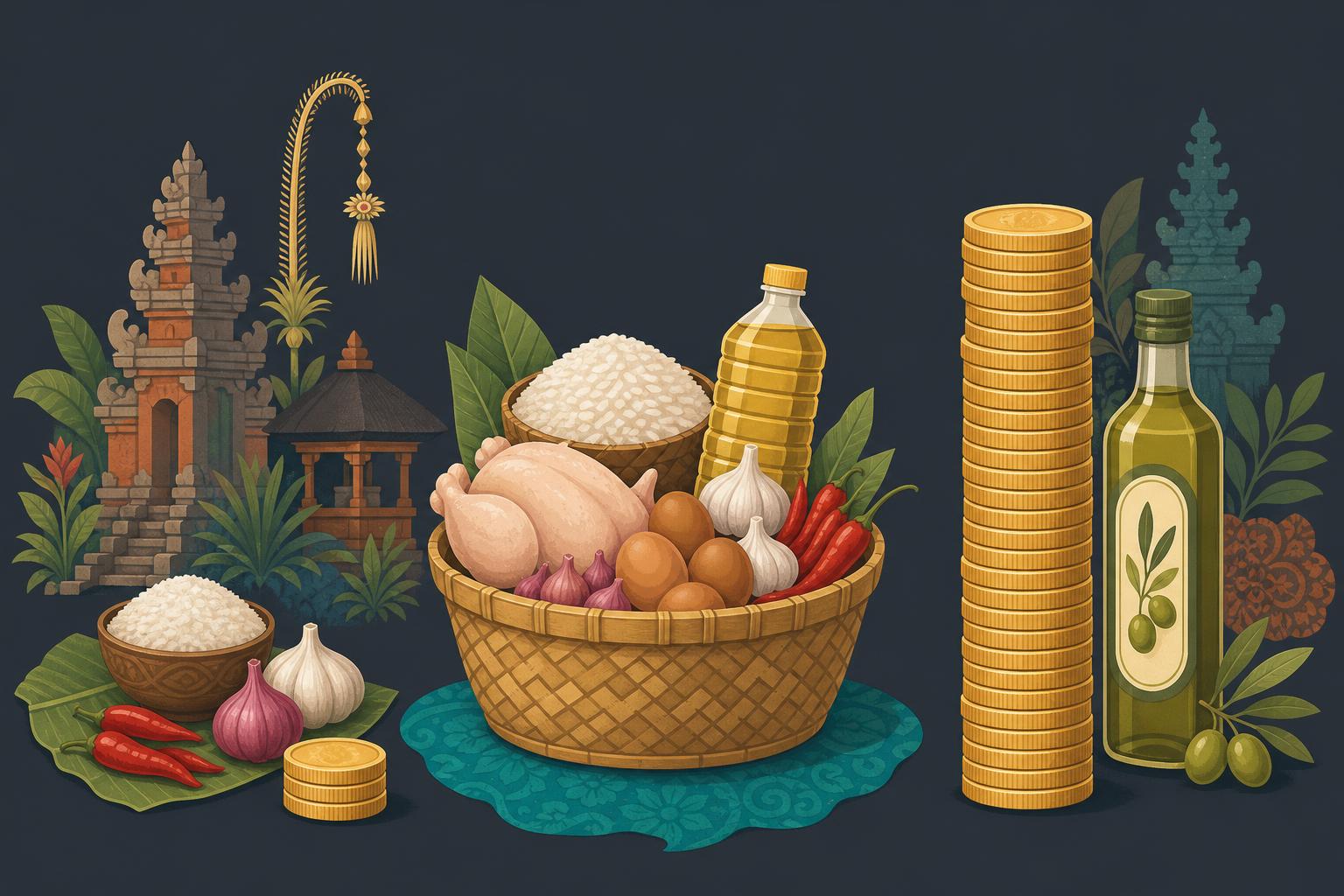
Verdict: false for an import-heavy basket. Local staples and imported specialty goods do not belong in the same price category. The gap can be substantial, but a single grocery total cannot be inferred from one or two products.
For context, Bali’s provincial monitoring on 8 November 2026 reported average medium-I rice at Rp15,113 per kg and broiler chicken at Rp42,172 per kg across its 60-market network, with shallots at Rp27,552 per kg, garlic at Rp30,782 per kg and red bird’s-eye chillies at Rp56,629 per kg. Trade Ministry SP2KP readings reproduced by Katadata on 14 October 2026 included chicken eggs at Rp27,714 per kg, premium packaged palm cooking oil at Rp22,185 per litre and loose granulated sugar at Rp17,978 per kg. These are dated market observations, not guaranteed supermarket prices or regulated maximum prices. Separately, Bapanas lists Bali’s Zone I retail ceilings under Decision No. 299/2025 at Rp13,500 per kg for medium rice and Rp14,900 per kg for premium rice; those ceilings should not be confused with observed shop prices.
Imported products can sit far outside that local-staple context. A Pepito promotion dated 1 September 2025 listed Borges Extra Light/Pure olive oil at Rp153,900 for 500 ml at selected stores, while the 14 October 2026 SP2KP reference for premium packaged palm cooking oil was Rp22,185 per litre. These are different oils, dates and retail circumstances—not a like-for-like current comparison—but they clearly illustrate why olive oil, cheese, imported cereal, wine or branded pantry goods should be budgeted separately from a local cooking basket. Confirm current imported-product prices with the store.
What to do with this: make two lists. Price the core foods you cook every week separately from imported comfort items and specialty diet products. Then choose substitutes deliberately rather than being surprised at checkout. Bali’s October 2026 consumer-price data, reported by ANTARA from BPS figures, showed 3.87% annual CPI inflation; that overall movement is not a grocery-only inflation rate. On 22 September, Denpasar’s government identified rice, cooking oil, eggs, water spinach, beef, red bird’s-eye chillies, pork and local oranges among commodities putting pressure on prices that month, another reason not to claim one island-wide household basket.
Grocery delivery apps eliminate the need to plan ahead
Verdict: false. Delivery is excellent for a missed ingredient, a heavy household item or a day when leaving home is impractical. It does not guarantee the same stock, substitutions, operating hours or delivery charge at every address.
GrabMart connects customers with nearby minimarkets, supermarkets and local markets for groceries and daily necessities. It offers immediate and scheduled orders, but availability follows the individual merchant’s opening hours. Basket minimums vary by shop, location and ordering time, with a small-order fee below the applicable minimum; delivery fees vary with the store’s location and are displayed before ordering.
GoMart is also available in Bali, according to Gojek’s current service-area guidance. Check the delivery address and available merchant in-app before ordering: stock, opening hours, fees and promotions can change. Gojek’s national service-area page publishes hours in WIB, not a verified Bali-local opening schedule, and individual stores may differ. Delivery-time claims are platform targets, not promises for a large basket, rain, traffic or a rural address.
What to do with this: save a few frequent-order lists—breakfast, cleaning supplies, a basic dinner and water-related items—but use delivery as a backup layer. For an unfamiliar address, place one small test order before relying on it for a move-in shop.
QRIS means you can leave cash at home
Verdict: mostly false. Digital payment is widespread, but it is not universal. Bank Indonesia figures reported by ANTARA put Bali at approximately 1.1 million QRIS merchant outlets and 1.15 million users by February 2026.
The everyday rule remains: ask bisa QRIS? (“Can I pay by QRIS?”), rather than assuming a stall can accept it. Larger shops may offer more cashless options, while a small market stall, a warung or a refill depot may prefer cash. A foreign card, Indonesian bank account, QRIS-capable payment method and cash wallet are not interchangeable tools. Bank Indonesia’s current Indonesian-language guidance lists cross-border QRIS partners Malaysia, Thailand, Singapore, Japan, South Korea and China, but foreign-app acceptance depends on supported providers and participating merchants—not merely having an overseas bank account. Japan’s listing alone does not confirm that Japanese payment apps can pay Bali merchants.
What to do with this: carry small rupiah notes for markets and incidental purchases, especially outside Denpasar and Badung. Keep enough change for a short shop rather than handing over a large note for a very small item.
A galon refill is a set-and-forget household task
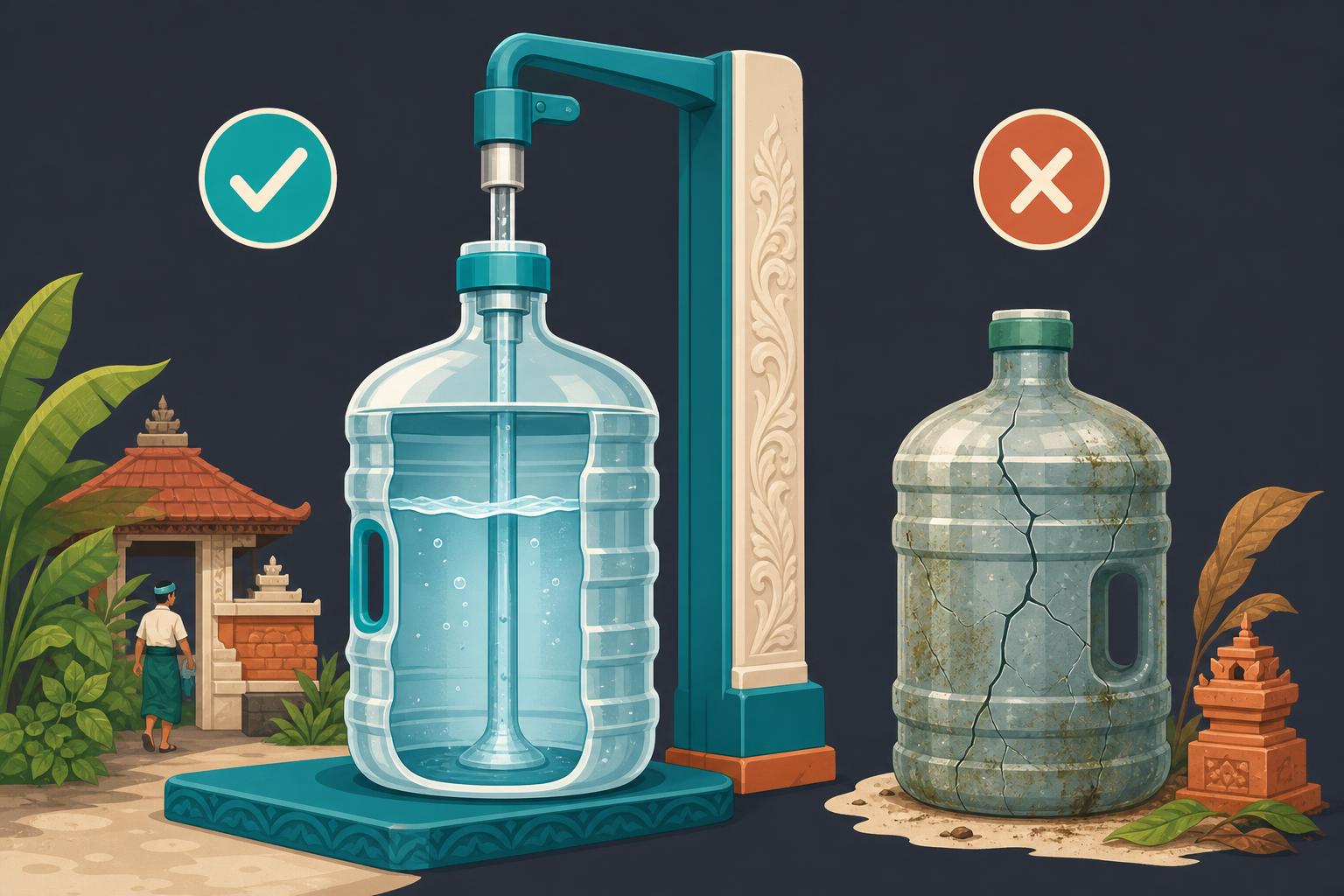
Verdict: false. Refill drinking water is a normal household routine, but the reusable container is part of the safety question. A refill depot can fill a customer’s container or one supplied by the depot. Official health-service inspection criteria require depots to inspect containers and refuse unsuitable ones; this does not establish that every depot’s water is independently verified safe.
Use a clean, serviceable galon and ask the depot whether it sanitises the jug before refilling. If the container is damaged, dirty or has an uncertain history, address that before treating it as part of the household water supply. Do not rely on the former dedicated 2014 refill-depot hygiene regulation: it was revoked by Permenkes 2/2023, effective 12 January 2023. Permenkes 3/2026 then partially revoked the 2023 regulation effective 11 March 2026, retaining specified articles and its annex.
Water is also a move-in detail worth clarifying with a host: whether a jug is supplied, where refills are normally obtained, and where the full container is stored. This sits alongside the wider practical question of what a rental includes, covered in this guide to Bali villa rental inclusions.
What to do with this: make water part of the first-day setup, alongside food, cleaning products and a way to pay. It is a recurring household need, not an occasional supermarket purchase.
One fixed monthly food budget works for every Bali resident
Verdict: outdated. There is no honest single number for “monthly food costs in Bali” that covers a local-cooking household, frequent restaurant meals, imported brands, dietary requirements, delivery charges and different locations. BPS Bali publishes an official table for average monthly per-capita food and non-food expenditure by regency/city and urban/rural area, but the accessible page does not expose the underlying numeric values. Without verifying that table, it should not be used to quote a monthly food figure.
Instead, create your own first-month baseline. Record each expense under four headings:
- Local staples and produce: rice, vegetables, fruit, protein, cooking oil and spices.
- Imported and specialty food: products you cannot easily replace in a local basket.
- Prepared food: warung meals, cafés and take-away purchases.
- Household consumables: drinking-water refills, cleaning supplies and toiletries.
Keep delivery fees visible rather than folding them into food. After several ordinary weeks, you will know whether the real pressure comes from imports, eating out, convenience orders or waste from buying too much fresh food. That evidence is more useful than a generic online budget.
What to do with this: begin with a modest pantry, learn which nearby sellers suit your routine, and review your own receipts after the first month. The food budget becomes predictable when it reflects how you actually live, not how another resident shops.