

You can arrive in Bali with a clear medication plan: a checked active ingredient, the permitted personal supply, documents ready for inspection, and a practical route for continuing treatment locally. Start this work before booking your flight, not while packing.
The preparation time depends on the medicine. An ordinary prescription medicine may need a straightforward document pack, while a psychotropic, a possible narcotic, or a cannabis-related product needs early written confirmation. This guide reflects research available on 10 November 2026 and is informational, not medical or legal advice.
- List every active ingredient, including medicines taken only when needed.
- Classify each product under Indonesian controls before deciding whether it can travel.
- Prepare a baggage supply and document pack that matches the applicable rule.
- Declare medicines on arrival and keep them available for Customs inspection.
- Arrange ongoing care in Bali through an Indonesian-licensed doctor and pharmacy.
Phase 1: Make an active-ingredient inventory before you pack for Bali
Write down what is actually in each medicine
Brand names travel badly across borders. The first task is to make a medicine inventory using the active ingredient or generic name shown on the label, rather than relying on a familiar brand. Include the strength, form, dose, frequency, why it is prescribed, and the number of units you intend to carry.
Do this for daily tablets, inhalers, creams, injections, sleep medicines, ADHD medicines, pain medicines, anxiety medicines, and anything bought over the counter at home. A product that seems routine in one country can be controlled differently in Indonesia.
Separate ordinary medicines from medicines needing a control check
Do not use broad labels such as “strong painkiller,” “opioid,” “ADHD drug,” or “sleeping pill” as your answer. Check the exact active ingredient against Indonesian controls. Methylphenidate is a Group II psychotropic under Ministry of Health Regulation 14/2025, and zolpidem and nitrazepam are examples of Group IV psychotropics. This does not mean every medicine in those treatment categories receives the same treatment.
Cannabis needs a particularly cautious approach. Cannabis plants, their parts and processed products, plus THC and its isomers, are classified as Group I narcotics. A medical-cannabis prescription from another country does not make a cannabis- or THC-containing product bringable through the personal passenger-medicine route. CBD products are also illegal in Indonesia, including medicinal products, according to current U.S. government travel guidance; do not bring them.
Ask BPOM before flying when there is any doubt
BPOM’s Special Access Scheme guidance is the starting point for passenger medicines. It distinguishes ordinary medicines, psychotropics, narcotics and precursors, and it makes clear that personal import is for personal use only, not resale or “jastip” informal personal-shopping arrangements. Read the current BPOM passenger-medicine guidance, then obtain written clarification for a borderline or controlled ingredient. BPOM lists WhatsApp +62 812-1298-7545 and [email protected] for personal-medicine import questions.
Do not assume a doctor’s letter solves every category. It is supporting evidence, not permission to carry a substance that BPOM does not permit through passenger baggage.
Phase 2: Decide whether your medicine can enter Indonesia in passenger baggage
Use the ordinary-medicine baggage thresholds correctly
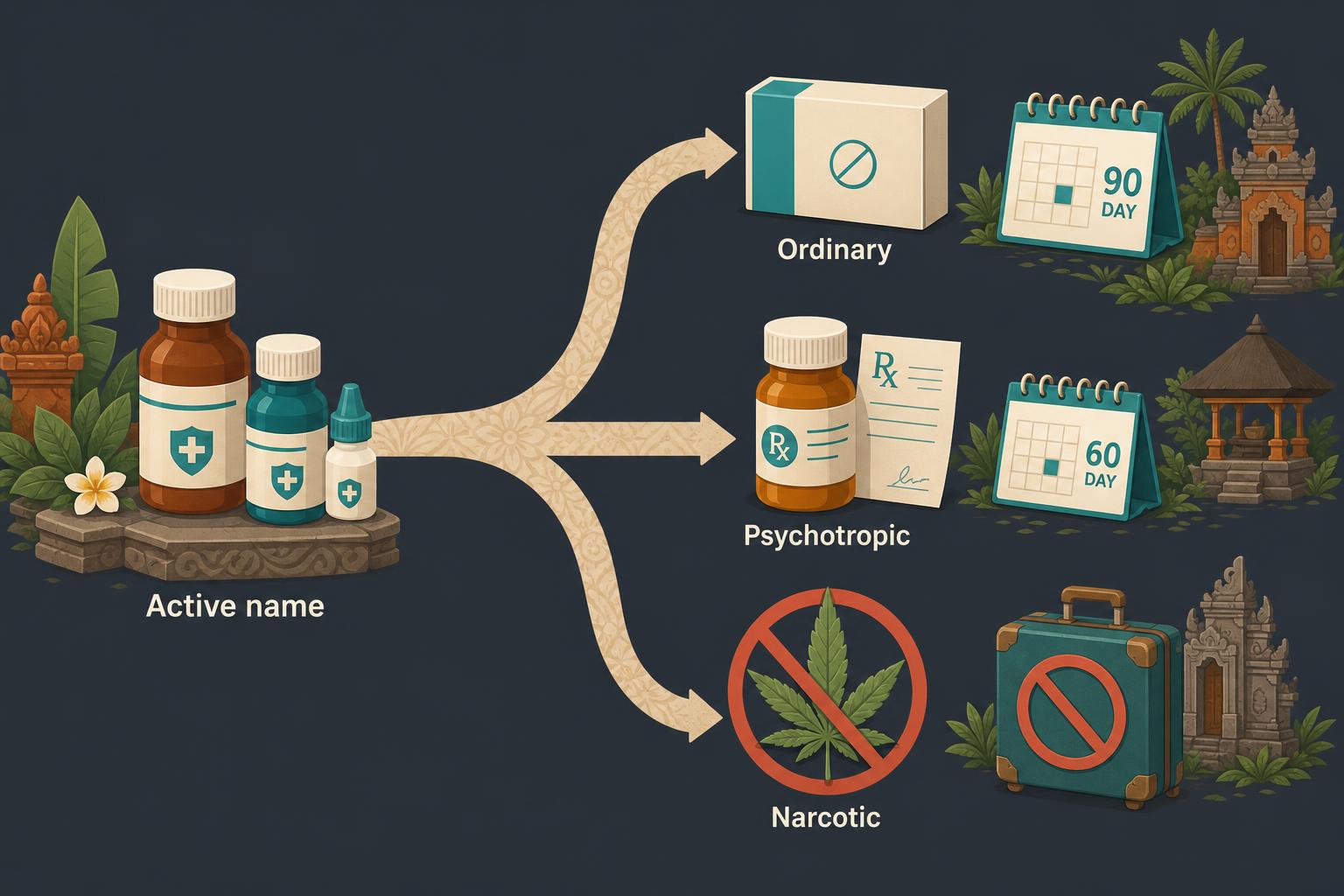
For ordinary medicines in baggage, BPOM’s current no-prescription thresholds are 30 individual solid units per product—tablets, capsules or pills, not boxes—three semisolid units, three liquid units, or three aerosol units. Above those thresholds, a doctor’s prescription in English is required, and the maximum quantity is a 90-day treatment supply.
Carry a prescription and doctor’s letter for every prescription medicine, even when your quantity is below a threshold. Do not automatically apply these allowances to insulin, injectable hormones or other injections; obtain product-specific confirmation from BPOM before travel.
Psychotropics have a stricter route and shorter supply
Psychotropic medicines in Groups II, III and IV may be carried in baggage only by foreign nationals, only with a doctor’s prescription in English, and only up to 60 days’ treatment. They cannot be posted or couriered into Indonesia. If your ADHD or sleeping medicine is psychotropic, plan around that 60-day ceiling rather than packing a longer relocation supply.
For internationally controlled medicines, a useful physician letter identifies the patient, generic name, amount and treatment duration. BPOM’s passenger guidance specifies an English-language prescription for the permitted psychotropic supply. The International Narcotics Control Board’s traveller guidance for controlled medicines is valuable because transit-country requirements can differ from Indonesian ones.
Narcotic medicines cannot use the personal baggage route
BPOM’s current guidance says narcotic medicines and narcotic precursors are not permitted through the personal passenger-baggage route from abroad. They also cannot be sent by post or courier. A prescription, a doctor’s letter, original packaging, or an overseas medical-cannabis authorisation does not override that prohibition.
This is not a detail to negotiate at an airport counter. Customs identifies narcotics, psychotropics, precursors and medicines as items that may trigger physical inspection, and lists narcotics and psychotropics without permission among prohibited passenger items. Unlawful narcotic import carries serious criminal penalties; older penalty figures require fresh legal verification following Law 1/2026 on Criminal Penalty Adjustments. Read the official Customs passenger-goods FAQ and obtain specialist advice before travel if your treatment may involve a narcotic. BPOM’s 17 July 2026 statement confirms that Customs retains authority to release or detain medicines, even where BPOM provides a technical recommendation.
Phase 3: Build a medicine document pack and baggage supply that Customs can assess
Keep each product identifiable
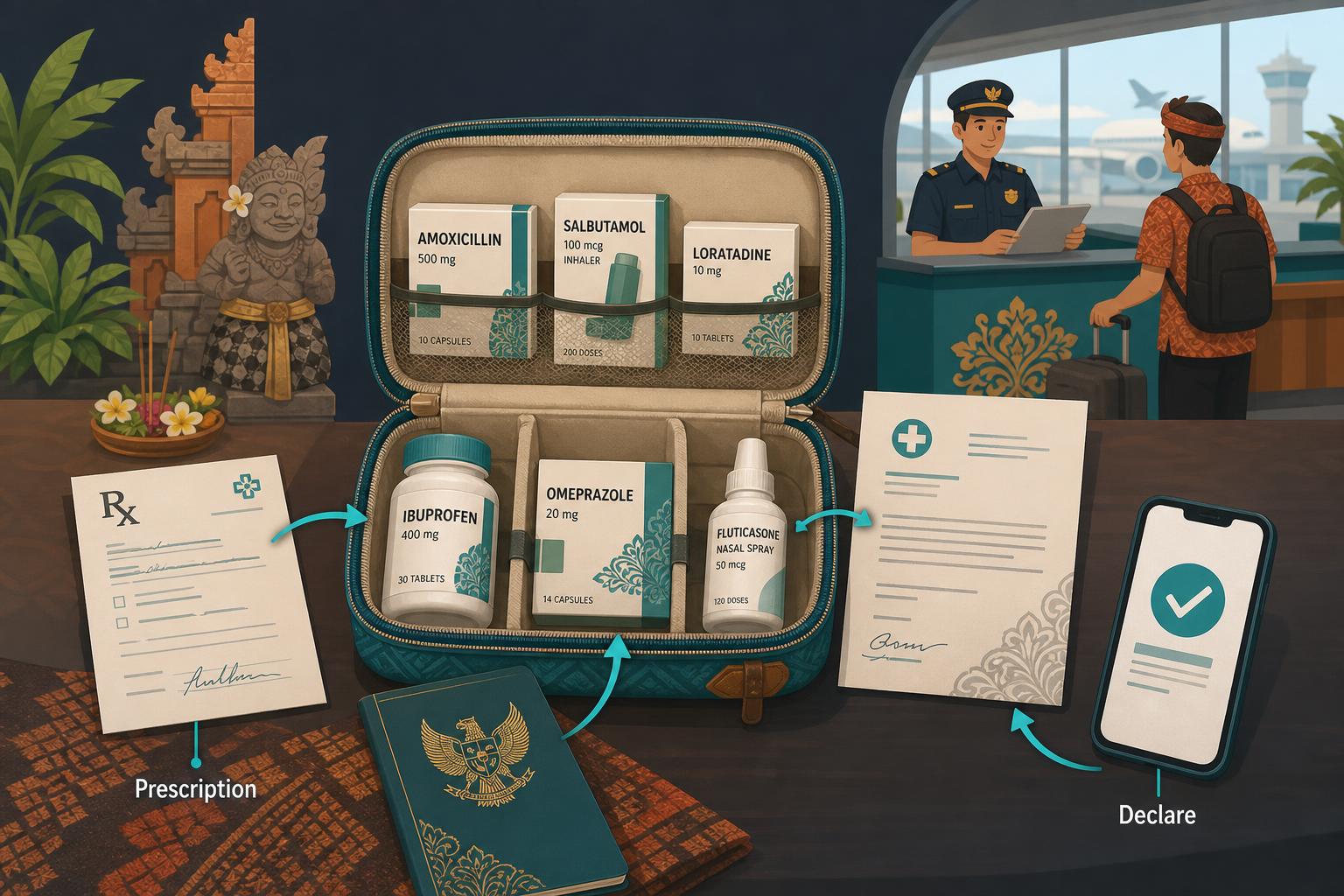
Pack medication in its original labelled packaging, as specified in current U.S. government travel guidance. This is prudent evidence of what the product is and who it was supplied to; it is not a workaround for prohibited narcotics. Avoid loose tablets in an unmarked organiser for the flight and arrival process. If you use a pill organiser day to day, carry the labelled original containers alongside it.
Prepare one readable doctor’s letter
Ask the clinician who prescribed or supplied the medicine to provide a letter in English identifying your passport-matching name, active substance, prescribed daily dosage and confirmation of personal use. The Indonesian embassy’s guidance says medical documents do not require embassy legalization. BPOM defines the supporting prescription for import documentation as one issued by the overseas doctor providing treatment in the medicine’s country of origin. Keep paper and offline digital copies in your carry-on bag.
| Carry-on item | What it should show | Why it matters |
|---|---|---|
| Original labelled package | Product and active ingredient | Links the physical medicine to your records |
| Prescription copy | Patient, medicine and prescribing clinician, in English | Supports personal medical use |
| Doctor’s letter | Passport-matching name, generic name, daily dosage, amount, treatment duration and personal use | Useful for controlled-medicine assessment |
| BPOM written response | Exact product or ingredient question | Evidence for borderline cases |
| Transit and airline checks | Route-specific requirements | Indonesia is not the only jurisdiction on the trip |
Check the whole itinerary, not only Bali
A transit airport can involve separate national controls, and your carrier may have its own rules for medicines, liquids or medical equipment. Check every transit country independently before departure. Do not send controlled medicines ahead by courier as a substitute for baggage: psychotropics, narcotics and precursors are excluded from that route.
If you are still choosing a home base, leave time for medical appointments and pharmacy visits during your first weeks. A short initial stay found through Livuma’s Bali rental search can help you settle before committing to a longer arrangement; listings show stay conditions and availability.
Phase 4: Declare prescription medication when you arrive at Ngurah Rai Airport
Complete the All Indonesia arrival declaration
International passengers arriving at Bali’s I Gusti Ngurah Rai International Airport have been required to use the integrated All Indonesia arrival declaration since 1 September 2025. It includes the Customs Declaration, so a separate electronic customs declaration is unnecessary, and can be completed free of charge from three days before arrival through arrival day. Current U.S. government travel guidance says all prescription medicines must be declared through All Indonesia. BPOM says passengers carrying medicines should declare them, follow the quantity limits, and show a prescription if requested during a Customs inspection.
Be accurate rather than trying to decide that a prescribed medicine is too unimportant to mention. Keep the medicine, prescription and doctor’s letter together in carry-on baggage so they can be produced without searching through checked luggage.
Answer by ingredient, quantity and personal use
If asked, explain the generic ingredient, that it is for your own treatment, the quantity carried, and the treatment duration. Do not describe medication vaguely, transfer it to someone else, or offer to carry medicine for another person. Personal import is not a route for resale or informal delivery.
Do not discard a prohibited product at the last minute and hope for the best
Where a product is clearly not permitted, do not fly with it. Resolve the issue before departure with BPOM and the clinician managing your care. The practical cost of preparation is time spent verifying ingredients and obtaining documents; the legal risk of guessing with a controlled substance is disproportionate.
Phase 5: Set up a lawful refill plan with a Bali doctor and pharmacy
Bring your clinical history to an Indonesian-licensed doctor
An overseas prescription is useful evidence of your treatment history and for import documentation, but it should not be treated as directly refillable at an Indonesian pharmacy. Under the current Ministry of Health rule, Indonesian prescriptions are made by a medical professional holding a local Surat Izin Praktik (SIP). The compliant path is a consultation with an Indonesian-licensed doctor, disclosure of your diagnosis and overseas records, then dispensing at a licensed facility on the Indonesian prescription.
For narcotics and psychotropics, Article 78(6) of Ministry of Health Regulation 5/2026 excludes electronic prescribing at facilities providing telemedicine; it is not a blanket ban on every electronic prescription in every setting. Plan an in-person clinical route rather than assuming an app consultation can continue every controlled medicine.
Find facilities through official directories, not social-media sellers
Use the official SATUSEHAT health-facility directory to identify registered hospitals, clinics, pharmacies and independent practices in Bali. Its facility information draws on national health-facility and workforce systems, making it a stronger starting point than an unverified delivery account or a seller in a messaging group.
Indonesian rules require prescription-only medicines, including hard drugs, narcotics and psychotropics, to be dispensed by a pharmacist or pharmacist specialist on prescription at a pharmaceutical-service facility. BPOM’s explanation of Regulation 5/2026, which replaced Regulation 24/2021, also requires medicines circulated through regulated outlets to have marketing authorization and places pharmacy medicine management under the responsible pharmacist. Drugstores, supermarkets and minimarkets cannot handle prescription-only medicines, narcotics or psychotropics. Do not buy prescription medication from informal sellers, even if they claim overseas products are easier to obtain.
Ask about availability without assuming registration means stock
Indonesia’s BPOM registry includes methylphenidate products, including a methylphenidate 10 mg generic and Concerta 36 mg with a listed licence date of 31 August 2024. Registration does not show whether a particular Bali pharmacy holds stock. Ask the doctor and licensed pharmacy about the locally available active ingredient and formulation only after the consultation.
If an essential non-controlled medicine is medically needed but unavailable locally, ask BPOM and your Indonesian-licensed doctor about a lawful supply plan before arranging any shipment. Current U.S. government travel guidance advises against mailing medicines to Indonesia because recipients may face detention or arrest. Do not rely on postal refills for continued care. Narcotics, psychotropics and precursors cannot be sent by post or courier.
Phase 6: Make your Bali housing plan support ongoing treatment
Choose a move-in sequence that leaves room for appointments
For a long relocation, avoid making your medication plan depend on a same-day refill after landing. Keep enough lawful supply for the period allowed by the applicable rule, schedule the local consultation early, and retain copies of every document and Indonesian prescription you receive.
When comparing longer rentals, consider how you will reach a clinic or pharmacy on an ordinary day, not only the view or coworking distance. Explore long-term rentals in Sanur or long-term rentals in Ubud when those locations suit your routine.
Keep treatment and tenancy records separate but organised
Your prescription records are private medical documents. Your rental agreement should separately record the home, payment schedule and move-in terms. Keep your housing record separate while you keep medical documents in your own secure file.
For the practical home setup after arrival, also review what a monthly Bali rental actually includes before assuming services or bills are covered.
Use a stop-and-check rule whenever treatment changes
Repeat the active-ingredient check when your doctor changes a dose, formulation or medicine. A change from one brand to another can mean a different controlled status. For any uncertainty, pause the travel or import plan and seek written BPOM confirmation before the product enters your luggage.
Bottom line: Bring only medicine you have verified by active ingredient, carry a prescription and doctor’s letter, declare it on arrival, never treat controlled-drug rules as optional, and establish local care through an Indonesian-licensed doctor and legitimate pharmacy.