
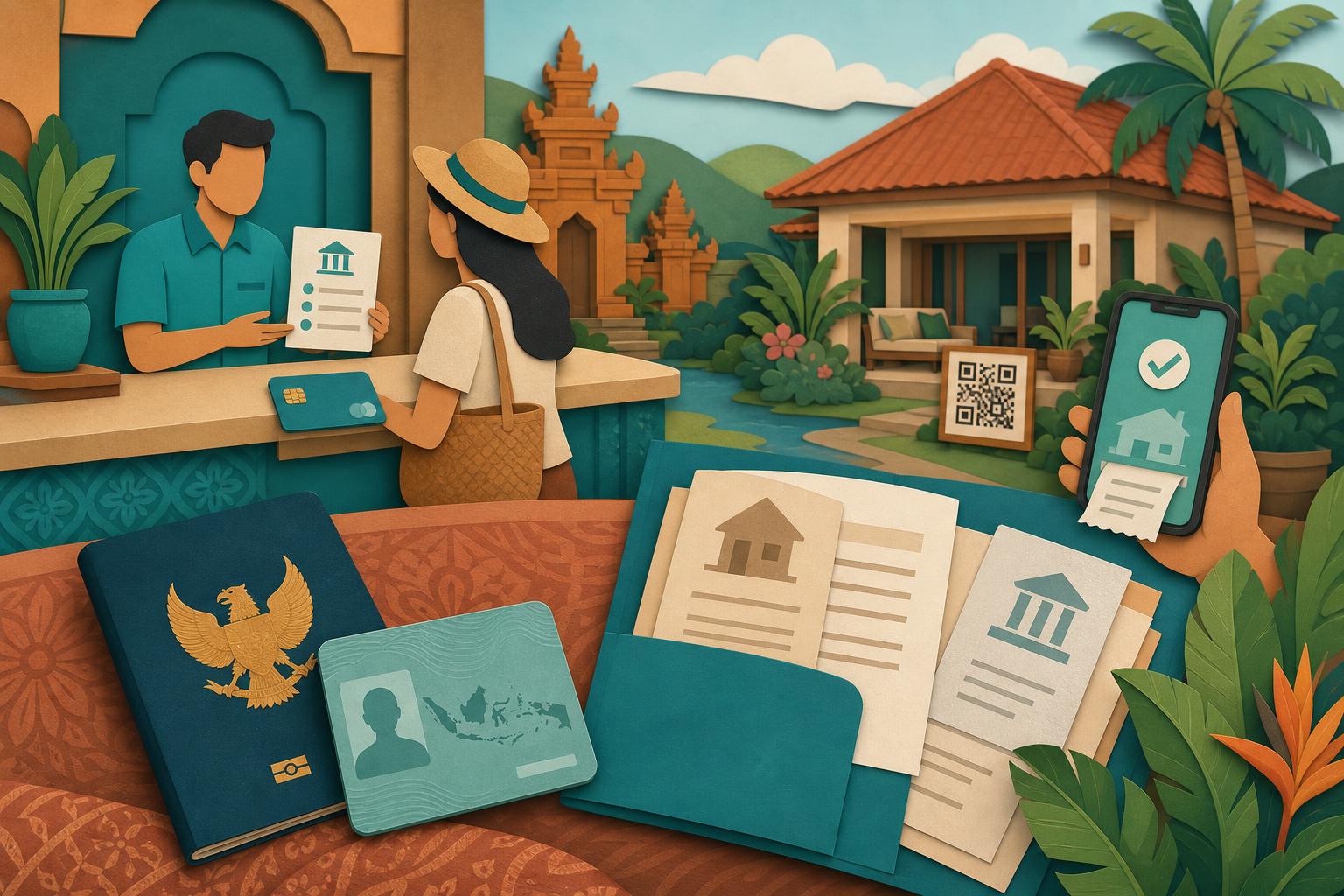
Opening a local bank account changes the texture of daily life in Bali: rent can be paid from your own name, a warung QR code becomes usable, and transfer receipts are easier to keep with a lease file. It is not, however, a formality that every arriving visitor can expect to complete on the first afternoon.
The practical dividing line is whether you are domiciled in Indonesia with a KITAS or KITAP. Banks assess the customer, the account product and the supporting documents together, so this guide separates what published bank requirements clearly support from what remains branch-dependent.
Can a foreigner open an Indonesian bank account in Bali?
Yes, a foreigner domiciled in Indonesia with a KITAS or KITAP is the clearest case for opening a standard local account. BCA’s published Tahapan requirements list a passport plus KITAS/KITAP for foreign citizens domiciled in Indonesia. BTN’s published requirements for foreign customers opening a Felas account also list a passport plus KITAS/KITAP. See the published BCA Tahapan requirements and BTN Felas requirements before choosing a product.
That is useful evidence of the general pattern, not a promise that every Bali branch will approve every application. The bank can assess whether your documents, residence status and expected account use fit its onboarding requirements.
KITAS and KITAP holders
Bring your passport and valid stay permit as the essential starting documents. A KITAS or KITAP gives the bank a documented basis to treat you as domiciled in Indonesia, which is materially different from arriving on a short visit.
It also makes practical sense to align the account application with the life you are building: the Indonesian address where you live, a working Indonesian mobile number, and a straightforward explanation of employment, business activity or the source of money you expect to receive and spend.
Indonesian citizens and residents
Indonesian-citizen document lists are not interchangeable with foreigner lists. For example, BCA’s Tahapan information lists NPWP for Indonesian citizens, while BTN’s Felas information lists KTP plus NPWP for Indonesian customers. Do not assume that a foreign applicant must present the same identity documents merely because they live with an Indonesian spouse, work colleague or housemate.
Tourists and other short-stay visitors
A tourist or visit-visa holder should not treat a standard rupiah account as guaranteed. BCA says a foreigner not domiciled in Indonesia may be asked for additional documents under anti-money-laundering, counter-terrorism-financing and proliferation-financing rules. That wording leaves approval and document requests to the bank’s assessment.
There is a narrow published exception for one BCA Dollar account: a foreigner without KITAS/KITAP who is not already a BCA customer may open one with additional required documents, an initial deposit of USD2,000 equivalent and a maximum balance of USD50,000 equivalent. BCA may block incoming credits when that balance limit is exceeded. It is a foreign-currency product condition, not a general assurance that a visitor can obtain an everyday local rupiah account. Read the BCA Dollar terms carefully and confirm with the branch that it will process this exception before relying on it.
Documents to prepare before visiting a Bali bank branch
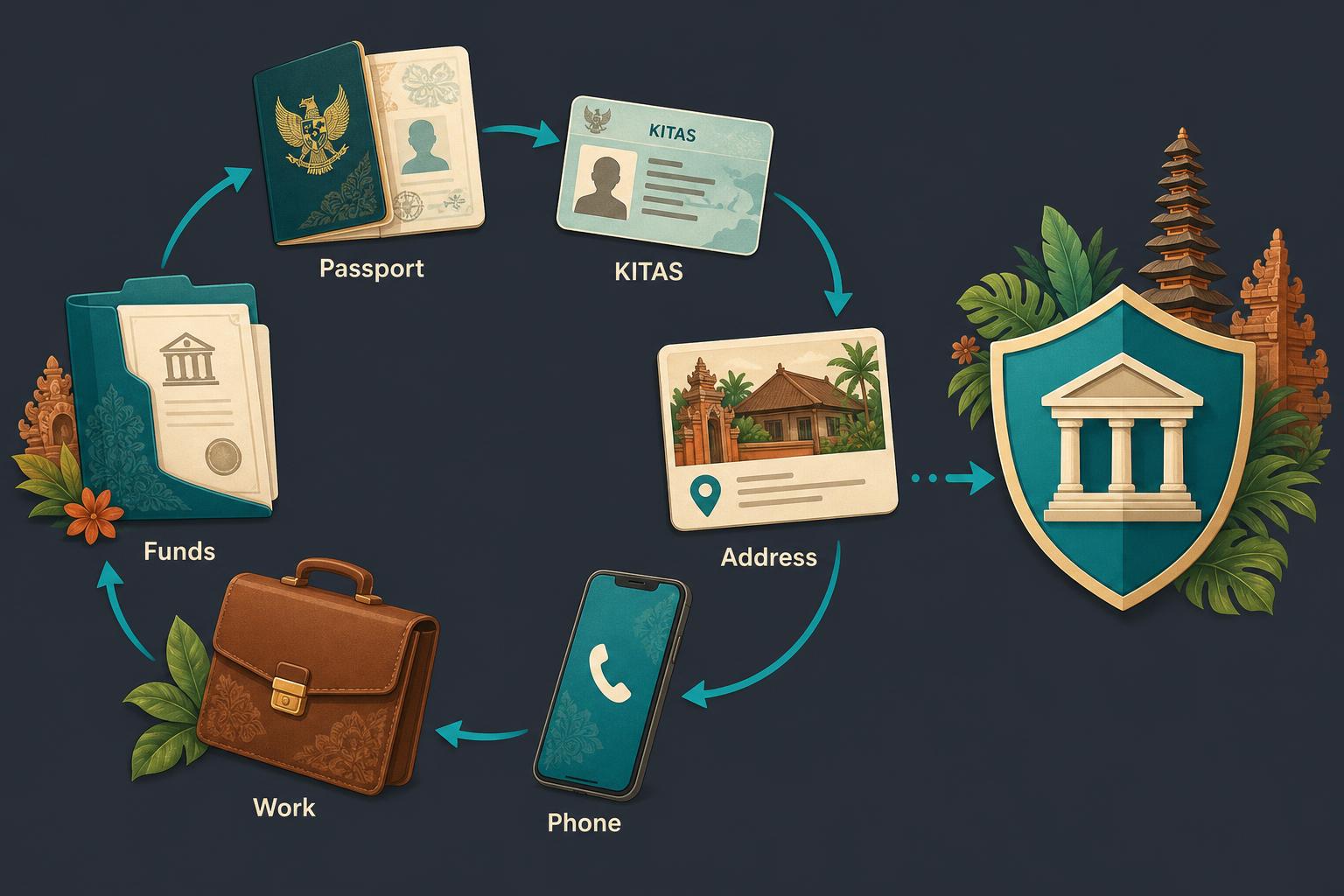
Prepare a neat application pack, but describe it accurately: passport and a valid stay permit are directly supported by major-bank foreigner documentation. Other items are information or evidence a bank may request during onboarding, rather than universal legal requirements for every account and every branch.
- Passport: bring the original and be ready to provide the details the bank requests.
- Valid KITAS or KITAP: the central supporting document for a foreigner domiciled in Indonesia.
- Local domicile address: have the address you actually use in Bali ready, including the relevant property details.
- Indonesian phone number: useful for account communications and mobile-banking setup.
- Work or business details: be ready to explain what you do and the account activity you reasonably expect.
- Tax information: bring NPWP details where applicable, but do not state that every foreign applicant must already hold an NPWP.
- Source-of-funds evidence: keep supporting material available if the bank asks how funds are earned, transferred or used.
For a renter, keep the signed lease, property address and landlord or authorised payee details together. A lease can help make your local address and expected rent transfers easy to explain; it does not replace the passport and immigration documents a bank requires.
If you are still choosing a home, compare live rentals by area, term, price and amenities through Livuma’s Bali rental listings. The property address, payment dates and named parties should be settled in the rental paperwork before you present a housing arrangement as part of your banking profile.
Minimum opening deposits and account-product details should be checked, not guessed
Do not arrive with an assumed universal minimum deposit. It changes by bank, currency, product and opening route. Published examples are useful only for the exact products they describe.
- BTN Felas: the published initial deposit for opening at a branch is USD100 or SGD100. BTN’s online flow states a USD10 minimum. Both routes require an existing BTN Batara account; online applicants must also have activated balé by BTN.
- BCA Dollar: the ordinary published minimum initial deposit is USD100 or SGD200; foreigners opening without KITAS/KITAP must instead deposit USD2,000 equivalent.
- BCA Tahapan: the opening deposit is Rp500,000 and the minimum retained balance is Rp50,000. A Blue Mastercard costs Rp15,000 per month; a separate Rp5,000 penalty applies if the monthly average balance falls below Rp100,000. See the published product details.
- Mandiri Livin’ passport-based account: the minimum opening deposit is Rp100,000.
- Mandiri Tabungan Valas: the USD account has a US$100 initial deposit and US$100 minimum balance, according to its published requirements.
Ask the branch for the current minimum opening balance, balance-maintenance conditions, card availability, transaction charges, mobile-banking activation steps and supported currencies for the product you are considering. A foreign-currency account and a daily rupiah transaction account solve different needs.
Also distinguish opening an account from funding it. The bank may ask questions about incoming money, expected transfer sizes or account purpose as part of its customer assessment. An unusually vague answer, conflicting story or unsupported source of funds can create delays even if you have the basic identity documents.
Bank KYC in Indonesia means identification, verification and ongoing account monitoring
People commonly call the onboarding process KYC, but Indonesia’s anti-money-laundering framework uses the term CDD, or Customer Due Diligence. OJK describes CDD as identification, verification and monitoring designed to ensure transactions match the customer’s profile; higher-risk customers may undergo Enhanced Due Diligence. The current framework is POJK No. 8/2023, effective 14 June 2023, which replaced POJK No. 12/2017 and its 2019 amendment. Article 26(2)(b) requires a foreign customer’s passport accompanied by immigration documentation; its explanation gives a stay-permit card as an example rather than prescribing KITAS/KITAP for every product.
In a branch conversation, that can mean the bank asks ordinary but specific questions:
- Where do you live and why are you in Indonesia?
- What is your employment or business activity?
- What funds will enter the account, and from where?
- What payments do you expect to make, such as rent or everyday spending?
- What tax details apply to your situation?
Answer consistently and use documents that match the explanation. CDD is not a one-time hurdle that ends at account opening: the bank monitors whether subsequent activity makes sense for the profile it has recorded. That is a reason to avoid letting an acquaintance use your account for unrelated payments or accepting unexplained third-party funds.
Why a local address and source-of-funds explanation matter
A local address, Indonesian phone number and clear source-of-funds story make an application easier to assess. They are not a shortcut around stay-permit requirements, and they should never be fabricated to make an account application look more local than it is.
For foreigners, tax position can become relevant to the information a bank requests. Indonesian tax rules say that a foreigner can become an Indonesian domestic tax subject when resident in Indonesia, present for more than 183 days in any 12-month period, or present in a tax year with intent to reside. The 183 days need not be consecutive, and partial days count as full days. A KITAP, a VITAS or ITAS valid for more than 183 days, a work or business contract exceeding 183 days, and a residential lease exceeding 183 days are listed examples of evidence of intent to reside. For the detail, read the Directorate General of Taxes’ tax-residency rule.
Tax residence and bank onboarding are related practical topics, but neither replaces the other. Bank staff cannot provide a personal tax determination simply by opening an account.
Mobile banking, debit cards and account access need a setup check at the branch
Before leaving the branch, ask how the bank will give you access to your account: mobile banking, debit card, ATM use, transfer confirmation and any device-registration steps. Do not assume every product has the same card or app features, especially where the account is in foreign currency or opened under a particular customer category.
Secure the basics from day one:
- Use the Indonesian number you can reliably keep active for account communications.
- Keep your registered address and contact information current.
- Set up official app access only through the bank’s stated process.
- Never send account credentials, PINs or approval codes to a landlord, agent, vendor or supposed bank representative.
- Save receipts and transfer confirmations alongside rent and utility records.
Online onboarding is available to eligible foreigners, but requirements depend on the bank and route. Mandiri’s Livin’ foreign-customer registration requires a passport with at least six months’ remaining validity and valid ITAS, ITAP or Golden Visa documentation. It requests residential address and current employment information, plus a fund-ownership declaration, a foreign-taxpayer declaration and document uploads. Its published FAQ excludes citizens of Russia, Iran, North Korea, Belarus, Ukraine and Syria from this online route. This is a restriction on that registration route, not an Indonesia-wide banking ban; confirm your eligibility with the bank. BCA’s guidance about opening an account online with an international mobile number specifically concerns Indonesian citizens who remain registered as Indonesian citizens. It should not be cited as a way for a foreign visitor or KITAS holder to bypass foreign-customer onboarding.
BI-FAST and QRIS make everyday Bali payments easier once the account is active
For domestic transfers, BI-FAST is Bank Indonesia’s real-time payment infrastructure, available 24/7. Its individual credit-transfer service supports transfers using an account number or a proxy address based on a mobile number or email address. Bank Indonesia’s published customer-charge cap for a standard individual BI-FAST transfer is Rp2,500 per transaction, although a participating bank may charge less. The system ceiling is Rp250 million per transaction; participating institutions may impose lower limits. See Bank Indonesia’s infrastructure guidance.
For in-person payments, QRIS is Indonesia’s national QR-payment standard. Payment service providers that offer QR-code payments are required to use QRIS. In practical terms, the same familiar QR format can appear at a café, shop or service counter, subject to what your bank or payment provider supports. QRIS can draw on server-based e-money as well as bank accounts, so an Indonesian bank account is not universally necessary. Bank Indonesia sets a Rp10 million per-transaction ceiling; providers may impose additional daily or monthly limits. Consumers should not be charged an additional fee for ordinary QRIS purchase payments, as explained in Bank Indonesia’s QRIS guidance.
QRIS TUNTAS also enables transfers between QRIS users and cash withdrawal or deposit through participating ATM/CDM machines or approved agents, with availability depending on the provider. Its published off-us transfer charge is Rp2,500, or Rp2,000 for transfers up to Rp100,000, and its transaction limit is Rp10 million. The Bank Indonesia QRIS page is the authoritative place to check the scheme and participating-service context.
For rent, use the payment rail the lease identifies and keep the confirmation. A fast domestic transfer is convenient, but speed does not cure a vague agreement or a mismatched payee name.
Paying a Bali rental deposit and monthly rent from your own account
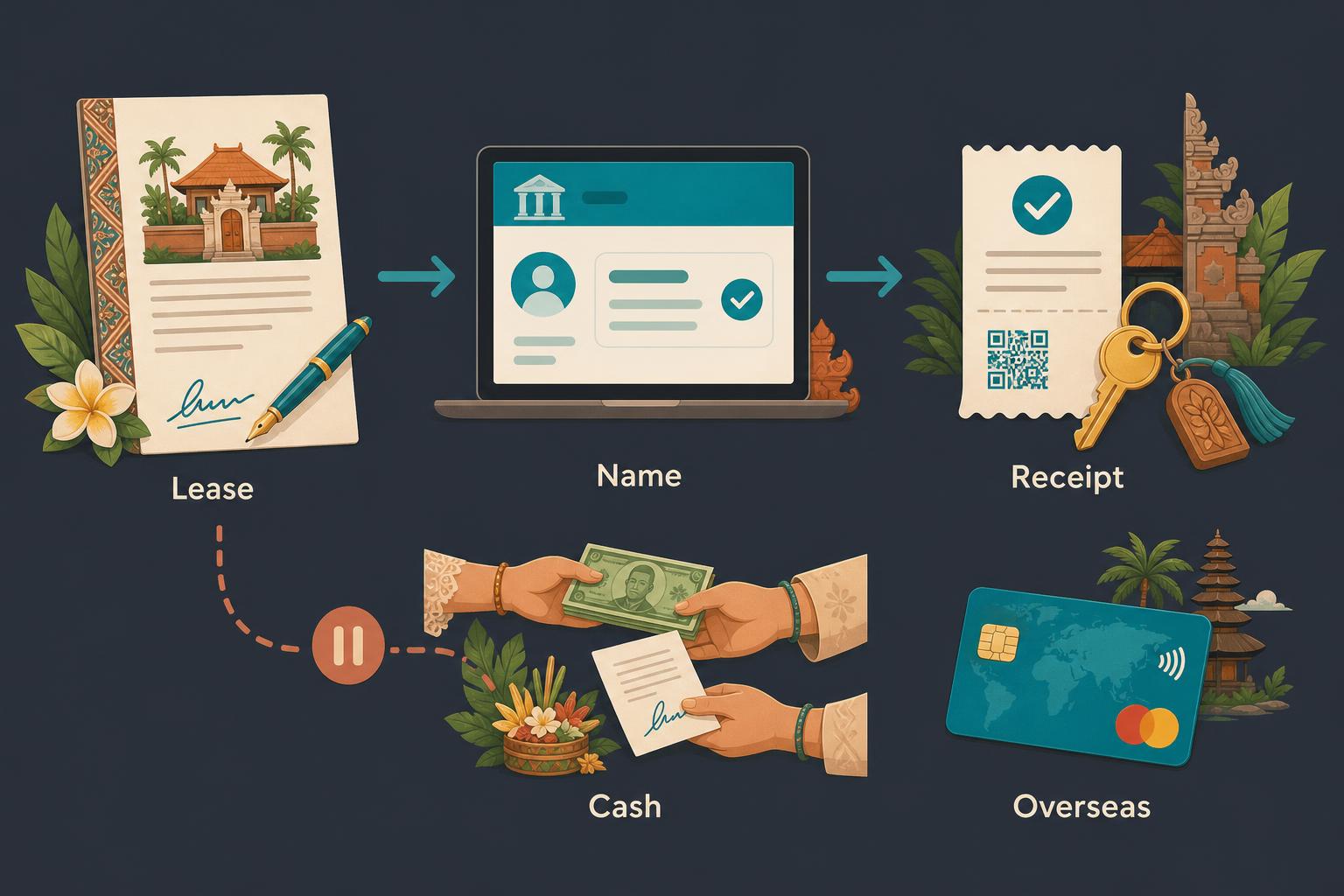
A local account is most valuable for housing when it creates a clean payment trail. Before sending a deposit or rent, obtain a written lease or receipt that identifies:
- the property;
- the landlord or authorised payee;
- the amount and due date;
- the payment period covered;
- deposit terms and refund conditions.
Check the recipient name displayed by your bank before authorising the transfer. BCA’s terms explain that displaying a recipient name and/or account number is intended to confirm the transfer and reduce mistaken transfers. If the name differs from the person named in the lease, stop and clarify it before sending money.
A request to pay an account not named in the lease is a red flag unless the landlord provides written authority and verifiable identification for the account holder. “My assistant’s account” or “the owner is overseas” may have an innocent explanation, but it is not enough on its own. The paper trail must show who is authorised to receive the money and why.
Use the payment detail as one part of a wider rental record. Our guide to what to check before signing a Bali rental contract covers the clauses that should sit behind every transfer confirmation.
Cash and overseas-transfer requests require a stronger written record
Cash is harder to trace, so avoid treating a handover of notes as self-proving. If cash is unavoidable, obtain a signed and dated receipt identifying the payer, payee, property, payment period, amount, currency, and whether the money is rent or a refundable deposit. Keep a copy with the lease.
An overseas account request is a commercial term, not something this guide can present as a nationwide Bali requirement. Bank Indonesia’s rupiah-use guidance explicitly includes residential rent among payments subject to rupiah requirements; access to a foreign-currency account does not itself exempt Bali rent payments. Ask for a written explanation, the beneficiary’s full details, the connection between that beneficiary and the named landlord, and a complete payment trail. If the request changes after you have agreed the lease, treat the change as a reason to pause rather than an administrative detail.
What to do if you transfer rent to a suspected scam account
Act immediately. Contact the sending bank or payment provider first, give it the transfer details, and ask what urgent steps it can take. Preserve the lease or chat messages, recipient account details, transfer proof, date and time, amount, and every relevant communication.
Report suspected fraudulent financial transactions immediately through OJK’s Indonesia Anti-Scam Centre and to law enforcement. Its reporting process asks for victim and recipient account details, the recipient bank or payment provider, account number, account-holder name, transaction time, amount, transfer proof and communications evidence. IASC says its purpose includes promptly delaying transactions in alleged scam accounts and attempting recovery of remaining victim funds. Start through the IASC reporting portal.
The best prevention remains a boringly complete record: a named payee, written terms, transfer confirmation and no pressure to send money before the documents make sense. For more rental-specific warning signs, read how to spot a Bali rental scam before you pay.
A practical first-week banking plan for new Bali residents
- Confirm your immigration status and collect your passport and valid KITAS or KITAP if you are domiciled in Indonesia.
- Choose an account product based on actual needs: daily rupiah spending, foreign currency, domestic transfers or rent administration.
- Prepare your local address, Indonesian number, work or business explanation, relevant tax details and source-of-funds support.
- Ask the bank to confirm its current foreign-customer requirements and minimum deposit for that exact product before travelling to the branch.
- At onboarding, answer CDD questions truthfully and consistently.
- Before leaving, check mobile-banking setup, debit-card availability, transfer features and how recipient names appear before a payment is confirmed.
- Pay rent only against written terms, to the named landlord or a documented authorised payee, and save each receipt.
This sequence is deliberately cautious. It respects the fact that a local account can simplify life in Bali without suggesting that a visitor is automatically eligible, that one document list fits every bank, or that an app transfer removes the need for a proper rental agreement.