

The real trade-off in renting in Bali without an agent is more control and direct contact versus taking full responsibility for checking the person, property and paperwork yourself. This comparison settles when a direct owner deal is sensible, when an agent adds value, and when a managed marketplace is the more practical agent-free route.
The three options are clear:
- Direct owner rental: you find a property and negotiate with the owner or their stated manager yourself.
- Agent-assisted rental: an agent introduces the property, coordinates communication and may help negotiate the arrangement.
- Platform-assisted direct rental: you deal with the host through a marketplace process rather than appointing a traditional agent.
None of these routes removes the need to read the agreement, inspect the home and understand the payment terms. What changes is who helps organise those steps and how much of the record is built into the process.
Renting in Bali without an agent: compare the three routes first
There is no identified primary-source rule requiring a residential tenant in Bali to use a property agent. A direct owner-tenant agreement is consistent with Indonesia’s general contract framework. Under Civil Code Article 1548, a lease is an agreement giving one party enjoyment of an item for a specified period in exchange for a price.
That does not mean every person holding a key is automatically entitled to rent out the home. The direct route works best when you can slow down, ask questions and create a proper record. An agent can be useful where language, distance or coordination are the main problems, but an introduction alone is not proof of authority or a substitute for a clear contract.
| Route | Who coordinates the search | Your main responsibility | Best fit |
|---|---|---|---|
| Direct owner | You and the owner or manager | Confirm authority, inspect, document every term | Tenant with time to investigate and negotiate |
| Agent-assisted | Agent, then owner or manager | Confirm the agent’s role and the owner’s authority | Tenant needing local coordination |
| Platform-assisted direct rental | Marketplace search and host communication | Assess the listing, home and booking-specific terms | Tenant wanting a recorded request and payment flow |
A written agreement still matters whichever route you choose. Indonesian contract rules require consent, legal capacity, a certain object and a lawful cause; a lawfully made agreement binds the parties. Read the underlying principles in the Civil Code contract explanation, then make sure the agreement identifies the actual property, parties, dates and price.
Finding homes without an agent means comparing like with like
Without an agent, the first challenge is not messaging every appealing villa. It is building a shortlist where the rental type, area, minimum stay, furnishing, house rules and stated payment conditions can be compared consistently.
Start by deciding whether you need a private villa or house, an apartment, or a room in a kost. A kost can suit a renter who values a room-based arrangement and shared facilities, but do not assume that the word “kost” tells you all the practical or tax details. Ask what use of the unit is exclusive, what facilities are shared, and which services the manager provides.
- Save the complete listing details, not only social-media images.
- Write down the location description and access route before arranging a visit.
- Compare the stated stay length and house rules before discussing price.
- Ask one consistent set of questions about utilities, services, repairs and the move-in date.
- Keep every revised offer in writing.
If your priority is a particular area, compare only homes that meet the same practical brief. For example, renters can browse long-term rentals in Ubud or use dedicated Seminyak kost listings rather than mixing unrelated property types in one informal search.
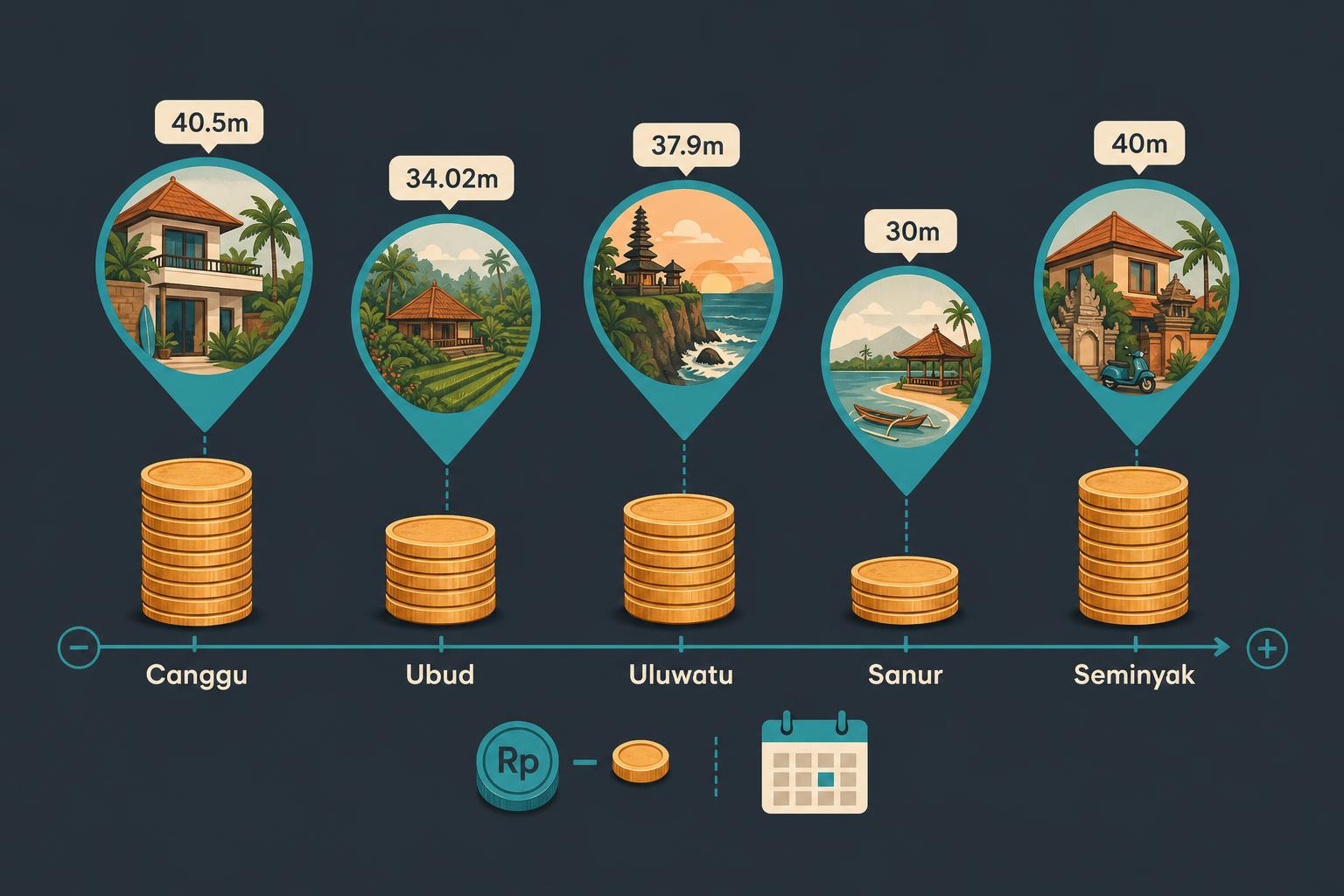
Direct owner versus agent costs: compare rent evidence, not promises
An agent-free deal is sometimes assumed to be cheaper, but the available information does not support treating that as a rule. The rent depends on the individual home, term, location, condition and inclusions. A direct owner may set any asking price; an agent may or may not be compensated by an owner; and a platform listing should be read for its stated rental price and conditions.
For a useful comparison, collect the same cost details for each shortlisted home. Asking prices are not completed rental transactions and do not establish what a particular home should cost.
| Cost detail | What to compare | What to clarify |
|---|---|---|
| Rent | Price for the same stay length | Whether the quote covers the full term |
| Payment schedule | Upfront amount and later instalments | Due dates and balance rules |
| Deposit | Amount and purpose | Refund conditions and deductions |
| Services | Cleaning, maintenance and security | Which charges are included or separate |
| Utilities | Electricity, water and internet | How usage and recurring costs are billed |
Use these details to identify a listing that deserves closer questions. In particular, compare the payment schedule and the full list of charges. A low headline rent can be a poor comparison if it leaves essential services or recurring costs unclear. For a closer area-specific search, see long-term rentals in Sanur.
Tax should not be turned into an unexplained line item. Under the ordinary domestic land/building rental regime, rental income is subject to final income tax at 10% of gross rental value; related maintenance, security, service and facility charges are included in gross value whether bundled or separate. Where the tenant is an ordinary individual rather than an appointed withholder, the lessor generally self-pays that tax. Accommodation-service income, including qualifying kost operations, is excluded from this regime, but that does not make the operator’s income tax-free. The treatment of a kost can depend on the actual service arrangement, not its label. See the Directorate General of Taxes explanation of rental income and kos arrangements.
Authority checks are stricter when renting directly from an owner
The biggest difference between an owner-led deal and an agent-led deal is not whether a friendly person replies quickly. It is whether you can establish who is authorised to grant the lease and who will sign the agreement.
Ask the person offering the property to explain their role plainly: owner, appointed manager, family representative, company representative or agent. Then match that explanation to the proposed agreement and payment recipient. If one person shows the home, another signs the lease and a third asks for funds, stop and get the roles explained in writing.
- Request the full legal name and contact details of the contracting party.
- Ask who owns the property or who has authority to act for the owner.
- Ask why any different person or entity is receiving payment.
- Confirm that the property address, boundaries or unit identity match the home you visited.
- Keep copies of the authority explanation and the final signed agreement.
Do not treat a public map display as conclusive ownership evidence. The government’s BHUMI platform says its displayed land data are not guaranteed complete, current or accurate, and official use requires a formal ATR/BPN public-information request. That makes a BHUMI map check a lead for questions, not definitive proof that a person can lease the home.
On Livuma, hosts must activate their account with identity verification, legal details and an Indonesian bank account before they can take paid bookings. That is useful process-level accountability, but you should still review the property, the host’s stated terms and the booking details yourself.
Viewing access and communication records decide how flexible your search can be
A direct owner can sometimes arrange a viewing quickly because there is no intermediary. The downside is that plans can become vague: a pin is sent without an address, a promised virtual tour never happens, or important details disappear into scattered chat threads.
Before travelling across Bali for a viewing, ask for confirmation of the exact unit, date, time, access arrangements and who will meet you. During the visit, check the property you see against the property described. Make notes on the parts of daily living that photos conceal: entry access, noise, mobile signal, water setup, appliances, parking, surrounding construction and any shared areas.
If you cannot attend, request a live virtual viewing where the person walks from the entrance through the actual unit. Ask them to show the items most relevant to your decision, rather than accepting a pre-recorded tour that may not establish the current condition.
Livuma’s monthly and yearly rentals may offer “view property first”, subject to the host and property: only a small deposit secures the request, and after an in-person or virtual viewing you confirm by paying the rest in the app, with no deadline or automatic confirmation, or cancel for free with a full deposit release or refund. In-app chat keeps viewing arrangements and answers in the same conversation rather than scattered across messages.

Written rental terms matter more than an agent’s verbal assurance
An agent’s statement that something is “standard” does not define your deal. Neither does a direct owner’s promise made during a viewing. The agreement should convert the arrangement into specific obligations that both sides can refer to later.
For a straightforward long-term rental, the written record should make these points unmistakable:
| Agreement subject | What needs to be specific | Why it matters |
|---|---|---|
| Parties and property | Who leases, who rents, and the exact home or unit | Connects the signature to the property you inspected |
| Term | Start date, end date and check-in arrangement | Prevents a different understanding of occupancy dates |
| Price and schedule | Rent amount, due dates, deposit or balance rules | Sets out what is due and when |
| Inclusions and duties | Services, utilities, repairs and house responsibilities | Avoids assumptions after move-in |
| Exit terms | Cancellation, notice, handover and refund logic | Creates a workable route out of the arrangement |
Read the wording before signing, especially where a translated summary differs from the agreement. Under Presidential Regulation 63/2019, agreements involving Indonesian citizens or private Indonesian institutions must use Indonesian; where a foreign party is involved, they must also use that party’s national language and/or English. Do not rely on an English-only lease. For a deeper clause-by-clause checklist, see what to check before signing a Bali rental contract.
Foreign tenant reporting and visa scope are separate from the rental route
Choosing an owner, agent or platform does not decide your immigration status. If you are a foreign tenant, ask whether the owner or property manager can report your stay through APOA. The official APOA system includes villas, kost or indekost, rented houses, apartments, condominiums, homestays and individual accommodation providers among its account categories.
Accommodation owners or managers must provide foreign-guest data when requested by Immigration under Article 72 of the Immigration Law, as explained in Ngurah Rai Immigration’s guidance. A successful APOA submission produces a Surat Tanda Terima Pelaporan Orang Asing, a reporting receipt you can ask your accommodation provider about. The Bali guidance reviewed does not establish a blanket 24-hour deadline for every private rental. This is a practical question to resolve before moving in, especially where a direct owner has little experience hosting foreign residents. Review the APOA accommodation-provider categories rather than assuming a private rental is outside the reporting system.
Your visa must independently fit your plans. For example, a C1 tourism visitor visa permits a first stay of up to 60 days from arrival and is for tourism and certain visitor or business-visit activities, not ordinary local employment. A rental agreement gives a right to occupy a home for its stated term; it does not grant a visa, work permission or a land right.
This distinction also matters if someone uses “leasehold” language to sell you an ownership story. A leasehold villa contract is a contractual right to use property for a stated term, not registered land ownership or Hak Pakai. If your objective is purchase rather than renting, use a separate buying process and start with Bali properties for sale rather than treating a rental agreement as an ownership document.
Who should choose direct owner, agent-assisted or platform-assisted renting?
Choose a direct owner rental if you can inspect carefully, ask for authority evidence, keep communication organised and are prepared to negotiate every material term in writing. It is the best route for a hands-on tenant who does not need someone else to coordinate the search.
Choose an agent-assisted rental if you need local scheduling help, translation support or someone to narrow an unfamiliar area. Still verify the agent’s role, the authority of the person signing and the full agreement. An agent should make coordination easier, not make basic checks unnecessary.
Choose a platform-assisted direct rental if you want to search comparable live inventory, keep host communication in one record, review terms before payment and use a payment flow where the host payout follows successful check-in under the booking terms. It is the clearest choice for renters who want an agent-free search without relying entirely on informal messages.
In short: use direct owner deals when you can do the due diligence yourself; use an agent when coordination is your constraint; use a platform when documented search, communication, terms and payment handling are your priority.
Renting in Bali without an agent through Livuma
- Compare homes: search Livuma’s live inventory using area, rental type, price and stay-length filters. Check photos, availability, house rules and verified guest reviews rather than relying on isolated social-media images.
- Read the terms: review the payment schedule, deposit or balance rules, deadlines, cancellation rules and refund logic before committing, so a low headline rent does not obscure the arrangement.
- Secure your request: choose dates and use a card reservation, not yet charged, or held Indonesian bank-transfer prepayment before the host sees it. Declined, withdrawn or expired requests receive an automatic full release or refund.
- Await the host’s response: approval within the response window charges the card reservation and confirms the booking. With “view property first”, only a small deposit secures the request; after viewing, pay the rest in the app to confirm, with no deadline or automatic confirmation, or cancel for a full deposit release or refund.
- Keep a record: use in-app chat for viewing and move-in arrangements. Complete identity verification before the rental agreement is issued; supported bookings receive digital agreement details and receipts.
- Confirm arrival: confirm check-in in the app or report a problem, which holds the host’s payout while it is resolved. Payout follows successful check-in under the booking terms, automatically about 24 hours later, never while a reported problem remains open.