

On July 2, 2026, Badung Regency made the Pecatu–Uluwatu traffic-engineering scheme permanent after a one-month trial intended to reduce congestion around Uluwatu.
Pecatu–Uluwatu traffic scheme became permanent on July 2, 2026
The permanent decision was made by Badung Regency’s Transportation Agency and the Traffic and Road Transport Forum (LLAJ). Officials said the trial had reduced congestion, particularly as late-day traffic builds around the south Bukit’s tourism routes.
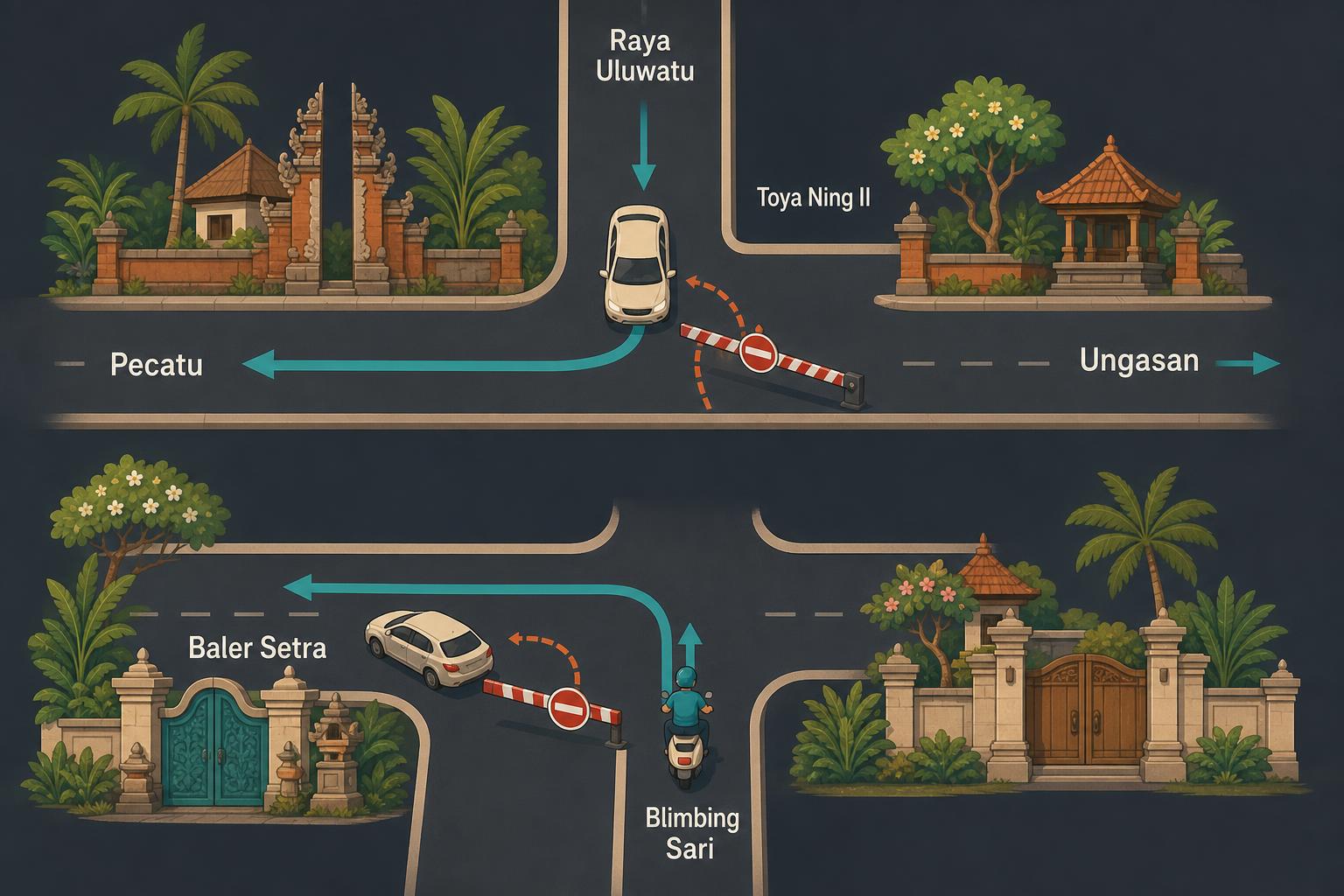
This is not a minor navigation-app adjustment. The scheme changes which turns vehicles may make at several points in Pecatu, including the key Jalan Toya Ning II–Jalan Raya Uluwatu and Jalan Baler Setra–Jalan Blimbing Sari junctions. The official announcement identifies six congestion-prone junctions in total.
For a person choosing a home in Pecatu, Ungasan or Uluwatu, the consequence is straightforward: a property can remain physically close to a destination while its practical evening route becomes longer. That matters for school collection, airport runs, staff arrivals, food and household deliveries, and any routine that requires crossing Jalan Raya Uluwatu near the restricted junctions.
The policy’s stated context is late-afternoon and evening movement toward tourist sites, sunset viewing and Kecak performances. During the trial, Dishub Badung warned that a route could be longer even where overall traffic flow was smoother. Read the government’s original trial announcement as a useful explanation of why the scheme prioritises flow over the shortest individual trip.
It is therefore worth separating two questions when assessing an address: how far away is it, and which legal turns are available at the time you will actually travel? They are no longer always the same question in this part of Badung.
Permanent Uluwatu turn restrictions: the routes that changed
The clearest time-limited restrictions apply every day from 5:00 p.m. to 10:00 p.m. WITA at the Jalan Toya Ning II–Jalan Raya Uluwatu junction:
- Traffic coming from Jalan Raya Uluwatu may not turn directly into Jalan Toya Ning II.
- Traffic leaving Jalan Toya Ning II onto Jalan Raya Uluwatu may turn left only, toward Pecatu.
- The right turn from Jalan Toya Ning II toward Ungasan is prohibited during that evening window.
At the Jalan Baler Setra–Jalan Blimbing Sari junction, vehicles may not turn west toward Jalan Raya Uluwatu. Motorcycles are exempt, so this restriction applies to cars and other non-motorcycle vehicles. That distinction is especially important for households that use both a car and scooters: their permitted routes may not match.
A further permanent addition took effect on July 2: a no-entry sign from Jalan Raya Uluwatu into Gang Batu Nunggul. Unlike the stated Toya Ning II evening restrictions, the announcement gives this prohibition no operating-hour limit. This restricts entry from Jalan Raya Uluwatu; it does not establish that the gang is closed from every approach.
The practical mistake is assuming every restriction has the same schedule. The official announcement is specific about the 5:00 p.m.–10:00 p.m. WITA window at Toya Ning II, but it is not equally specific about operating hours at Baler Setra–Blimbing Sari. Treat those as separate rules rather than applying one timetable to every junction.
How permanent Pecatu traffic changes affect renters, hosts and buyers
Traffic engineering does not change a property’s title, lease terms or physical condition. It does change the lived usefulness of its access roads. That can be material when comparing homes on opposite sides of Jalan Raya Uluwatu or when deciding whether a quiet gang is convenient for a household’s real routine.
Renters deciding between Pecatu, Ungasan and Uluwatu
Long-term renters should treat an evening drive as part of the viewing, not as an optional extra. Test the route from the property to the places you will use repeatedly: school, shops, a workplace, airport direction, medical appointments, and the pickup point used by drivers or delivery services. Then run the return route. A direct-looking map route may require a different approach once the relevant turn is unavailable.
When comparing long-term rentals in Uluwatu, add route access and likely evening direction of travel to the usual comparison of bedrooms, facilities and rental terms.
For a lower-cost room arrangement, access still matters. A resident who relies on a scooter may have a different permitted path from a housemate using a car, particularly at Baler Setra–Blimbing Sari. Browse kost options in Uluwatu with the same address-level route check in mind.
Livuma’s live rental inventory shows each listing’s location on a map, availability, minimum stay, house rules and booking conditions. Use that information alongside an independent evening route test.
Owners and hosts managing guest, staff and supplier access
Hosts should not assume guests, cleaners, maintenance teams or drivers know the new movement pattern. Give them a route note that distinguishes car access from motorcycle access and says whether the instruction concerns arrival, departure, or both. A route that works for a scooter can be the wrong instruction for an airport transfer or a delivery van.
For a property accessed through Gang Batu Nunggul, the no-entry change from Jalan Raya Uluwatu deserves particular attention because the official announcement states no operating-hour limit. Update any saved arrival instructions rather than relying on an old map pin or a message copied from a previous stay.
Hosts should keep a shared record of booking-specific access instructions alongside the booking conversation; it does not replace the driver’s duty to follow signs and directions on the road.
Buyers and long-hold investors assessing location
A buyer should not reduce this to a claim that one neighbourhood is “better connected” than another. The relevant question is more precise: from this exact gate, where can a car turn between 5:00 p.m. and 10:00 p.m. WITA, and what detour is required for the trips the future occupant will make?
Test both the homeward route and the outbound route. A house may be easy to reach from Pecatu but awkward to leave toward Ungasan in the restricted period, or vice versa. For people reviewing properties for sale in Uluwatu, this is now a location due-diligence point alongside the usual inspection and document review.
What Pecatu residents should do before signing, renewing or listing a home
There is no need to overreact to a traffic-management change, but there is a strong case for replacing assumptions with an address-specific test. Use this short process before committing to a rental or purchase:
- Write down recurring journeys. Include school, work, airport direction, staff commuting routes, groceries, deliveries and regular social trips.
- Test in the relevant window. Drive the property-to-destination and destination-to-property routes between 5:00 p.m. and 10:00 p.m. WITA, not only during a quiet daytime inspection.
- Use the right vehicle. Test a car route if the household uses a car. Do not infer car access from a motorcycle route where motorcycles are expressly exempt.
- Ask for the actual entrance routine. Confirm which road a driver should approach from, whether a supplier uses a different access point, and how visitors should leave after evening events.
- Record the useful answer. Save the tested route and access instruction with the property file, lease notes or host information so it is not lost after move-in.
This is also useful for people planning a car-light routine. The choice between walking, rides, scooters and a household car depends heavily on the journeys you make most often; see living in Bali without a scooter for the broader practical trade-offs.
For renters ready to compare the address, rental length and amenities of available homes, live rental listings provide a starting point. The route test should still happen independently at the time and in the vehicle relevant to your own move.

What remains unclear about Baler Setra hours and ticketing enforcement
Two points should be treated carefully rather than filled in with assumptions.
First, the Baler Setra–Blimbing Sari operating hours are not clearly restated in the July 2 permanent-scheme announcement. The announcement expressly attaches the daily 5:00 p.m.–10:00 p.m. WITA period to the Toya Ning II–Jalan Raya Uluwatu turn restrictions. Its Baler Setra paragraph does not expressly repeat hours. During the June trial, which began on June 2, 2026, the overall scheme ran from 2:00 p.m. to 10:00 p.m. WITA. This does not establish that the same trial timetable applies permanently at Baler Setra.
Second, permanent traffic engineering was not described as immediately ticketable enforcement. Badung said scheme-specific police ticketing would begin only after a Badung Regent’s Decree, or SK Bupati, was issued as its legal basis. As of November 10, 2026, no later confirmation or decree number was located in this refresh. This does not establish that scheme-specific ticketing remains suspended or that drivers are exempt from ordinary traffic enforcement.
Neither uncertainty is a reason to disregard a sign, staff direction or restriction in place. It is a reason to avoid telling tenants, drivers or prospective buyers more than the official material confirms. For the underlying permanent decision and the government’s wording, consult the Badung Regency announcement of July 2.
Badung also said personnel would continue to staff key locations during operating hours, including the Pecatu Village Office, Toya Ning, Nirmala and Politeknik Negeri Bali junctions, alongside Linmas, police and Satpol PP. On-road signage and directions at the time of travel remain the practical reference point.
What has not changed despite the permanent Uluwatu traffic rules
The July 2 decision does not mean that every route through Pecatu is closed, that motorcycles and cars face identical restrictions, or that every restriction operates on the same timetable. The motorcycle exemption at Baler Setra–Blimbing Sari and the stated evening window at Toya Ning II are important differences.
It also does not mean a new ring road has opened. Badung describes this traffic engineering as a short-term measure, while a ring road remains the longer-term congestion solution. Badung officially marked the start of JLS Segment 4, Labuan Sait–Pedati, and the Pura Kulat–Labuan Sait road with groundbreaking on July 27, 2026. The published construction programme places initial JLS works plus Siligita junction improvements, totaling 10.89 km, in 2026–2027; this is not a confirmed opening date. The located official sources do not confirm that the new Pecatu links are available for through traffic. The Rp516 billion figure in Badung’s September 1, 2026 update concerns 4.7 km of Canggu–Tibubeneng connectivity, not the Ayana–Uluwatu ring road.
Finally, the scheme does not make an address automatically unsuitable for renting, hosting or buying. It makes route testing more important. A property may still suit your budget and daily pattern very well—but that conclusion should come from a peak-evening trip from its actual gate, not an off-peak estimate alone.