

You are looking for an Uluwatu villa that suits the life you will actually lead: beach trips, work calls, grocery runs, visitors, and a realistic move-in date. This uluwatu villa rental guide turns that decision into a practical sequence, from choosing a micro-location to recording the condition of the home at handover.
Uluwatu sits within South Kuta (Kuta Selatan), Badung Regency, rather than being one uniform neighbourhood. That matters because a villa’s road access, surrounding construction, water setup, and distance from your repeated routes can change substantially from one pocket to the next. For district context, consult BPS’s Kuta Selatan District in Figures 2025.
Uluwatu villa rental guide: start with the life the villa must support
Write a non-negotiable brief before viewing villas
A good villa is not simply the one with the best pool photograph. Begin with the constraints that would make a property unworkable after the first week:
- your intended rental length and earliest realistic move-in date;
- number of bedrooms needed for household members, guests, or a dedicated workspace;
- need for a lockable desk room, reliable mobile signal, or private call space;
- whether you will drive, use a scooter, rely on ride-hailing, or need frequent car access;
- parking needs, including the turning and gate space rather than only the number of vehicles;
- comfort with steps, steep driveways, open living rooms, noise, insects, or nearby building work;
- which costs must be included versus separately billed.
Rank these points as essential, preferred, and optional. This keeps an attractive view or a decorative interior from overruling practical needs such as safe access after dark or a usable work room.
Decide whether a private villa is the right rental format
A villa can provide privacy, outdoor space, and room for a household, but it may also place more responsibility on the tenant to understand pool, garden, water, waste, and staff arrangements. Ask what day-to-day care is expected from you and what is arranged by the owner or manager.
If you mainly need a furnished room and shared facilities, a kost may better match both your budget and maintenance tolerance. Compare Uluwatu kost options alongside villas instead of assuming a villa is the only way to live in the area.
Uluwatu villa rental guide: choose a micro-location by repeated routes
Test the route, not the pin on a map
For each contender, trace the journeys you will repeat: your usual food shop, gym, school or childcare, medical needs, meetings, airport trips, and preferred beach access. A listing may use “Uluwatu” broadly, while its practical location is determined by the final turns from the main road to the villa gate.
Do the route at a time that resembles your ordinary schedule. Notice narrow lanes, gradients, blind corners, drainage edges, road surface, parking at the gate, and whether two vehicles can pass. If you expect deliveries or visitors, consider how clearly a driver can find the property without directions being relayed several times.
Ask what changes after rain, at night, and during construction
A daytime viewing can conceal issues that shape daily comfort. Return or ask for a current video showing the approach road, entrance, outdoor lighting, parking, and the route from bedroom to bathroom after dark. Ask directly whether water enters outdoor areas, whether access becomes difficult in heavy rain, and whether building work is planned or active nearby.
Do not treat a verbal “quiet area” description as a condition of the lease. Identify the noise-sensitive rooms, check the boundary walls, and listen for traffic, venue sound, dogs, pumps, and construction. Keep notes property by property so impressions do not merge after several viewings.
Match the terrain to your household and transport
Cliff-side and hilly settings can mean stairs, changes in level, exposed outdoor edges, and driveways that need confident vehicle handling. A family with young children, a person with mobility needs, or a renter using a car should inspect these features particularly carefully.
Ask where scooters, cars, bins, gas bottles, and deliveries are normally placed. These small operational details reveal whether the villa works as a home rather than merely as a holiday setting. For route-specific context, read about the permanent Pecatu route changes before relying on an old travel-time assumption.
Choose an Uluwatu villa layout for work, guests, and maintenance
Separate the bedroom count from the usable-room count
Count what each room can genuinely do. A bedroom may be attractive but too exposed to pool noise for video calls; a spare room may lack a desk wall, curtains, storage, or dependable cooling. Check where you will take calls, store luggage, dry laundry, prepare food, and put visiting friends without disrupting the household.
For a longer stay, examine storage early: wardrobes, kitchen cupboards, linen space, tool storage, and a secure place for passports or electronics. A villa that looks uncluttered during a viewing may become difficult once everyday belongings arrive.
Understand open-plan living in real conditions
Open living and dining spaces can be enjoyable, but they expose the home to weather, insects, windblown dust, heat, and sound. Ask whether doors, blinds, screens, or shutters close fully and test them yourself. Look for the practical separation between indoor and outdoor areas, particularly around the kitchen and bedrooms.
Also inspect bathroom ventilation, signs of moisture, door closures, ceiling condition, and the drainage slope around outdoor showers or pool decks. These are not cosmetic details; they affect daily cleaning, privacy, and how quickly an issue becomes a maintenance request.
Clarify who handles pool, garden, and staff access
Ask whether pool treatment, gardening, cleaning, pest treatment, and rubbish collection are included, optional, or your responsibility. If workers enter regularly, establish their usual days, hours, gate access, and whether you need notice before entry. Confirm this in the written agreement or in a schedule attached to it.
Do not assume “fully furnished” answers these questions. Furnishing describes contents, not the service arrangement, replacement responsibility, or cost of keeping a pool and garden usable.
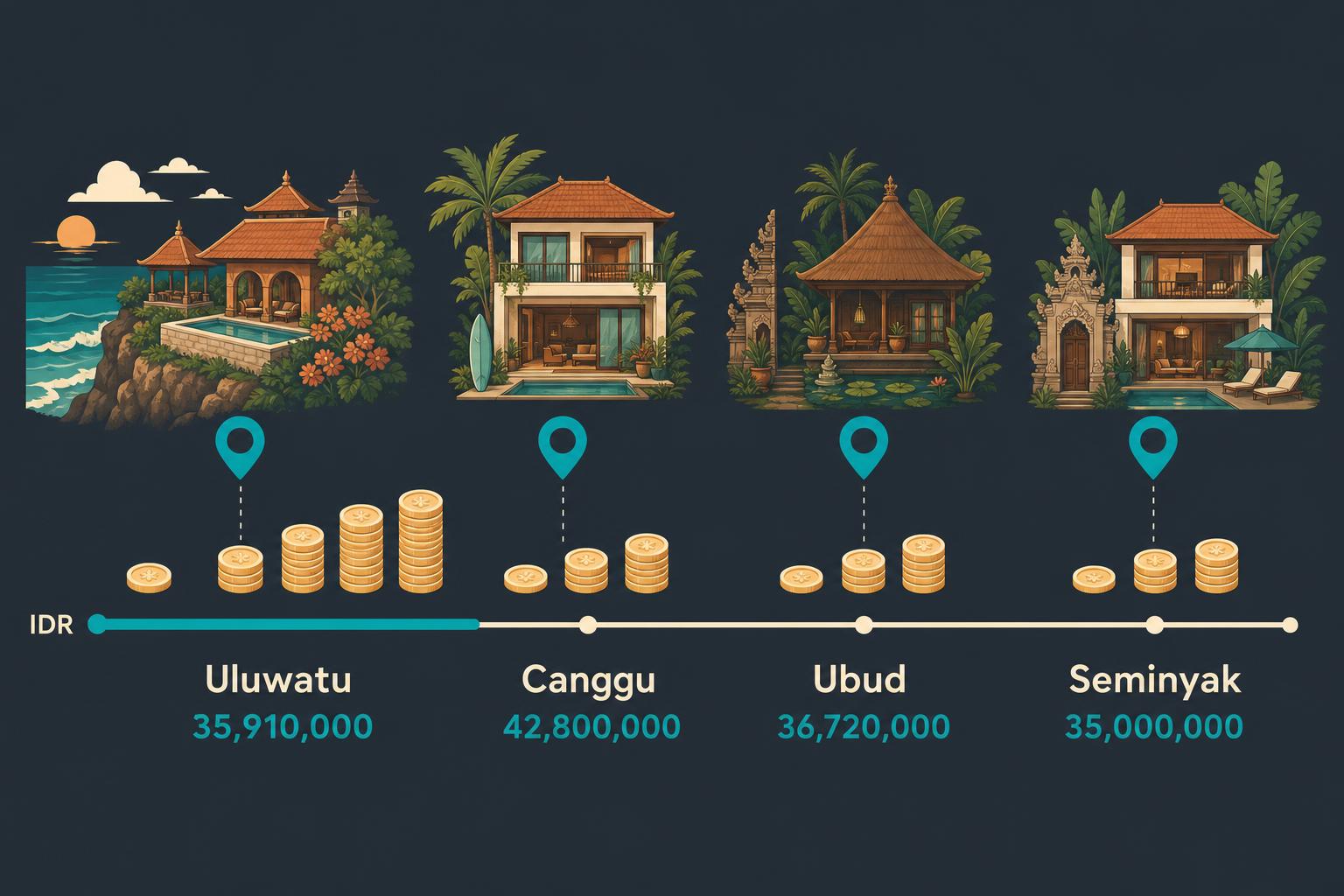
Compare Uluwatu villa rents using live listings, not invented averages
Use current quotes as your reference point
There is no current government or BPS source in the supplied research that publishes an Uluwatu-specific median villa rent or long-term villa-rental benchmark. The September 2026 inventory figures previously used here were not independently verified and should not be treated as established market rents.
Compare current listings for your actual dates, bedroom count, and lease term rather than relying on that dated snapshot. Asking prices are not guaranteed quotes for a particular property or an Uluwatu-wide market benchmark. Compare the actual inclusions, condition, and payment schedule before deciding whether a villa fits your budget.
Read a lower or higher quote as a question to investigate
A quote below comparable current listings is not automatically a bargain, and a higher quote is not automatically overpriced. Ask what accounts for the difference:
- rental duration and whether the quoted rate changes by term;
- number of usable bedrooms and bathrooms;
- furniture condition and appliance quality;
- pool, garden, housekeeping, internet, and utility treatment;
- road access, parking, and location relative to your routes;
- current availability and the exact handover condition.
Keep a comparison sheet with the quoted rent in one column and every included or excluded cost in adjacent columns. This is more reliable than choosing based on a headline monthly figure.
Compare Uluwatu with other Bali long-term rental markets carefully
| Area | Listings to compare | Monthly rent | Costs to check separately |
|---|---|---|---|
| Uluwatu | Same dates, term, and bedroom count | Use current property-specific quotes | Utilities, internet, pool, garden, and housekeeping |
| Canggu | Same dates, term, and bedroom count | Use current property-specific quotes | Utilities, internet, pool, garden, and housekeeping |
| Ubud | Same dates, term, and bedroom count | Use current property-specific quotes | Utilities, internet, pool, garden, and housekeeping |
| Seminyak | Same dates, term, and bedroom count | Use current property-specific quotes | Utilities, internet, pool, garden, and housekeeping |
Compare like-for-like villas rather than treating a platform snapshot as an area-wide market benchmark. A headline rent cannot settle an area choice alone: test the total cost, property condition, and repeated routes against your brief.
Screen an Uluwatu villa listing before spending time on a viewing
Get the missing facts in writing before travelling
Before arranging a viewing, ask for the exact monthly or total rental price, minimum term, start date, payment timing, deposit requirement, utilities, internet, service schedule, pet policy, occupancy limit, and whether the shown furniture will remain. Ask for recent photos or video of any room not clearly shown.
Then ask who is authorised to offer the villa and who will sign the agreement. A polished listing does not by itself establish authority to lease. Do not send an off-platform holding payment merely to secure a viewing or because another interested renter is mentioned.
Compare like with like across each candidate
Use the same questions for every villa. If one quote includes regular pool care and another says nothing, mark the second as unknown rather than included. If a listing says “internet available,” establish whether it is active, where the router is, who pays, and what happens if service fails.
Livuma’s live rental listings let guests search by area, rental type, price, stay length, bedrooms, and amenities, while listing pages show availability, minimum stay, house rules, and booking conditions. That makes it easier to narrow candidates before spending time on viewings and still ask property-specific questions.
Keep communication and evidence together
Save the listing URL, photographs, messages, names, quoted terms, and any video tour in one dated folder. If terms change, ask for a clear written restatement rather than relying on an old chat message. This file becomes useful when checking the eventual agreement and handover inventory.
Where available, in-app chat keeps questions and answers associated with the booking rather than dispersed across personal message threads. Regardless of channel, do not assume chat replaces a signed rental agreement.
Inspect an Uluwatu villa as a functioning home, not a showroom
Run water, power, cooling, and connectivity checks
At the viewing, turn on taps and showers, flush toilets, inspect under sinks, and ask about the water source, storage, pump, filtering, and what to do if supply stops. Look for leaks, staining, unusual smells, weak pressure, and drains that do not clear promptly.
Operate air conditioning in each bedroom, test lights and sockets where appropriate, open and lock doors and windows, and ask to see the electrical meter. For remote work, test mobile reception and the actual internet connection from the desk location, not only beside the router.
Inspect the perimeter, roofline, and outdoor systems
Walk the boundary. Check gates, locks, exterior lighting, drainage channels, pool surrounds, retaining walls, roof gutters, and any external storage. Notice trees or vegetation touching buildings, standing water, exposed cables, and slippery surfaces.
Ask how faults are reported, who chooses a repair person, and what response process applies if an essential service fails. Record the answer, but make sure important responsibility and cost allocations also appear in the agreement.
Document contents and existing damage before money changes hands
Make a dated inventory covering furniture, appliances, keys, remotes, meters, pool equipment, linens if supplied, and visible defects. Photograph each room widely, then take close images of cracks, stains, chips, and damaged items. Capture opening meter readings at handover.
This is particularly important where a deposit is involved. For a deeper checklist on documenting the money and recovery process, see Bali rental deposits: pay, document and recover yours.

Put Uluwatu villa payment, deposit, and handover terms into one record
Make the agreement answer the expensive questions
A usable rental agreement identifies the parties, villa address, rental period, rent, payment dates, deposit amount and conditions, included services, utility responsibility, repair reporting, entry arrangements, permitted occupants, house rules, renewal process, and what happens if either side wants to end the arrangement early.
Read every attachment, especially the inventory and any rules sheet. If a promised feature or service is central to your decision, name it in the agreement rather than relying on a listing description. This guide is practical information, not legal advice; seek qualified local advice for a clause or structure you do not understand.
Do not pay before you know the schedule and refund logic
Ask for the full payment schedule before paying: what is due, when it is due, what it is for, and under what written circumstances it is refundable or retained. Obtain a receipt for every payment and make sure the recipient corresponds to the contracting party or is clearly authorised.
Complete handover with a check-in record
At check-in, use the inventory to count keys, remotes, furniture, and appliances. Record meter readings and photograph anything newly noticed. Confirm the contact person for urgent repairs and the method for reporting non-urgent issues. Send both parties the final inventory and keep a copy with the signed agreement and receipts.
A complete record is not pessimistic. It gives the renter and owner the same starting point, reduces memory-based disagreements, and makes the eventual move-out inspection much easier to conduct.
Match your Uluwatu rental plan to your Indonesian immigration status
A villa lease does not create permission to live or work in Indonesia
Signing a rental agreement is separate from immigration permission. The C1 tourism visitor visa permits an initial stay of up to 60 days, can be extended to 180 days total, and has an initial government fee of IDR 1,000,000; extensions require additional procedures. It is for tourism and specified visitor activities. It does not permit employment or receiving income from work in Indonesia, as the official visitor-visa guidance explains.
The E33G Remote Worker Limited Stay Visa is the category designated for a foreigner living in Indonesia while working remotely for an overseas employer. It permits a one-year stay and requires evidence of an annual salary of at least US$60,000, an employment agreement with a company established outside Indonesia, and the preceding three months’ bank statements showing a balance of at least US$2,000. Government charges for the one-year package are IDR 7,000,000, excluding private agent fees. It does not authorise working for or receiving payment from individuals or legal entities in Indonesia. Check the official E33G visa guidance against your own activities before committing to a long lease.
Plan extensions and address updates around your move
Since May 29, 2025, foreigners applying to extend a stay permit, including Visa on Arrival holders, must attend an immigration office for a photo and interview after submitting the application and documents online. Do not schedule a villa move or travel around Bali as though an extension is a fully remote administrative task.
Foreigners and/or their guarantors can submit address-change data through the eVisa platform. Ngurah Rai Immigration’s ITAS/ITAP address-mutation procedure requires the new address and supporting documents, including a domicile certificate from at least the banjar or kelurahan, followed by immigration verification. When you move villa, preserve your agreement and address details, and confirm the update obligations that apply to your permit. Our guide to registering a Bali address explains related address records in more detail.
Know how rental tax and Indonesian tax residency differ
Rental-income tax is generally the lessor’s administration issue
Qualifying income from renting Indonesian land and/or buildings is subject to 10% final income tax on gross rent, including separately billed or bundled maintenance, security, service, and facility charges. Where a tenant is an individual who is not a withholding taxpayer, the landlord or lessor must self-pay the tax. Confirm the applicable current payment and filing deadlines with DJP or a qualified tax adviser, as Coretax changed several monthly payment deadlines from January 2025 and older guidance may be outdated.
That does not mean a renter should ignore how tax is reflected in a quote. Ask whether the stated rent is the complete amount you will pay, who issues the receipt, and whether any service charges exist. Do not agree to unclear cash arrangements as a substitute for a written payment record.
Kost and ordinary building rent are not the same tax category
DJP distinguishes standard house or building rental from a kost or boarding-house accommodation service. Accommodation services including kost are excluded from the 10% final land-and-building-rental tax and are treated as business income under the applicable income-tax regime. This is one reason to identify the actual accommodation and contracting arrangement rather than applying villa assumptions to every room rental.
Track your days independently of your lease dates
A foreigner becomes an Indonesian domestic tax subject if they reside in Indonesia, are present for more than 183 days in any 12-month period, or are present in a tax year with an intention to reside. Days need not be consecutive, and partial days count as full days. PER-23/PJ/2025 expressly identifies a residential lease exceeding 183 days as possible evidence of an intention to reside, but it does not replace an individual tax-residency assessment. Read the official DJP residency criteria and obtain professional advice for your circumstances.
Renew, leave, or move between Uluwatu villas without losing records
Raise renewal decisions before the final days
Re-read the agreement well before its end date. Check whether it contains a notice requirement, rent-review process, renewal option, or a fixed end date requiring a new agreement. Ask for any renewal proposal in writing and compare it with current alternatives using the same brief and inspection standards you used initially.
Do not assume that staying on after the stated term has the same payment, deposit, or repair terms. Make the extension period and all changed terms explicit.
Use the original inventory for move-out
Arrange a joint final inspection where possible. Compare the original photos and list with the property’s condition, record closing meter readings, return every key and remote, and request a written acknowledgment of handover. If deductions are proposed, ask for the specific basis and supporting evidence.
Keep your agreement, receipts, payment confirmations, inventory, and key correspondence after departure. They are the record you need if questions arise later about the deposit, final utilities, or your former address.
Rent first or buy later: keep the Uluwatu decisions separate
Use a rental period to learn the operational reality
Renting can help you test road access, work routines, water systems, neighbourhood sound, and your tolerance for villa maintenance before considering a purchase. But a rental agreement does not create a purchase right, secure a future selling price, or prove a property’s title and approvals.
Keep purchase discussions separate from your tenant relationship. If you later want to explore ownership options, browse properties for sale in Uluwatu as a separate research process rather than treating a lease as due diligence.
Foreign buyers must use the permitted ownership structures
Government Regulation No. 18 of 2021 provides for a foreigner with valid immigration documents to own an Indonesian residence within permitted legal structures. A landed residence may be held under Hak Pakai (Right to Use), including Hak Pakai over Hak Milik under a formal land deed. It does not make ordinary freehold Hak Milik land a direct foreign ownership title.
Before buying, independently verify the land certificate or title, spatial-use approval, and building approvals. In Badung, PBG applications require items including land-certificate data, land-use approval, spatial-planning information, environmental documents, and technical drawings; an SLF confirms a building is fit for use before it is utilised. These checks are purchase due diligence, not steps that a renter can skip into a lease.
Do not turn tourist demand into a rental-yield claim
Bali recorded 6,948,754 direct foreign tourist arrivals in calendar year 2025, and August 2026 recorded a 68.19% occupancy rate for star-rated hotels, versus 67.29% in July 2026. Those are Bali-wide tourism indicators, not Uluwatu villa occupancy, rent, or yield benchmarks. Do not use them to justify a property’s projected income.
For a short-term villa operation, licensing and the actual business classification matter. OSS maps KBLI 2020 code 55193, Vila, to KBLI 2025 code 55203, Aktivitas Vila, within short-term accommodation. Have a qualified adviser assess the specific Badung property, operating model, approvals, and tax treatment before buying on the assumption that it can be rented nightly.
Renting an Uluwatu villa through Livuma
- Search long-term rentals in Uluwatu against your villa brief; compare photos, availability, minimum stay, house rules, booking conditions, and verified guest reviews.
- Read the booking-specific payment schedule, deposit or balance rules, deadlines, cancellation terms, and refund logic before committing.
- Pick dates and secure the request before the host sees it with a card reservation, without a charge yet, or a held Indonesian bank-transfer prepayment. Declined, withdrawn, or expired requests receive an automatic full release or refund.
- The host answers within a limited window; approval charges a standard card reservation and confirms the booking. For eligible monthly or yearly rentals, “view property first” secures only a small deposit: after an in-person or virtual viewing, pay the rest in the app to confirm, with no deadline or automatic confirmation, or cancel free for a full deposit release or refund. Record viewing and move-in arrangements in chat.
- Complete guest identity verification before the rental agreement is issued. For supported bookings, the platform generates agreement details and receipts from the listing, booking terms, and verified guest details.
- Confirm arrival or report a problem in the app. Host payout follows successful check-in, automatically about 24 hours later, and remains on hold while a reported problem is open.