

On 8 October 2026, Badung councillor I Putu Parwata urged comprehensive assessments before construction decisions on the proposed Ngurah Rai Airport–Canggu water taxi.
For renters and buyers, the distinction matters: this was scrutiny of a proposed project, not a cancellation announcement—and not confirmation that a service is ready to use. The sensible property decision remains the same: judge airport access using the roads available today, rather than paying for a promised future connection.
What changed on 8 October 2026: a call for fuller water-taxi assessments
Parwata, chair of Badung DPRD’s Ethics Council, or Badan Kehormatan, called for the government to examine environmental and community impacts before deciding on construction. His intervention concerned both the proposed coastal infrastructure and how the service’s travel-time claims should be understood.
The 8 October reporting by Bali Post identifies questions about coastal currents, sedimentation, surfing waves, fishing access and sacred areas. These are risks to investigate, not established findings that the project has already caused damage.
The statement followed a Tibubeneng public consultation on 2 October 2026. At that consultation, coordinating-ministry official Liz Zeny Merry said at least 14 further studies covering sociocultural, environmental and technical issues remained necessary before a final decision.
That sequence is more useful than a simple headline saying the project is moving forward or being stopped. Preparation has been announced, but substantial questions remained in November. On 5 November 2026, Badung DPRD’s Golkar faction requested a comprehensive assessment, particularly of potential effects on surfing waves at Berawa. Neither an earlier target nor a later demand for scrutiny establishes an operating service.
For a property search, the change is about confidence in the proposal—not a new airport-access option. A listing’s reference to a future water taxi should therefore be read as a contingent possibility, not an existing amenity.
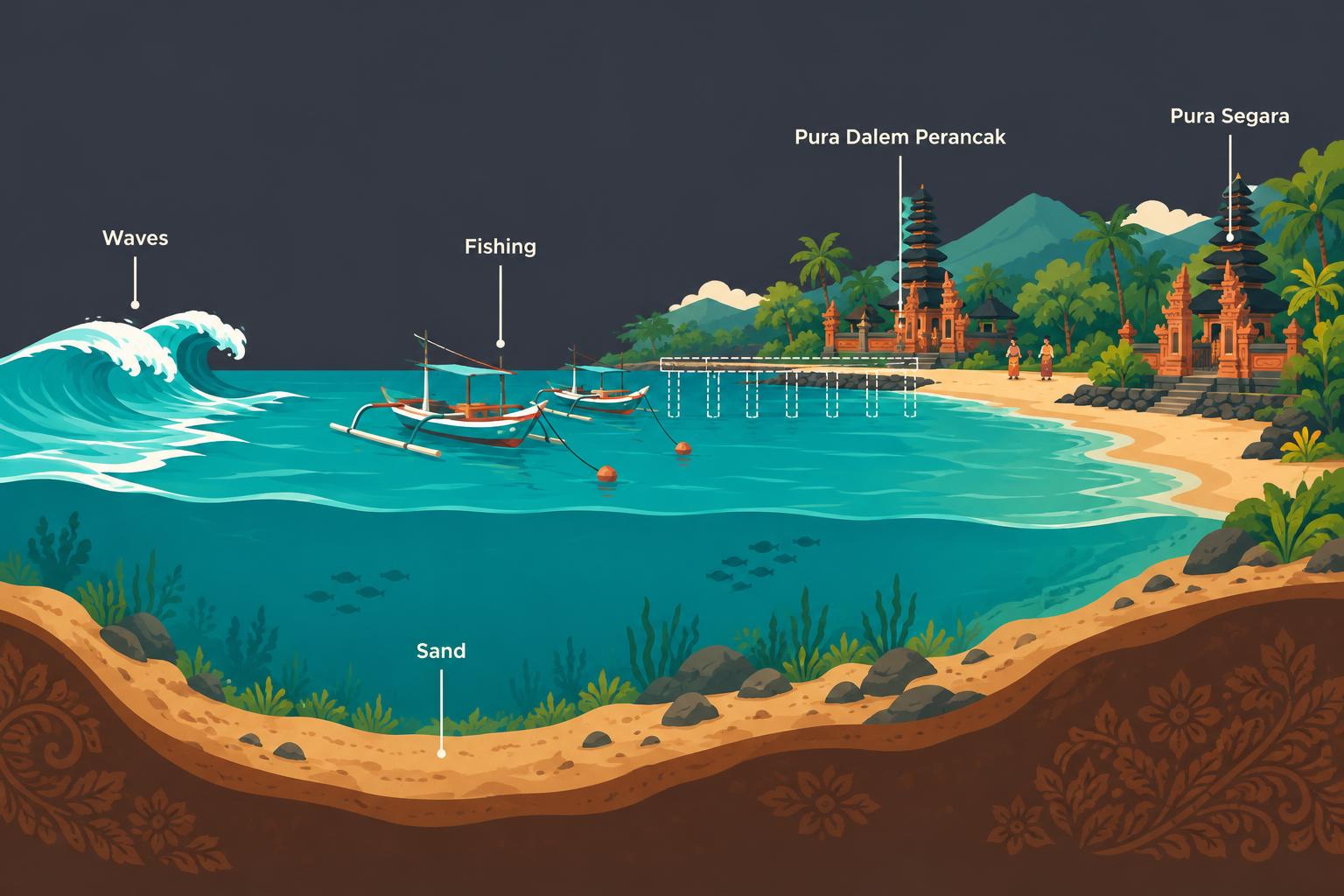
What the coastal concerns mean around Berawa and Perancak
The environmental questions are specific to the proposed coastal connection. Parwata identified possible changes to currents and sedimentation, effects on surfing waves, and consequences for fishing access and sacred areas. The reporting does not establish that those effects will occur, or quantify their severity.
For someone considering a nearby home, this calls for separating the proposed transport benefit from questions about how the surrounding coast might be used. A convenient landing point, if eventually approved, would still need to coexist with existing activities and places.
- Currents and sedimentation: these require investigation; do not describe coastal damage as an established outcome.
- Surfing waves: possible effects were raised, but the supplied reporting does not establish a measured change.
- Fishing access: existing boat-mooring areas are part of the planning discussion, not empty space awaiting development.
- Sacred sites: different temples have been discussed separately and should not be treated as interchangeable.
The temple distinction is particularly important. At the 2 October 2026 consultation, Tibubeneng village head I Made Kamajaya said Pura Dalem Perancak would not be moved. Reporting separately identified potential impacts on Pura Segara Perancak and Palinggih Tugu Barak, with no final relocation decision. The Bali Post consultation report also recorded that construction funding arrangements had not been finalized.
On 2 October 2026, Badung official I Made Agus Aryawan estimated that 50–80 fishers used the existing mooring area; replacement arrangements would depend on the impacts. That describes potential exposure, not completed displacement. Ask what is proposed and what has actually been decided; avoid repeating claims that boats or temples have already been relocated.
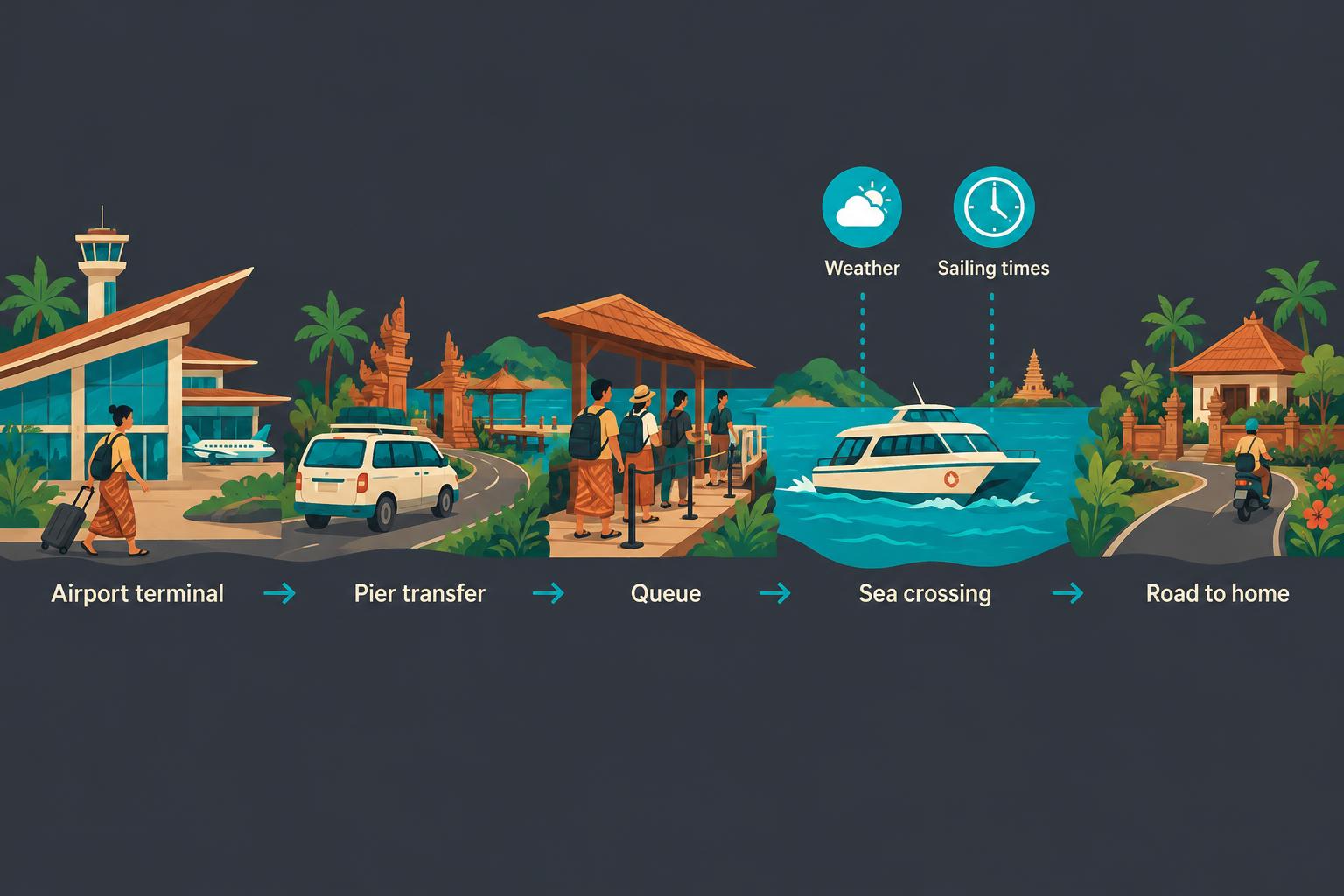
Who the proposed 30-minute crossing affects—and what it leaves out
ASDP’s projected maximum 30-minute sea journey is not a verified airport-to-home travel time. Parwata specifically called for airport-terminal access, passenger queues, pier transfers, weather and operating schedules to be considered alongside the crossing.
The practical journey would need to account for each component:
- Getting from the airport terminal to the departure point.
- Waiting for boarding and an available departure.
- Making the sea crossing under the applicable operating conditions.
- Leaving the arrival point and reaching the actual property.
A shorter sea leg does not, by itself, establish a shorter total journey. Nor does proximity to a proposed landing establish that a home will have convenient access to it.
Renters choosing an airport-accessible Canggu base
If you fly frequently, assess the exact property address against your actual arrival and departure needs. ASDP’s 19 April 2026 statement reported observed airport–Canggu road journeys of approximately one to two hours. That is a broad route estimate, not a promise for a particular villa, apartment or kost.
Check the road journey from the home itself, including the final approach and luggage access. If you will not drive, assess everyday transport separately; our guide to living in Bali without a scooter addresses that wider decision. An airport connection would not automatically solve daily trips.
Buyers assessing a claimed transport premium
Ask whether the property still suits your use and budget without the proposed service. A claim that future access justifies a higher price is not the same as evidence of an approved landing, a usable timetable or a fare.
The supplied research does not quantify any water-taxi effect on property prices or rental income. Treating future access as contingent is a decision-making precaution, not a forecast that nearby values will rise or fall.
Hosts describing airport transfers to prospective guests
Keep existing transfer information separate from proposed infrastructure. Describe the property’s current access honestly, and do not turn the projected crossing time into a guaranteed airport transfer. If guests ask about the water taxi, explain that the reviewed sources do not establish an opening date or operating timetable.
What renters and buyers should check before committing to a property
Start with a simple question: would this home still work if the water taxi were unavailable throughout your stay or ownership plans? If the answer is no, the unresolved project is carrying too much weight in the decision.
Use the same checks whether you are dealing directly with an owner, through an agent or on a platform:
- Confirm the exact location. A broad Canggu or Berawa description cannot establish the route from a particular doorway.
- Inspect current access. Check the final approach, vehicle access, luggage handling and where a driver could collect you.
- Separate present facts from proposals. Ask what source supports a claimed landing location, opening date or transfer time.
- Compare homes without the project benefit. Evaluate the rent or asking price against the property’s existing condition, facilities and access.
- Keep material representations in writing. Do not let an informal promise about future transport substitute for clear property and booking terms.
Livuma listing pages show the location on a map with a directions link, helping you assess the actual address rather than an area label; see the rental platform walkthrough.
When comparing long-term rentals in Canggu, assess each address using current access. For local context beyond airport journeys, use the Pererenan and Berawa rental guide. Buyers comparing properties for sale in Canggu should apply the same current-access test, while keeping purchase due diligence separate from rental-booking protections.
What remains unconfirmed about the route, funding and opening date
As of 6 November 2026, the reviewed official and established-news sources do not establish a confirmed opening date, operating timetable, ticket fare or validated end-to-end journey time.
The route description also needs care. In comments made on 10 April 2026 and reported on 11 April, Bali’s transport department described the route under study as Sekeh Beach, beside the airport, to Berawa Beach. The ANTARA report on that route is background to the proposal; October reporting discussed a proposed Perancak landing but said design and location were not final.
Other unresolved points include:
- Assessments: the 2 October consultation report identified at least 14 further studies needed before a final decision. ASDP said on 19 April that it and PT Angkasa Pura Indonesia had already completed a feasibility study; the further assessments do not mean no feasibility work had occurred.
- Construction: the Transport Ministry’s 8 April 2026 announcement targeted August 2026–July 2027, but officials at the October consultation could not confirm when construction would begin.
- Funding: the arrangement had not been finalized; possible participants included central government, Badung government, communities and private parties.
- Operations: ASDP’s 19 April 2026 announcement targeted completion of detailed engineering design and permitting during 2026 before reporting to government for further direction and assignment—not confirmed passenger operations.
For a housing decision, look for subsequent confirmation of the landing, delivery arrangements and usable service details. An earlier construction target should not be treated as an assured opening schedule.
What has not changed: existing access still determines property convenience
The scrutiny in October and November did not announce cancellation, establish environmental damage or confirm that passenger services were available. It also did not validate a door-to-door airport journey of approximately 30 minutes.
For renters, hosts and buyers, current road access remains the defensible basis for describing airport convenience. A future water taxi may become relevant when its location and operating details are established. Until then, it is a possible additional benefit—not a guaranteed feature of the home.