

230 live long-term rentals in Canggu versus 47 in Ubud is the figure that most changes how to use Livuma Balis rental platform. According to Livuma listing data (November 2026), the platform’s visible choice was not evenly spread across Bali. Start by comparing the depth of inventory in the area you want, then compare individual listing terms—not by assuming that every Bali district offers the same volume, price band or booking route.
Livuma is operated by PT Livuma Home Market. Its website displays NIB 0702260005208 as of November 10, 2026. The platform brings together rental listings for villas, apartments, houses, rooms and kosts, with daily, monthly and yearly options, alongside selected property-sale and land listings. This article concerns the rental side: a sale listing is not a rental booking, and rental-specific payment handling and documents should not be presumed to apply to a purchase.
230 Canggu rentals show where Livuma Balis rental platform has the deepest long-term choice among these five areas in November
According to Livuma listing data (November 2026), Canggu had 230 live long-term rentals, while Uluwatu had 71. Those were the two largest supplied area counts. Ubud had 47, Seminyak 37 and Sanur six.
For a renter, the practical point is not that one place is automatically better. A larger count gives you more current listings to compare for layout, stay length, amenities, house rules, availability and booking conditions. It can make it easier to reject a home that does not fit rather than forcing a compromise. A smaller count calls for more patience and clearer priorities.
Use the live search rather than treating this table as a promise of future availability. Listing counts move as hosts add homes, calendars change and rentals are booked.
| Area | Live long-term rentals (November 2026) | What the count supports |
|---|---|---|
| Seminyak | 37 | A more limited selection |
| Canggu | 230 | The broadest supplied selection |
| Uluwatu | 71 | The second-largest supplied selection |
| Sanur | 6 | The smallest supplied selection |
| Ubud | 47 | A more limited selection |
All counts are according to Livuma listing data (November 2026). They describe long-term rentals on Livuma, not every rental home in each area. Neighbouring area catchments can overlap, so listing counts are not additive.
A useful first pass is to search all live rental listings with your intended area, rental type, price, stay length, bedroom and amenity filters. Each listing presents its own photos, pricing, availability, minimum stay, house rules and booking conditions, so the comparison happens on the listing detail rather than through scattered messages.
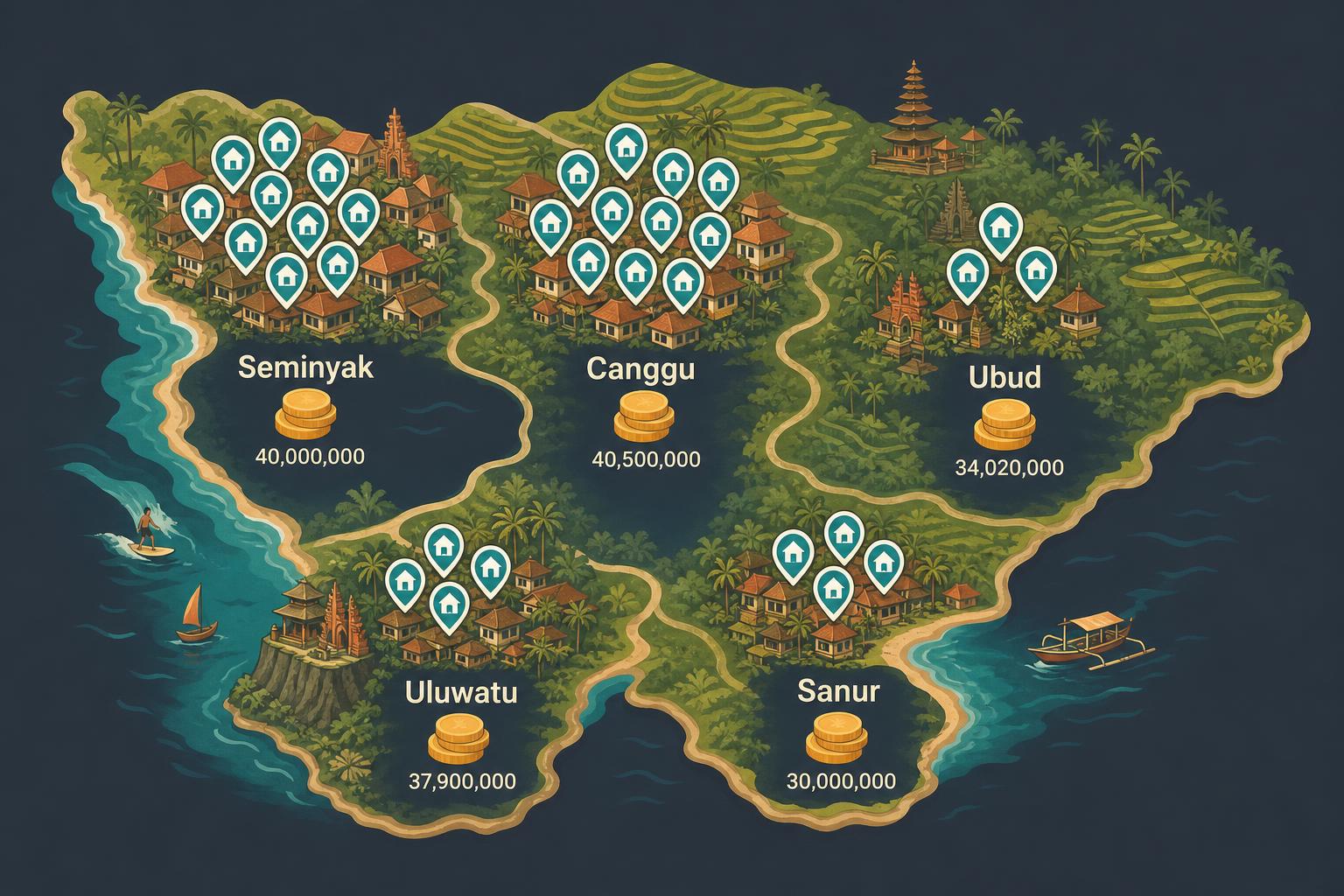
IDR 38,772,000 in Canggu and IDR 22,500,000 in Sanur show different monthly reference points
The supplied median monthly asking rent is IDR 38,772,000 in Canggu and IDR 22,500,000 in Sanur, according to Livuma listing data (November 2026). Medians are useful as area reference points: they show the middle value in the relevant live long-term listing set, not the price of a particular villa, apartment, house, room or kost. These are self-published asking prices, not completed transactions or independently verified Bali-wide benchmarks.
Seminyak’s median is IDR 35,000,000, Uluwatu’s is IDR 35,000,000 and Ubud’s is IDR 27,000,000. The ranking here is a snapshot of Livuma’s listed long-term rentals in November 2026; it is not a valuation, forecast or claim about every home in Bali.
| Area | Median monthly asking rent (November 2026) | Most listings fell between (August 2026 snapshot) |
|---|---|---|
| Canggu | IDR 38,772,000 | IDR 21,600,000–73,000,000 |
| Ubud | IDR 27,000,000 | IDR 14,040,000–90,342,000 |
| Uluwatu | IDR 35,000,000 | IDR 12,000,000–76,680,000 |
| Sanur | IDR 22,500,000 | IDR 17,000,000–55,000,000 |
| Seminyak | IDR 35,000,000 | IDR 20,000,000–73,004,800 |
According to Livuma listing data (August 2026), the stated typical range is the middle 80% of listings. In other words, most listings fell between the two figures shown; these are not absolute minimum or maximum rents. The ranges retain the original August snapshot, while the medians are November figures; they should not be read as a single current dataset or a historical trend. No current typical range is published for Sanur.
Compare a specific home against its area’s median and current listings, then read what that home actually offers. A price alone does not tell you its rental type, bedrooms, amenities, house rules, minimum stay or whether it is available for your dates. For a focused search, see long-term rentals in Canggu or long-term rentals in Uluwatu.
Three stay lengths show how Livuma Balis rental platform searches work
Livuma displays three stay lengths: daily, monthly and yearly, as of November 10, 2026. That figure matters before you contact a host because the platform’s viewing route distinguishes daily stays from monthly and yearly rentals.
Set the stay-length filter first, then narrow by area, rental type, price, bedrooms and amenities. This keeps a short stay from being compared with a longer rental merely because the photos look similar. It also directs you to the relevant booking conditions on the live listing.
- Daily: a rental option on the platform, but not eligible for the viewing process described for longer stays.
- Monthly: a rental option for which an in-person or virtual viewing can be requested, subject to the host and property.
- Yearly: the other longer-rental option for which an in-person or virtual viewing can be requested, subject to the host and property.
The platform also lists rooms and kosts. If a room is the right property type for your search, browse kost options in Ubud rather than assuming that the area medians above describe that specific category.
Two viewing formats for monthly and yearly stays give renters a checkpoint before paying the rest
Livuma states, as of November 10, 2026, that monthly and yearly renters can request two viewing formats: in person or virtual. The availability of either format remains subject to the host and the property. Daily stays are not eligible for this viewing process.
This is a decision point, not a substitute for reading the listing. Before requesting a viewing, make a short list of what you need confirmed from the listing: the available dates, stated minimum stay, house rules, bedrooms and the amenities that matter to you. During a viewing, keep the discussion tied to those same points so that a later request reflects the home you assessed.
On Livuma, in-app chat keeps guest-host arrangements in one conversation, and the optional “view property first” route secures only a small deposit for eligible monthly or yearly rentals. After an in-person or virtual viewing, you confirm by paying the rest in the app, with no deadline or automatic confirmation—or cancel for free and have the deposit released or refunded in full.
A viewing does not establish every term by itself. Check the booking-specific payment schedule, deposit or balance rules, deadlines, cancellation rules and refund logic presented before you commit. For a deeper document checklist, read what to check before signing a Bali rental contract.
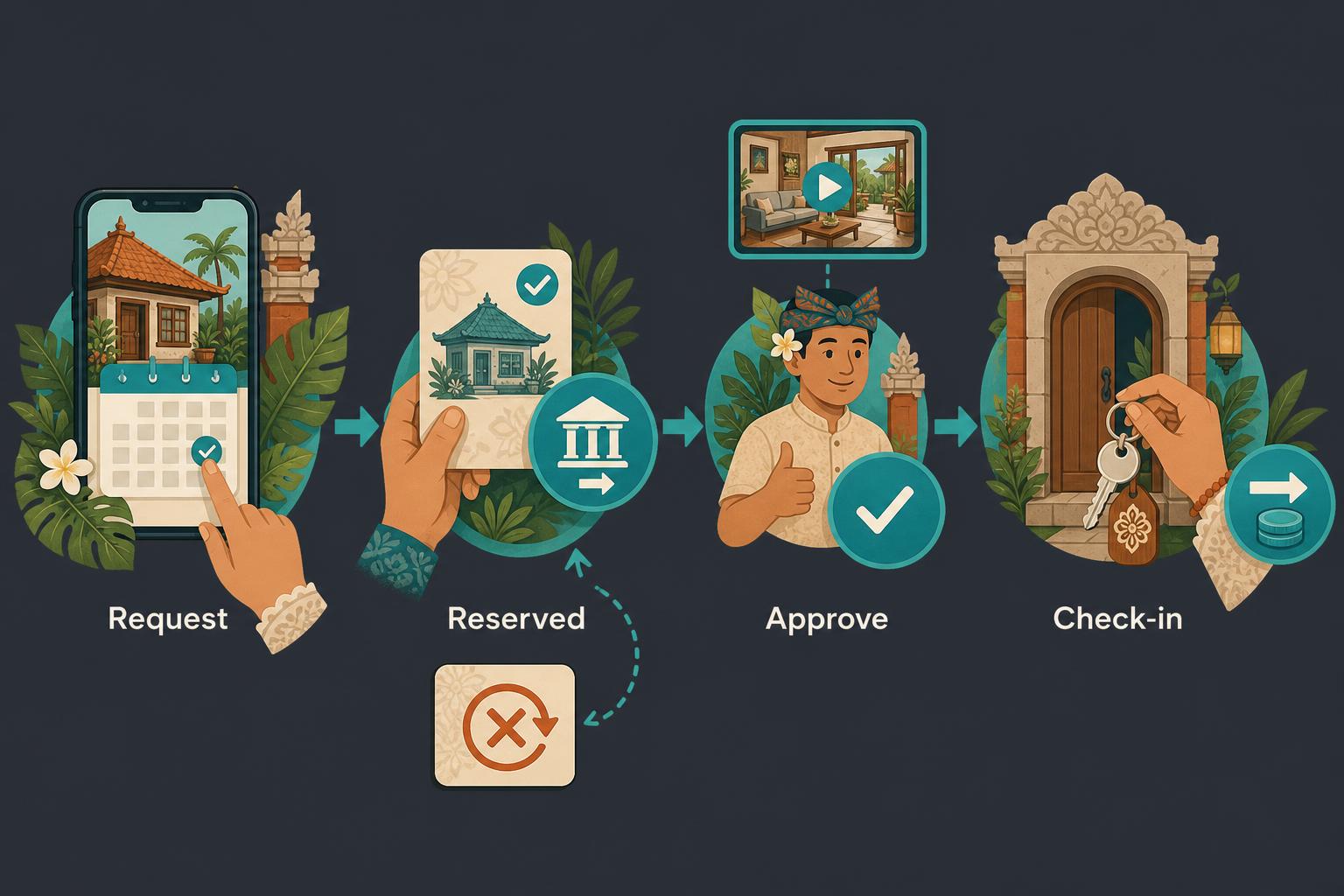
One booking request on Livuma and one host decision determine whether a reserved amount becomes a charge
Instead of sending money based on an informal agreement, use the live rental listings and review the checkout terms first.
- Find a home using the area, rental type, price, stay-length, bedroom and amenity filters. Read its availability, minimum stay, house rules, booking conditions and verified guest reviews.
- Review the payment schedule, deposit or balance rules, deadlines, cancellation rules and refund logic before committing.
- Pick dates and secure the request before the host sees it: a card amount is reserved without a charge, or an Indonesian bank-transfer prepayment is held by Livuma.
- The host answers within a limited response window. Approval charges the card reservation and confirms the booking; a decline, withdrawal or expired request automatically releases the reservation or refunds the prepayment in full.
- For an eligible monthly or yearly “view property first” request, secure only a small deposit and arrange the viewing in chat. Afterwards, pay the rest in the app to confirm, with no deadline or automatic confirmation, or cancel free for a full release or refund.
- Complete guest identity verification before the rental agreement is issued. Livuma generates agreement details and receipts for supported bookings.
- At check-in, confirm arrival or report a problem. The host payout stays on hold while a reported problem is resolved and is released only after successful check-in under the booking’s terms.
Zero separate guest service fee means the displayed rental price is the Livuma guest price
Livuma states zero separate Livuma guest service fee as of November 10, 2026: guests pay the rental price shown. It also states that exact payment timing and cancellation terms are displayed before reservation. This does not mean every rental has identical deposit, balance, deadline, cancellation or refund rules. Those are booking-specific and must be read at checkout.
For rental bookings, Livuma handles payment through its platform and does not release the host payout until successful check-in under the booking terms. Payments can be made by card or Indonesian bank transfer through Xendit. Do not extend that statement to property sales or land listings.
The operational record continues after payment: Livuma says it generates digital rental agreement details and receipts for supported bookings, and its check-in flow lets the guest confirm arrival or report a problem. A reported problem puts the host payout on hold while it is resolved. That is useful when you want the schedule and transaction record attached to the booking rather than relying on a verbal summary.
For the company’s current rental statements and live inventory, see the Livuma website.
7% is typically the host fee, while payout follows confirmed check-in
Livuma’s stated host fee is typically 7% on successful paid bookings, according to the platform information supplied for this article. Hosts pay no platform fee on an unsuccessful booking. The public homepage displays a 7% host fee on paid bookings as of November 10, 2026; the October 7, 2026 terms specify that the applicable percentage appears in the host dashboard and is confirmed before payout, so hosts should not treat 7% as a universal quotation.
The platform supports daily, monthly and yearly rentals. These options do not remove the need to make each listing’s photos, pricing, availability, minimum stay and house rules accurate.
A host must activate an account with identity, legal details and an Indonesian bank account before taking paid bookings. Payout follows successful check-in for the rental booking under its terms. Hosts ready to understand the setup can use the Livuma hosting guide, then create a listing only when the property information is ready.
2020 electronic-system rules explain why platform identity and data handling deserve scrutiny
Indonesia’s Ministerial Regulation No. 5/2020 became effective on November 24, 2020 and was subsequently amended by Regulation No. 10/2021. The amended framework covers private electronic-system operators, including internet portals and apps used to offer or trade goods and services, financial-transaction services and online communication services. The regulation sets requirements for eligible operators to register and address information security and personal-data-protection obligations.
That context is a reason to distinguish confirmed company information from assumptions. Livuma identifies its operator as PT Livuma Home Market and displays NIB 0702260005208 on its website as of November 10, 2026. This verifies the website disclosure, not the underlying government registration. An NIB is a prerequisite to separate PSE registration, not a PSE registration certificate. The supplied information does not verify that Livuma is registered as a Private Electronic System Operator, nor does it verify a separate payment-service licence. Those should not be claimed without checking the relevant official registry or further company documentation.
Read the underlying Ministerial Regulation No. 5/2020 and its amendment if you need the formal regulatory text. For a renter, the practical habit is simpler: use the account and booking record, read the terms shown before reservation, and separate rental-platform claims from claims about a property purchase.