

On an ordinary weekday morning, Bali’s workday starts in different rhythms. In Canggu and Berawa, scooters are already converging around Jl. Nelayan and Jl. Pantai Berawa; in Ubud, the choice may be between a desk near Nyuh Kuning or Penestanan; in Sanur, a quieter desk off the bypass can set a very different pace.
A coworking membership is not just a place to open a laptop. For a long-stay resident, it determines where a daily scooter trip happens, whether client calls have a private room, how late work can run, and how much a home internet outage matters. This guide compares verified options and published prices across six Bali work bases, then shows how to test one before paying for a month.
Which Bali coworking area fits your work style and social routine?
The best Bali coworking area is usually the one that removes the most friction from your actual week—not the one with the most recognisable digital-nomad reputation. Start with your call schedule, preferred work hours, tolerance for a scooter commute and whether you want one familiar workspace or access across several locations.
Canggu: choice and late-hours flexibility near Jl. Nelayan
Canggu suits workers who want several published membership structures and who may work outside a conventional daytime schedule. BWork on Jl. Nelayan advertises 24/7 unlimited-member access, while PUCO Rooftop publishes 24-hour weekday access. Both have distinct focus-room options, which matters more than an attractive communal floor if calls are central to your job.
The trade-off is the commute. Badung’s transport agency identified congestion in Canggu and surrounding areas as a serious issue in an August 2026 coordination meeting. Treat every prospective home-to-desk journey as something to trial at your real start and finish times, rather than judging it from a map. Badung’s congestion coordination is a useful reminder that a short nominal route can still shape the whole working day.
Berawa: one membership across multiple Setter locations
Berawa works for people who value a beach-side address but want the option to switch work settings. Setter’s Berawa Beach site is at Jl. Segara Perancak/Jl. Pantai Berawa No. 1, and its membership system also covers its Canggu and Ubud spaces. That can suit someone whose routine moves between the south and Ubud, provided the travel itself is realistic.
Berawa is not automatically a calmer Canggu substitute. The Badung government specifically included Berawa in its planned traffic-engineering expansion as of April 2026. A renter who needs to arrive at a daily stand-up on time should test the route in both directions before choosing a lane or housing compound.
Pererenan: a smaller, focus-first desk option
Pererenan is a better fit for someone seeking a smaller workspace rather than assuming it offers the same depth of inventory as Canggu or Berawa. The Decision Table is a coworking option in Pererenan, but its capacity and facilities need direct confirmation. It may appeal to workers who dislike a busy coworking floor, but advance confirmation of a desk and call space is important.
Do not assume a published monthly alternative exists here: no direct operator-published tariff or opening schedule was established for The Decision Table, so confirm booking options and current prices directly. TheHub Pererenan restricts coworking to accommodation guests, with workspace access included in a stay; it offers no public day passes.
Seminyak fringe, Sanur and Ubud: distinct workday rhythms
Bali Bustle Sunset is near Seminyak on the Sunset Road/Denpasar side, rather than in beachside Seminyak proper. It can suit someone who wants a practical shared workspace, but confirm whether cross-location access applies at Sunset. Sanur’s FLOW Workspace, at Jl. Danau Poso No. 66, is described by its operator as just off the bypass and close to the beach; its setup is particularly relevant for workers who need phone booths and access until midnight.
Ubud offers a different split. Setter Ubud is on Jl. Raya Sanggingan, while Outpost operates in Nyuh Kuning and Penestanan. Choose between them based on the home-to-desk route and the kind of space you need: Setter publishes desk, focus-room and meeting-room counts for Ubud, while Outpost sells day passes on site and states that its Bali locations open 24 hours daily; confirm day-pass-specific entry arrangements directly.
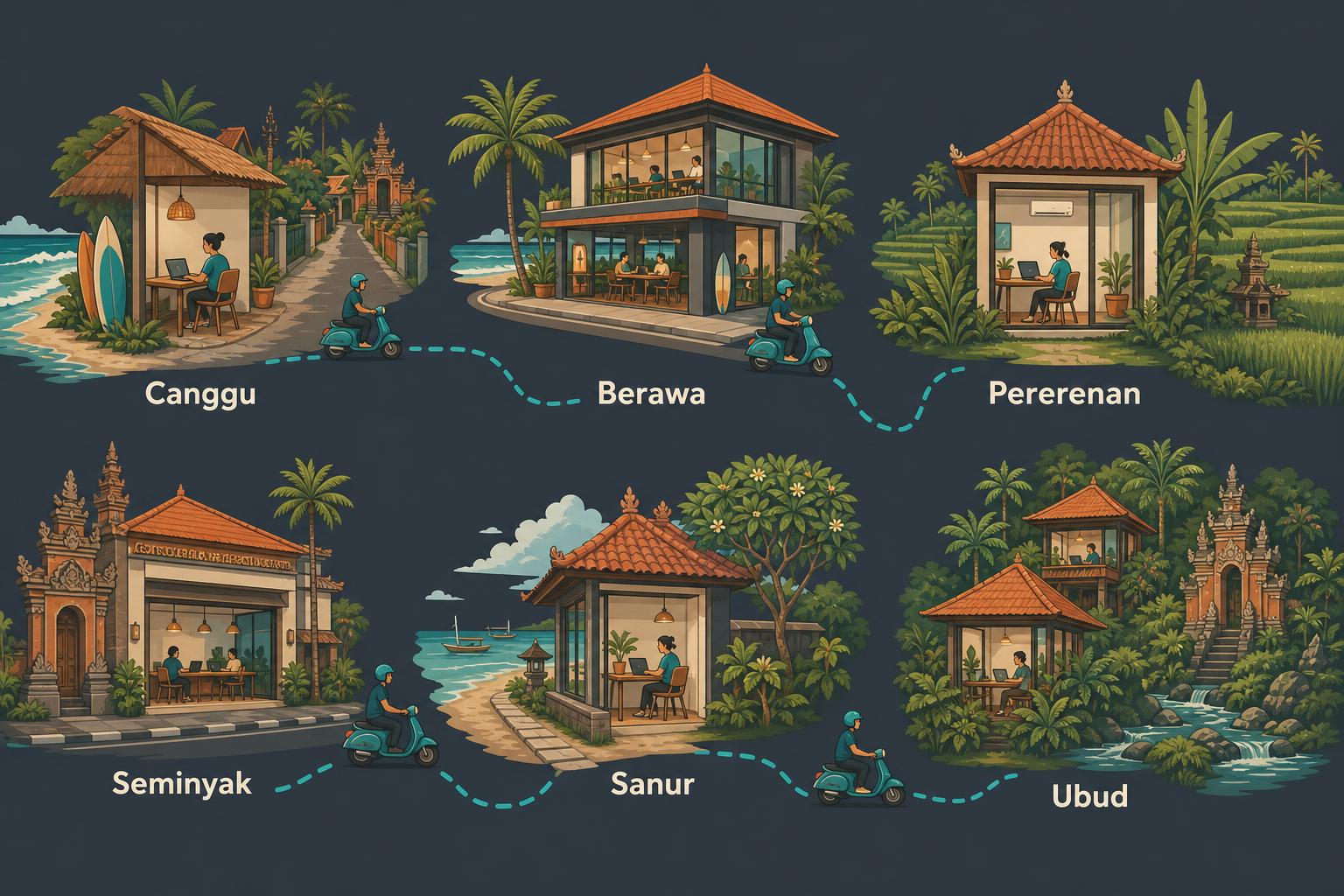
Published Bali coworking day-pass and monthly prices by area
Day-pass pricing is useful for testing a space, but it does not tell you whether a monthly plan includes the hours and private-room access your work requires. The table below uses operator-published pricing and identifies where a price is not publicly available or requires confirmation.
| Area and workspace | Published day pass | Published longer pass | Work-base consideration |
|---|---|---|---|
| Canggu — BWork, Jl. Nelayan | Rp299,000; Rp199,000 for Indonesian ID holders | Rp3.85 million unlimited monthly; Rp2 million monthly restricted to 3 pm–10 am | 24/7 unlimited-member access; focus-room allowance differs by plan |
| Canggu — PUCO Rooftop | Rp200,000, including 24-hour internet access; weekend building hours apply | Rp2 million Monthly Mate for 30 days | 24 hours Monday–Friday; 8 am–10:30 pm Saturday–Sunday |
| Berawa/Ubud/Canggu — Setter | Rp299,000 | Rp1.19 million weekly; Rp3.99 million monthly | Three-location access and five monthly focus-room hours |
| Pererenan — The Decision Table | Confirm current price directly | No operator-published tariff established | Confirm seat, focus-room availability and current price |
| Seminyak fringe — Bali Bustle Sunset | Sunset tariff not published; confirm directly | Sunset tariff not published; confirm directly | Confirm whether network pricing and cross-location access apply at Sunset |
| Sanur — FLOW Workspace | Rp300,000; access until midnight | Rp2.4 million for 10 days per month; Rp3.8 million monthly Community membership | Phone booths, meeting-room access and registered-member 24/7 access |
| Ubud — Outpost | Price not published on the available page | Price not published on the available page | 24-hour Bali locations; confirm day-pass entry arrangements |
At BWork, the Rp299,000 pass includes 24-hour coworking/Wi-Fi access, one focus-room hour and 10 printing pages, subject to limited availability. Confirm initial check-in hours directly. Its Rp3.85 million unlimited monthly plan includes Canggu–Uluwatu access and two focus-room hours per day; the Rp2 million option has access restricted to 3 pm–10 am. Memberships cannot be frozen, transferred, cancelled or refunded after payment and activation. Check BWork’s published Canggu membership terms before comparing it with an apparently similar monthly pass.
PUCO’s Rp2 million Monthly Mate pass covers 30 days and includes 12 focus-room hours and locker access, subject to availability. Its Rp200,000 day pass includes 24-hour internet access, one coffee/tea and one focus-room hour, subject to availability; weekend building access remains limited to 8 am–10:30 pm. An eight-hour communal-workspace package costs Rp150,000. Its separate rooms are priced at Rp30,000 per hour for a fan-equipped Focus Room and Rp50,000 per hour for an air-conditioned Focus Room+; confirm current meeting-room prices directly. That distinction is why a cheaper membership can become a poor fit for a meeting-heavy worker.
Setter publishes Rp299,000 day, Rp1.19 million weekly and Rp3.99 million monthly passes. The monthly plan includes three Bali locations, call booths and five focus-room hours per month; its booking system labels the monthly dedicated-desk plan non-refundable. Bali Bustle’s listed common-space passes for Kuta, Pararaton and Bustle Base are Rp150,000 daily, Rp700,000 weekly and Rp2 million monthly; confirm current private-call room prices directly. Sunset’s location page does not publish a coworking tariff, so confirm rather than assuming those rates apply there. Setter’s published plan details and Bali Bustle’s terms should be checked again at the point of purchase, including taxes, promotions and room overages.
FLOW publishes a Rp300,000 day pass with hot- or standing-desk access, private phone booths and access until midnight. Its Rp2.4 million plan covers 10 days per month; the Rp3.8 million Community membership includes hot/standing desks, phone booths and meeting-room access. FLOW’s Sanur membership page is the place to verify current inclusions.
How reliable is Wi-Fi at Bali coworking spaces?
Bali-wide monitoring is context, not a desk-level promise. During Ministry of Communication and Digital monitoring in March 2026, Bali’s average internet speed was 105 Mbps; the ministry reported national download and upload averages of 95 Mbps and 42 Mbps. Those figures do not establish the speed, latency, upload capacity or contention at a particular coworking desk. The ministry’s monitoring report should therefore not replace an on-site test.
Several operators advertise bandwidth or fallback arrangements, but advertised bandwidth is not an independently verified service level. Setter describes 100 Mbps “failasafe” internet on day passes and 200 Mbps on weekly and monthly passes, without publishing its backup architecture or guaranteed throughput. FLOW advertises 150 Mbps Wi-Fi but does not state a backup ISP or generator arrangement. Bali Bustle claims Wi-Fi up to 100 Mbps.
Outpost states that its Bali workspaces use 200 Mbps shared ISP bandwidth plus a dedicated 100 Mbps line from a different provider, using load-balancing routers. Its generator statement on the cited page applies to Sri Lanka, not Bali. Ask separately about power resilience at every Bali site; do not infer generator coverage from an internet claim.
For daily video calls, test five things from the desk zone you intend to use:
- Download and upload speed at morning, lunch and late-afternoon peak periods.
- Latency and packet loss, not only the headline speed-test result.
- A real video call, with camera and screen sharing if those are normal for your work.
- A representative file upload, especially if you work with design, code, media or backups.
- The staff answer on second ISP, UPS or generator coverage, powered circuits and the last outage response. Treat vague answers as uncertain.
A home connection can be useful, but a nearby workspace with bookable booths gives workers with fixed calls a more resilient routine. The workspace is not a substitute for testing the rental’s own internet, electricity setup and quiet hours; it is a practical second location when your work cannot pause.
Phone booths, meeting rooms and call etiquette determine whether a desk works
Communal coworking floors are for quiet individual work unless the workspace says otherwise. A normal-volume sales call, interview or team meeting can make an otherwise good desk unusable for everyone nearby. Before joining, observe what actually happens: are calls moved to booths, are rules enforced, and does sound leak from the private rooms?
The facilities are materially different. BWork’s day pass includes one hour of focus-room use. PUCO separates fan-and-LAN focus rooms, air-conditioned Focus Room+ rooms and a meeting room. Setter advertises private meeting and call rooms, while its monthly membership includes five focus-room hours. FLOW lists privacy booths, conference/meeting rooms and quiet and collaborative zones. Bali Bustle has a separately priced Skype room for non-members.
Reserve the exact room before committing. Ask about included credits, booking windows, time caps, overage rates, cancellation rules and whether a room can be reserved at the same time as your recurring client call. A “phone booth available” claim is not enough if every booth is already taken when your meeting begins.
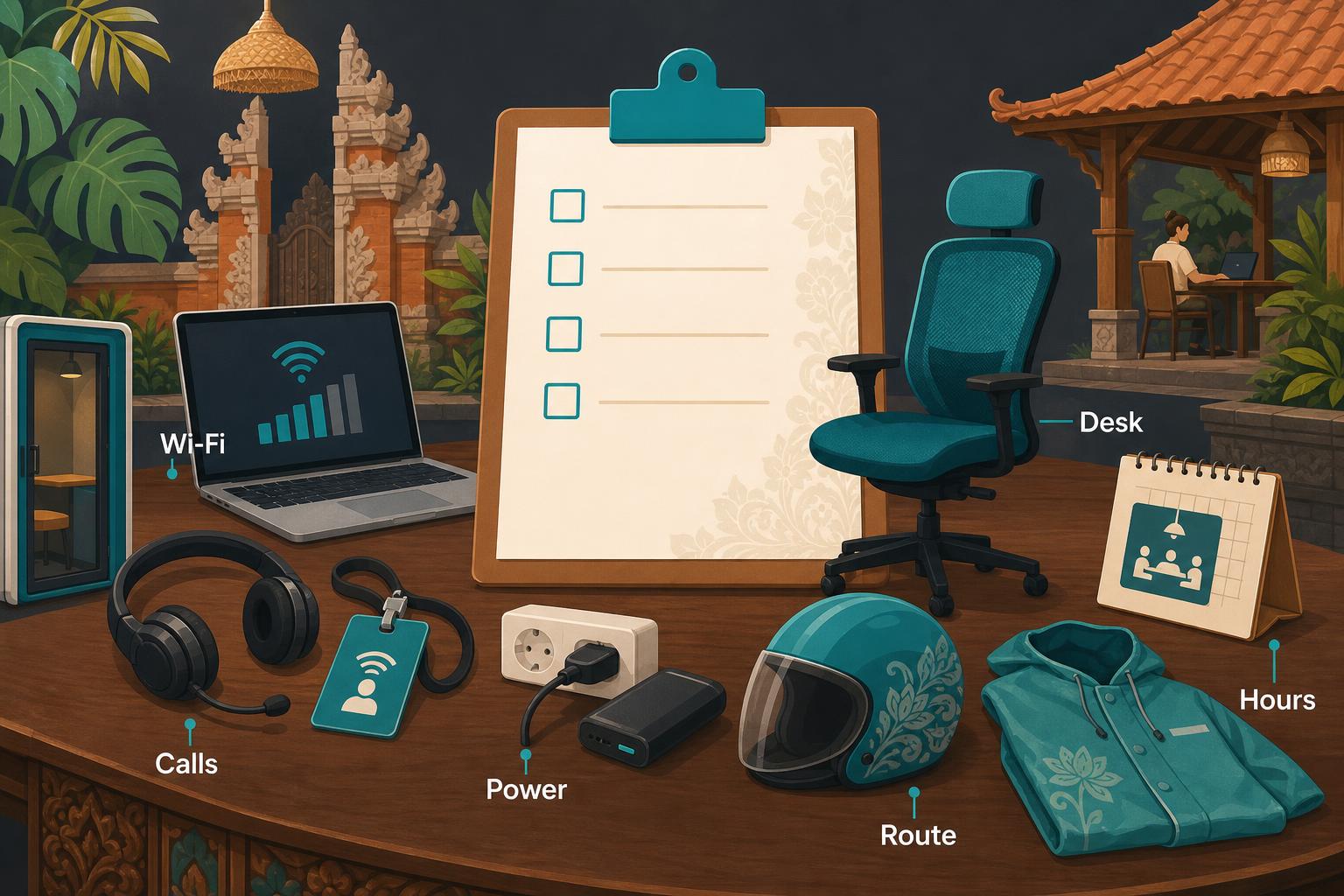
Where should remote workers rent when coworking is part of the routine?
Choose a work base before signing a long rental, then map homes from the workspace outward. The right radius depends on how often you will go, the hours you work, your transport method and whether you need to carry equipment. A weekly trial can reveal more than an online map: ride the route in rain, at your intended arrival time and after an evening session.
For workers anchored at Jl. Nelayan, compare long-term rentals in Canggu after identifying the workspace and route you will genuinely use.
If FLOW is your likely base, browse Sanur long-term rentals with Jl. Danau Poso and your other weekly destinations in mind.
Use the housing search as a comparison tool, not a rushed payment channel. On Livuma, you can filter live inventory by area, rental type, price, stay length, bedrooms and amenities. Compare the home-to-work journey alongside the listing’s stay conditions rather than treating a coworking address as an afterthought.
A budget-room renter can also decide whether a shorter commute is worth a different room format. For example, Seminyak kost listings are worth comparing against Sunset Road commute needs, while a worker set on Ubud can review long-term rentals in Ubud against routes to Sanggingan, Nyuh Kuning or Penestanan.
Food, parking and air-conditioning shape the everyday coworking habit
A work base only works if you can repeat the routine comfortably. The decision is often less dramatic than Wi-Fi marketing: can you park a scooter without stress, eat lunch without losing the middle of the day, return after an errand, stay cool through the afternoon and get home after a late call?
Published facilities vary. Confirm parking and air-conditioning directly with The Decision Table. Bali Bustle lists parking, water, coffee/tea, Wi-Fi and fully air-conditioned work areas. Setter advertises climate-controlled rooms and complimentary drinks. FLOW lists standing desks as well as hot desks, and BWork’s membership structure includes locker access on its unlimited monthly plan. These details should be verified on a day pass because a facility listed online may not be available at every desk or at every hour.
Make your trial visit a normal workday, not a quick tour. Arrive with your scooter, laptop charger, meeting headset and the bag you would normally carry. Leave for lunch, come back, use the bathroom, take a call and find out whether the small frictions feel manageable. If you are choosing between living with or without a scooter, read the practical trade-offs in living in Bali without a scooter before selecting a workspace-dependent address.
Opening hours and seasonal traffic can make the wrong membership expensive
Match access hours to the least convenient part of your schedule, not the easiest. Confirm The Decision Table’s current opening hours directly. PUCO lists 24 hours Monday to Friday but 8 am–10:30 pm on Saturday and Sunday, with the last transaction at 10 pm. BWork advertises 24/7 coworking access; its non-peak monthly plan is restricted to 3 pm–10 am. Confirm initial check-in hours, guest access and support outside reception hours.
Setter advertises 24/7 access, while FLOW says registered members can have 24/7 access even though its day pass runs until midnight. FLOW registers new members Monday–Friday 9 am–6 pm and Saturday 9 am–5 pm, with registration closed Sunday. Outpost states that its Bali locations open 24 hours daily and sells Ubud day passes on site; confirm day-pass-specific entry arrangements. Bali Bustle advertises 24/7 access for members, but day-pass first-entry and overnight arrangements require confirmation. These are not interchangeable promises: ask when 24/7 access activates, how entry works, who is present overnight and what happens if a card, code or app entry fails.
For Canggu and Berawa residents, congestion is also an opening-hours issue. A late-closing desk may sound ideal but be less useful if the return journey is the part of the day you most want to avoid. Build in an alternative: a nearby home work corner, a workspace closer to home, or a membership with multiple locations.
How to trial a Bali coworking space before buying a monthly membership
Use a day pass or short pass as an audit, not a sightseeing visit. A monthly plan should only follow after the space has passed the conditions of your real workweek.
- Work from the exact desk zone. Check chair ergonomics, air-conditioning, desk lighting, plug density, monitor compatibility and background noise.
- Run network tests repeatedly. Measure download, upload, latency and packet loss, then make a real video call and upload a representative work file.
- Test the private-room system. Reserve a booth or focus room and confirm credits, limits, fees, sound isolation and punctual access.
- Ask about resilience directly. Ask about a second ISP, UPS or generator coverage, circuits that remain powered and past outage response. Mark an unspecific answer as uncertain.
- Observe call etiquette. Make a normal-volume call from the communal floor only where permitted, and see whether staff direct calls to booths.
- Visit at your difficult hours. Include evenings, weekends or early starts if clients require them.
- Complete the commute. Check parking, scooter approach, rain-season arrival conditions and actual door-to-door timing from the home you are considering.
- Get the all-in membership terms. Confirm tax-inclusive price, deposit and refund rules, freeze policy, guest policy, re-entry, locker allocation and whether the quoted price is promotional.
Who should not make a Bali coworking membership their main work base?
Do not default to a coworking membership if your work is mostly quiet, asynchronous and easily done from a carefully selected home. A daily commute can become an unnecessary expense of time and attention, especially in the Canggu–Berawa corridor. In that case, prioritise a rental with a functional work corner and test its connection, power and noise conditions during a viewing.
A small Pererenan space may not suit someone who needs guaranteed spontaneous meeting-room availability. A day-pass-only worker may not benefit from a premium 24/7 plan. And a person with confidential calls should not rely on a claimed booth without verifying sound isolation and booking access.
Conversely, coworking is a strong option for people who need a clear boundary between home and work, dependable access to a private call setting, a desk that can operate late, or a practical fallback when home connectivity is uncertain. Pick the area first through your working pattern, then let the membership and housing choice reinforce each other.