

Bali’s October 11–20, 2026 meteorological-drought warning is now historical. As of November 9, Bali is transitioning from dry season to rainy season: the provincial government described that transition on November 6, while BMKG reported a highest daily rainfall observation of 300 mm in Bali during November 1–4. Water supply and fire-safety checks remain practical precautions, but the October warning should not be read as a current island-wide status.
Bali’s October 2026 drought warning: the areas and dates to know
The previously cited warning covered October 11–20 and applied to different parts of Bali at different levels. It was a practical signal for households, landlords and prospective buyers to check water systems before a shortage became an urgent moving-day or repair problem. The table below records that historical warning, not current November alert levels.
| Area | Historical BMKG drought status for Dasarian II, October 11–20, 2026 | Practical priority |
|---|---|---|
| Bangli and Buleleng | Awas | Highest-alert areas in that bulletin: check stored water, pumping and backup supply. |
| Badung, Gianyar, Denpasar and Tabanan | Siaga | Confirm how the home is supplied and who handles a disruption. |
| Jembrana, Karangasem and Klungkung | Waspada | Conserve water and review the property’s water arrangements. |
BMKG’s published warning is not a prediction that every tap will stop. It identifies meteorological drought conditions and elevated exposure. Under BMKG’s early-warning regulation, an Awas warning can be triggered by at least 61 consecutive dry days, forecast rainfall below 20 mm per 10-day period with high probability, and/or a severely negative standardized precipitation index. Read the agency’s current meteorological-drought warning alongside local information for the specific village and home.
The conditions behind the warning had been building. By July 31, three Bali rain posts had passed 60 consecutive dry days: Sumber Klampok and Sumber Kima in Gerokgak, Buleleng, and Batur in Kintamani, Bangli. In Jembrana, drought had affected about 596 households by the August 14 report; BPBD Jembrana had distributed 127,000 litres of clean water in total, including in Melaya, Negara, Mendoyo and Jembrana districts. On September 1, BPBD Jembrana reported delivering 4,000 litres to drought-affected Banjar Sekar Kejula, Yehembang Kauh village, Mendoyo, identifying 241 beneficiary households. BPBD Bali’s September report, published October 5, records 4,541 households affected by drought during September. Its October report, published November 6, records 1,990 households affected during October; this is a separate monthly figure, not a cumulative September–October total.
What the rainfall outlook and low groundwater availability actually mean
Bali Climate Station’s August 20 forecast projected generally 1–50 mm of provincial rainfall in September, 0–100 mm in October and 18–150 mm in November 2026. It classified rainfall across those three months as generally Below Normal. These ranges come from the August climate bulletin: they are earlier forecasts, not measured rainfall totals or a current November forecast. By November 6, the provincial government described Bali as transitioning to the rainy season, and BMKG reported a highest daily rainfall observation of 300 mm in Bali during November 1–4. That does not tell you whether an individual villa, kost or apartment will have water on a given day; a property relying on shallow storage, a pump or a well should not be assumed to recover quickly after a brief shower.
The water-source question is particularly important because July groundwater availability was assessed as mostly Kurang (low/insufficient) across Bali. Areas assessed as Cukup included Karangasem, Bangli, Penebel, Tampaksiring, Sidemen, Bebandem, Selat, Banjarangkan, Klungkung, Dawan and Manggis. These are historical broad availability assessments, not a current certificate that every home in those places has reliable water.
The wider climate pattern supports taking water preparedness seriously. BMKG recorded a Niño 3.4 sea-surface-temperature anomaly of +2.99°C in Dasarian II August 2026 and categorised the El Niño as very strong. At that time, it projected El Niño to persist at least into Q1 2027, while noting that a possible positive Indian Ocean Dipole during September–December 2026 could worsen drought conditions. The Bali Climate Station’s August climate summary is the useful reference for that earlier rainfall and groundwater context.
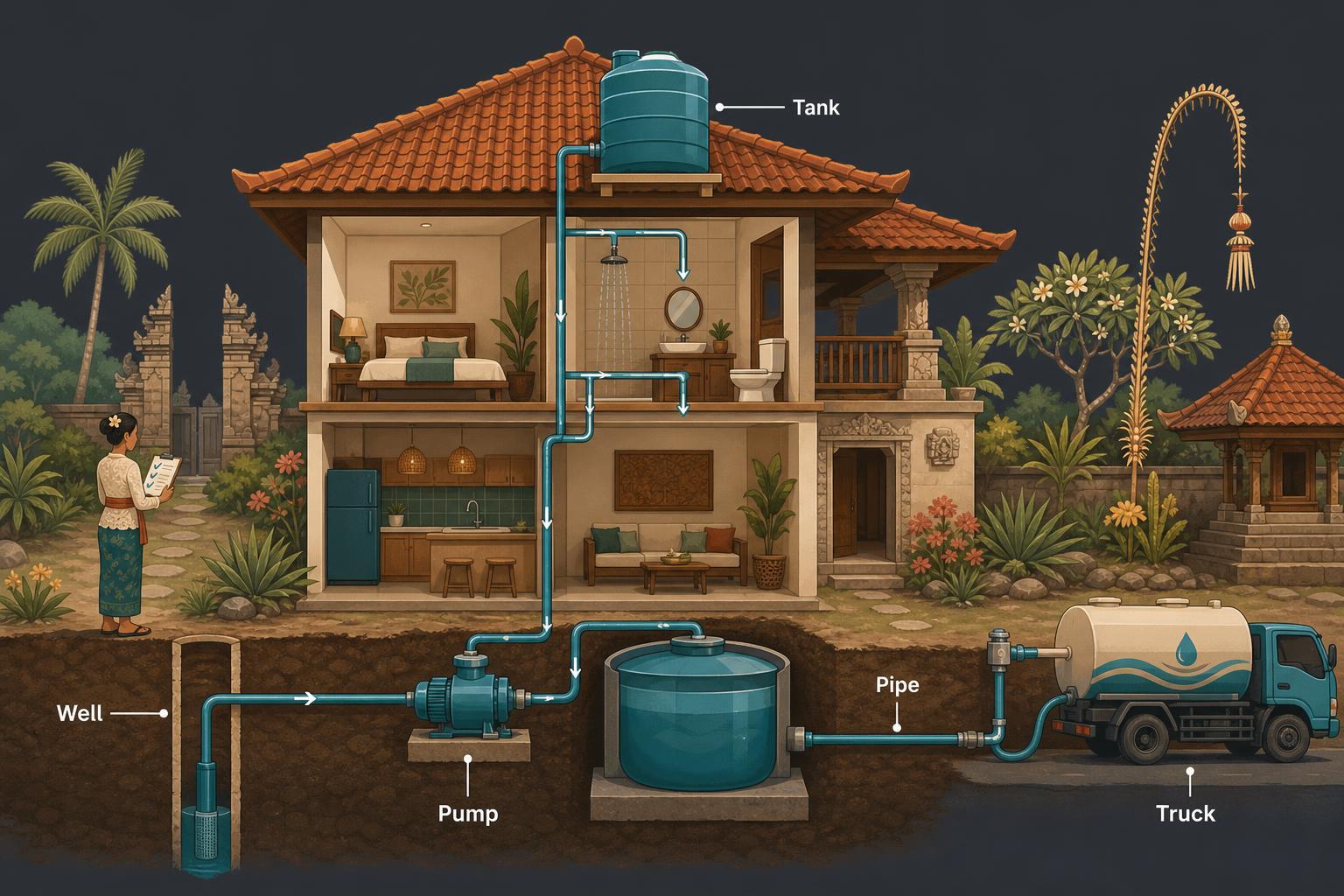
For a household, the point is simple: a dry-season water issue can be a storage, pressure, pump, plumbing, source-quality or delivery-arrangement issue. “There is a well” is not a complete answer to any of them.
Who Bali’s drought warning affects: renters, hosts and property buyers
Renters in villas, houses, apartments and kost
Ask the owner or manager for a clear explanation of the source: piped utility water, a well or bore, delivered water, or a combination. Then ask what happens if that source is constrained. A tenant needs more than a verbal assurance that water is “normally fine.”
- Where are the tanks, and what usable capacity do they have?
- When were the pump, filters, plumbing and float controls last checked?
- If water is delivered, who contacts the supplier and who pays?
- Who pays for pump repair, electricity used for pumping and water-quality treatment?
- Will a supply interruption affect showers, toilets, laundry, garden work or a shared building’s common facilities?
Get the landlord’s position on emergency tanker deliveries and related costs in writing. No current Bali-wide official tanker-water price list was identified as of November 9, 2026, so a generic island-wide tanker price is not a sound basis for a tenancy decision.
When comparing homes, use the listing and viewing to record the water-system answers, not just the bedroom count. On Livuma’s live rental listings, eligible monthly and yearly rentals offer “view property first”: secure a small deposit, then confirm after an in-person or virtual viewing by paying the rest in the app, with no deadline or automatic confirmation—or cancel for free and have the deposit released or refunded in full.
Hosts and owners with occupied homes
Owners should check the physical system and the household communication plan. A tenant should know whom to contact, whether a temporary delivery must be approved first, and whether garden irrigation will be reduced. Do not wait until the tank is empty to find an old pump problem or an inaccessible tank hatch.
For hosts, the drought warning is also a listing-accuracy issue. If a property has a particular water source, storage arrangement or limitation, describe it accurately rather than implying a level of supply that the property cannot support. Hosts managing long-term homes should review their listing details alongside the hosting overview and keep water-source information accurate.
Buyers assessing a Bali property
Water access belongs in property due diligence alongside access, title and building condition. Bali’s spatial-planning rules contemplate controls in critical groundwater zones, including restrictions on new groundwater abstraction, gradual reductions in abstraction and progressive tariffs. A bore or well should therefore be investigated as an operating system with a documented status, not treated as an unconditional asset.
Request evidence of the actual source, utility connection status, pumping history, water bills or delivery records, maintenance records and any relevant permits or approvals. Permen ESDM 4/2026, effective January 22, 2026, requires approval under Article 6 for non-business basic daily groundwater use of 100 m³/month or more per household or group; use below that threshold is exempt from that approval requirement. Groundwater supporting business activities, including tourism and other services, requires an Izin Pengusahaan Air Tanah, with applications through OSS, so the household exemption should not be assumed to cover a commercially operated villa or kost. Under Article 21, an individual’s basic-needs groundwater approval is valid during that holder’s lifetime; buyers should not assume the seller’s personal approval automatically transfers with the property. Confirm the applicable route directly with the relevant local water or ESDM authority. Buyers can begin a location-specific search through Bali properties for sale, but should retain their own professional due diligence for every water source.
What renters and homeowners should do during Bali’s seasonal transition
BPBD’s September 1 guidance advised conserving water in anticipation of the dry season. That remains a useful household precaution during the seasonal transition. Start with an inspection that distinguishes a manageable inconvenience from a system that needs repair or a written contingency plan.
- Inspect storage. Locate every tank, check that it can be accessed safely, and ask whether its stated capacity is actually usable. Look for obvious leaks, loose covers and overflow problems.
- Test the pump and pressure. Run taps at ordinary household-use times. Note pressure changes, cycling, unusual noise, tripped electricity and any delay in refilling a tank.
- Identify the source and handoff point. Establish whether water enters from a utility line, well, bore, delivery truck or shared system. Know which valve or pump serves your unit.
- Write the response plan. Put contacts, payment responsibility, approval steps and the agreed response for a failed pump or depleted supply in the lease, addendum or written message.
- Reduce non-essential use. Pause or reduce irrigation where possible, fix leaks promptly and avoid treating stored water as unlimited.
- Check fire basics while you are checking water. Remove combustible rubbish and dry vegetation from around the building, and make sure exits and access routes are not blocked.
For a new monthly or yearly rental, written water terms matter as much as identifying the equipment. Check booking-specific payment schedules, deposit or balance rules, deadlines, cancellation rules and refund logic before committing; use that same discipline to get supply responsibilities recorded in the rental terms rather than leaving them to a chat message.
Water use can also affect a tenant’s monthly costs. In Badung, Perumda Tirta Mangutama’s household tariffs effective January 1, 2026 are progressive and vary by electricity capacity. For households above 2,200 VA, the stated charges are Rp4,749/m³ for 0–10 m³, Rp8,165/m³ for more than 10–20 m³ and Rp8,743/m³ above 20 m³, plus a Rp13,000 monthly fixed charge. The R1 group is charged Rp2,235/m³ for its first 10 m³, Rp5,716/m³ for above 10–20 m³ and Rp6,002/m³ above 20 m³. Accommodation businesses with fewer than 10 rooms are listed under Usaha I, not automatically a household tariff. Check the official Badung 2026 tariff decision and ask which utility category, if any, serves the actual property.
Fire precautions during Bali’s drought warning: avoid ignition, not only water waste
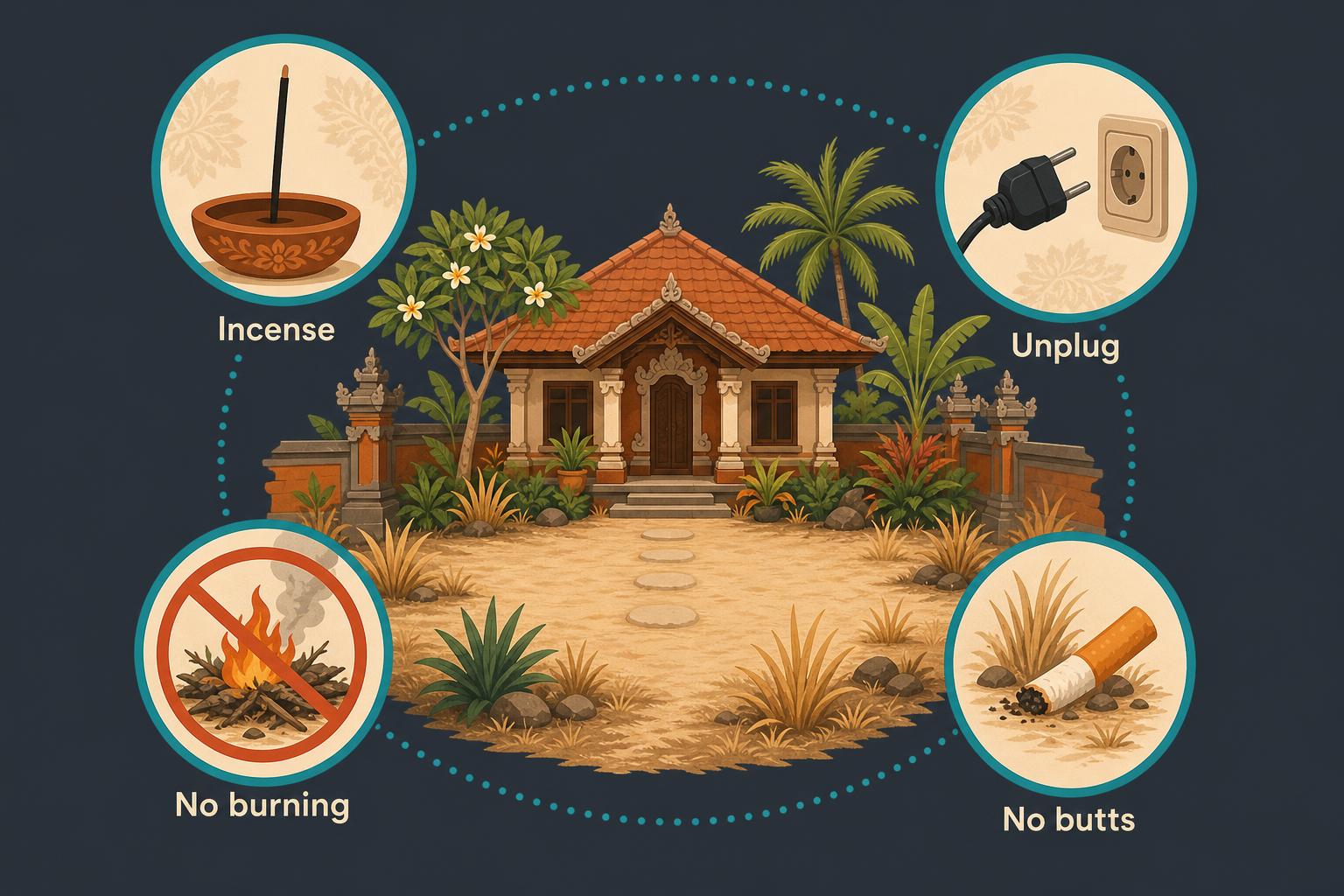
Dry conditions change the consequences of casual household behaviour. Bali BPBD specifically advises residents not to burn land, burn rubbish or discard cigarette butts. It also advises unplugging electrical devices and extinguishing burning incense when leaving home.
Apply that guidance around the property, not only indoors:
- Do not burn garden waste, cleared vegetation or household rubbish.
- Keep cigarette butts out of dry grass, planting beds and rubbish piles.
- Extinguish incense before leaving, rather than assuming it will burn out safely.
- Unplug electrical devices when leaving the home, as BPBD advises.
- Tell gardeners, staff, guests and contractors that burning rubbish is not an acceptable shortcut during these conditions.
Land burning is not merely discouraged: Indonesia’s Environmental Protection and Management Law prohibits it and provides criminal sanctions of 3–10 years’ imprisonment and fines of Rp3 billion–Rp10 billion. The practical household message is still the first one—do not create an ignition source. See BPBD Bali’s October 11 drought and fire-safety guidance for its stated precautions.
What remains uncertain about Bali water supply and drought costs
The October 11–20 warning is historical, and current local conditions must be checked with BMKG and the relevant local authority rather than inferred from that bulletin. Several details must also be checked property by property and authority by authority. There is no identified official Bali-wide tanker-water price list as of November 9, 2026, so renters and owners should not rely on a social-media quote as an island-wide benchmark. Request the supplier name, delivery arrangement and written allocation of costs for the address in question.
Utility tariffs also cannot be transferred casually between regencies. Badung’s 2026 tariff decision is a useful documented benchmark for homes served by that utility, not a Bali-wide rate. In Denpasar, the available official Tirta Sewakadarma schedule is dated June 29, 2022; its continued availability does not establish that it remains the current tariff. Confirm the current bill and tariff directly with the relevant utility before budgeting.
Finally, the applicable individual household bore or well permitting route requires confirmation with the relevant local authority under Permen ESDM 4/2026. Its household approval threshold is 100 m³/month or more, while business groundwater use requires an Izin Pengusahaan Air Tanah. Request documents from the seller or owner, but do not assume that an old document, a visible pump or a neighbour’s practice resolves the current administrative position.
What Bali’s October 2026 drought warning has not changed
The warning has not established that all Bali homes will lose water, that every well is prohibited, or that tanker deliveries have one official island-wide price. It has not converted a general rainfall forecast into a guarantee about a specific property’s tap pressure, water quality or garden condition.
It also has not removed the need for ordinary rental due diligence: inspect the home, ask how utilities are handled, and get responsibilities in writing. For a property purchase, it has not replaced title, planning, building and water-source due diligence.
The seasonal context has changed since the October warning. With Bali transitioning toward the rainy season, that historical alert should not be used to assign current warning levels. Water storage, pump condition, supply arrangements and ignition risks should still be checked before a household runs out of water, rather than assuming recent rain has resolved every property’s supply problems.
Checking a Bali rental’s water arrangements
- Compare the listing details. Search live rental inventory by area, rental type, price and amenities. Review photos, availability, house rules and booking conditions; identify water-source and storage questions to put to the host.
- Review terms before committing. Check the payment schedule, deposit or balance rules, deadlines, cancellation rules and refund logic so emergency-water budgeting is not confused with booking costs.
- Clarify the contingency plan. Ask who contacts a delivery supplier, approves emergency expenditure and pays if a pump fails or stored water runs out.
- Use a viewing where available. Check tanks and pumps, ask how the system serves the home, and confirm any water limitations before committing to the rental.
- Keep arrangements on record. Record water responsibilities and move-in details in writing, and check that the rental terms reflect what has been agreed.
- Report a problem on arrival. Test the supply at check-in and promptly report any interruption or fault through the agreed contact or booking channel.