

Bali’s low-emission-area programme now names six areas: Nusa Dua, Kuta, Ubud, Sanur, the Nusa Penida Islands and the Gajah Mada Cultural Heritage Area in Denpasar. The expanded designation was adopted on 6 October 2026, following the five projects identified in the provincial announcement on 6 August.
Bali’s six low-emission areas were designated on 6 October 2026
The six designated locations are:
- Nusa Dua and Kuta, in Badung Regency
- Ubud, in Gianyar Regency
- Sanur and the Gajah Mada Cultural Heritage Area, in Denpasar City
- The Nusa Penida Islands, in Klungkung Regency
The designation is a provincial tourism and environmental initiative, not a published map of streets where petrol vehicles are barred. Bali’s provincial government identifies Governor’s Decision No. 912/04-B/HK/2026, adopted on 6 October 2026, as the instrument establishing the six-area Kerthi Bhumi Satwika programme. The intergovernmental cooperation agreement was signed on 10 October 2026 at Pura Er Jeruk, Gianyar, covers 2026–2030 and involves Bali Province, Denpasar City, and Badung, Gianyar and Klungkung regencies.
For people choosing a long-term home, the immediate effect is not a new move-in rule. It is a reason to look more closely at the building systems behind a listing: electricity supply, roof condition, solar equipment, battery capacity, parking and waste arrangements.
Sanur is already one of the places named in the project. Renters comparing long-term rentals in Sanur should treat energy and parking questions as part of the property comparison, alongside rent, location and bedrooms.
The announced Bali low-emission plan has five environmental pillars
The six-area programme retains five connected pillars rather than one standalone solar or traffic policy:
- Green energy, including rooftop solar for buildings including hotels, villas, offices and homes.
- Green transport, including battery-electric mobility alongside the development of suitable charging infrastructure.
- Green ecosystems, including more land cover and forest preservation.
- Green tourism, including less single-use plastic in tourism areas.
- Green communities, with community participation rooted in local values.
The policy direction had appeared earlier. On 25 January 2026, the Governor identified the original five places as initial electric-vehicle zoning targets and described Nusa Penida as a prospective “green island”; PLN said charging infrastructure would need to be adequate. That was a policy-development statement, not a published traffic restriction. The programme is being implemented in phases through 2030; Nusa Penida’s 100% renewable-energy ambition is a 2030 target, not a description of its current electricity supply.
Likewise, the province’s 2025–2029 development plan refers to encouraging rooftop solar in connection with new PBG building approvals and expanding public EV charging or swap infrastructure. Its wording is mendorong, or encourage. It should not be read as proof that every existing or future home already has a universal solar obligation.
The distinction matters because headlines can make a direction of travel sound like a finished compliance regime. The 6 August provincial announcement describes the earlier five-project scope, but does not publish parcel boundaries, deadlines, penalties or a zone budget; it is no longer the complete current area list.

What low-emission projects could mean for renters, villa owners and buyers
Long-term renters in Kuta, Sanur, Ubud, Nusa Dua, Nusa Penida and Gajah Mada
A renter is unlikely to install rooftop solar themselves. The practical issue is whether a home advertised as solar-powered actually suits the tenant’s electricity use and billing arrangement.
Ask the owner or manager:
- Is the electricity account prepaid or postpaid, and whose name is on the PLN account?
- Is the solar system grid-connected, battery-backed, or both?
- Can the owner show PLN approval for an installed grid-connected system?
- Which costs remain payable by the tenant: electricity, solar maintenance, battery replacement or repairs?
- Does the home have suitable parking or electrical capacity if an electric scooter or car becomes part of your routine?
A solar claim does not automatically mean a zero electricity bill. Under the national rooftop-solar rule, systems governed by the new regime do not receive bill credits for excess electricity exported to the grid. Qualifying previously operating or approved systems retain export/import billing arrangements for 10 years from utility approval; a capacity change brings the system under the newer rules. Daytime consumption, battery configuration and the actual PLN account setup all matter.
Make these costs explicit in the rental terms, rather than relying on a listing caption or a verbal promise. You can search Livuma’s live rental inventory by area, rental type, price, stay length, bedrooms and amenities.
For an Ubud search, compare what is physically included at each home rather than assuming two similarly priced villas have the same electrical setup. When comparing long-term rentals in Ubud, confirm solar, parking and utility details directly with the host.
Existing villa owners and rental hosts
Owners in the six named areas should start with a factual inventory, not an assumption that equipment must be installed immediately. Record the current electricity connection, roof layout, shading, installed inverter and panels, battery condition, parking configuration and existing waste practices.
If a villa has solar, describe it precisely in the listing and lease. “Solar panels” alone does not tell a prospective tenant whether the system is approved, whether it exports to the grid, whether it has battery backup, or who carries maintenance responsibility. Hosts preparing a rental listing should set out the property’s actual amenities, pricing and booking conditions rather than making broad sustainability claims.
Existing plastic restrictions are also relevant to operational routines. Bali’s regulation covering plastic bags, polystyrene or styrofoam and plastic straws is dated 21 December 2018. The six-area programme proposes further reduction in tourism areas, but it did not create that original restriction.
Property buyers and people planning a build or major renovation
For a buyer, the announcement makes infrastructure due diligence more important. A building’s roof, electricity connection and parking are no longer merely design preferences if the project direction is toward solar adoption and electric mobility.
Before committing to a new build or substantial renovation, ask the relevant local authority about the PBG requirements that apply to that parcel: Badung for Kuta and Nusa Dua, Gianyar for Ubud, Denpasar for Sanur and Gajah Mada, and Klungkung for Nusa Penida. Do not assume that the provincial announcement by itself creates a province-wide rooftop-solar mandate.
Buyers can also compare properties for sale in Sanur or properties for sale in Ubud with a more focused inspection brief: roof access and condition, electrical capacity, daylight demand, parking, tree cover and the approvals supporting any installed system.
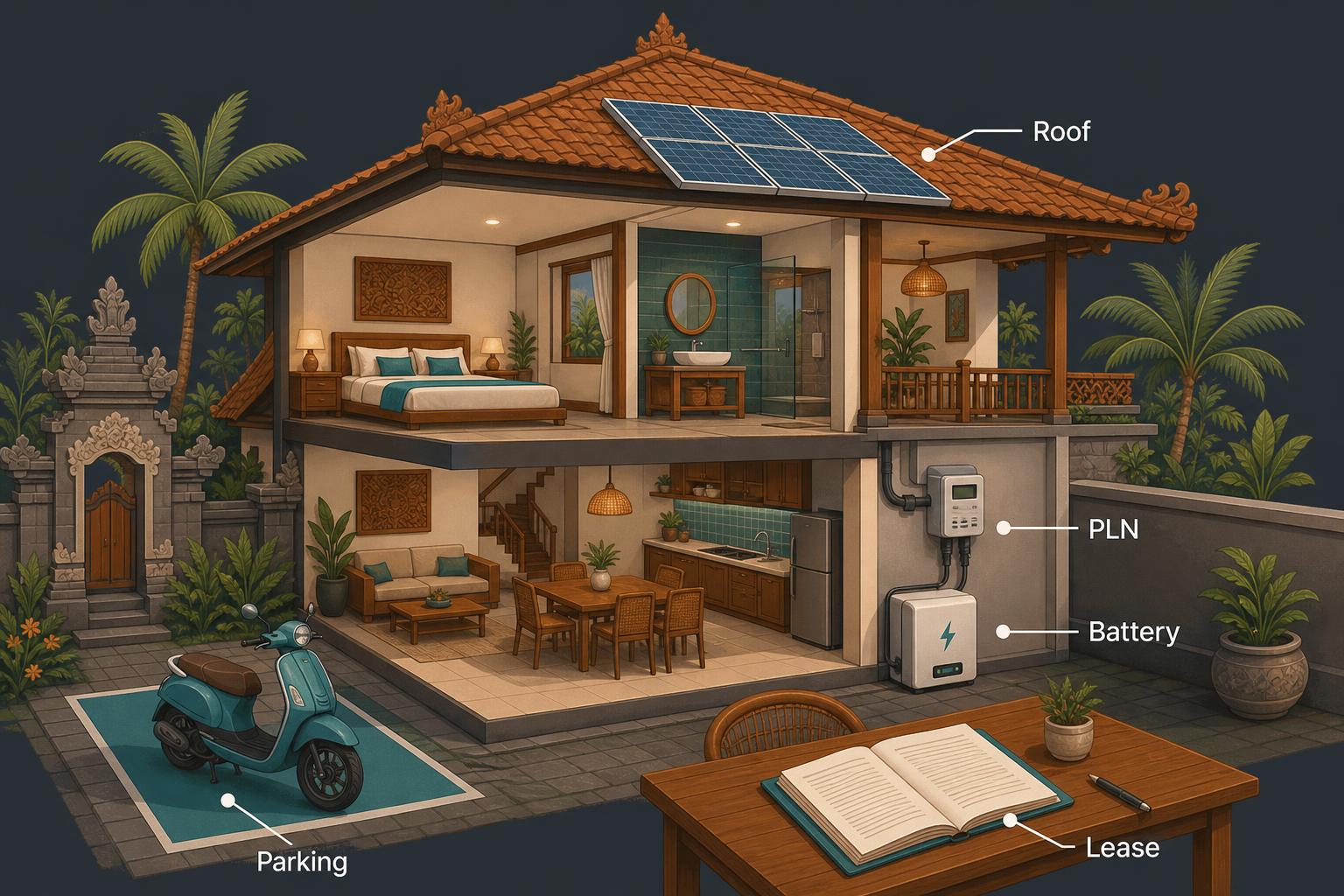
What to do now before signing a lease or buying in a designated area
There is no need to postpone a rental or purchase solely because one of the six areas has been named. There is a strong reason, however, to gather better evidence before you price a property’s running costs or renovation scope.
- Identify the exact location. Confirm whether the property is in one of the named project areas; the reviewed October announcements do not establish parcel-level boundaries. For Sanur, confirm the applicable roads and port-area provisions with Denpasar’s transport department using the final local regulation.
- Inspect the electricity setup. Photograph the meter, inverter, panels and battery equipment where present. Ask for the PLN account details and approval documents relevant to a grid-connected solar system.
- Put running-cost responsibility in writing. A lease should say who pays electricity, solar servicing, battery replacement and equipment repairs.
- Check parking as an amenity. If you expect to use an electric scooter or car, establish whether parking access and a safe charging arrangement are actually available. Do not infer public charging availability from the programme announcement.
- For construction, verify locally before budgeting. Ask the authority responsible for the property’s area which PBG and technical requirements apply to the proposed work.
- Keep claims proportionate. “Solar-ready” should lead to questions about roof, wiring and approvals; it is not evidence of a completed compliant system.
National rooftop-solar rules are already specific. A prospective grid-connected customer applies to the electricity provider in January or July. Where quota is unavailable, the application goes on a waiting list for the next period. Installation may proceed only after provider approval; operating without approval can lead to disconnection, a capacity-based penalty and potentially temporary suspension of electricity service. The applicable framework is Energy and Mineral Resources Regulation No. 2/2024, which took effect on 31 January 2024, replacing Regulation No. 26/2021.
That is why a buyer should not treat a seller’s planned solar installation as a simple add-on. For systems up to 500 kW, there is also a one-time pre-installation report requirement under electricity-business rules, and installation must be handled by a qualified business and meet electrical-safety requirements.
What is still unclear about Bali’s six low-emission zones as of 9 November 2026
The programme’s direction and establishing instrument are clear; the reviewed October announcements do not settle all operative details. The provincial government identifies 6 October as the decision’s adoption date, distinct from the 10 October cooperation-agreement ceremony. The signed Governor’s Decision and its annexes were not retrieved. The following points remain unverified, although Sanur has a separate local framework:
- Exact zone maps and parcel-level boundaries for the six provincial areas.
- Which types of development, building or business will face which treatment.
- Specific compliance dates and transition periods within the 2026–2030 cooperation period.
- Penalties or enforcement mechanisms tied to the six-area programme, distinct from Sanur’s existing parking provisions.
- A programme implementation budget.
- Whether Governor’s Decision No. 912/04-B/HK/2026 or implementing instruments impose compulsory rooftop solar on particular building types; a universal retrofit obligation has not been verified.
- Uniform six-area vehicle-entry rules, emissions standards, exemptions or a date for restricting petrol cars and scooters.
Sanur’s Mayor Regulation No. 39 of 2025 was enacted and promulgated on 24 September 2025 and is listed as in force as checked on 9 November 2026. A legal-database transcription describes gradual control of fossil-fuel vehicles according to infrastructure readiness, not an immediate blanket petrol-vehicle ban. Its parking provisions refer violations to existing legislation rather than specifying a new LEZ entry fee or monetary fine. Confirm operative street-level requirements with Denpasar’s transport department against the final official document; the readily searchable JDIH PDF in its forum directory is labelled as a draft.
Sanur’s 21 February 2026 launch included an electric-shuttle management handover. The Intaran electric shuttle is a local transport option; confirm current routes, operating times, fares and payment arrangements with the operator before travelling. A WRI Indonesia-authored account published on 25 September says the operational action plan and logistics and parking arrangements were still being developed; suggested delivery hours before 08:00 and after 20:00 were a proposal, not verified law.
The provincial programme encourages rooftop-solar adoption, but the reviewed sources supply no universal installation deadline or penalty schedule. In reporting on 20 October, Denpasar’s deputy mayor said a further mayoral regulation would address green-building expectations for new Sanur hotels, while existing hotels would be encouraged to add solar panels gradually. Gajah Mada implementation was still under study. As of 9 November 2026, an enforceable universal villa retrofit obligation has not been verified. Renters and buyers should distinguish the policy objective from a confirmed legal duty.
Use primary documents when a property pitch depends on the policy. The national government’s explanation of the rooftop-solar framework confirms that local provider quota and system conditions govern capacity, replacing any simplistic claim that a customer can install up to 100% of connected PLN capacity. Low-emission-area designation does not itself establish that connection capacity is available for a particular property.
What Bali’s low-emission-zone announcement has not changed
As of 9 November 2026, no low-emission-area-linked amendment to foreign property-title eligibility, leasehold rules, Indonesian visa categories or property-tax rates was identified in the reviewed measures. This does not establish that unrelated Indonesian rules remained unchanged throughout 2026. Its stated measures concern energy, mobility, land cover, plastic reduction and community action.
The reviewed provincial announcements have also not established a uniform petrol-car or petrol-scooter entry ban for Kuta, Sanur, Ubud, Nusa Dua, Nusa Penida or Gajah Mada. Battery-electric mobility is a programme pillar, but the retrieved October announcements do not establish uniform vehicle access restrictions, emissions thresholds, enforcement dates or exemptions. The transcription of Sanur’s separate regulation describes gradual fossil-fuel-vehicle controls according to infrastructure readiness; confirm current local access requirements before travelling.
Finally, the announcement has not introduced Bali’s single-use-plastic restrictions from scratch. Those rules date from 21 December 2018, including administrative sanctions for specified breaches. The new programme points toward further reduction in tourism areas rather than replacing the earlier regulation.
The sensible response is therefore practical rather than dramatic: check a home’s real energy setup, make utility responsibilities explicit, and verify local building requirements for a project. The six-area designation is a material planning signal, but the reviewed announcements are not a complete rulebook for residents, tenants or buyers.