

A 76.4% rise in villa-accommodation NIB registrations shows operators were responding to Indonesia’s OTA licensing campaign before the deadline. That figure, reported by Kemenpar as of May 20, 2026, was the largest growth rate among the short-stay accommodation categories it tracked. It matters because August 1, 2026 was not simply another administrative date: it marked the planned start of delisting for an identified group of accommodation businesses that had not regularised their licensing for online travel agency (OTA) sales.
For a Bali renter, this changes the questions worth asking before a substantial non-refundable payment. For a villa owner or buyer relying on short-term bookings, it makes the operator’s licensing record part of the asset’s commercial due diligence. It does not prove that every unlicensed Bali listing disappeared on August 1, nor that every listing still visible online has been automatically screened. The national API-based verification system remains targeted for June 2027; no subsequent official launch confirmation was located as of November 10, 2026.
Villa NIB registrations grew 76.4% by May 20, showing operators were responding before the deadline
76.4% is Kemenpar’s reported increase in NIB registrations for villa accommodation as of May 20, 2026, compared with March 31, 2025. Across eight tourism KBLI categories, short-stay accommodation units with NIBs in OSS were up 46.5% over the same period. The villa category led that growth.
The practical reading is not that a NIB alone settles every question about a villa. It is that licensing has moved from a back-office issue to an operating requirement for accommodation marketed through digital channels. Kemenpar framed this as national governance of online accommodation businesses, rather than a Bali-only rule. Its October 2026 update reported 113,692 short-term accommodation businesses with NIBs nationwide as of September 23, up 65.2% from March 31, 2025. This is a registration count, not a Bali occupancy or fully compliant-property count.
For a prospective guest, distinguish the accommodation business from the holiday experience advertised in the listing. A polished page, strong reviews or an attractive location do not replace asking who operates the property and whether that operator can provide the business details requested by the Ministry.
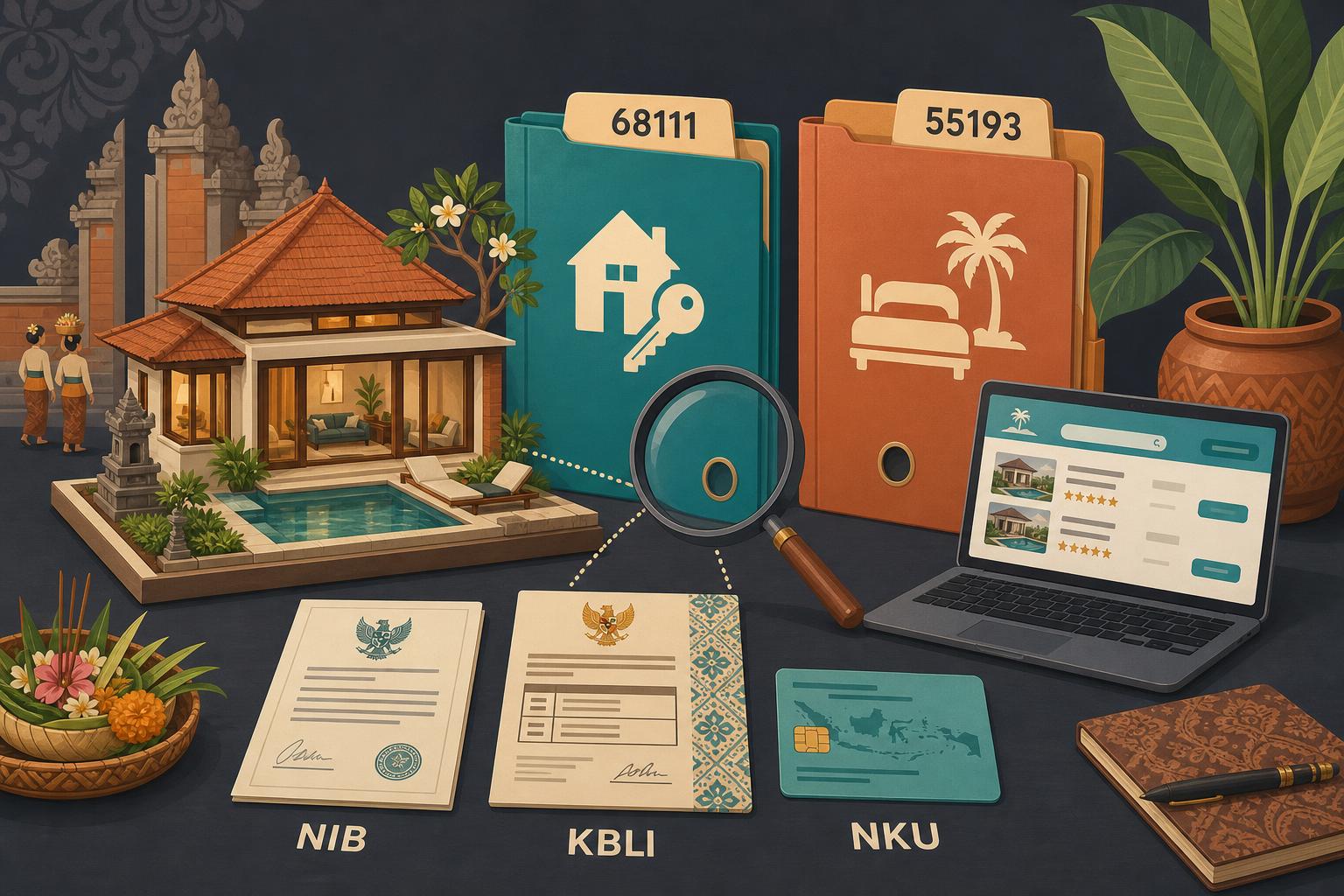
- NIB: the Business Identification Number.
- KBLI: the business classification that should fit the actual activity.
- NKU: Nomor Kegiatan Usaha, also included in Kemenpar’s planned OTA/OSS verification data.
Those three items are more useful as a due-diligence starting point than a vague assurance that a villa is “licensed.” They also help a renter identify whether the person taking payment is connected to the business said to operate the accommodation.
About 1,600 identified businesses faced a planned delisting wave from August 1, not an automatic sweep of every Bali listing
About 1,600 already-identified unlicensed accommodation businesses nationwide were the announced enforcement target on May 26, 2026, according to ANTARA’s report on Kemenpar’s timetable. This is the most important number to interpret carefully.
Kemenpar said it would send notices identifying affected listings to OTAs from June 2, 2026. Platforms were expected to notify the relevant hosts, and delisting could begin on August 1, 2026 after a two-month remediation window. The public information describes a targeted cohort and a planned enforcement process; as of November 10, 2026, this research had not located a primary-source or established-news report independently confirming an actual removal total. Newly onboarded OTA merchants were expected to provide their NIB and appropriate KBLI already, rather than await the August deadline.
| Date | What Kemenpar said would happen | What readers should not assume |
|---|---|---|
| March 31, 2026 | An earlier publicly announced licensing target. | That this remained the final practical deadline. |
| June 2, 2026 | Notices identifying affected listings were due to be sent to OTAs. | That every OTA listing was manually reviewed. |
| August 1, 2026 | Delisting could begin for the identified non-compliant cohort after remediation time. | That all unlicensed Bali accommodation was automatically removed that day. |
| June 2027 | Target launch for the API-based automated verification system. | That this system was already operating in November 2026. |
The earlier March 31 licensing target was followed by the later June-to-August enforcement process. Kemenpar’s December 9, 2025 statement also explicitly rejected claims that Indonesia was banning OTA platforms. For anyone evaluating a villa today, online visibility is therefore a useful signal but not conclusive evidence of compliant operation.
On October 16, 2026, Governor Wayan Koster again asked online accommodation platforms not to market unlicensed Bali villas, rental houses or lodgings. This was a renewed enforcement appeal, not a new universal deadline.

Compliance support in seven provinces shows operators received assistance, not only enforcement attention
Six coaching clinics had reached more than 1,500 operators since March 2025, Kemenpar reported in its May 2026 guidance. Bali was one of five priority provinces, alongside Jakarta, West Java, Yogyakarta and West Nusa Tenggara. Kemenpar’s October 2026 update reported field reviews and operator assistance in seven provinces, superseding that earlier programme snapshot.
That context matters for owners who received a platform notice or discover a classification mismatch. The stated program combined assistance with enforcement: businesses that comply after delisting may be reinstated, according to Kemenpar. A delisted online listing is therefore not necessarily a permanent commercial outcome, but it is a disruption that an owner should not ignore.
The Ministry’s accommodation verification portal asks an owner to provide the NIB, select a KBLI, upload the NIB PDF and identify OTA URLs; as checked November 10, 2026, it also includes an NPWPD regional taxpayer-number field, without the mandatory-field marking used for NIB and KBLI. Its platform fields include Airbnb, Agoda, Booking.com, Traveloka and Tiket.com, among others. That breadth explains why the issue reaches beyond one booking site or one type of traveller.
Owners advertising stays should treat their exact operating setup as the subject of the check: the entity, the business activity, the accommodation and the online channels need to line up. A host preparing a long-term rental instead can review Livuma’s hosting flow, where account activation requires identity verification, legal details and an Indonesian bank account before paid bookings can be accepted.
The Ministry requires NIB, KBLI and NKU, so renters should ask for three business details before a large payment
Three data points—NIB, KBLI and NKU—are required in Kemenpar’s planned OTA/OSS verification process. These are identifiers, not three interchangeable permits. This is more specific than asking whether a property has “papers.” Kemenpar has urged consumers to select accommodation with those details and a suitable KBLI.
For a short-stay villa, ask the operator, not just the account name on a booking platform, for the relevant business information before committing a large non-refundable amount. Keep the reply with the listing URL, payment instructions and booking terms. If the operator cannot explain which entity is accepting the booking, pause and seek clarity before paying.
| Check | Why it matters after August 1 | Useful evidence to retain |
|---|---|---|
| Operator identity | It establishes who says they run the accommodation business. | Named operator and written response. |
| NIB | It is part of the Ministry’s required verification data. | NIB information supplied by the operator. |
| KBLI and NKU | They help test whether the stated activity matches the accommodation operation. | Business details and the listing URL. |
| Payment and cancellation terms | They set the practical consequences if plans or availability change. | Written terms before payment. |
For a monthly or yearly home, licensing for tourist accommodation may not be the central question; the agreement, operator authority and payment trail still are. For affected OTA bookings, Kemenpar advised guests to consult their individual platform’s cancellation policy; its May announcement did not establish a uniform refund entitlement across platforms.
KBLI 68111 versus the current villa code 55203 shows why an income villa needs a use-specific review
Two KBLI references are central to the buyer and owner question in Kemenpar’s May 2026 guidance: the Ministry identified Bali cases where villa owners used KBLI 68111 for real estate, while saying a business genuinely operating short-term tourist villa accommodation should amend its deed and classification to the villa-accommodation category it referenced as KBLI 55193, now mapped to KBLI 2025 code 55203.
OSS describes KBLI 55193 under KBLI 2020 as “Vila”: public accommodation services in private houses rented specifically to tourists, with facilities and managed by the owner. But do not turn that reference into a universal checkbox. OSS identifies a one-to-one conversion from KBLI 2020 code 55193 to KBLI 2025 code 55203, “Aktivitas Vila”. BKPM’s March 30, 2026 announcement says previously issued business licences remain valid, with numerical-only KBLI changes scheduled for automatic OSS/AHU adjustment by June 18, 2026—not universal cancellation and reapplication. Check the operator’s live OSS record and obtain appropriate professional advice for the specific transaction.
For a buyer, the commercial question is direct: is projected online short-term-rental income dependent on an accommodation activity that the current entity is actually set up to operate? A sale brochure’s income forecast is not an answer. Request the entity’s operating documents, understand the intended guest model, and make the review part of the purchase file before relying on OTA revenue.
Foreign investors also need to check eligibility before assuming a classification change or new entity will solve the issue. Bali’s provincial government confirmed on July 24, 2026 that new PMA licensing applications in 18 specified low- and medium-low-risk business categories had been blocked province-wide since the third week of May; affected fields include owned/leased real estate and certain accommodation activities.
Readers comparing assets can browse properties for sale in Ubud or other sale listings as a starting point, but a property listing is not proof that an existing or future tourist-accommodation operation has the necessary licensing. Rental-booking payment protection and rental documents do not apply to property sales.
Long-term rentals offer a separate option after a disrupted short-stay listing
A renter whose plans no longer suit an uncertain short-stay arrangement may have a separate market to compare. A long-term rental listing does not, by itself, prove that the property is licensed as tourist accommodation.
Long-term renting should be assessed on its own terms: stay length, house rules, exact payment schedule, viewing opportunity, who has authority to lease, and a written agreement. Do not assume a short-stay operator’s commercial licensing question is identical to a long-term household lease question.
| Rental detail | What to compare | Why it matters |
|---|---|---|
| Stay length | Available dates and minimum stay. | A replacement rental needs to fit the intended household stay. |
| Payment schedule | Deposit, balance and later rent deadlines. | A monthly rate does not necessarily mean monthly payments. |
| House rules | Permitted use and booking conditions. | A household lease should not be assumed to permit tourist-accommodation activity. |
| Viewing | Whether an in-person or virtual viewing is available. | A viewing can help assess whether the home suits the stay. |
| Agreement | Operator authority and written rental terms. | The accommodation listing alone does not settle these questions. |
Compare the live terms and availability of long-term rentals in Uluwatu or another area before treating an advertised monthly rate as a quote for a specific stay.
A June 2027 API target means online visibility remains a signal, not a complete compliance verdict
June 2027 remains Kemenpar’s target for the API-based automatic verification system. Once operating, the Ministry says OTAs must ensure that accommodation listings, properties and partners are not marketed without a valid NIB and appropriate KBLI classification. As of November 10, 2026, no subsequent official launch confirmation was located.
This leaves a clear practical approach for each group:
- Renters: verify the operator’s business details for a tourist-accommodation stay, retain written terms, and do not let a familiar OTA logo substitute for basic checks.
- Owners: reconcile the entity, NIB, current classification, OTA URLs and actual guest activity; respond promptly to any platform or Ministry communication.
- Buyers: separate the property itself from the business model used to market it, especially where anticipated returns depend on short-term OTA bookings.
The August 1 deadline is best understood as the planned beginning of a targeted compliance test, not the end of due diligence. In Bali’s villa market, the question is now no longer only whether a property can attract guests. It is whether the business offering those stays can keep selling them through the channels on which the forecast depends.
Checking and booking a Bali villa through Livuma after the OTA deadline
- Compare the listing details. Search Livuma’s live rental inventory by area, rental type and stay length. Review availability, house rules and booking conditions rather than treating online visibility as licensing proof.
- Read the terms before committing. The booking-specific payment schedule, deposit or balance rules, deadlines, cancellation rules and refund logic appear in the interface, so a substantial payment is not based on an informal promise.
- Secure the request. Reserve the amount on a card or make an Indonesian bank-transfer prepayment held by the platform before the host sees it. A declined, withdrawn or expired request receives an automatic full release or refund. Host approval charges the card reservation and confirms the booking.
- Keep checks and documents on record. Use in-app chat for operator questions and move-in arrangements. Hosts complete account activation checks before accepting paid bookings; guests complete identity verification before the rental agreement is issued. For supported bookings, the platform generates agreement details and receipts—not proof of tourist-accommodation licensing.
- Confirm arrival or report a problem. Host payout is not released until successful check-in under the booking’s terms; reporting a problem puts it on hold while resolved.