

A wedding package can describe a ceremony as “official” without explaining who registers the marriage or which document you receive afterward. Add advice from wedding forums, embassy checklists and couples married under earlier procedures, and it becomes easy to confuse a beautiful celebration with a legally registered marriage.
Getting married in Bali as a foreigner is possible, but nationality, religion and the receiving registration office determine the route. Two foreign nationals and a foreign–Indonesian couple do not necessarily submit identical paperwork. Nor does a religious officiant’s certificate always complete the registration process.
The claims below separate Indonesian marriage law from nationality-specific paperwork and Bali’s local administrative practice. The central distinction is simple: arrange the legal religious marriage and its appropriate registration, not merely the wedding event.
Foreigners can legally marry in Bali
Verdict: True, provided the couple meets the applicable marriage requirements.
Indonesia expressly provides for registering marriages of foreign nationals performed in Indonesia at their request. That provision appears in Article 35(b) of Law 23/2006 on population administration. Neither spouse necessarily has to be Indonesian.
A foreign national can also marry an Indonesian citizen. Article 57 of Law 1/1974 calls this a perkawinan campuran, or mixed marriage: the distinction is nationality, with one spouse Indonesian. It does not simply mean a marriage between people of different religions.
For these mixed-nationality marriages, Articles 59–60 require compliance with Indonesian marriage law when the marriage takes place in Indonesia, plus proof that each person meets the requirements applicable to them.
- Two foreign nationals: establish each person’s nationality-specific eligibility and confirm which local office will accept the application.
- A foreign–Indonesian couple: prepare the foreign partner’s eligibility documents alongside the Indonesian partner’s administrative documents.
- Age: Law 16/2019 sets the ordinary minimum marriage age at 19 for both sexes; marriage below that age requires judicial dispensation.
- Parental permission: Article 6 of Law 1/1974 requires it for someone marrying before age 21, subject to statutory alternatives when parents are unavailable.
Article 1 of Law 1/1974 defines marriage as a bond between a man and a woman. Indonesian law therefore does not provide a marriage-registration route for same-sex couples.
Before paying for a wedding package, send the intended registrar your nationalities, ages, religions and previous-marriage status. Ask for confirmation of eligibility and jurisdiction, rather than relying on a planner’s general assurance that “foreigners can marry here.”
A beach or villa wedding makes you legally married in Bali
Verdict: False; the venue and celebration do not establish legal registration.
A celebrant-led ceremony at a beach or villa can be entirely symbolic. The location, exchanged vows and souvenir certificate do not, by themselves, establish a registered Indonesian marriage.
Article 2 of Law 1/1974 on marriage requires marriage according to the parties’ religion or belief and separately requires registration. These are distinct requirements, not interchangeable options.
A package may include the legal steps, only the celebration, or some paperwork assistance. Its name is not enough to tell you which. Ask the provider to identify:
- The religious officiant and the religious marriage procedure.
- The receiving KUA or civil-registration office.
- Who submits the application and subsequent documents.
- The official proof of marriage you will receive.
- Any outstanding requirements that remain your responsibility.
If you marry legally elsewhere and celebrate in Bali, describe the Bali event as a symbolic celebration. That avoids treating its ceremony certificate as Indonesian legal proof.
If you intend Bali to be the place of legal marriage, keep the event booking separate from the legal checklist. Obtain confirmation from the officiant and registrar before committing to arrangements that cannot easily change. An attractive venue cannot resolve missing eligibility documents or an unsuitable registration route.
Civil registration lets different-faith couples bypass religious marriage
Verdict: False; civil registration is not a secular alternative to the religious requirement.
For a non-Muslim marriage, the civil registry records the marriage after the religious marriage. It does not replace that religious step with a stand-alone civil wedding.
Interfaith marriage is a particularly important area to check before making plans. Supreme Court Circular SEMA 2/2023, issued on 17 July 2023, instructs judges not to grant applications to register marriages between people of different religions or beliefs. Advice suggesting that couples can routinely solve this through a court application should not be treated as a dependable route.
The Australian Embassy’s marriage guidance for Indonesia advises that both parties must share a religion. Couples should not assume a civil-registry appointment supplies a workaround.
Nationality and religion answer different questions. A foreign–Indonesian couple can be a mixed-nationality marriage while sharing a religion. Conversely, two people holding the same nationality can encounter a religious eligibility problem.
- Tell the intended religious authority both partners’ actual religions or beliefs.
- Ask what evidence and preparation that authority requires.
- Confirm the associated registration route directly with the receiving office.
- If your circumstances remain unresolved, seek qualified advice before committing to a legal wedding in Indonesia.
Do not regard a change of wording on a booking form as a solution to religious eligibility. The question is whether the religious marriage and registration can lawfully proceed, not whether the event organiser is willing to conduct a celebration.
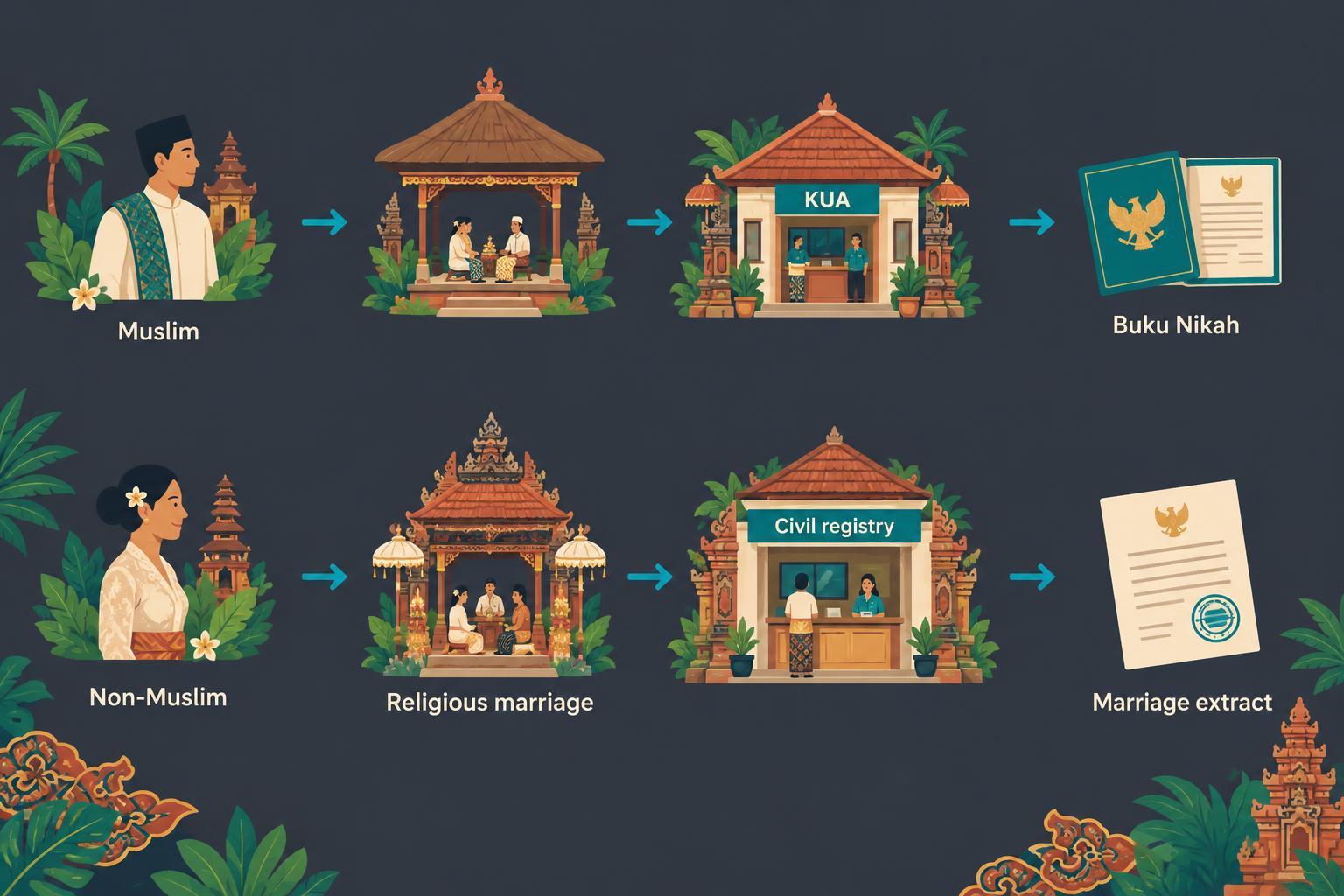
Muslim and non-Muslim marriages follow different registration routes
Verdict: True; KUA and the civil registry perform different roles.
Muslim marriages use the local Kantor Urusan Agama, usually called KUA. The official proof is Buku Nikah. A second civil-registry marriage certificate is not required for this route.
The current Muslim-registration regulation is PMA 30/2024, which replaced PMA 22/2024. Its ceremony requirements include Muslim spouses, a marriage guardian or wali, two qualifying male Muslim witnesses and ijab kabul. Registered applicants must also complete Bimbingan Perkawinan marriage guidance; its certificate is required at the marriage examination.
For two foreign Muslim applicants, obtain the intended Bali KUA’s current written acceptance. Earlier official guidance expressly allowed this under the previous regulation, but PMA 30/2024 does not repeat that explicit provision. That is an implementation question to resolve with the office, not evidence that all foreign couples are prohibited.
Non-Muslim marriages follow a different sequence:
- Confirm eligibility and documents with the religious authority and receiving civil registry.
- Complete the religious marriage and obtain its evidence.
- Report the marriage to Dinas Kependudukan dan Pencatatan Sipil, commonly called Disdukcapil or Catatan Sipil.
- Obtain the official civil-registration extract, Kutipan Akta Perkawinan.
The religious officiant’s certificate alone is not the civil-registration proof. When a provider promises a “marriage certificate,” ask which document they mean.
Confirm the receiving office’s jurisdiction at the outset. Your preferred venue, nationality and document-issuing embassy do not remove the need to establish which KUA or Disdukcapil will handle your case.
You need proof that you are free to marry
Verdict: Mostly true; the accepted document depends on nationality and registration route.
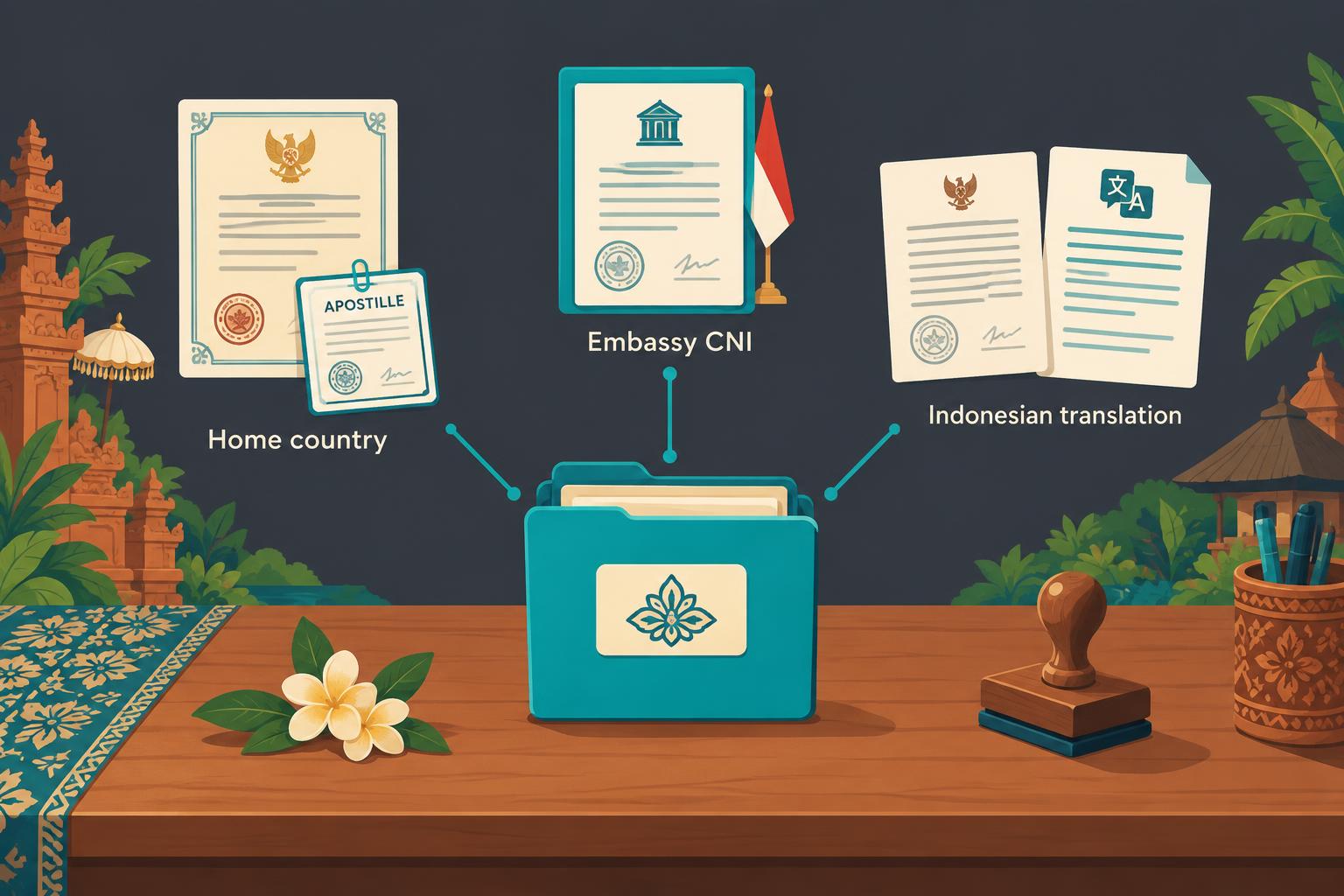
A certificate of no impediment, commonly called a CNI, establishes eligibility to marry. However, not every country issues the same certificate, and an embassy affidavit should not automatically be described as identical to a home-country civil-status certificate.
For the foreign applicant in a Muslim foreign–Indonesian marriage, Article 4(3) of PMA 30/2024 lists these core documents:
- A certificate of no impediment or the applicable marriage-permission document.
- A birth-certificate copy and passport copy.
- Parents’ details.
- Divorce evidence or a former spouse’s death evidence, where applicable.
The Indonesian KUA applicant’s national administrative list includes a village or kelurahan marriage introduction, birth certificate, KTP, KK, health certificate and consent. A recommendation from the home KUA is required when marrying outside the home subdistrict.
For foreign civil-registry applicants, Presidential Regulation 96/2018 lists religious-marriage evidence, couple photographs, travel documents, permission from the applicant’s country or representation, and applicable Indonesian residence documents. Ask the receiving office about previous-marriage evidence and its complete local submission requirements.
Nationality changes how you obtain permission:
- Australians: apply for a CNI through an Australian mission in Indonesia. The Bali consulate covers Bali, NTB and NTT, subject to registrar jurisdiction requirements. Australian guidance says registrars normally reject Australian CNIs older than three months.
- Americans: the U.S. government cannot certify marital status; its guidance provides for a sworn eligibility statement, notarized at an embassy or consulate where required.
- British applicants: current guidance directs applicants to apply online and attend an affidavit or affirmation appointment at the British Embassy Jakarta or British Consulate Bali.
For mixed foreign–Indonesian marriages, Article 60(5) of Law 1/1974 says the eligibility certificate or substitute court decision loses effect if the marriage is not performed within six months of issue. This is separate from nationality-specific acceptance periods, including the Australian CNI’s normal three-month window. Coordinate its issuance with the legal ceremony, not just the reception date.
Under PMA 30/2024, where no embassy or representative office exists in Indonesia, the foreign applicant’s marriage permission may come from a competent authority in their country.
Every foreign document needs an apostille before a Bali wedding
Verdict: False; authentication requirements are document-specific.
Indonesia’s participation in the Apostille Convention took effect on 4 June 2022. For covered public documents between countries where the Convention applies, an apostille replaces consular legalization. This does not establish a blanket rule that every passport, birth certificate, divorce decree and death certificate needs an apostille.
PMA 30/2024 specifically requires an apostille copy with eligible no-impediment or status documents issued by a competent foreign-country authority. An embassy-issued CNI needs separate consideration: the Convention excludes documents executed by diplomatic or consular agents.
Authentication and translation also solve different problems. An apostille addresses the document’s authentication; it does not translate its contents or establish that the receiving office accepts it as proof of marriage eligibility.
For KUA applications, PMA 30/2024 requires foreign-language documents in the foreign-applicant checklist to be translated into Indonesian by an official translator. Malay-language documents are exempt. When arranging a sworn translation, confirm that the translator and completed format meet the receiving office’s official-translator requirement.
Use a document-by-document checklist:
- Identify the issuer: a home-country authority or an embassy or consulate.
- Ask whether the registrar needs an original, copy or authenticated copy.
- Confirm whether apostille or another authentication procedure applies.
- Confirm the required Indonesian translation and treatment of attached authentication pages.
- Check names, dates and previous-marriage details across the completed file.
Obtain these answers before paying for authentication and translation. Preparing every document in the most elaborate possible way can still leave you with the wrong eligibility document or an unacceptable translation.
One Bali document checklist works at every registration office
Verdict: False; national requirements and local submission details must be checked separately.
National legislation establishes the legal framework. The receiving office supplies practical details such as jurisdiction, photograph quantities, acceptable copies and appointment arrangements. A checklist from another regency is useful background, not automatic approval.
Badung’s published service standard includes a foreign–foreign marriage route requesting an application, religious-marriage evidence, translated consular permission, a visit visa and passports. It does not universally require KITAS or KITAP for that route.
For foreign–Indonesian applications, the same published standard requests KTP-el or SKTT where held, or legalized visa and passport documents where absent, alongside consular permission translated into Indonesian and signed or stamped by an official translator.
Confirm directly with Badung that it can register your intended religious marriage and which evidence it will accept. Obtain written confirmation of jurisdiction before relying on the published checklist for your venue.
Confirm photograph quantities, dimensions and format directly with the receiving office. Use that office’s current instructions rather than assuming another checklist applies.
Build the legal deadlines into your plan:
- KUA filing: at least 10 working days before marriage. Shorter notice requires a subdistrict-head dispensation or a stamped statement explaining the reasons.
- Civil-registration reporting: Law 23/2006 provides a 60-day period and extends registration to foreigners marrying in Indonesia at their request.
- Eligibility-document timing: account for the six-month validity rule applicable to mixed foreign–Indonesian marriages and any shorter nationality-specific acceptance period.
Do not confuse marriage paperwork with your separate stay and address arrangements. If you are remaining in Bali, review the distinctions in our Indonesian visa guide and Bali address-registration guide as separate planning tasks.
An Indonesian marriage certificate guarantees recognition overseas
Verdict: False; recognition depends on the receiving country’s law.
First, obtain the correct Indonesian proof. For Muslim marriages, Buku Nikah is the official extract from the marriage record. PMA 30/2024 ordinarily provides for delivery immediately after the ceremony, or within seven working days when delayed for a specific reason.
For non-Muslim marriages, Disdukcapil records the marriage and issues Kutipan Akta Perkawinan. Keep the religious-marriage evidence too, but do not mistake it for the civil-registration extract.
Check the issued document against your passports before starting overseas-use procedures. Then establish what the receiving authority needs:
- Ask whether the marriage is recognised under the relevant country’s law.
- Confirm which Indonesian proof must be submitted.
- Check translation, authentication and any reporting requirements.
- Keep the original and the supporting documents together.
For using Buku Nikah overseas, AHU’s official FAQ requires prior Kemenag legalization through the provincial office or designated central directorate before the overseas-use authentication process. Do not assume it follows exactly the same preparatory steps as a civil-registry extract.
An apostille authenticates a covered document; it does not guarantee recognition of the marriage. U.S. guidance on marriage abroad directs Americans to their state Attorney General’s office for recognition and documentation requirements. British guidance states that embassies and consulates cannot confirm a foreign marriage’s legal validity in the UK and directs uncertain cases to independent legal advice.
If marriage also prompts a property purchase, treat that as a separate legal enquiry; our explanation of Indonesian property titles is a starting point for the questions to investigate.
The dependable endpoint is not the wedding day alone: it is the appropriate Indonesian marriage record, checked documents and a confirmed route for using that proof where you need it.