

Before hiring a nanny or housekeeper in Bali, establish who will employ the worker: your household, an agency, or the business already servicing your villa. That distinction determines which agreement you need and who must account for wages, holiday allowances, social protection and working conditions.
This guide separates legal requirements from suggested contract terms and advertised service prices. The legal position reflects research checked on 7 November 2026; implementing rules and BPJS procedures need confirmation before you sign.
Who employs your nanny or housekeeper in Bali?
Household employment has a new legal framework
Indonesia’s Law No. 2/2026 on Domestic Worker Protection, known as UU PPRT, took effect on 30 April 2026. Guidance treating household employment as governed only by older ministerial rules is therefore outdated.
The law recognizes direct recruitment and placement through domestic-worker placement companies, or P3RT. Article 36 requires implementing regulations by 30 April 2027. Confirm current rules and procedures rather than filling gaps with company-payroll assumptions.
Included villa cleaning is not necessarily your employment relationship
A cleaner supplied by a villa-management, hospitality or cleaning business may have a different employer from someone you hire privately. Ask who contracts with the worker, pays them, approves leave and handles accidents. An agency introduction alone does not answer this.
Check what your Bali villa rental includes before recruiting separately. Use listing information and booking-specific terms to distinguish included services from arrangements you must make yourself.
Recruiting domestic help: documents, references and a paid trial
Check eligibility and verify experience directly
Article 5 requires new recruits to be 18 or older, possess an electronic KTP and provide a health certificate from a healthcare facility. Inspect required documents and obtain consent for necessary copies without retaining original identity documents.
As a practical screening step, speak directly with two previous employers. Ask about employment dates, duties, reliability, child safety and reasons for leaving. Verify claimed first-aid or childcare qualifications rather than relying on a profile badge or forwarded testimonial.
Define the job before assessing the candidate
Specify childcare versus cleaning, the number and ages of children, workplace, language needs, schedule and any travel. A nanny responsible for a child should not discover after starting that deep cleaning is also expected during supervision.
Arrange a paid, supervised trial with agreed tasks and remuneration. For childcare, discuss feeding instructions, allergies, pool access, emergency contacts and who may collect the child. For housekeeping, explain chemical storage, fragile surfaces and rooms that are private.
These screening suggestions supplement the legal document requirements; they are not additional statutory recruitment conditions.

What nanny and housekeeping prices in Bali actually show
Compare advertised quotations without calling them average salaries
No representative current Bali household-worker wage survey was verified. These attributable quotations help frame enquiries, but they are not island-wide salary averages or proof that every advertised schedule complies with the law.
| Provider and service | Advertised price | Important qualification |
|---|---|---|
| Nannies in Bali: live-out childcare for one child | From Rp7 million per four weeks | 40 hours weekly; transport excluded |
| Nannies in Bali: live-in childcare | From Rp8 million per four weeks | Food, toiletries and bedroom provision excluded |
| 1800 Bali Nanny: one child | Rp80,000/hour | Daily travel from Rp50,000 |
| Housekeeping Bali: one cleaner | Rp50,000/hour | Equipment and chemicals included; customer service price, not worker take-home pay |
The Nannies in Bali quotations were checked on 7 November 2026. 1800 Bali Nanny’s booking information carries a travel-fee update dated 30 July 2026. Housekeeping Bali advertises its cleaning price as a service package.
Separate cash wages from the total household budget
Record salary, transport, meals, accommodation, THR, BPJS, extra hours and recruitment charges separately. A four-week package is not automatically the same billing period as a calendar-month salary.
For broader planning, keep these employment costs distinct from the expenses in your Bali family cost-of-living budget. Ask each provider for the same duties and coverage so the comparison is meaningful.
Agency fees, licensing and responsibility questions
Verify the placement company and obtain an itemized quotation
P3RT licensing comprises an NIB and Standard Certificate under Article 26. Ask for both. Where recruitment crosses provincial boundaries, Permenaker 18/2024 requires additional placement documentation, including SPP AKAD; ask the agency how it handles this.
Nannies in Bali specifies a three-month minimum placement; its salary quotations exclude agency-related fees, and no numerical placement fee is published. Obtain a signed quotation confirming the placement services, fees and advance-payment requirements before paying.
No defensible Bali-wide placement-fee range was verified. The placement-cooperation agreement should specify the service fee and placement guarantee. P3RT may not deduct workers’ wages: employer-paid recruitment costs must not become disguised worker deductions.
Ask who carries every employer responsibility
- “Are you placing a worker employed by our household, or supplying your own employee—and what documents establish that?”
- “Who pays wages, THR, extra hours and BPJS, and provides proof?”
- “Who approves leave, supplies replacement cover, handles accidents and complaints, and completes local reporting?”
- “What triggers replacement, refund or cancellation charges, and who settles the worker’s outstanding entitlements?”
Record answers in the relevant agreements. A replacement promise is not a substitute for identifying the employer.
What a Bali domestic-worker agreement should contain
Direct hiring and agency placement have different written-contract rules
For direct hiring, Article 12 permits the parties’ agreement to be converted into a written employment contract; it does not universally require that conversion. Written terms are nevertheless strongly advisable.
For agency placement, Article 11 requires an Indonesian-language written employment contract in two stamped originals, with copies for the agency and RT/RW. Give the worker an understandable signed copy, not merely an English document prepared for the household.
Employers must report the worker’s presence to the local RT/RW under Article 19(h). Ask locally which equivalent neighborhood authority handles this in the relevant Bali village.
Put the actual job and payment arrangements in writing
Required contract particulars include identities, workplace, start date and duration, duties, rights and obligations, working conditions, wages and payment method, execution details, and signatures or fingerprints.
Add clear practical provisions for ordinary hours, breaks, time off, live-in facilities, extra duties, confidentiality and ending employment. State who authorizes changes when several adults give instructions.
Article 11(6) requires amendments to the written employment contract to be agreed mutually in writing. Update the agreement when childcare expands, the workplace changes or overnight duties become regular; do not rely on an informal understanding that the salary “covers everything.”
Minimum pay, working hours and THR: law versus agreement
Wages are agreement-based, but hours must remain humane
UU PPRT supplies no numerical minimum wage; domestic-worker wages are agreement-based under Article 15. Bali’s 2026 provincial minimum wage is Rp3,207,459 monthly under Governor’s Decision 1011/03-M/HK/2025, but this is a contextual benchmark—not automatically the statutory household-worker floor.
The law requires humane hours and rest without prescribing a numerical overtime formula. Specify ordinary hours, breaks, weekly rest, extra-hour rates, overnight or on-call duties, and holiday-work compensation.
Confirm additional-hour charges directly with the provider. A provider’s rate is not statutory overtime. Similarly, a live-in arrangement must not be treated as continuous availability.
THR is an entitlement, not an optional holiday gift
Domestic workers have a legal entitlement to monetary religious holiday allowance, or THR, with the amount and payment timing agreed between the parties. Record both explicitly.
A suggested contractual benchmark is one month’s agreed cash wage after a full year, proportional payment for shorter service, the relevant religious holiday and an advance-payment date. This is a proposed agreement structure, not a verified universal household formula.
Permenaker 6/2016 concerns workers in companies. Do not automatically import its seven-day payment deadline into household employment without establishing applicability. Likewise, voluntary tipping in Bali should not be confused with contractual wages or legal THR.
BPJS coverage: who registers, pays and checks it?
Confirm health and employment protection separately
Article 16 provides for government-funded health contributions through eligible assistance arrangements. Otherwise, health contributions are employer-funded based on the agreement or employment contract, acknowledged by RT/RW. Employment-social-security contributions are employer-funded according to the agreement or employment contract under Article 16(3).
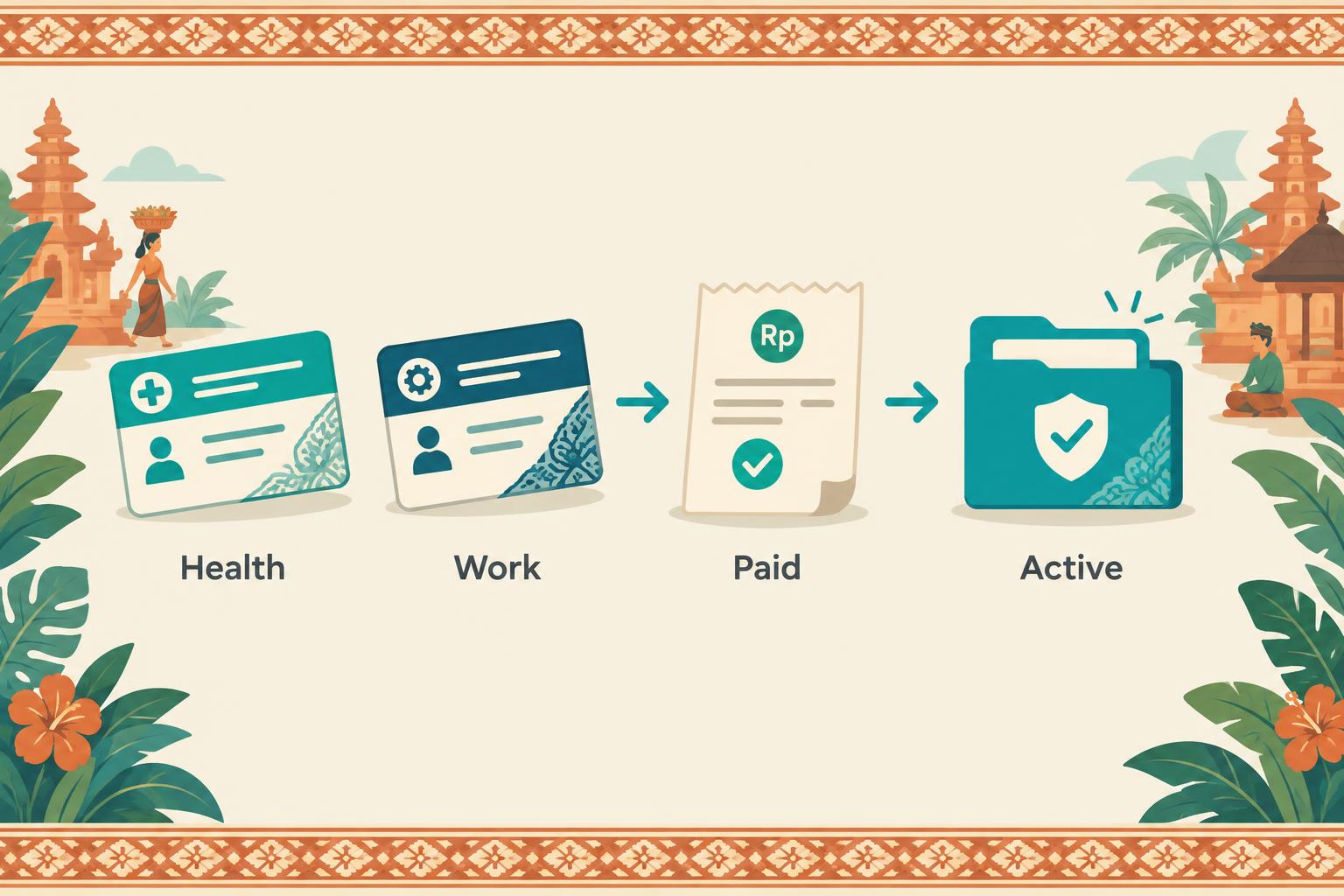
Do not accept “already has BPJS” as a complete answer. Obtain evidence of active BPJS Kesehatan and BPJS Ketenagakerjaan separately, identifying who registers, pays, monitors arrears and helps with claims.
Keep enrollment evidence and payment records accessible to the worker. Ask what happens if existing membership is inactive or the agency changes during employment.
Confirm contributions directly rather than copying company payroll
BPJS Ketenagakerjaan’s domestic-worker guidance, dated 17 December 2025, describes a roughly Rp36,800 monthly package covering occupational accidents, death and old-age protection. It is a published example, not a newly confirmed November 2026 tariff.
Confirm enrollment category, declared-income basis and current contributions directly with BPJS. PU and BPU structures differ; a company payroll split should not automatically be copied into a household arrangement.
The agreement-dependent wording was challenged in Constitutional Court case 352/PUU-XXIV/2026. On 29 October 2026, the Court declared the application inadmissible on procedural grounds. It did not decide the substantive constitutional challenge or invalidate this wording.
Live-in accommodation, privacy and household boundaries
Specify the room and protect off-duty time
Suitable accommodation is a statutory right for full-time/live-in domestic workers under Article 15. Describe the actual room, privacy, bathroom access, meals, power and water, belongings storage, and off-duty freedom.
ILO Recommendation 201 offers good-practice guidance, not an Indonesian statutory room specification. Treat live-in accommodation as a living arrangement, not permission to interrupt rest whenever the household needs help.
If you are choosing a home for a live-in arrangement, confirm the proposed room and access with the owner rather than assuming an extra bedroom is available for staff. When comparing homes on Livuma, in-app guest–host chat keeps those rental arrangements on record; it does not replace the worker’s separate employment agreement.
Make confidentiality specific without blocking complaints
Agree rules for children’s photographs, social-media posting, household information, visitors and access codes. Explain what the worker may share with family and what information must remain private.
A confidentiality clause should expressly preserve reporting of abuse, access to authorities and legal advice. Also discuss household cameras and private spaces openly, rather than leaving the worker to discover monitoring after moving in.
Ending domestic employment and completing the hiring checklist
Agree notice, final pay and live-in move-out arrangements
Workers ordinarily owe one month’s resignation notice; Article 14 separately lists grounds for ending employment. Do not assume that this establishes an identical employer-notice rule.
Specify employer notice, final-pay date, contractual termination compensation, return of keys and belongings, and reasonable move-out arrangements. Do not insert company-sector severance formulas without confirming applicability.
ILO Recommendation 201 recommends reasonable notice and time to seek work and accommodation for live-in workers dismissed for reasons other than serious misconduct. Treat this as good-practice guidance, distinct from a verified Indonesian statutory formula.
Complete these checks before the worker starts
- Define duties, workplace, schedule, child-safety instructions and reporting lines.
- Inspect eligibility documents, contact references and verify relevant qualifications.
- Agree a paid, supervised trial and its remuneration.
- Identify the employer and verify agency licensing where relevant.
- Separate wages, THR, extra hours, transport, accommodation, BPJS and fees.
- Document rest, leave, privacy, complaints, notice and final settlement.
- Assign BPJS registration, contribution checks and neighborhood reporting.
- Provide an understandable signed agreement and emergency contacts.
Review the arrangement together after starting. If duties or schedules change, update written terms rather than allowing extra work to become an unspoken expectation.
Frequently asked questions about hiring domestic help in Bali
Direct recruitment, salaries and written contracts
Can I hire a nanny directly in Bali?
Yes. UU PPRT recognizes direct recruitment by households as well as placement through P3RT companies. New recruits must meet the age and document requirements. Direct hiring does not remove household responsibilities for agreed wages, humane hours and rest, THR, social-protection arrangements and neighborhood reporting.
What is the average nanny salary in Bali?
No representative current Bali household-worker wage survey was verified. Nannies in Bali advertises live-out childcare for one child from Rp7 million per four weeks, covering 40 hours weekly and excluding transport. This is a provider quotation, not an island-wide average or a statutory minimum wage.
Is a written domestic-worker contract mandatory?
The rules differ by recruitment route. Article 12 permits a written employment contract for direct hiring rather than universally requiring one. Agency placement requires an Indonesian-language written contract in two stamped originals, with copies for the agency and RT/RW. Written terms remain advisable for direct hiring too.
Holiday allowances, BPJS and agency accountability
Do household workers in Bali have a right to THR?
Yes. THR is a legal monetary entitlement, not simply a discretionary holiday gift. Household parties should agree its amount and payment timing explicitly. The company-sector formula and seven-day deadline should not automatically be applied to private-household employment without first establishing that the company regulation applies.
Does a household need to arrange BPJS for its worker?
The law addresses both health and employment social protection. Outside eligible health-contribution assistance arrangements, health contributions are employer-funded based on the agreement or contract and acknowledged by RT/RW; employment contributions are employer-funded according to the agreement or contract. Establish who registers and checks active status. Verify BPJS Kesehatan and BPJS Ketenagakerjaan separately, and confirm current procedures directly with BPJS.
Does an agency placement fee transfer employer responsibilities?
No such transfer should be assumed. Ask whether the agency places someone employed by your household or supplies its own employee, and request documents establishing that arrangement. The agreements should allocate wages, THR, BPJS, leave, accidents, reporting and final settlement separately from replacement guarantees or recruitment fees.