

Imagine paying the annual rent on a Bali home, then opening the school admissions email: tuition, levies, registration and a refundable deposit all need funding. The expensive mistake in estimating Bali cost of living for families is committing to housing before checking the entire family’s arrival bill.
There is no defensible single monthly total that fits every family here. School choice, the actual rental, transport arrangements and medical cover can change the answer substantially. The useful approach is to combine verified prices with quotes for your own household, while keeping recurring spending separate from money needed before you move.
The figures below distinguish published school fees and official price references. They are budgeting anchors—not a promise that your family can live on a particular amount.
“My Bali cost of living for families estimate uses the wrong rent”
A rental median is useful only if you understand what it measures. An area-wide marketplace figure does not tell you the price of a family house with your required bedrooms, kitchen, school access and lease length.
The fix: shortlist homes that meet the same requirements, then compare their actual quotes. Specify bedrooms, enclosed living space, cooking facilities, school access, internet and maintenance inclusions before deciding which area is affordable.
Livuma’s rental listings let you narrow live inventory by bedrooms, amenities, rental type and stay length rather than budgeting from an area median alone. If Canggu is your candidate base, use the Canggu long-term rental inventory to identify comparable homes.
Do not assume the lower rental quote automatically wins: a home that creates an expensive school run may leave your family worse off overall.

“My Bali cost of living for families budget leaves out school entry fees”
Schooling can make a family budget look very different from a couple’s relocation budget. The trap is treating the tuition headline as the complete school bill—or treating a refundable deposit as money still available for rent.
For the 2026–27 academic year, Canggu Community School’s published fees include:
- Years 1–2 tuition: Rp162 million per child annually.
- Capital levy: Rp21.5 million annually for Early Years–Year 5, payable for the first and second family members attending.
- Years 1–2 materials/resources levy: Rp9 million annually, payable for the first and second family members attending.
- Application fee: Rp2.5 million, non-refundable.
- Years 1–13 notice deposit: Rp50 million, refundable subject to the school’s conditions, including written withdrawal notice at least one full term ahead.
- Years 1–13 registration: Rp17 million for the first child and Rp14 million for each additional family registration; these charges are non-refundable.
These charges have different purposes. Tuition and annual levies belong in recurring education costs; application and registration are entry costs; the notice deposit is tied-up cash with conditions attached to its return. CCS separately advertises a 5% full-year-payment discount; obtain a written invoice rather than automatically deducting another 5% from the displayed annual tuition.
Bali Island School’s 2026–27 schedule lists Rp234.627 million annually for Grade 1, comprising tuition and capital levy. Its three-year-old half-day preschool is Rp76.85 million annually on the same basis. The instalment option increases tuition by 1.5% compared with annual payment.
A different preschool example is Veritas Intercultural School, which publishes Rp7.95 million per three-month term for preschool/prekindergarten tuition, with enrolment fees separate. These are not interchangeable offers: age group, hours and programme matter.
The fix: obtain an itemised admissions quote for each child’s actual year group. Ask about entry charges, deposits, payment dates, transport, meals, uniforms, activities and withdrawal conditions. Confirm availability and suitability before signing a nearby lease.
A school’s annual fee can be spread across your budget for planning, but that does not change when the school requires payment.
“Cheap groceries made me underestimate the household bills”
Local ingredient prices help establish a baseline, but they cannot establish your family’s complete food budget. Imported preferences, prepared meals, delivery, school lunches and household supplies need separate entries.
Bali’s provincial monitoring across 60 markets reported these prices on November 7, 2026:
- Medium I rice: Rp15,113/kg.
- Broiler chicken: Rp42,172/kg.
The Bali retail food series reproduced from Ministry of Trade SP2KP data reported these prices on October 8, 2026:
- Premium rice: Rp16,050/kg.
- Chicken eggs: Rp27,536/kg.
- Premium packaged palm cooking oil: Rp22,111/litre.
These are reported retail reference prices, not a quote from every market or supermarket. Use them to check assumptions, then price the basket your household actually buys. Keep groceries separate from restaurant meals so changes in eating habits remain visible.
The utility side needs the same discipline. As checked on November 8, 2026, a current address-specific price for IndiHome’s 100 Mbps service remained unverified. Obtain an address-specific quotation confirming service, installation terms and final monthly cost at your rental address.
PLN confirms electricity tariffs remain unchanged for October–December 2026. Published residential energy tariffs are Rp1,444.70/kWh for 1,300–2,200 VA and Rp1,699.53/kWh for 3,500 VA and above. These are not all-in household bills; do not assume the owner’s past bill matches your air-conditioning use.
The fix: request recent electricity bills or token records, identify the meter serving your home, and establish who pays for water, internet, cleaning, pool care and gardening. Ask whether anything described as included has a cap or limited service schedule.
For the meter questions, use the practical checks in Bali electricity bills and rental checks. Write unresolved costs into your budget as pending—not as zero.
“The cheaper home needs a school run I haven’t priced”
A housing comparison is incomplete until it includes the school journey and your working day. The problem is not simply distance: the home, school, childcare and work arrangements must function together.
There is no sufficiently verified transport or childcare price in this research to justify a standard family allowance. A generic scooter budget is particularly unhelpful if your household plans to use a car, a driver or school transport.
The fix: test the route at the times you will use it, then request quotes for the actual arrangement. Check what happens when children finish at different times, an after-school activity runs late, or a parent needs the vehicle for work.
- Ask schools whether transport is available from the exact rental address.
- Clarify whether a transport quote includes waiting, extra stops and changes to the regular schedule.
- For childcare, specify duties, hours, school holidays and cover when the usual caregiver is unavailable.
- Check whether an isolated rental creates extra delivery or travel spending.
If you do not intend to ride, the separate guide to living in Bali without a scooter can help frame the practical questions before you commit.
Healthcare also needs a household-specific quote. Private insurance costs were not sufficiently verified to publish a family estimate. Compare outpatient care, hospital admission, exclusions, excesses and emergency arrangements—not just the premium.
Official JKN guidance includes foreigners working in Indonesia for at least six months among participants. That does not establish automatic eligibility for every newly arrived expatriate family, so confirm your status instead of assuming public cover will replace private arrangements.
“I budgeted for one visa, but my family needs separate arrangements”
Foreign families need an immigration budget that matches each person’s status. A remote-worker permission for a parent is not the same application as the arrangements for a spouse or child.
As checked on November 8, 2026, the official Indonesian immigration fee and eligibility information lists the E33G one-year government fee at Rp7 million, with multiple re-entry permission. Applicants must demonstrate at least US$60,000 annual income and an employment agreement with a company established outside Indonesia. They must also provide three months of bank statements showing at least US$2,000 or equivalent, separate from the annual-income requirement.
Immigration lists E31B for spouses of ITAS/ITAP holders and E31E for unmarried biological children under 18 joining an ITAS/ITAP-holding parent. The research does not establish dependent application fees, so do not multiply the E33G price across your family.
For an exploratory visit, eligible nationalities can use a B1 visa on arrival costing Rp500,000 for 30 days, with one extension to a maximum total stay of 60 days. Since May 29, 2025, stay-permit extensions require an immigration-office photograph and interview after online submission, including for visa-on-arrival holders. This is not a substitute for checking the appropriate long-stay category.
Bali’s tourist levy is Rp150,000 per foreign tourist, separate from immigration charges. Official guidance identifies KITAS/KITAP holders, family-unification visa holders and student-visa holders as exempt without advance exemption applications; check the applicable exemption rather than adding the tourist levy indiscriminately to a resident budget.
The fix: build a person-by-person checklist of category, government charges, any separately quoted assistance and renewal timing.
Tax planning is another separate task. Indonesian domestic tax-subject status can arise through residence, more than 183 days’ presence within 12 months, or presence during a tax year with an intention to reside; the days need not be consecutive. Treaty provisions may affect the outcome. Use the Indonesia tax-residency explainer to prepare questions for a qualified adviser, rather than assuming a visa determines your tax position.
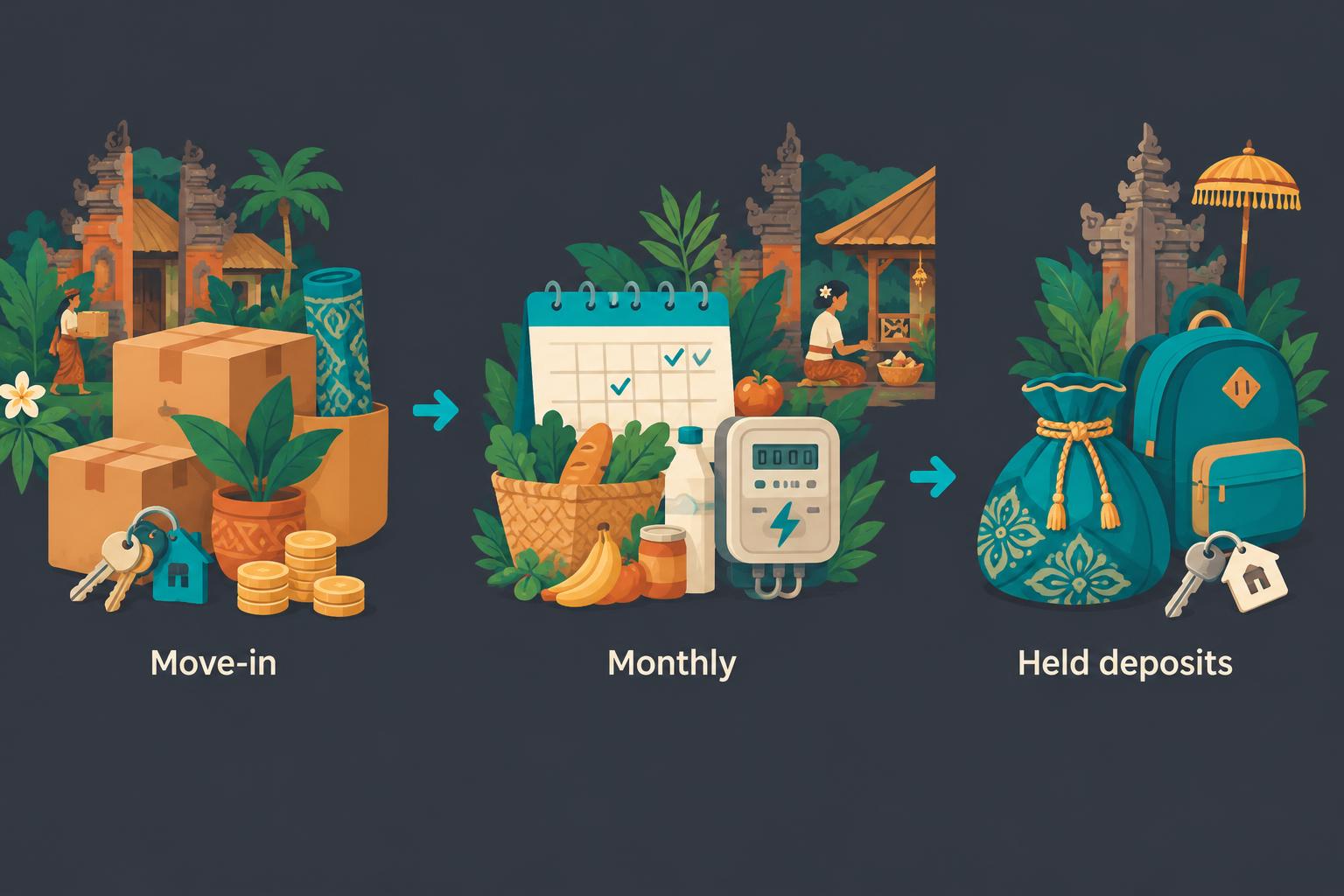
“My monthly total works, but I can’t fund the move”
A family budget can be affordable over the year and still fail at arrival. Advance rent, school payment dates and deposits concentrate cash demands before your ordinary routine begins.
The fix: keep separate records for spending and payment timing:
- Recurring household costs: rent, groceries, power, water, internet, transport, childcare and medical cover.
- Recurring annual costs: applicable school fees, levies and immigration renewals, entered against their actual due dates.
- Non-refundable setup costs: school application and registration, relocation purchases and any quoted connection or installation charges.
- Refundable but unavailable cash: rental deposits and school deposits, with the conditions and timing of return recorded.
- Unquoted costs: items awaiting written confirmation, clearly marked as incomplete.
Do not count advance rent again as an additional expense if it already belongs in your annual housing budget. It is a timing issue. Equally, do not count a refundable deposit as spendable savings while it is held.
Ask the landlord for the complete payable amount and inclusions. The ordinary land/building rental-income tax described by DJP is 10% of gross rent and applies to the recipient’s income; it is not automatically an extra tenant charge. Clarify any claimed addition before agreeing the price.
Review payment schedules, deposit or balance rules, deadlines and cancellation terms before you commit. Reconcile payment timing with your school and relocation calendar.
Allow room for changing prices without inventing a universal contingency percentage. BPS Bali figures reported by ANTARA on November 2 record October 2026 consumer-price inflation of 3.87% year-on-year and 0.25% month-on-month. Those figures describe consumer prices generally, not the future increase in your rent or school bill.
“I still need a clear answer about my family’s Bali budget”
How much does it cost for a family to live in Bali per month?
The verified information does not support a universal all-in monthly family total. Housing, school choice, transport, childcare and insurance require household-specific quotes. Start with a suitable rental’s actual price, add published fees for each child’s year group, and price your food and service needs. Keep annual charges and arrival cash separate from regular monthly spending.
Which Bali area is cheapest for a family?
The verified information does not establish a cheapest area for families. Compare actual quotes for homes with the same bedrooms, facilities and lease length, then include school transport and other household costs. A lower rental quote does not necessarily mean a lower total family budget.
How much do international schools in Bali cost?
Published examples differ by school and year group. Canggu Community School’s 2026–27 Years 1–2 tuition is Rp162 million annually, excluding separately listed levies and entry charges. Bali Island School lists Rp234.627 million annually for Grade 1, comprising tuition and capital levy. Request a complete admissions quote because deposits, registration and payment choices can affect the cash required.
Are groceries and internet cheap enough to offset school costs?
Verified grocery references and an address-specific internet quotation cannot establish that trade-off. Medium I rice was reported at Rp15,113/kg in Bali’s provincial monitoring across 60 markets on November 7, 2026, while IndiHome’s address-specific 100 Mbps price remained unverified when checked on November 8. Neither reference describes a family’s complete household spending. Price your actual basket and address-specific connection, then compare those costs with the full school bill.
What upfront costs should a family budget for when moving to Bali?
Check advance rent, rental deposits, school application and registration, school deposits, immigration applications and separately quoted relocation or connection costs. Some are expenses; others are advance payments or refundable funds that remain unavailable. Record the due dates and refund conditions for each item. A monthly affordability calculation alone does not show whether you can fund everything required before moving in.