
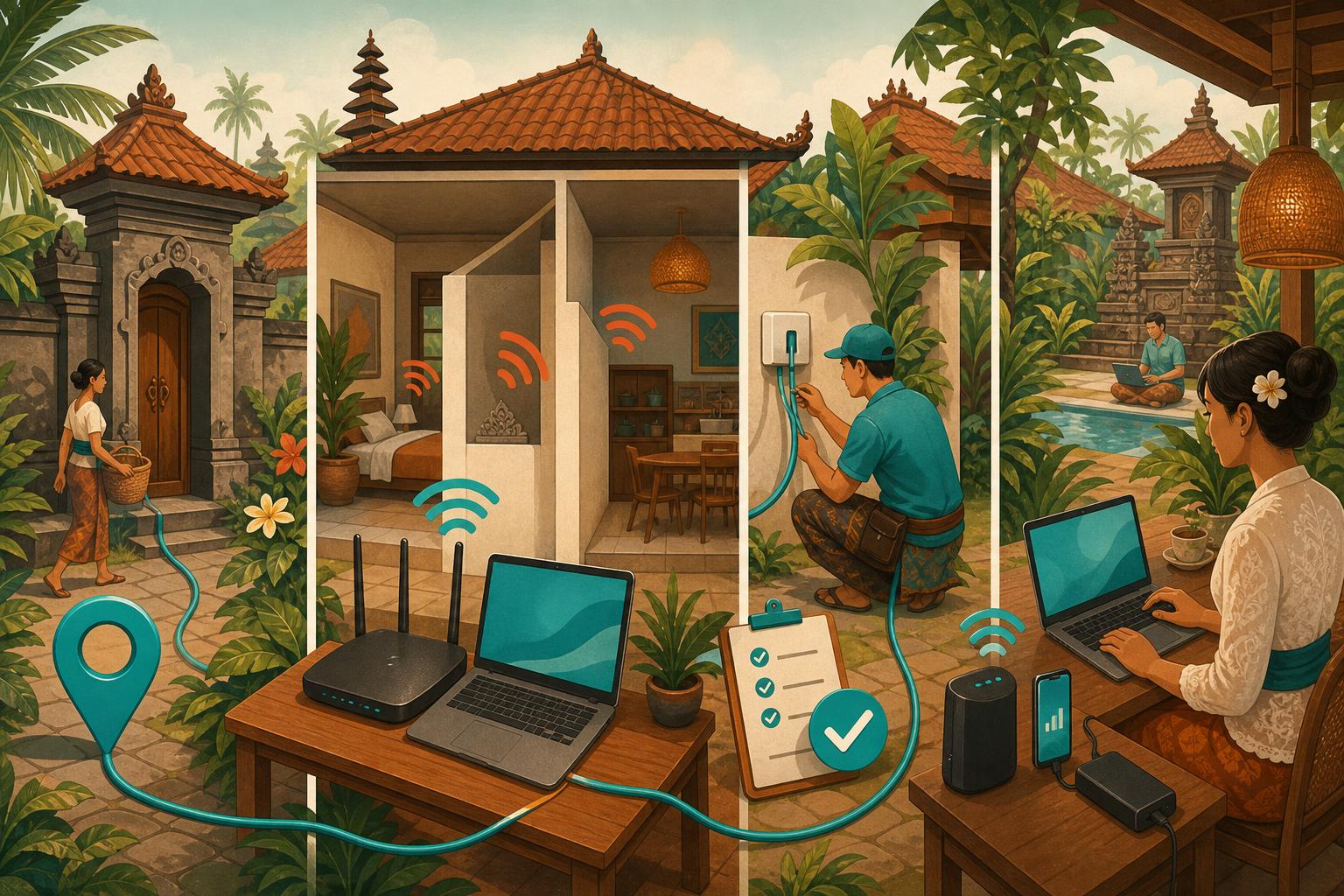
“Wi-Fi included” is one of the most repeated lines in Bali rental adverts, yet it can describe anything from a well-positioned fibre router to a mobile hotspot serving several rooms. The confusion persists because neighbours on the same lane can have different cable routes, building permissions, router layouts and cellular signal.
For a long-term renter whose calls, uploads or online work cannot wait, internet is not a nice extra to inspect after the pool and bedrooms. It is a property system. These eight common claims separate a promising listing description from the questions that reveal whether a villa, apartment or kost will work as a daily base.
“Wi-Fi included” means the rental has dependable home internet
Verdict: false. “Wi-Fi included” tells you that a wireless network exists; it does not identify the provider, connection type, plan, account holder, router placement or recent performance from your intended workspace.
A villa can have an active fibre line but weak coverage upstairs. A kost may have a shared router that performs acceptably in a common area and poorly behind several concrete walls. A property may also be using a wireless service rather than fibre. Those are different setups with different failure points.
Before treating internet as included, ask for:
- the active provider and exact plan name;
- the contracted download and upload rate;
- the monthly bill and whether it is included in rent or charged separately;
- whether the account is held by the landlord or tenant;
- the location of the optical network terminal, modem and Wi-Fi router; and
- at least two dated speed-test screenshots from the room where you will work.
Ask for one Wi-Fi result and, where possible, one Ethernet result. Ethernet helps separate a sound incoming connection from a weak in-home Wi-Fi setup. If a landlord separately charges tenants for shared IndiHome access, check permission: its subscription contract prohibits reselling some or all of the service without Telkomsel’s written permission.
When comparing long-term rental listings in Bali in Livuma’s live rental inventory, use the listing’s amenities and house rules as a starting point, then ask the host for these connection details before you commit.
Fibre availability can be judged from the neighbourhood name alone
Verdict: false. There is no authoritative public, neighbourhood-by-neighbourhood fibre-coverage dataset for Bali in the available research. Availability is address-specific, including within the same popular long-stay area.
That matters in places where renters commonly assume connectivity is uniform. Canggu, Ubud, Uluwatu, Sanur and Seminyak are useful location names for choosing a routine, but none is proof that a particular lane, compound or building has a usable fibre port.
The practical sequence is simple: obtain the exact address, give it to the provider and ask them to confirm serviceability before signing. Then ask whether the existing connection is active, whether the port is usable and whether a cable path already exists. A property with an old router on a shelf is not automatically ready for a new tenant’s needs. Biznet’s Denpasar coverage map distinguishes covered areas from areas under construction and those planned for 2025–2028; planned coverage is not operational service. Its registration process requires confirmation that the specific house or apartment is serviceable, with installation scheduled after payment.
Do not let a generic “fast Wi-Fi” line substitute for an address check.
If your shortlist is around Ubud, compare homes through long-term rentals in Ubud, but treat the provider’s address confirmation—not the area page—as the decisive connectivity evidence.
IndiHome, CBN, MyRepublic Air and Orbit are interchangeable choices
Verdict: mostly false. They solve different access problems, so the right option depends on what can be installed at the address and how you use the connection.
Telkomsel’s IndiHome is a residential fixed-line option. Its live landing page on 9 November 2026 advertises a 50 Mbps base package temporarily upgraded to 75 Mbps for 180 days, starting at Rp230,000 per month, a starting price rather than a confirmed quote for every Bali address. Its Double Speed package has a 75 Mbps base speed temporarily upgraded to 200 Mbps for 180 days, starting at Rp240,000 per month. Ask for an address-specific quote and the base speed after the promotional period rather than relying on the upgraded headline figure. See the provider’s current IndiHome packages before ordering.
CBN advertises residential Bali fibre up to 1 Gbps and describes its 100 Mbps tier as symmetrical 1:1 upload/download. Its Bali page describes Fiber 100 with a base speed up to 100 Mbps and a promotional boost up to 200 Mbps for six months. Confirm current prices with CBN and request an address-specific written quote that states tax, router and installation charges.
IndiHome’s subscription contract applies a Fair Usage Policy to 1P, 2P and 3P packages, so unlimited service does not mean unrestricted full-speed usage. Biznet’s Home catalogue advertises Home 0D at up to 50 Mbps for Rp250,000 per month. Obtain an address-specific written quotation confirming the applicable fair-use allowance and reduced speed rather than treating the headline price as a complete description of the service.
MyRepublic Air, launched on 14 April 2026 with Bali among its initial ordering areas, is fixed wireless access rather than fibre-to-the-home. It is intended to complement residential fibre, not simply duplicate it. That distinction matters when you are weighing a cable installation against a wireless link.
Telkomsel Orbit is another wireless-home option. Orbit 5G in Bali is self-installed, with the Orbit 5G H1 modem listed at Rp2,499,000 including 200 GB for the first 30 days. Its listed promotional data packages include 100 GB for Rp131,000, 250 GB for Rp260,000, 625 GB for Rp505,000 and 1,250 GB for Rp909,000 for 30 days. The 250 GB package, priced including VAT, comprises 200 GB usable across networks plus 50 GB specifically for 5G, not 250 GB of unrestricted all-network data. It can be useful where a technician visit is impractical or as a backup, but availability and actual speed depend on local cellular coverage. It is not an unlimited fibre replacement by default.
The Mbps printed on a plan is the speed every room will receive
Verdict: false. A plan rate is an access-plan label, not proof of the speed, latency and stability that a particular device will experience in a particular room. Biznet explicitly describes its Home Internet as a shared, “up to” service whose speed is not constant at all times in its FAQ.
The previously cited August 2026 figures from the Speedtest Global Index mirror could not be verified directly against Ookla’s official Indonesia page as of 1 October 2026. National medians are not a promise for Bali, a provider or your rental.
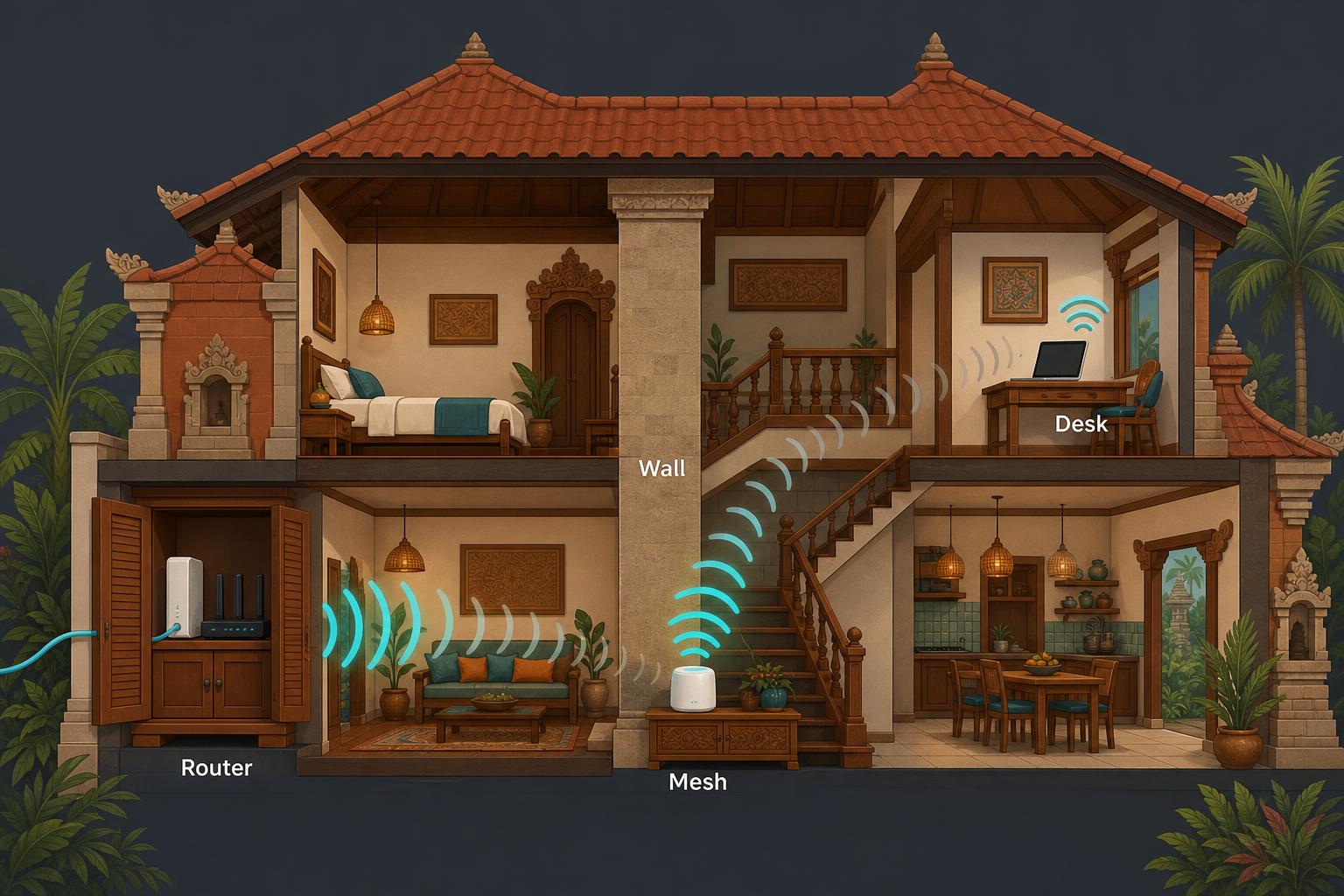
Inside the home, the router may be the limiting factor. A router hidden in a closed cabinet, placed at one end of a long villa or separated from a desk by thick walls, several rooms or multiple floors can produce poor Wi-Fi despite a healthy fibre line. IndiHome itself markets mesh Wi-Fi to extend coverage through partitioned homes and lists a Rp65,000 one-time mesh installation fee. Its Ultra Mesh terms say performance varies with device placement, network conditions, building structure and building size; mesh does not guarantee the advertised speed in every room.
During a viewing, stand at the desk or bedroom you expect to use. Run a test there, not only beside the router. Note download, upload and ping, along with the date and time. If the property has a large layout, ask whether a mesh system is installed, who owns it and whether it stays when you move in. IndiHome’s Ultra Mesh devices must be returned when the add-on is terminated, with a stated Rp500,000 penalty for failure to return them.
Indonesia’s telecom framework requires network and telecommunications-service providers to meet service-quality standards set by the Director General. It does not create a simple published rule that every residential fibre plan must always deliver its advertised maximum Mbps. That is why evidence from the exact property matters more than an advert’s largest number.
A new fibre line can always be installed within three days
Verdict: mostly false. IndiHome’s current ordering instructions specify installation within a maximum of 3 × 24 hours after registration is successfully confirmed, not three days from an initial enquiry. Confirm that your registration has been successfully confirmed and obtain the installation appointment for your address.
A straightforward installation can be delayed when a new drop cable is required, a building manager must approve access, a landlord has not authorised drilling, a cable route is unclear or local capacity work is needed. In a managed apartment or a compound, the person who can approve an installation may not be the person collecting your rent.
Confirm IndiHome’s actual installation fee for your ordering channel and address, including applicable VAT and any promotion expiry, rather than assuming an advertised installation price will apply to your order.
IndiHome’s subscription contract distinguishes postpaid charges excluding VAT from advance-payment charges including VAT. Under the general calculation for taxable non-luxury services effective from 1 January 2025, VAT is 12% × an 11/12 taxable base, producing an effective 11% burden, subject to special regimes. Compare tax-inclusive quotations rather than headline prices alone.
For new customers registering through GraPARI or Sales Force from 1 April 2026, except those choosing advance payment, IndiHome also requires a deposit equal to the selected package’s service charge plus applicable VAT, payable after installation to activate service. Continuing customers receive it as a credit against month 13, not an immediate cash refund when a short tenancy ends. Telkomsel’s deposit guidance describes the deposit offsetting early-termination charges for customers leaving before 12 months. Its subscription contract specifies a Rp1,000,000 termination penalty before 12 months, measured from its defined “Completed Non Aktif” status.
Get permission in writing before you plan around a new line. The approval should cover the specific work that might be required:
- a new cable run;
- wall drilling;
- a roof antenna for a wireless option; and
- a second provider if the existing service is inadequate.
This is also a tenancy issue, not just a technician issue. Put responsibility for the monthly bill, installation cost, equipment ownership and removal or handover at the end of the lease into the rental terms. The separate guide to Bali rental agreement clauses that protect tenants is useful when you need to turn a verbal promise into a clear obligation.
A single speed test from the living room is enough to approve a rental
Verdict: false. A single, undated result beside the router cannot show normal working conditions, room-by-room coverage or outage resilience.
Request at least two recent screenshots made from the intended workspace. Each should show the test date, time, download, upload and ping. If possible, compare Wi-Fi with Ethernet. Then ask for the dates, duration and cause of the last several outages.
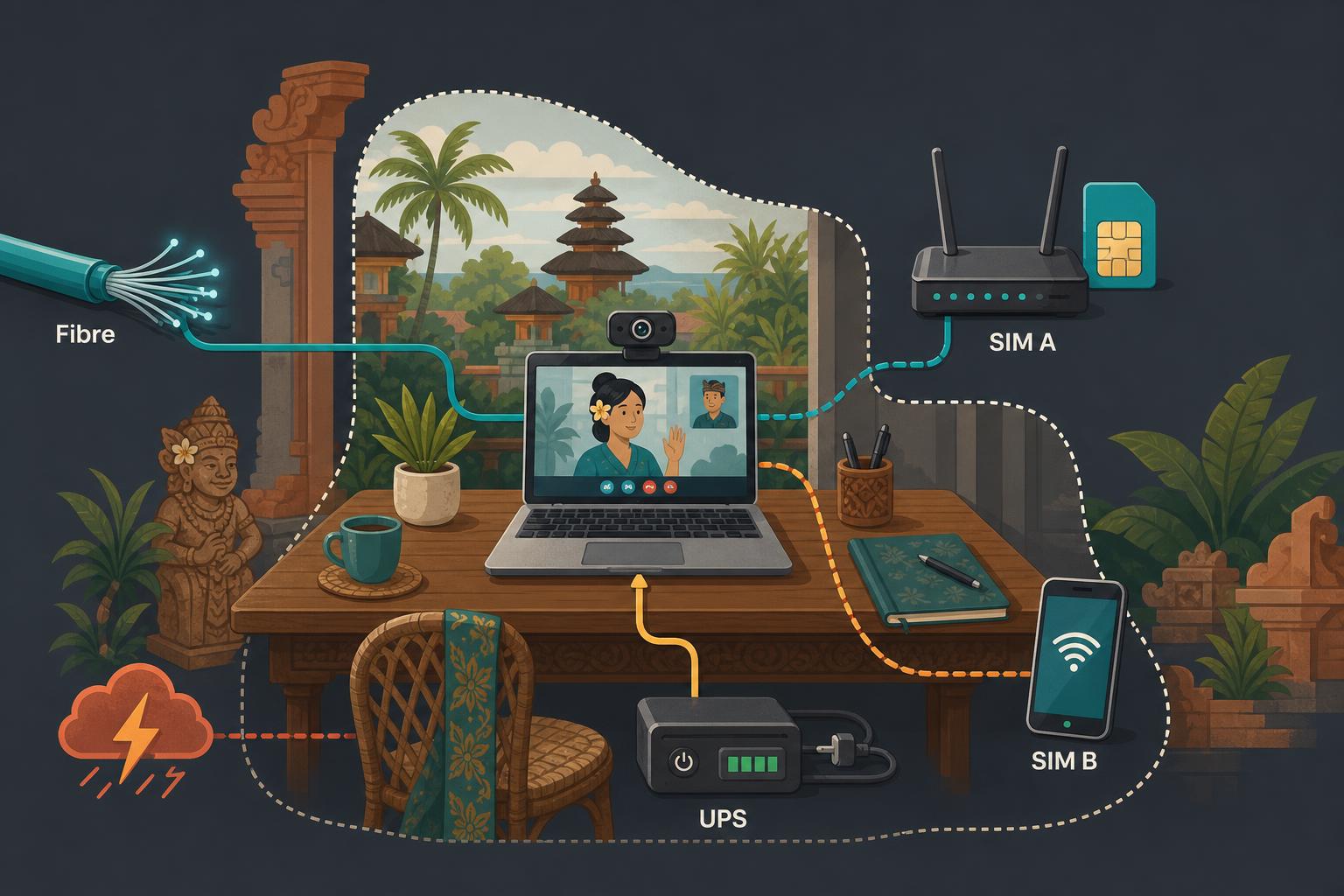
Separate internet outages from electricity outages. Fibre service and the Wi-Fi router stop during a power cut unless the relevant equipment has battery or UPS backup. A landlord may describe the “internet” as reliable when the fibre line itself has few faults, while the real disruption is the lack of power to the modem and router.
Look at the physical setup rather than relying on reassurance:
- Is the optical network terminal accessible and powered?
- Is the router exposed, ventilated and sensibly located?
- Does the desk receive a usable signal with doors closed?
- Are there Ethernet ports or a practical cable route for a stationary workstation?
- Is there a UPS, and does it power the modem and router rather than only a lamp?
For a villa, check the power arrangement alongside connectivity. A disruption to either system can stop a workday, which is why the checks in Bali electricity bills and rental checks belong on the same viewing list.
One home connection is enough for anyone who works online
Verdict: mostly false. One good fibre connection may be entirely adequate for casual browsing and streaming, but a renter whose income depends on calls, live sessions or deadline uploads should plan a tested fallback.
The simplest backup is mobile data on a different operator from the primary home connection. Use dual-SIM or eSIM phones, or keep a separate 4G/5G router ready. The point is diversity: if your primary fixed line and your backup depend on the same network failure, the second device is less useful.
Test both networks at the exact rental before relying on them. Check signal and a real video call from the workroom, not only a quick result outside by the gate. Keep the backup charged, know how to tether it, and review how much data your routine consumes before a long meeting day arrives. Mobile backup cannot be assumed available during Nyepi: Bali’s 2026 joint appeal requested that operators deactivate mobile data from 06:00 WITA on 19 March until 06:00 WITA on 20 March, while maintaining emergency communications.
Telkomsel’s registration guidance requires NIK/KTP-number registration plus facial biometric verification for new registrations from 1 July 2026; existing customers can voluntarily update their registration. Foreign users are directed to GraPARI or designated outlets with an original passport, KITAS or KITAP for staff verification. For a newly arrived renter, confirm the in-store registration route before relying on a mobile backup. For a foreign phone, SIM registration is not the only check: Customs guidance confirms that operators’ “IMEI for Foreigners” service allows Indonesian cellular-network access for a maximum of 90 days, not a permanent long-term solution; Customs registration for longer-term imported-device use has a separate 60-day-from-arrival deadline.
Since 28 August 2026, operators must offer options protecting paid unused data quota without additional preservation or use charges, including rollover, validity extensions, compensation or refunds. Check the actual package’s quota-protection terms; do not assume every data pack automatically rolls over.
Internet is a minor detail compared with the monthly rent
Verdict: false for remote workers and online businesses. Rent determines the size and location of your home, but an unsuitable connection can determine whether that home functions for the reason you moved there.
Homes at very different budgets can all need the same address-level connectivity check. Do not pay more because an area is known for cafés, coworking or villa living and assume the home network will follow.
Make connectivity a condition of your decision: verified provider, plan, workspace result, outage history, power-backup answer and written permission for a second connection if needed. If the owner cannot provide the information before signing, treat that uncertainty as part of the property’s value—not an inconvenience to solve after move-in.
For renters comparing a monthly stay with a longer commitment, the distinction between included services and separately managed costs should be settled early. Read monthly versus yearly rental contracts in Bali before deciding how much flexibility you need if the connection proves unsuitable.