

You have decided that a short stay is not enough and now need to know how to rent a villa in Bali long term without discovering expensive problems after moving in. The real decision is not simply which villa looks best online: it is whether the location works for your routine, the person offering it can lease it, and the written terms match what you expect to receive.
This guide takes you from a workable rental brief through viewing, verification, agreement, payment and handover. It is written for renters planning a monthly or longer villa stay, whether you are arriving from overseas, relocating with family, or already living elsewhere in Indonesia.
How to rent a villa in Bali long term: define the stay before searching
Set a rental length that fits your actual Bali plan
Start with the period you can genuinely commit to. “Long term” can mean a monthly arrangement or a much longer lease, but those are different commitments. A lower-looking monthly figure is not useful if it requires a stay length that does not suit your visa, work plans, school calendar or trial period in Bali.
Write down your preferred move-in date, earliest acceptable handover date, intended end date and whether you need flexibility to extend. Ask whether the villa is available for the entire period rather than assuming a calendar gap means it is.
- Choose a target stay length and a fallback length.
- Decide whether you can move once during your Bali stay.
- Separate rent from deposit, utilities, staff and move-in costs in your own budget.
- Keep enough time before arrival to compare homes and inspect them.
Turn lifestyle wishes into non-negotiable filters
A villa’s bedroom count is only one part of daily comfort. Create two lists: requirements that would make the home unworkable, and preferences that are negotiable. For remote work, this may include a quiet room for calls, a usable desk area and a clear answer on internet. For a family, it may be bedroom separation, kitchen practicality, pool safety and the route to regular activities.
Also define practical access: parking, road width, stairs, drainage around the entrance, delivery access and noise at the times you will actually be home. A beautiful pool does not solve a difficult commute or a bedroom that is too hot to use comfortably.
Keep immigration status separate from the rental decision
A villa lease does not grant you Indonesian immigration status. A C1 tourist visa permits an initial stay of up to 60 days and extensions up to a maximum of 180 days, while prohibiting selling goods or services or receiving employment or business remuneration from Indonesian people or companies. Extension applications require in-person photographs and interviews after online submission, so do not plan on an entirely online process. Foreign nationals employed by companies outside Indonesia who work remotely in Indonesia should understand the designated E33G visa category: a one-year, multiple-entry limited-stay route without a local sponsor, requiring an overseas-company employment contract, a minimum annual salary of US$60,000 and three months of bank statements showing a minimum US$2,000 balance. It is not a route for every freelancer. Check the official C1 visa guidance, extension procedure and E33G visa guidance against your own circumstances.
How to rent a villa in Bali long term by choosing an area
Compare daily routes rather than neighbourhood reputations
Choose an area by the trips you will repeat: work, school, gym, food shopping, beach, medical appointments or visits to friends. Make those journeys at the hours you expect to use them. A villa that seems close on a map can feel far away when the route is narrow, busy or poorly lit after dark.
Check the immediate lane as carefully as the wider neighbourhood. Stand outside the property, listen for construction and traffic, and look at where rubbish is placed, how vehicles pass and whether rainwater has an obvious path away from the house.
Use live listing data as a comparison point, not a promise
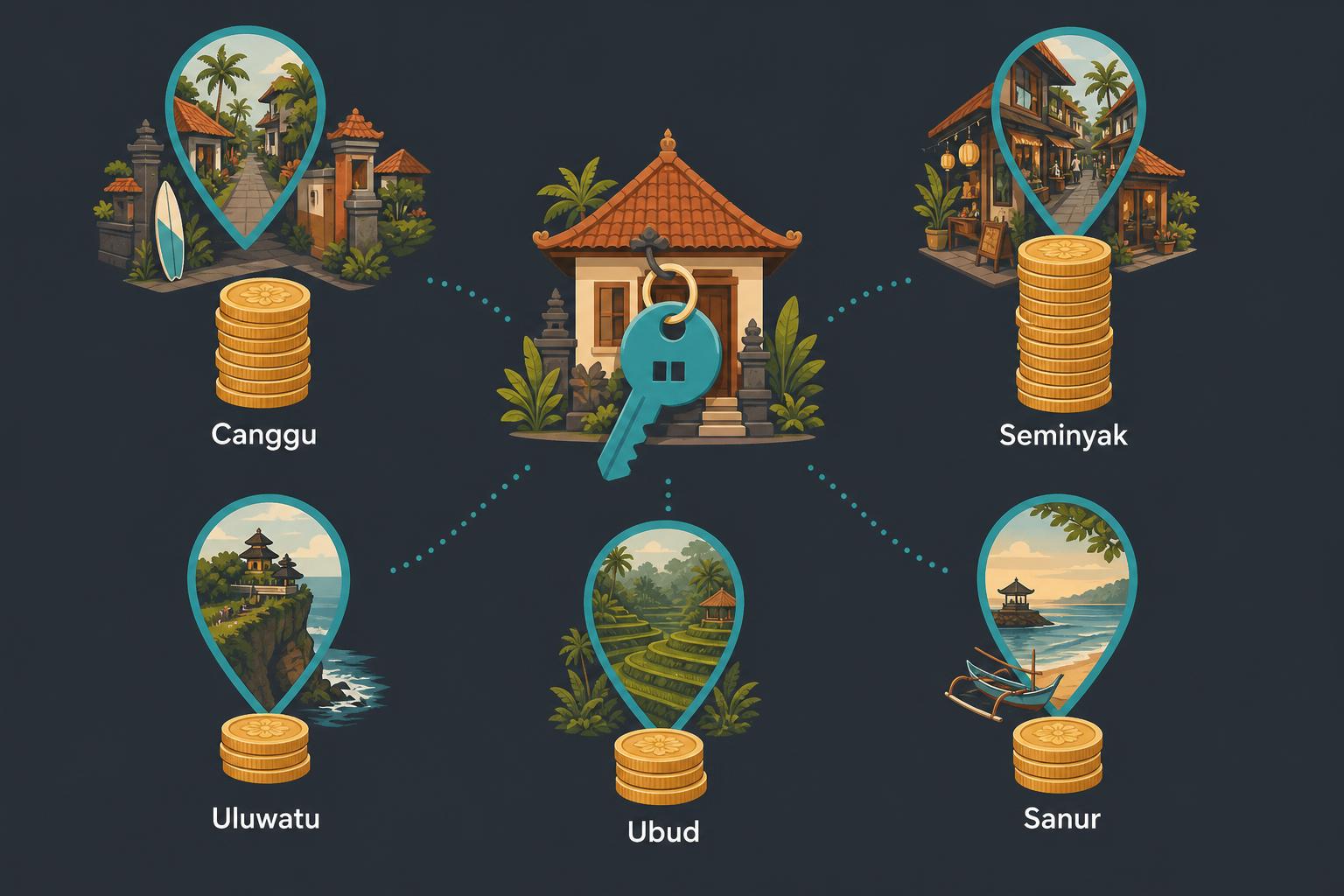
According to Livuma listing data (August 2026), Canggu had a median monthly asking rent of IDR 40,500,000; most listings fell between IDR 21,120,000 and IDR 73,110,600. Seminyak had 283 listings, with a median of IDR 40,000,000 and most listings between IDR 20,000,000 and IDR 73,281,600.
In Ubud, 40 long-term rentals had a median monthly asking rent of IDR 34,020,000, with most listings between IDR 13,736,000 and IDR 91,800,000. Uluwatu had 66 listings, a median of IDR 36,990,000 and a typical range of IDR 12,000,000 to IDR 76,680,000. Sanur had 52 listings, a median of IDR 29,500,000 and most listings between IDR 15,550,000 and IDR 54,900,000.
Understand what the figures can and cannot tell you
These are listing-data reference points, not official area-wide rent averages and not a valuation of any one villa. Bedroom count, furnishing, pool, road access, included services, condition, rental length and exact micro-location can all make a meaningful difference. Use the figures to spot an outlier, then ask what concrete features explain it.
The table retains the August 2026 marketplace asking-price snapshot, not current inventory or transaction prices. The Canggu inventory count is omitted pending verification.
| Area | Long-term rentals (August 2026) | Median monthly asking rent | Most listings fall between |
|---|---|---|---|
| Canggu | — | IDR 40,500,000 | IDR 21,120,000–73,110,600 |
| Seminyak | 283 | IDR 40,000,000 | IDR 20,000,000–73,281,600 |
| Ubud | 40 | IDR 34,020,000 | IDR 13,736,000–91,800,000 |
| Uluwatu | 66 | IDR 36,990,000 | IDR 12,000,000–76,680,000 |
| Sanur | 52 | IDR 29,500,000 | IDR 15,550,000–54,900,000 |
For an area-specific starting point, compare long-term rentals in Sanur, long-term rentals in Ubud or long-term rentals in Uluwatu alongside your own route test.
Build a long-term Bali villa budget that can survive the lease
Ask what the advertised rent includes before comparing homes
Do not compare headline rent alone. For each shortlisted villa, obtain a written itemisation of what is included and what is billed separately. Common questions concern electricity, water, internet, cleaning, pool care, gardening, rubbish, security, repairs and any move-out cleaning expectation. The answer can differ from one property to the next.
Confirm when each charge is due, who receives it, and whether you will receive readings or bills. PLN’s tariffs for all 13 nonsubsidized customer groups remain unchanged for October–December 2026, according to CNBC Indonesia’s November 4 report, but that does not tell you which tariff class or meter arrangement a particular villa has. Ask whether electricity is charged at meter cost or marked up, and photograph the meter at handover.
Distinguish a deposit from prepaid rent and other charges
Ask the owner or authorised manager to label every amount clearly. Rent paid in advance, a security deposit, a booking payment and payment for services should not be left as one unexplained total. For a deposit, establish its purpose, the condition-report process, permitted deductions, the return deadline and how the final utility amount is settled.
Before transferring money, calculate the full cash commitment due before keys are handed over. This protects you from agreeing to a monthly rate that appears affordable but requires a much larger initial outlay than expected.
Do not make the tenant responsible for an unknown tax position
Income from ordinary leasing of land and/or buildings is generally subject to Indonesian final income tax at 10% of gross rental value, including related maintenance, security, service and facility charges even under separate agreements. Where an ordinary individual tenant is not a designated withholding agent, the landlord pays that tax directly; qualifying corporate, government and designated individual tenants must withhold. This is tax on the recipient’s rental income, not automatically an additional tenant surcharge. Lodging services with accommodation are excluded from this regime, so do not automatically apply the same rate to kost income; exclusion does not mean the business is tax-free. Ask the owner which party is responsible for each payment under the agreement rather than accepting an unexplained extra charge. The Directorate General of Taxes sets out the rental-income tax treatment.
Find long-term villa listings without losing the comparison trail
Use one written brief for every enquiry
Send the same core questions to each prospective host or manager: availability dates, minimum stay, rent basis, included items, payment schedule, deposit, house rules, viewing options and whether the named person is authorised to lease the villa. Consistent questions produce comparable answers and expose omissions early.
Save links, messages, photos and written responses in one folder. This is especially useful when listings move between social media, chat applications and informal introductions, where the original claim can be difficult to find later.
Compare the property record, not only the photo gallery
A useful long-term listing should give you enough detail to decide whether a viewing is worthwhile: photos, pricing, availability, minimum stay, house rules and booking conditions. Treat broad phrases such as “fully equipped” as a prompt for specific questions, not evidence that every item you need is present.
On Livuma, renters can search live rental inventory by area, rental type, price, stay length, bedrooms and amenities. Listings show photos, pricing, an availability calendar, minimum stay, house rules, booking conditions and verified guest reviews in one place, which makes it easier to retain a like-for-like shortlist before you arrange viewings.
Keep a shortlist small enough to inspect properly
Shortlist homes that meet your non-negotiables, then rank them by daily fit rather than decoration. It is better to inspect a manageable number thoroughly than to send deposits toward several unverified possibilities. If a villa cannot be viewed in person, request a live virtual walkthrough that follows your checklist instead of relying on edited video.
Inspect a Bali villa for ordinary-day living, not viewing-day appeal
Test water, power, internet and the rooms you will use
Open taps, flush toilets, check drains, look below sinks and ask where water storage and pumps are located. Turn on lights and air conditioning where possible, inspect sockets you would use for work, and ask how electrical interruptions are handled. If internet matters, test it from the actual work area and ask who provides support if it fails.
Walk every bedroom and bathroom. Look for damp smell, visible staining, damaged fittings, door and window locks, hot-water function and airflow. Check outdoor areas for slippery surfaces, loose tiles, exposed wiring and standing water.
Visit at a time that reveals noise and access
Try to see the property at more than one time of day if you can. Morning, afternoon and evening can reveal different patterns of traffic, neighbouring activity, construction, barking dogs, music and lane access. A quiet daytime viewing is not a reliable test of a villa near a busy route or active building site.
Ask what is planned or known nearby, but make your own observations. Future construction cannot always be predicted, so focus on the current conditions and whether you can live with reasonable change around the property.
Record condition before it becomes a dispute
Take dated photos and video of existing marks, furniture, appliances, meters, keys, remotes and any missing or damaged item. Create an inventory with the owner or manager and make sure both sides can access the same version. This record matters at check-in and again when your deposit is assessed at move-out.
Verify who is authorised to lease the Bali villa
Ask the right person to explain their authority
A host may be the owner, an appointed manager or someone acting under another arrangement. Ask who the contracting party is, who will sign the agreement, who will receive rent and who is responsible for repairs. Names, payment details and the agreement should tell a coherent story.
If a representative is involved, ask for written evidence that they are authorised to offer and manage the rental. Do not treat a keyholder, neighbour or social-media account as proof that a person can bind the property owner.
Use land information checks for a larger commitment
For a substantial or lengthy lease, use independent professional advice appropriate to the transaction and ask about official land information checks. An electronic land-certificate check can show the registered right holder, mortgage or encumbrance information, blocks, seizures, disputes or case information, the expiry date and, where recorded, lease information in additional notes. ATR/BPN also provides public land-information functions including parcel plotting and parcel-location search through Sentuh Tanahku.
This is not a substitute for tailored legal advice, but it helps frame the questions that should be resolved before a major payment. Indonesia’s Basic Agrarian Law recognises a building-land lease right, Hak Sewa untuk Bangunan, with foreign nationals domiciled in Indonesia among eligible holders.
Know when a villa lease is not a property purchase
Renting gives you the contractual right described in your agreement for the agreed period; it is not the same as acquiring land or a home. Foreign individuals cannot hold Hak Milik land title, which Article 21 of Law 5/1960 reserves to Indonesian citizens. Do not let sales language blur that distinction. If you are deciding between renting and buying, read the foreign-buyer step-by-step guide before treating a lease as an ownership route.

Put the long-term villa agreement into plain, testable terms
Make the property, dates and price unambiguous
The agreement should identify the villa clearly, name the parties, state the rental start and end dates, explain the rent amount in rupiah, and show exactly when each payment is due. Bank Indonesia’s rupiah guidance requires rupiah-only domestic price quotations, including online offers and residential rent, and contractual transaction values must also use rupiah. It should say what happens if either party wants an extension, early departure or late handover.
Attach or reference the inventory, condition record and list of included services. If a promise mattered to your decision—such as a specific appliance, regular pool care or a furnishing change—put it in writing rather than relying on a message thread.
Agree the rules for repairs, guests and access
Clarify who handles routine maintenance, urgent repairs and damage caused by tenant use. Agree how the owner, manager, cleaner, gardener, pool technician or other staff may access the villa, how much notice is expected, and what happens in an emergency.
Also cover guests, pets, smoking, events, subletting, parking and any restrictions on using the home for work. The goal is not an overly complicated document; it is a shared answer before a disagreement occurs.
Read cancellation and deposit language line by line
Check the cancellation position before paying, particularly where rent is prepaid. Deposit clauses should state what evidence is used for deductions and how a final account is calculated. If a term is unclear, ask for it to be rewritten in ordinary language. A verbal reassurance is much harder to rely on after money has changed hands.
Choose a payment sequence that leaves a clear record
Do not pay before the essentials are settled
Before payment, confirm the property, contracting party, dates, amount, payment destination, cancellation terms and the next handover step. Keep receipts and payment confirmations together with the agreement. Avoid a rushed transfer simply because another renter is said to be waiting.
Use payment details that match the agreement
The account or payment method should align with the contracting party or a documented authorised recipient. Ask for an explanation before paying a different person or an account that cannot be connected to the agreement. Keep the proof of each transfer and ensure the receipt identifies what the payment covers.
Complete identity and accommodation steps promptly
Foreign renters should provide accurate accommodation information when it is requested. Under Article 72 of Immigration Law No. 6/2011, as amended by Law No. 63/2024, accommodation owners or managers must provide foreign-guest data when requested by immigration officials and/or Indonesian police. APOA is the accommodation reporting system used by operators, with passport information and check-in and check-out reporting. Ask your host or manager how they handle the accommodation record. Article 71 separately requires foreigners to report address changes to the local immigration office; the host’s reporting does not replace this obligation. See the immigration reporting provisions.
Check in to a Bali villa with evidence, keys and contacts
Walk through the inventory before accepting the home
At handover, compare the villa with the agreed inventory and condition record. Count keys, gate remotes, access cards and gas bottles where relevant. Photograph utility meters and note their readings. Test the items you will need that first night: lights, water, toilets, door locks, internet and air conditioning.
Send any discrepancies immediately in writing. Waiting until the end of the first week can make it harder to show that damage or an omission existed before you moved in.
Collect contacts for the problems that actually occur
Keep a list for the property manager, owner or authorised representative, internet support, pool or garden contact where applicable, and any building or security contact. Ask how urgent issues should be reported outside normal hours, and use written follow-up after a phone call so there is a record of what was agreed.
Confirm the start of your rental record
Make sure you have the final agreement, receipts, inventory and payment schedule stored somewhere accessible. Whichever route you use, a complete handover file is valuable when you extend, move out or need to query a charge.
Manage a long-term Bali villa tenancy after move-in
Report maintenance early and with useful evidence
Describe the issue, when it began, what part of the villa is affected and whether it is urgent. Add clear photos or video. Early reporting limits damage and makes it easier for the responsible person to arrange a repair. Do not commission non-emergency work yourself unless the agreement says you may or you have written approval.
Track your time in Indonesia independently of the lease
A housing lease exceeding 183 days is expressly listed as possible evidence of an intention to reside for tax-residency purposes under PER-23/PJ/2025, effective December 9, 2025, which replaced PER-43/PJ/2011 and PER-2/PJ/2009. A foreign national can become an Indonesian domestic tax subject when resident in Indonesia, present for more than 183 days in any 12-month period, or present in a tax year with an intention to reside. Interrupted stays count, and part of a day counts as a full day; tax residency is not determined solely by waiting until day 184. Dual-resident cases involving treaty partners are subject to the applicable tax treaty. Your lease and immigration status are therefore separate records that may have related consequences. Read the official tax-residency rule and seek qualified advice for your personal position.
Prepare the move-out process before the final month
Re-read the agreement before giving notice. Arrange a preliminary inspection if possible, ask how final utilities will be calculated and remove personal items before the handover. Use the original check-in evidence to guide a joint condition review. Return keys and remotes with a written acknowledgement, and retain the final settlement record.
Long-term Bali villa rental mistakes that are easy to avoid
Signing because a villa feels scarce
Tourism demand can create urgency: Bali’s star-rated hotel occupancy was 68.19% in August 2026, according to RRI’s report of BPS figures released October 1. That hotel indicator does not establish long-term villa occupancy, villa availability or a fair rent for a particular home. Do not turn general market pressure into a reason to skip viewing, verification or written terms.
Assuming every furnished villa has the same operating costs
Two similar-looking villas can have different utility arrangements, maintenance obligations and deposit rules. Ask the questions in writing every time. If you want a lower-cost room-based option instead of a whole villa, compare the practical differences with kost rooms in Ubud or another suitable area rather than assuming the labels mean the same thing.
Confusing a convenient process with a guaranteed property outcome
Documents, verified accounts and protected payment flows improve the rental record, but they do not eliminate the need to inspect, read and ask questions. The strongest approach combines your own viewing and condition evidence with a clear agreement, traceable payment and orderly check-in.
Renting a long-term Bali villa through Livuma
- Build a comparable shortlist. Compare long-term rentals in Canggu or your chosen area, checking availability, minimum stay, house rules and verified guest reviews against your brief.
- Read and secure the request. Payment schedules, deposit or balance rules, deadlines, cancellation terms and refund logic appear before commitment. A card reservation or held Indonesian bank-transfer prepayment secures the request before host review; the card is not yet charged.
- Wait for the host’s answer. The host has a limited response window. Approval charges the card reservation and confirms a standard booking; decline, withdrawal or expiry automatically releases the reservation or refunds the prepayment in full.
- View first where available. For monthly and yearly rentals, subject to host and property, “view property first” secures only a small deposit. Arrange the in-person or virtual viewing in in-app chat, then pay the rest in the app to confirm, with no deadline or automatic confirmation—or cancel for free for a full deposit release or refund.
- Connect documents and check-in. Guests complete identity verification before agreement issuance; supported bookings generate digital agreement details and receipts. Confirm arrival or report a problem in the app. Payments run through Xendit, and host payout follows successful check-in, automatically about 24 hours later, never while a reported problem remains open.
Final checklist: choose the area by your routine; compare what rent includes; inspect the villa in use; verify who can lease it; write down every material term; keep payment and handover records; and keep your visa and tax position separate from the rental contract.