

This is for foreigners building a life in Bali, whether they are employed remotely, freelancing, running a business, retiring or staying long enough for Bali to become home. It explains the Indonesian tax-residency questions that arise before an annual return is due, but it is not personal tax advice.
When does a foreigner become an Indonesian tax resident?
A foreigner becomes an Indonesian domestic tax subject, or SPDN, if they reside in Indonesia, spend more than 183 days in Indonesia during any 12-month period, or are in Indonesia during a tax year with an intention to reside there. These are alternative tests: reaching more than 183 days is not the only route to Indonesian tax residence.
The current operative rule is DGT Regulation PER-23/PJ/2025, which took effect on 9 December 2025, replacing PER-43/PJ/2011 and PER-2/PJ/2009. It applies the same broad framework to Indonesian and foreign individuals, so nationality does not determine the answer. What matters is the person’s actual presence, living arrangements and evidence of their plan to live in Indonesia.
Tax residence is important because it normally changes the scope of income Indonesia can tax. A domestic taxpayer is generally considered on Indonesian and foreign income, subject to treaty, foreign-tax-credit and specialist-expatriate rules discussed below. A person who remains a foreign tax subject, or SPLN, may still have Indonesian tax exposure, but the analysis begins with Indonesian-source income instead.
For the authoritative wording and indicators, read the DGT regulation on domestic and foreign tax subjects. Keep a personal arrival-and-departure record from the start of a Bali stay; it is much easier to reconstruct a rolling period before it becomes close.
How does Indonesia count the 183 days for tax residency?
Indonesia counts more than 183 days across a rolling 12-month period, not from 1 January to 31 December. The physical-presence threshold is therefore 184 days, not exactly 183. The days do not have to be consecutive, so several Bali visits can accumulate toward the test even if they are separated by trips abroad.
Any fraction of a day in Indonesia counts as one full day. In practical terms, an arrival late in the day and a departure early in the day are still each days to include in the count. Do not rely on a rough estimate based on visa duration, a booking calendar or the number of months on an island; use travel records and count actual presence carefully.
The rolling feature is the part most often missed. On every relevant date, look back over the preceding 12 months and total the Indonesian days in that window. A person who has not crossed the threshold in a calendar year can nevertheless cross it in a rolling period spanning two years. When this test is met, subjective tax liability begins from the first day of the relevant Indonesian stay, not merely day 184, as explained in Indonesia’s official OECD tax-residency submission.
- Record every Indonesia arrival and departure.
- Count partial days as full days.
- Review the prior 12 months rather than only the current calendar year.
- Assess the separate intention-to-reside test as well.
Day counting establishes physical presence; it does not by itself settle where each item of income is sourced or whether a tax treaty changes the final residence result.
Can I be Indonesian tax resident before I reach 183 days?
Yes. A person can become Indonesian tax resident before exceeding 183 days if they are in Indonesia in a tax year and intend to reside here. PER-23/PJ/2025 identifies several forms of evidence that can demonstrate that intention, which means this is a document-and-facts question rather than a future prediction.
Relevant evidence can include a KITAP; a VITAS or ITAS valid for more than 183 days; and an Indonesian work, business or activity contract exceeding 183 days. PMK 18/2021 Article 2 also identifies a residential lease exceeding 183 days and documents showing that family members have moved to Indonesia. Residence is factual: a non-stopover home available for use, whether owned, rented or otherwise available, a centre of personal, social, economic or financial activities, and habitual daily activity in Indonesia can each point toward residency.
A long lease is therefore not merely a housing decision. Before committing, preserve the signed lease, dates, payment records and the address. When comparing homes, Livuma’s live rental listings show stay length, availability, house rules and booking conditions before a request is sent; those listing details are useful for planning, though your signed agreement and circumstances are what matter for tax analysis.
If a longer Ubud move is under consideration, compare the practical lease terms in long-term rentals in Ubud before treating the move as a temporary visit. A licensed adviser should assess the complete facts, especially where a lease and work arrangement begin before the 183-day mark.
Does a KITAS, KITAP or remote-worker visa decide my tax residence?
No. Immigration permission and income-tax residence are separate legal determinations. An ITAS, KITAP, VITAS or other visa can be evidence of an intention to reside, but it is not the sole tax-residency test and does not override the day-count or factual-residence tests.
For example, immigration separately lists E33G as a limited-stay visa category for remote workers. Holding that visa does not itself answer whether the holder is Indonesian tax resident, whether work performed in Indonesia has Indonesian source, or whether a treaty applies. Equally, someone on a different stay status should not assume they are outside the tax rules simply because their immigration document does not say tax resident.
Keep the questions in separate columns when planning a move:
- Immigration: what activity and period does the stay permission allow?
- Tax residence: do the statutory residence, day-count or intention tests apply?
- Income treatment: where is each income item sourced, and do treaty or credit rules apply?
For immigration context, see the separate explanation of the difference between tourist visas, KITAS and Golden Visa routes. It is useful relocation reading, but it cannot replace a tax-residency review.
If I stay under 183 days, can Indonesia still tax my income?
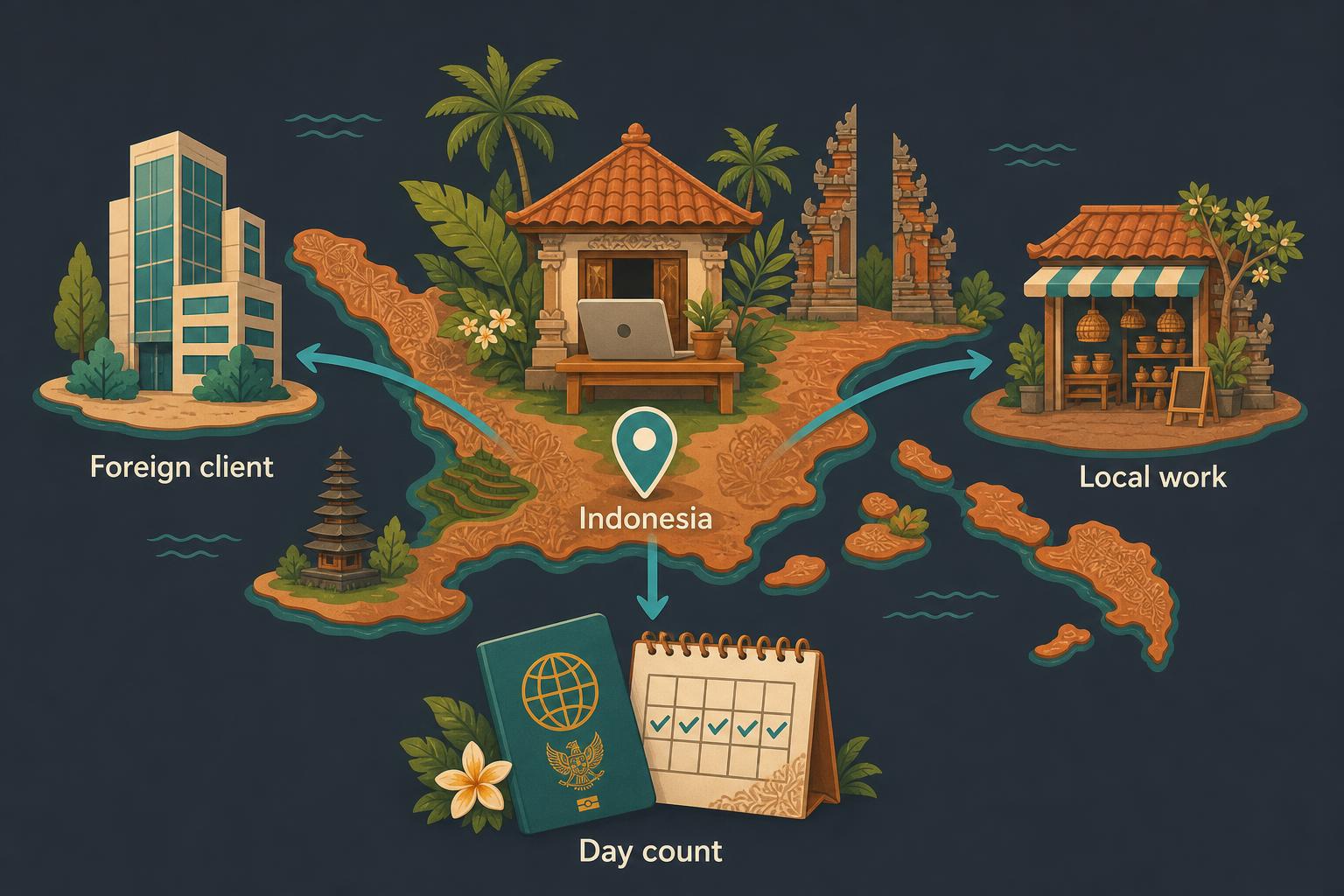
Yes. Staying at or below 183 days does not automatically mean no Indonesian tax is due. A foreigner who does not reside in Indonesia, is present no more than 183 days in 12 months and does not meet the intention-to-reside test will generally be a foreign tax subject, or SPLN, but Indonesian-source income can still be taxable in Indonesia.
The source question must be examined separately for each income stream. Indonesian work, business activity, property income or other Indonesia-connected income may require Indonesian treatment even where the recipient remains non-resident. A permanent establishment can also be relevant where applicable. The correct conclusion depends on the activity, contract, payer, place of performance and any applicable treaty rather than on a single label such as visitor or digital nomad.
This distinction matters for short-stay consultants and recurring visitors. A person might accurately say they have not passed the 183-day threshold, yet still have Indonesian-source income to address. Conversely, a person who has become resident must then consider the broader worldwide-income position.
Do not try to solve this by counting days alone. Save contracts, invoices, work scopes, travel records and evidence of where services were actually performed. Those records give an adviser the information needed to distinguish residence from source and to check whether local withholding or reporting obligations arise.
Does Indonesian tax residency mean I must report worldwide income?
Usually, yes. Indonesian domestic taxpayers are generally subject to Indonesian income tax on income from both Indonesia and abroad. This is the default worldwide-income position, so a resident should not assume that foreign clients, overseas shares, a foreign employer or an overseas bank account place income outside the Indonesian tax base.
Worldwide income does not mean the same income must necessarily bear full tax twice. A tax treaty may allocate taxing rights or resolve dual residence, and foreign income included in Indonesia’s tax base may qualify for an Article 24 foreign-tax credit for tax paid or payable abroad in the same tax year. The credit is calculated by income category and country, capped at the lowest of the applicable treaty-permitted foreign tax, actual foreign tax and Indonesian proportional limit.
Start with a clean inventory rather than a single total: employment income, freelance receipts, business income, Indonesian property income, foreign investment income and any tax withheld abroad. Then identify the country connected to each foreign item and retain proof of foreign tax. This is particularly important if more than one country is involved.
There is a narrowly framed expatriate exception, but it requires qualification and approval. It should not be treated as a general exemption for people who happen to live in Bali while being paid from abroad.
What is the four-year foreign-income exception for specialist expatriates?
Some qualifying foreign citizens can elect Indonesian-income-only taxation for four tax years from first becoming Indonesian resident, but the regime is limited and requires DGT approval. Leaving Indonesia does not pause or restart that four-tax-year period. It is not an automatic benefit of being a foreigner, having a remote role or receiving salary outside Indonesia.
The rule is for foreign employees in prescribed positions or foreign researchers who meet specific-expertise requirements. Relevant expertise is in science, technology or mathematics and must be evidenced by certification, education and/or at least five years of relevant experience. The individual also has a knowledge-transfer obligation.
An application is made electronically through DGT-designated channels, or to the registered KPP if that channel is unavailable. After the receipt acknowledgment is issued, the KPP has up to 10 working days to approve or reject it. If approved, the annual return reports Indonesian income; if rejected, both Indonesian and foreign income are reported. The current administrative provisions appear in PMK 81/2024 Articles 442–447, effective 1 January 2025.
A qualifying person cannot use this four-year treatment if they instead use an applicable Indonesian tax treaty with the country where their foreign income arises. That choice can have significant consequences, so it should be made with tailored professional advice before filing.
Are remote salary and freelance fees paid abroad still relevant in Bali?
Yes. The location of an employer, client, payroll platform or bank account does not by itself settle Indonesian residence or income-source treatment. A Bali-based remote employee or freelancer who exceeds 183 days, or shows an intention to reside, should separately review residence status and the source characterization of services performed from Indonesia.
This is especially clear under the specialist-expatriate regime: remuneration for work, services or activities performed in Indonesia is Indonesian income even when paid outside Indonesia. So a foreign bank transfer is not a reliable test of where income belongs for Indonesian tax purposes.
For a remote-worker review, assemble the facts an adviser will need:
- arrival and departure history;
- visa and residential-lease dates;
- employment or client contracts and job description;
- where work was physically performed;
- payslips, invoices and payment records; and
- foreign tax returns and withholding evidence.
Freelancers should take particular care not to collapse business, personal residence and source questions into one answer. A client abroad may be commercially important, but it does not remove the need to analyse work actually carried out while living in Bali.
When do I need an NPWP, and how do foreign residents register?
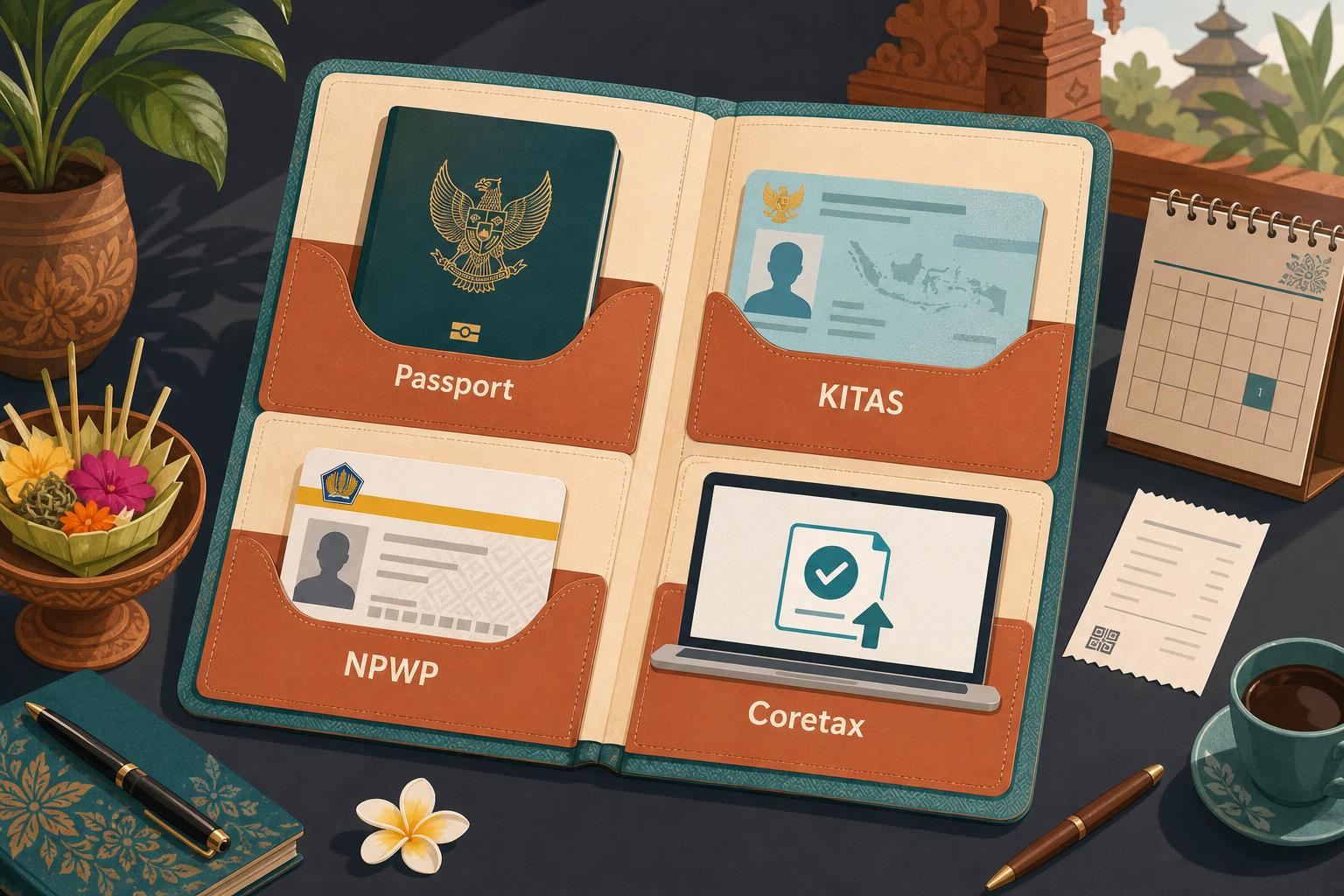
An Indonesian domestic tax subject becomes an Indonesian taxpayer when they receive Indonesian and/or foreign income above the PTKP tax-free threshold. For an individual, the basic PTKP allowance is IDR 54 million per year. At that point, NPWP registration and related compliance should be addressed promptly rather than postponed until the annual filing season.
Foreigners who must register generally provide a passport and KITAS or KITAP. Registration may be completed independently online through Coretax DJP or in writing, and current Coretax materials state that new foreign individual registrants receive a 16-digit NPWP. The official DGT NPWP registration requirements are the right starting point, but an adviser can identify the correct registration timing and KPP for your facts.
Keep your tax identity separate from a rental booking, but retain housing records in the same secure file. Keep rental agreements, booking terms and receipts as a record. Those records do not determine tax residence, yet they can help document the timing and terms of a move.
An NPWP is an identifier, not a conclusion that every item of income receives the same treatment. Registration should be followed by a proper review of income, withholding, treaty position and annual-return obligations.
What are the PTKP allowance and individual income-tax rates in Indonesia?
The basic individual PTKP allowance is IDR 54 million per year, and resident individual income tax uses progressive rates on taxable income. Taxable income is not simply gross salary or gross freelance receipts, so use these bands as a framework rather than calculating a final liability from a bank balance.
| Taxable income band | Rate |
|---|---|
| Up to IDR 60 million | 5% |
| Over IDR 60 million to IDR 250 million | 15% |
| Over IDR 250 million to IDR 500 million | 25% |
| Over IDR 500 million to IDR 5 billion | 30% |
| Over IDR 5 billion | 35% |
The rates apply progressively: moving into a higher band does not apply that higher rate to all taxable income. Other individual circumstances and income categories may affect the eventual computation, which is why a resident with foreign income, multiple income streams or foreign withholding should avoid self-calculating from rate headlines alone. Ordinary land/building rental income generally attracts 10% final income tax on gross rent under PP34/2017, rather than these progressive bands or the PTKP allowance; see DGT’s explanation of rental-income tax.
The DGT explanation of individual income-tax calculation confirms the allowance and brackets. Use it alongside advice on deductions, withholding and credits relevant to your actual income.
When is the Indonesian annual SPT due, and where do I file it?
An individual annual SPT is generally due by 31 March after the end of the calendar tax year, and annual returns for tax year 2025 onward are filed through Coretax DJP, replacing the previous DJP Online e-Filing/e-Form workflow for those returns. Filing is a yearly process, so do not wait until March to discover missing foreign-income records or overseas tax documents.
For the 2026 tax year, the standard filing deadline is 31 March 2027. For the 2025 tax year, DGT gave one-off Coretax implementation relief by waiving late-payment and late-filing administrative sanctions through 30 April 2026; the statutory filing deadline remained 31 March 2026. That was not a recurring extension and should not be used to assume later years have an April deadline.
Prepare a filing folder during the year containing your NPWP details, Indonesian income evidence, foreign income by country, foreign withholding proof, payment records and any specialist-regime approval. If you received Indonesian income only through withholding, still confirm whether an annual return is required in your situation rather than assuming the withholding ends all obligations.
The official Coretax annual SPT guidance for individuals explains the filing channel and general deadline. Taxpayers need Coretax account activation and an authorisation code/electronic certificate; Coretax access does not require EFIN, as explained in DGT’s account-activation guidance. Submit early enough to resolve access, data-entry or payment questions before the deadline.
How do tax treaties and foreign-tax credits prevent double taxation?
Tax treaties and foreign-tax credits can reduce double taxation, but they are not automatic permission to ignore Indonesian reporting. A treaty matters most when the same person is treated as resident under Indonesia’s domestic rules and the rules of a treaty-partner country, or when two countries may tax the same income.
If someone is resident in both Indonesia and a treaty-partner country under domestic law, Indonesian residence is determined under the relevant treaty tie-breaker provisions. Treaty text, effective dates and Multilateral Instrument modifications must be checked for the individual country involved; DGT maintains an official tax-treaty database for that work.
Where foreign income is included in an Indonesian resident’s tax base, Article 24 may allow credit for foreign income tax paid or payable in the same tax year. Under PMK 192/2018 Article 6, the credit is calculated by income category and country, capped at the lowest of the applicable treaty-permitted foreign tax, actual foreign tax and Indonesian proportional limit. A high foreign withholding amount is therefore not automatically fully creditable in Indonesia.
An Indonesian resident seeking treaty benefits abroad may request an Indonesian certificate of domicile, known as SKD SPDN, through the current Coretax process. Treaty residence, foreign credit and the specialist four-year regime can interact, so obtain advice before choosing a position.
When should a Bali expat use a licensed Indonesian tax consultant?
Use a DGT-licensed Indonesian tax consultant before filing if you have crossed or may cross 183 days, signed a long lease, work remotely from Bali, have foreign income, paid tax abroad, own income-producing property, or could be resident in two countries. These are fact-heavy questions where a mistaken assumption can affect registration, reporting and treaty claims.
Ask the adviser to address the sequence, not just the final tax bill: your residence start date, the day count, intention evidence, source of each income item, any Indonesian withholding, worldwide-income reporting, foreign-tax-credit calculations, treaty tie-breaker analysis and the right annual SPT position. A specialist-regime applicant should also ask whether a treaty choice is available and preferable before applying.
Check credentials rather than relying on social-media recommendations. DGT provides a searchable registered tax-consultant system, and tax-consultant practice requires a DGT-issued licence. Bring documents in an organised format and tell the adviser about overseas income even if you believe it is exempt; the answer often turns on facts that seem secondary.
Good advice does not promise a preferred outcome. It records the facts, applies the applicable rules and gives you a filing position you can understand and support.
FAQs
Does Indonesia use a calendar year for the 183-day test?
No. The 183-day presence test uses any rolling 12-month period, while the annual individual tax return follows the calendar tax year. Those are different clocks, so a person can become resident through days spanning two calendar years and later report income through calendar-year SPT filings.
What is the difference between an NPWP and an annual SPT?
An NPWP is the taxpayer identification number used for Indonesian tax administration. An annual SPT is the tax return filed for a calendar tax year. Having an NPWP does not answer the final tax due, and filing an SPT requires the taxpayer to report income and relevant tax information for that year.
What records are most useful for a remote worker’s Indonesian tax review?
Keep passport travel history, visa records, residential leases, employment or client contracts, payslips or invoices, bank-payment evidence, foreign tax returns and proof of foreign tax withheld. These documents help establish day count, intention to reside, the place services were performed and potential foreign-tax-credit calculations.