

“The villa is insured” sounds reassuring until you ask what happens after a flood, an earthquake or a cancelled rental season. Beliefs about insuring a property in Bali often come from estate-agent assurances, homeowner brochures and quotations compared only by their annual premium. They persist because the important differences sit in eligibility conditions, exclusions and policy schedules—not in the product name.
Owners, investment-villa operators and residential tenants need different answers. The useful question is not simply whether insurance exists, but whether the named property, its actual use, its contents and the losses you want covered match the contract. These widely repeated claims show where to look.
“Insuring a property in Bali means every disaster is covered”
Verdict: False.
A basic fire policy is not a promise to pay for every kind of building damage. AAUI’s published Indonesian Standard Fire Insurance Policy, known as PSAKI, covers fire, lightning, explosion, aircraft impact and smoke. Its standard wording excludes flood, inundation, landslide and windstorm unless expressly covered through an extension.
Earthquake, volcanic eruption and tsunami are also excluded from standard fire wording. AAUI publishes separate earthquake-policy wording, PSAGBI, listing earthquake, volcanic eruption, resulting fire or explosion, tsunami and liquefaction as insured perils. That does not mean those protections automatically accompany a fire quotation.
Start with the hazards you need covered, then ask the insurer to identify the corresponding policy wording or endorsement. A reassuring product description is not enough.
- Fire: identify the insured events and exclusions.
- Flood: request the specific extension and its conditions.
- Earthquake and tsunami: check the separate or additional coverage offered.
- Contents: establish whether these are insured alongside the structure.
Ask for the schedule, wording and endorsements together before accepting. Read the published PSAKI wording, revised following the Constitutional Court’s Article 251 ruling, as a reference, but make the documents issued for your property the basis of your decision.
Insurance is also separate from personal safety. Our guide to earthquake and tsunami preparedness in Bali addresses evacuation and household planning, which a policy cannot replace.
“Flood cover is unnecessary if the Bali villa looks dry”
Verdict: False.
A dry viewing tells you about conditions during that visit, not the property’s flood exposure. BPBD Bali recorded 205 flood locations during the September 9–10, 2025 disaster, with Denpasar recording the largest number. Those figures were updated on September 13, 2025. They demonstrate a real exposure, not that every property in an affected area has the same risk.
Use BNPB’s InaRISK hazard information to screen the actual location for flood, earthquake, tsunami and volcanic risks. A map is a starting point for questions, not a guarantee about an individual building or an insurer’s acceptance.
Then investigate what the map cannot settle for you:
- Ask the owner or manager about previous water entry and keep the answer in writing.
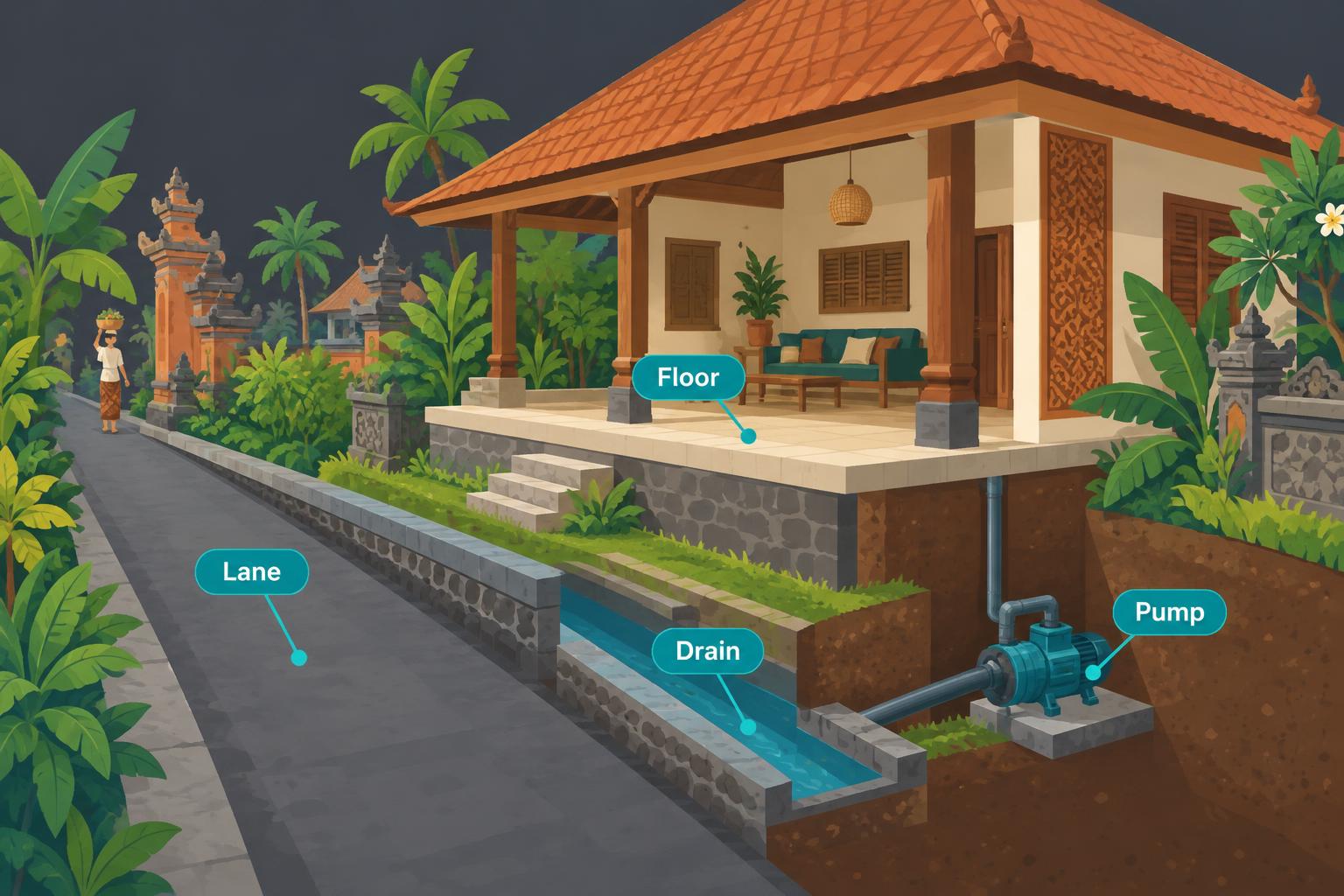
- Look at the relationship between the floor, driveway, lane and nearby drainage.
- Ask where pumps, electrical equipment and stored belongings would sit if water entered.
- Give the insurer any known history rather than assuming an earlier incident is irrelevant.
For flood insurance in Bali, ask the insurer to show exactly how flood, inundation and other water damage are treated. Do not assume these descriptions are interchangeable. Confirm the extension, exclusions and deductible before deciding whether the protection fits the building.
The practical outcome is a property-specific decision: neither a dry visit nor an area’s reputation is an adequate substitute for checking the address and the contract.
“A homeowner policy also covers my rented Bali villa”
Verdict: False.
A building can look like a private home while being used as an investment rental. That distinction matters when choosing Bali villa insurance. Allianz RumahKu Plus, for example, explicitly requires the residence not to be rented out or vacant. Under its published eligibility conditions, that particular product is unsuitable for a rented investment villa.
The same product accepts residences of no more than three floors, with Class 1 non-combustible construction and access for fire engines. These are product-specific restrictions, not universal rules for every insurer. The published RumahKu Plus conditions illustrate why a familiar homeowner label is not enough.
Describe the actual operation when requesting quotations:
- Whether the property is owner-occupied, rented or sometimes vacant.
- Whether guests change frequently or a tenant occupies it long term.
- The building’s construction materials, floors and vehicle access.
- Any mixed residential and commercial use.
Ask for written confirmation that the proposed policy accepts that use. If the operating model changes later, ask the insurer what needs updating rather than assuming the original acceptance continues unchanged.
PSAKI requires complete, truthful disclosure of material facts, and the application forms part of the insurance agreement. Keep a copy of what you submitted. This is more useful than relying on an informal assurance that “everyone uses this policy for villas.”
“Only the property owner can arrange insurance”
Verdict: False.
Residential tenants are not automatically excluded from property insurance. ACA’s published ASRI eligibility includes individuals with an insurable interest, including homeowners and residential tenants. Eligibility still needs confirming for the applicant, property and protection requested; being a tenant does not mean every product or every item qualifies.
Separate the building from its contents. BCAinsurance’s fire product lists buildings, contents and stock as insurable categories. Its published exclusions include jewellery, precious metals, antiques or art, and securities. A policy covering a furnished house therefore does not necessarily protect everything inside it.
Before arranging tenant contents insurance, make an ownership inventory:
- Owner’s property: furniture, appliances and other supplied items.
- Tenant’s property: belongings brought into the home.
- Items needing clarification: valuables, art and anything outside the insurer’s accepted categories.
Ask whose interests are insured and which items appear in the schedule. Do not assume the landlord’s building insurance protects your belongings, or that your contents policy covers damage to the landlord’s structure.
For supported rental bookings, Livuma generates digital rental agreement details and receipts from the listing, booking terms and verified guest details, as explained in its rental platform walkthrough. Those records can help organise the tenancy file, but they are not an insurance policy or confirmation of cover.
Keep a separate contents inventory with supporting evidence. Our explanation of what a Bali villa rental includes can help frame the ownership questions to resolve before insuring supplied furnishings.
“The property’s asking price tells me how much to insure”
Verdict: False.
An asking price answers a sales question, not the policy’s valuation question. Start by asking what is being insured and how a loss would be valued. Do not treat a purchase price or an agent’s estimate as an insurer-approved building valuation.
AAUI’s published PSAKI defaults to actual value immediately before the loss, allowing technical depreciation, unless the policy agrees otherwise. In plain language, new-for-old rebuilding is not automatic. A quotation needs to make its valuation basis clear, not simply display a large sum insured.
Underinsurance creates another problem. PSAKI applies proportional loss-sharing when the sum insured is below the property’s actual insured value at the time of loss. Choosing a lower insured amount to reduce the premium can therefore affect the settlement, rather than merely limiting the maximum payout.
Ask the insurer or adviser to explain:
- Which building components and contents the valuation includes.
- Whether settlement uses depreciated actual value or an agreed alternative.
- How the proposed sum insured was established.
- How the underinsurance condition would operate on a partial loss.
- When renovations or replacement furnishings should trigger a review.
Request a written worked example using your proposed figures. The aim is to understand the settlement method before a loss, not discover afterwards that “insured value” meant something different from the cost you expected to recover.
“Insuring a property in Bali is just about the premium”
Verdict: False.
A cheaper quotation may leave you paying more after damage. Compare the deductible—the portion you bear—alongside the insured events, eligibility, valuation basis and exclusions. The percentage alone is not enough: you need to know what it is calculated against.
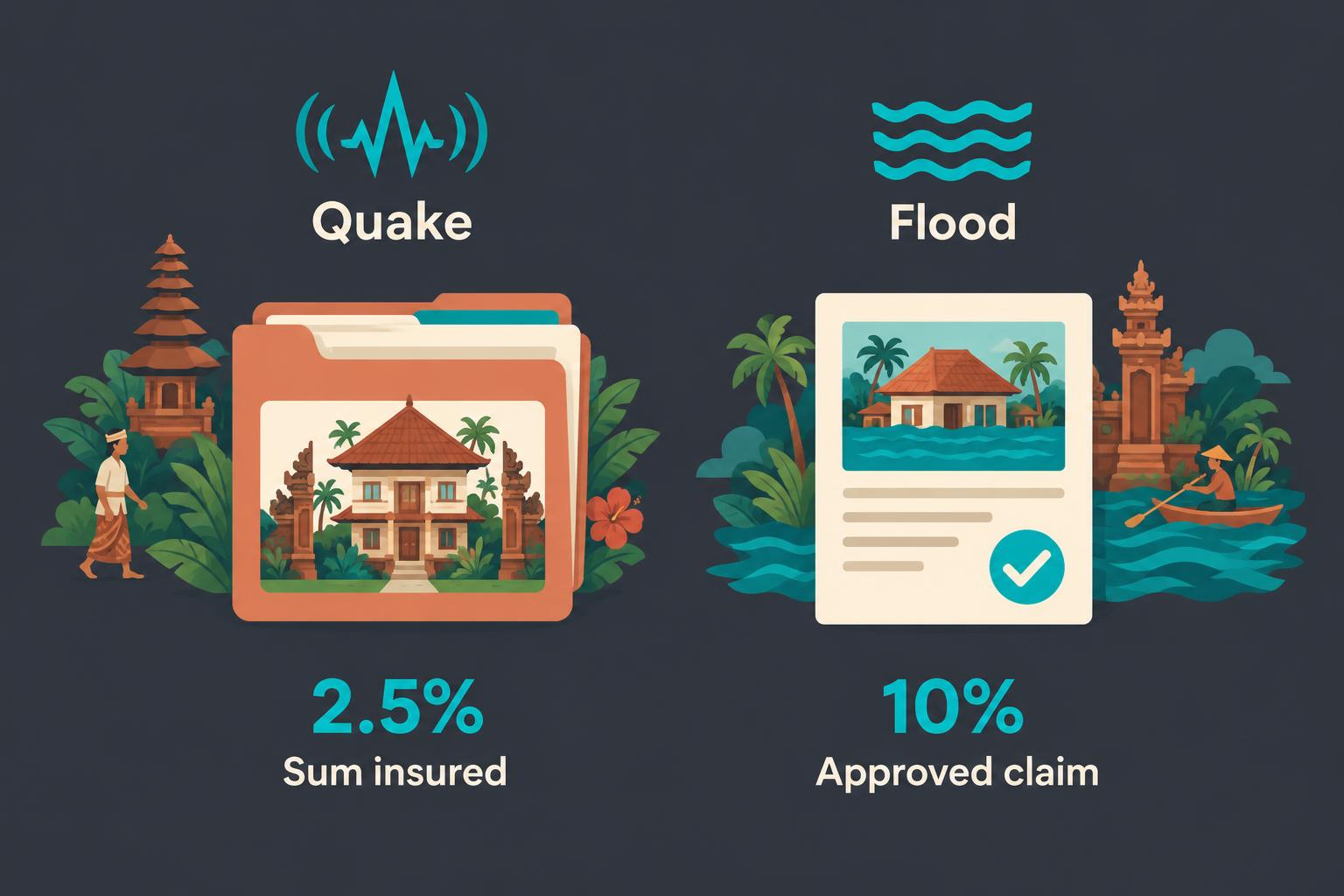
BCAinsurance’s published fire-insurance product gives a useful example. Its earthquake, eruption and tsunami deductible is 2.5% of the sum insured, not 2.5% of the claim. Its flood, storm and water-damage deductible is 10% of the approved claim. These are that product’s published terms, not a Bali-wide standard.
Check the BCAinsurance product details for the distinction, then ask each competing insurer to identify its own calculation base. A percentage of the whole insured amount and a percentage of the approved loss can produce very different out-of-pocket costs.
There is no verified current Bali rental-villa premium benchmark in the research supporting this article. BCA advertises fire-insurance premiums from Rp200,000/year, but this is a marketing minimum, not a verified premium for a Bali rental villa or comprehensive catastrophe cover. Confirm current pricing for your property with the provider.
For a useful property insurance cost comparison, send the same information to each provider:
- The same address, construction details and declared use.
- The same insured assets and requested valuation basis.
- The same flood and earthquake coverage requests.
- A request for all deductibles, limits and exclusions.
Compare the resulting contracts, not just the annual totals. Include the amount you would need to fund yourself after a covered event.
“Building insurance pays the rent while repairs happen”
Verdict: False.
Repairing the building and replacing lost income are different insurance questions. Standard PSAKI excludes business interruption. Building-damage insurance alone therefore does not establish protection for lost villa rental revenue.
If rental income supports the property’s running costs, ask specifically about business interruption or rental-income protection. Do not assume either phrase guarantees that the proposed policy covers your particular operation.
Get written answers to these questions:
- Is lost rental income insured at all?
- Which damage events would trigger that cover?
- How would the insurer establish the income lost?
- What limits, waiting conditions or other restrictions apply?
- What booking, payment and accounting evidence would be required?
Keep confirmed bookings separate from hoped-for occupancy. An asking rent is not the same thing as documented revenue, and an insurance decision should not depend on an unsupported earnings forecast.
For hosts using Livuma, rental payments follow the schedule shown in the booking, and supported bookings generate receipts; the hosting guide explains the platform workflow. These records can support an organised income file, but Livuma does not insure the property or promise reimbursement for lost rent.
Plan for costs that remain payable while income is interrupted. Insurance may address agreed losses, but it should not replace a cash reserve or a clear understanding of what the insurer has actually accepted.
“Good records make a property claim easier to prepare”
Verdict: True.
A policy is only part of a usable insurance file. AAUI’s published PSAKI wording requires a claim form, policy copy, incident confirmation from the village or kelurahan head or local police, and supporting loss information. Preparing records before damage occurs makes those requirements easier to address.
Keep the policy schedule, endorsements, application, contents inventory and supporting purchase or repair documents together. Save dated property images and the insurer’s claim contact details somewhere you can access if the building is unusable.
After an incident, notify the insurer promptly and follow its instructions for evidence and repairs. Confirm the notification and written-report deadlines in your issued policy with the insurer rather than treating a fire-policy deadline as a universal Indonesian rule. AAUI’s published PSAGBI earthquake wording requires immediate notification and a written loss report within 60 calendar days after notification.
- Record what happened and when you discovered the damage.
- Photograph affected areas and prepare an itemised loss record.
- Ask what supporting incident confirmation is required.
- Keep copies of submissions and written responses.
Before buying, verify the insurer or intermediary through OJK’s FIND directory, which checks financial businesses and professionals licensed, registered or supervised by OJK.
If a complaint remains unresolved, LAPS SJK provides a dispute-escalation route. Mediation applications can be submitted through OJK’s APPK platform or directly to LAPS SJK, subject to verification and applicable mediation requirements. Keep the complaint correspondence as carefully as the original loss evidence.