

Finish this process with an approved scope of work, a traceable permit file, and the documents needed before the completed building is used. Handling renovation and building permits in Bali takes more than submitting drawings: you must first establish what the site allows and whether the existing building matches its approvals. There is no verified Bali-wide end-to-end processing time covering design, document collection, revisions and construction.
The practical sequence is scope, site checks, technical documents, application and payment, construction, then fitness-for-use documentation. Have the property's location, existing permits, land documents and a written description of the proposed changes ready before commissioning detailed plans.
Define renovation and building permits in Bali before commissioning plans
- Describe the existing building and its approved use.
- Separate cosmetic maintenance from changes to structure, size, appearance or function.
- Ask the relevant regency or city technical office which application route applies.
Understand what PBG and SLF each approve
PBG, or Persetujuan Bangunan Gedung, is the building approval framework that replaced IMB under PP No. 16/2021, effective 2 February 2021. BPK lists that regulation as in force as of 8 November 2026.
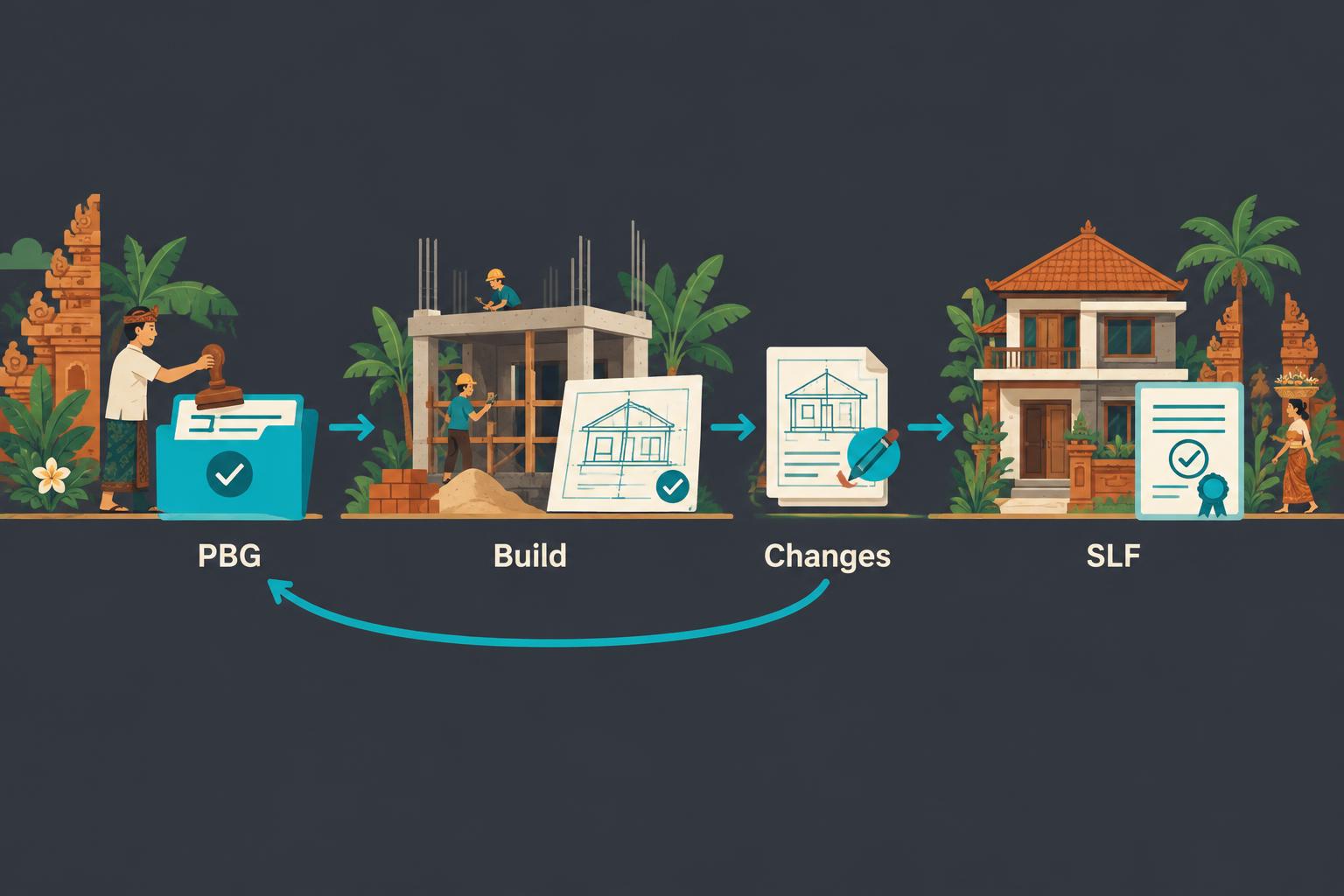
SLF, or Sertifikat Laik Fungsi, is the certificate of fitness for use. The essential sequence is different for each document: obtain PBG before construction begins and SLF before the building is used. An approval to build is not itself confirmation that the completed building is fit for use.
Write a renovation brief that reveals permit triggers
Describe proposed changes explicitly rather than calling everything a refurbishment. Article 262(2) of PP No. 16/2021 identifies the following as grounds for a PBG amendment:
- Changes to building function.
- Changes to floor levels or floor area.
- Changes to building appearance.
- Changes to component specifications relevant to safety or health.
- Structural strengthening of a building with moderate or severe damage, and specified heritage-building work.
Adding a floor, extending enclosed space, changing the facade or strengthening a damaged structure should therefore trigger a permit discussion before contractors start. Do not assume an old approval covers a substantially different proposal.
Confirm whether cosmetic work needs an application
Government guidance expressly excludes maintenance and repair work from the PBG-amendment requirement. Routine repainting or repairs should not automatically be treated as requiring a new approval; obtain a local classification where the scope goes beyond maintenance or changes appearance, structure, function or safety-related components.
Send the local technical office a clear work description and photographs. Ask whether the project needs a new approval, an amendment or no PBG application, and retain the response. A contractor's verbal assurance is not a substitute for local classification.
Check Bali land rights, zoning and existing permits before committing
- Identify the regency or city responsible for the property.
- Check land control and permission to carry out the proposed work.
- Compare existing permits with the building on site.
- Resolve planning restrictions before paying for detailed design.
Establish who controls the land and building
If you are renovating on leased land, collect the documents showing your right to use it and clarify the proposed works with the landowner. Denpasar's residential PBG checklist specifically requires evidence of land control when the landowner and building owner are different people.
Do not treat possession of a lease, keys or a sales brochure as proof that the building has the necessary approvals. Land rights and building permissions answer different questions. The separate guide to checking Bali electronic land certificates covers the land-document side of that review.
If you are comparing renovation candidates through Livuma's Bali properties for sale, request the existing permit file before treating a property as suitable for redevelopment. Marketplace browsing does not replace title, zoning or building-permission checks.
Check height, development intensity and proposed use
Bali's official tourism-area zoning guidance under Perda No. 2/2023 specifies a maximum building height of 15 metres above ground in tourism areas. Development intensity is also governed by the applicable regency or city RTRW and RDTR planning rules. Badung's current 2025–2045 RTRW is Perda No. 4/2025, promulgated 21 April 2025.
That height figure is not blanket permission to build to that height on every Bali plot. Ask the local office what the parcel permits, including the proposed building function and applicable development limits, before finalising the design.
Productive farmland needs particular caution. Bali's official 2026 register now lists Perda No. 4/2026 on controlling productive-land conversion and prohibiting nominee land ownership. Its operative text, commencement date, exceptions and transitional treatment were not retrievable in this review. Obtain a site-specific answer rather than assuming either universal prohibition or automatic exemption.
Reconcile the existing approval with the actual building
Ask for the IMB or PBG, approved drawings and any SLF documentation. Compare the address, function, floor area, levels and layout with what exists. The national SIMBG FAQ says an IMB issued before PP No. 16/2021 remains valid where the building has already been constructed and has not changed.
Permission problems are not merely administrative inconveniences. On 21 July 2025, authorities began demolishing 48 unauthorized buildings at Bingin Beach after an order dated 15 July 2025, with the provincial government identifying occupation of Badung government land, green-zone/spatial-planning violations and absent permissions—not merely a missing renovation approval. The related Badung illegal-structures clearance report provides further context for treating site compliance as an early check.

Assemble Bali PBG documents and technical drawings before submission
- Obtain the checklist for the property's jurisdiction and building function.
- Gather identity, land, planning and tax documents.
- Prepare architectural, structural, mechanical/electrical/plumbing and any required pool drawings.
- Confirm whether soil investigation is necessary.
Use Denpasar's checklist as a starting point, not a Bali-wide template
The Denpasar residential PBG checklist gives a concrete example of what to prepare. Another regency, city or building function may require a different submission. Confirm the current local checklist before commissioning the final package. Badung's BASIC portal lists land certificates, spatial-planning information—ITR/KRK/KKPR—environmental documentation, architectural plans, structural calculations/drawings and mechanical/electrical/plumbing documentation among its PBG submission requirements.
| Document or drawing | Preparation task | Scope of the evidence |
|---|---|---|
| Identification | Collect the applicant's identity documents. | Included in Denpasar's residential checklist. |
| Land-right evidence | Obtain documents identifying the land and rights held. | Included in Denpasar's checklist. |
| Land-control evidence | Document control where landowner and building owner differ. | Specifically identified by Denpasar. |
| Paid property-tax evidence | Collect the payment evidence requested locally. | Included in Denpasar's checklist. |
| SKRK planning statement | Confirm the city planning statement needed for the site. | Included in Denpasar's checklist. |
| Site photographs with coordinates | Prepare photographs that identify the actual site. | Included in Denpasar's checklist. |
| Architectural and structural drawings | Prepare coordinated plans reflecting the proposed work. | Included in Denpasar's checklist; Badung also lists structural calculations and mechanical/electrical/plumbing documentation. |
| Pool plans and sections | Include the swimming pool in the drawing package. | Required by Denpasar where a pool forms part of the proposed site development. |
| Soil investigation or sondir | Check whether the proposed building or ground conditions trigger it. | National SIMBG guidance requires it above two storeys or on less-stable ground; Badung's checklist also lists soil-test results. |
Coordinate the drawings before uploading them
Ask the design team to show the existing condition and proposed work clearly. Check that the site plan, architectural drawings, structural calculations/drawings and mechanical/electrical/plumbing documentation describe the same project. A pool should not appear only in a landscaping sketch when the required submission includes pool plans and sections.
For buildings exceeding two storeys, or buildings on less-stable ground, the national SIMBG FAQ requires soil investigation, commonly called sondir. Badung's local checklist also lists soil-test results, so confirm project-specific requirements. Establish this early so the structural design is not prepared around an unresolved ground assumption.
Keep one controlled document set
Use consistent property details across the application and supporting documents. Keep copies of what was submitted, revised and eventually approved. Ask whoever prepares the application to explain missing items in writing rather than describing the file as simply ready to go.
Submit renovation and building permits in Bali through SIMBG or OSS as applicable
- Select the application route appropriate to the building's status.
- Use OSS for business applicants' PBG registration, or SIMBG as applicable, for processing by the relevant local government.
- Track requests for missing information or technical revisions.
- Confirm the official levy before making payment.
Choose the correct route for new, IMB-era or unpermitted buildings
The Ministry of Public Works' SIMBG system handles PBG and SLF applications, while the relevant regency or city technical and licensing offices where the property is located process them. Article 110 of PP No. 28/2025 specifies submission of business applicants' PBG registration through OSS. There is no single Bali-wide permit office that approves every project.
- New construction: obtain PBG before starting construction.
- Changed existing building: confirm the relevant PBG amendment route for the proposed changes.
- Already-built property with an IMB: the national FAQ says an existing IMB can support an SLF-renewal application without obtaining a replacement PBG; proposed changes still need separate assessment.
- Already-built property without IMB or PBG: confirm the applicable existing-building and SLF route with the local technical and licensing offices, including any business-specific requirements. Do not assume one route applies universally.
PP No. 28/2025 took effect on 5 June 2025, replacing PP No. 5/2021 as the risk-based business-licensing framework. Commercial villa projects should not rely exclusively on pre-2025 licensing descriptions. Confirm which route applies locally; an existing-building application is not automatic approval or permission to ignore land-use problems. An existing unpermitted building should be assessed before you commit to renovating it.
Budget official charges separately from professional services
There is no verified Bali-wide renovation price per square metre or standard all-inclusive permit-agent fee in the reviewed official sources. Obtain a project-specific budget rather than relying on a single advertised package.
SIMBG's PBG levy calculator uses location, building function, floor area, storeys and basement information. Its estimate excludes infrastructure levies. Keep these cost headings separate:
- Official PBG levy and any separately applicable infrastructure levy.
- Design and technical-document preparation.
- Soil investigation where required.
- Application assistance, if commissioned.
- Construction and changes to the original scope.
- Any applicable construction-tax obligation.
Badung has an official PBG levy-information service where applicants can check an assessment using a registration code. Request the assessment and payment record rather than accepting an unexplained cash demand.
Badung reported free PBG services for qualifying low-income households, or MBR, on 22 January 2025. That targeted housing measure is not a general exemption for investment villas.
Ministry guidance says SLF applications attract no government levy where IMB/PBG already exists. This does not mean privately commissioned technical work is free.
Check the construction-tax question without guessing a rate
PMK No. 81/2024 covers qualifying self-building work involving new construction or extensions of existing buildings with an area of at least 200 m². The measure concerns building area, not plot area, and is not a tax on every cosmetic renovation. Under PMK No. 53/2025, effective 1 August 2025, self-building VAT is calculated as 20% × 11/12 × the VAT rate × construction expenditure excluding land—equivalent to 2.2% at the 12% statutory VAT rate, not 2.4%. Ask a qualified tax professional whether your project falls within the relevant rules; the threshold alone does not establish the tax treatment of every renovation.
Plan around revisions, not just the advertised service time
For business applications, Article 113 of PP No. 28/2025 allows up to five technical-compliance examinations within 26 working days after documents are declared correct. This is one processing stage, not a Bali-wide end-to-end timeline. Ask the relevant local office what its current processing period covers and what information remains outstanding. Do not make the contractor's start date depend solely on that figure.
Begin approved construction and keep Bali renovation changes on record
- Confirm that the required PBG has been obtained before construction begins.
- Give the contractor the approved drawings and scope.
- Check proposed changes against the approval before carrying them out.
- Keep a completion file for the SLF stage.
Make the approval a construction start gate
Do not confuse a submission receipt, an agent's progress update or a levy estimate with an issued approval. Before work begins, identify the document authorising the proposed construction and check that it covers the intended project.
Article 263 of PP No. 16/2021 also requires the construction schedule and start date before work starts. Failure to respond to the prescribed clarification process within six months after PBG issuance can result in revocation.
In your construction arrangements, specify who keeps the approval file, who communicates with the technical office and how design changes will be handled. These are practical project controls, not substitutes for government approval.
Review variations before they become physical changes
A larger room, an extra level, a revised facade or a different building use can change the permit position. Ask the design team and local technical office whether a proposed variation requires an amendment before instructing the contractor to execute it.
For structural reinforcement, document the damaged condition and proposed solution. Strengthening buildings with moderate or severe damage is specifically included among the PBG-amendment triggers; it should not be treated as ordinary repainting or maintenance.
Keep evidence for the completed-building review
Retain approved drawings, subsequent approved revisions and records explaining what was actually built. Ask the technical office what completion evidence the SLF application will require for your building. Badung's existing-building SLF checklist includes a fitness-for-use report, as-built architectural/structural/mechanical/electrical/plumbing drawings and technical assessor details. Resolve differences between the approved design and completed works rather than leaving them for a future buyer or occupant to discover.
Obtain SLF and complete the building's handover before use
- Follow the applicable SLF application route through SIMBG and any required OSS business-licensing steps.
- Resolve outstanding technical or document requirements.
- Obtain SLF before the building is used.
- Hand over the permit and completion file with the property.
Separate construction completion from permission to use
A contractor saying the renovation is finished does not replace the SLF requirement. PBG addresses the building approval stage; SLF addresses fitness for use. Article 122 of PP No. 28/2025 expressly requires business operators to obtain SLF before using the building. Keep both documents, and the drawings supporting them, in the property's permanent file.
For an IMB-era building, the national SIMBG FAQ says an existing IMB can support an SLF-renewal application without a replacement PBG. For a building that previously lacked IMB or PBG, confirm the applicable existing-building and business-licensing route locally rather than assuming completion of the renovation regularises it.
Article 297 of PP No. 16/2021 specifies SLF renewal periods of 20 years for single and row houses and five years for other buildings. Renewal requires a fitness examination; confirm the building's classification rather than assuming every villa has the same renewal period.
Keep building documents separate from rental-platform records
If the completed property will be rented out, explain its actual condition and facilities accurately and keep building approvals available for due diligence. An SLF is a building fitness-for-use document; do not treat it as proof of every permission relevant to your intended activity.
Livuma's hosting guide explains the separate rental onboarding process: hosts provide identity verification, legal details and an Indonesian bank account before taking paid bookings. That account verification is not an inspection or certification of the property's permits.
Questions to resolve before closing a Bali building-permit file
Do I need a building permit to renovate a villa in Bali?
It depends on the proposed work. Government guidance identifies changes to function, floor levels, floor area, appearance and safety- or health-relevant components as PBG-amendment triggers. Structural reinforcement of moderately or severely damaged buildings is also included. Minor cosmetic work may be treated differently, so obtain a classification from the property's regency or city technical office before starting.
Does repainting or replacing tiles require PBG in Bali?
Government guidance expressly excludes maintenance and repair work from the PBG-amendment requirement, so routine repainting or tile repairs do not automatically require a new approval. Provide the local technical office with photographs and a written scope if the work goes beyond maintenance, especially if it also changes appearance, structure or safety-related components, and retain its response.
How long does a PBG application take in Bali?
There is no verified Bali-wide turnaround covering land checks, design, document collection, revisions and construction. For business applications, PP No. 28/2025 allows up to five technical-compliance examinations within 26 working days after documents are declared correct; this is only one processing stage. Ask the relevant local office what its current processing period covers, and avoid promising a construction start date until the necessary approval has actually been obtained.
How much do building permits cost in Bali?
The official PBG levy is project-specific. SIMBG's calculator uses location, building function, floor area, storeys and basement information, and its estimate excludes infrastructure levies. There is no verified Bali-wide all-inclusive permit-agent fee in the reviewed sources. Request an itemised budget separating official charges, design, technical investigations, application assistance and any applicable tax obligations.
Does an old IMB need to be replaced with PBG?
Not automatically. The national SIMBG FAQ says an IMB issued before PP No. 16/2021 remains valid where the building has already been constructed and has not changed. It also says an existing IMB can support an SLF-renewal application without a replacement PBG. Proposed changes still need separate assessment. Compare the existing approval with the building and planned work, then ask the relevant technical office which application or amendment route applies.