

Your real decision when renting a house in Bali as a family is not simply villa versus house. It is whether a specific home can support your children’s daily routine, your work pattern, transport needs and immigration paperwork without creating expensive surprises after you move in.
A family lease deserves a slower process than a holiday booking. Use this reference to turn a promising listing into a practical home decision: test the route, inspect the house as a household, document every term and keep the address records you may need later.
Renting a house in Bali as a family starts with a weekly routine
Map the journeys each person must make
Before comparing bedrooms or pools, write down the repeated trips your household will make: school or childcare, groceries, medical appointments, work, activities and visits with friends. Test each route from the exact lane, at the times you expect to use it. A home that feels quiet during a midday viewing can work very differently when everyone is leaving at once.
Ask practical questions that listing photos cannot answer: where will a driver or car wait, can a stroller be carried safely from parking to the door, and is the final access road comfortable in wet weather? For a family that will not use scooters daily, read the guide to living in Bali without a scooter alongside your location shortlist.
Decide what cannot be compromised
Separate genuine non-negotiables from nice-to-haves. A family’s essentials commonly include enough enclosed sleeping space, a kitchen that can handle daily cooking, secure access, reliable water arrangements, room for storage and an address that works for the administration you need to complete.
- How many people will sleep in the property every week?
- Do children need separate bedrooms now, or within the lease term?
- Will relatives, a helper or a caregiver need regular access?
- Do you need desk space away from shared family areas?
- What must be reachable without a long daily journey?
Choose a Bali family rental area by the life outside the gate
Compare daily convenience, not area reputation
Neighbourhood labels are broad. A house in the same named area may be close to everyday services or down a lane that adds substantial time to every errand. Visit the immediate surroundings on foot and by the transport you will actually use. Look for road conditions, drainage, street lighting, nearby construction and the practical distance between the front door and your normal destinations.
Sanur may suit households prioritising a different pace and local errands, while Canggu, Ubud, Uluwatu and Seminyak each require an address-level assessment. Do not select an area only because another family liked it; their school, working hours and transport arrangement may be entirely different.
Use live listings to build a realistic shortlist
Search tools are useful when they let you compare the details that affect family living: stay length, bedrooms, amenities, house rules and availability. On Livuma, you can search live Bali rental homes by area, price, rental type and other practical filters, then retain a short list for viewings rather than relying on screenshots passed between contacts.
For a location-specific starting point, browse long-term rentals in Uluwatu or long-term rentals in Sanur, but treat each listing’s precise access and conditions as the deciding evidence.
Family-house rental costs: use area evidence without inventing a Bali average
What the August 2026 listing data shows
There is no official Bali-wide dataset for current family-house rents by neighbourhood, so a single “average Bali family rent” would be misleading. The most useful available comparison here is Livuma listing data for long-term rentals, recorded in August 2026:
| Area | Live long-term rentals | Median monthly rent | Most listings fall between |
|---|---|---|---|
| Canggu | 254 | IDR 44,470,000 | IDR 20,000,000–75,420,000 |
| Ubud | 36 | IDR 42,930,000 | IDR 16,600,000–91,800,000 |
| Uluwatu | 49 | IDR 38,000,000 | IDR 12,000,000–73,752,000 |
| Sanur | 47 | IDR 29,000,000 | IDR 15,300,000–65,000,000 |
| Seminyak | 256 | IDR 43,100,000 | IDR 20,000,000–75,300,000 |
These figures describe live long-term listings, not completed transactions, and they are not limited to family houses. They are best used to set a search range and identify the questions a lower- or higher-priced home should answer. They remain an August snapshot, not verified November rental figures.
Budget for the lease, not rent alone
Ask for a written breakdown of rent, deposit, payment dates, power, water, internet, pool or garden care, security, waste collection and any service charges. Do not assume that a furnished house includes every item your household will use. Bali’s official CPI inflation was 3.79% year-on-year in September 2026; that is general consumer inflation, not a rent index, but it is a sensible reason to make recurring charges explicit rather than leaving them informal.
Rental income from ordinary land and building leases is subject to 10% final income tax on gross rent, including separately charged maintenance, security, services and facilities. Where the tenant is an ordinary individual who is not a designated withholding agent, the owner generally self-remits it; it is not automatically a separate 10% tax payable by the renting family. Your lease should therefore say whether rent is tax-inclusive and how separately billed charges are treated. See the Directorate General of Taxes explanation of rental-income tax. Lodging-service income, including qualifying kost accommodation, is excluded from this ordinary rental-income tax, but is not tax-free. The actual service and transaction arrangement determine classification, not the property’s name, payment schedule or furnished status alone, as explained in the official kost and kontrakan tax clarification.
Inspect a Bali family home for ordinary days, not viewing-day charm
Walk the home in the order your family uses it
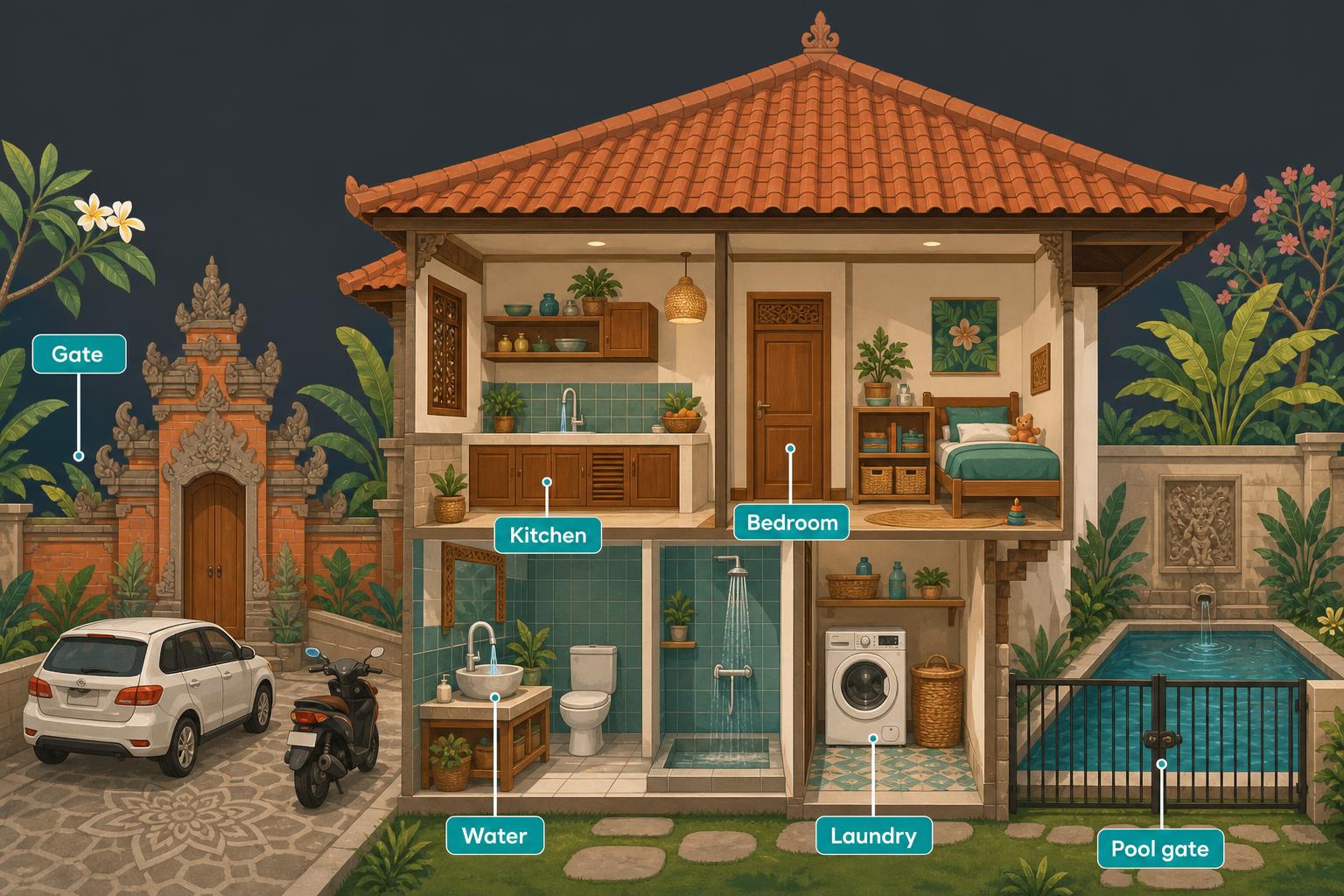
Start at arrival: gate, parking, path, entrance and the place where wet shoes, bags and helmets will collect. Continue through bedrooms, bathrooms, kitchen, living area, laundry, outdoor space and staff or storage areas. Open cupboards, run taps, flush toilets, inspect locks and note where children could reach a pool, road, steep edge or unsecured stair.
Ask what is included and capture it in an inventory. “Furnished” is not a useful standard unless both sides record the actual beds, appliances, cooking equipment, furniture, keys, remotes and outdoor equipment provided.
Check water, drainage, heat and maintenance access
Ask the owner or authorised lessor how water is supplied, who contacts the relevant provider if it fails, and where tanks or pumps are located. Look for signs of past water entry, blocked drains, damp, loose paving and roof issues. Ask whether a garden, pool or other feature needs scheduled service, who arranges it and who pays.
Also establish who may enter the property for maintenance, how notice is given and whether a family member needs to be present. These are day-to-day boundaries, not minor details.
Bedrooms, kitchen and outdoor space must match family use
Measure usable rooms rather than counting rooms
A room called a bedroom may be small, open to another space, difficult to cool or unsuitable for a child’s sleep routine. Check window coverings, ventilation, power points, storage, bathroom access and whether doors close securely. Consider where cots, school bags, laundry and everyday toys will actually go.
If adults work from home, test whether calls can happen without taking over the dining table. A larger communal space can be valuable, but only if it does not replace the private sleeping and work zones your household needs.
Make pool and garden decisions deliberately
A pool, garden or open terrace can be a major benefit, but it creates supervision and maintenance questions. At the viewing, identify every route from the house to water, the condition of gates and fencing, slippery surfaces, external lighting and whether the pool service arrangement is written down.
Do not accept an assurance that something will be repaired later without a dated written record. For items essential to safe family use, agree the action and timing before payment.
Whole-house leases and kost rooms serve different family needs
Why a kost is not automatically a family rental
A kost is room-based accommodation and can have shared facilities and house rules. It may work for an individual, a short bridge stay or a very specific household arrangement, but it should not be represented as a substitute for a whole-house lease without checking the actual written rights.
Do not assume a kost includes a private kitchen, visitor access, parking, family-sized space or an address usable for every administrative purpose. Confirm occupancy, shared spaces, curfews or visitor rules, utilities and notice requirements in writing.
Use a temporary stay to make a better long lease
A short initial arrangement can give your family time to learn the routes and inspect houses without rushing into a lengthy upfront commitment. If you do choose a room-based option while searching, compare the house rules carefully; budget accommodation is not automatically flexible accommodation.
The key is to treat the temporary home and the long-term home as separate decisions. The first solves arrival. The second must support your full routine.
Get the landlord’s authority and the exact address before paying
Confirm who is entitled to grant the lease
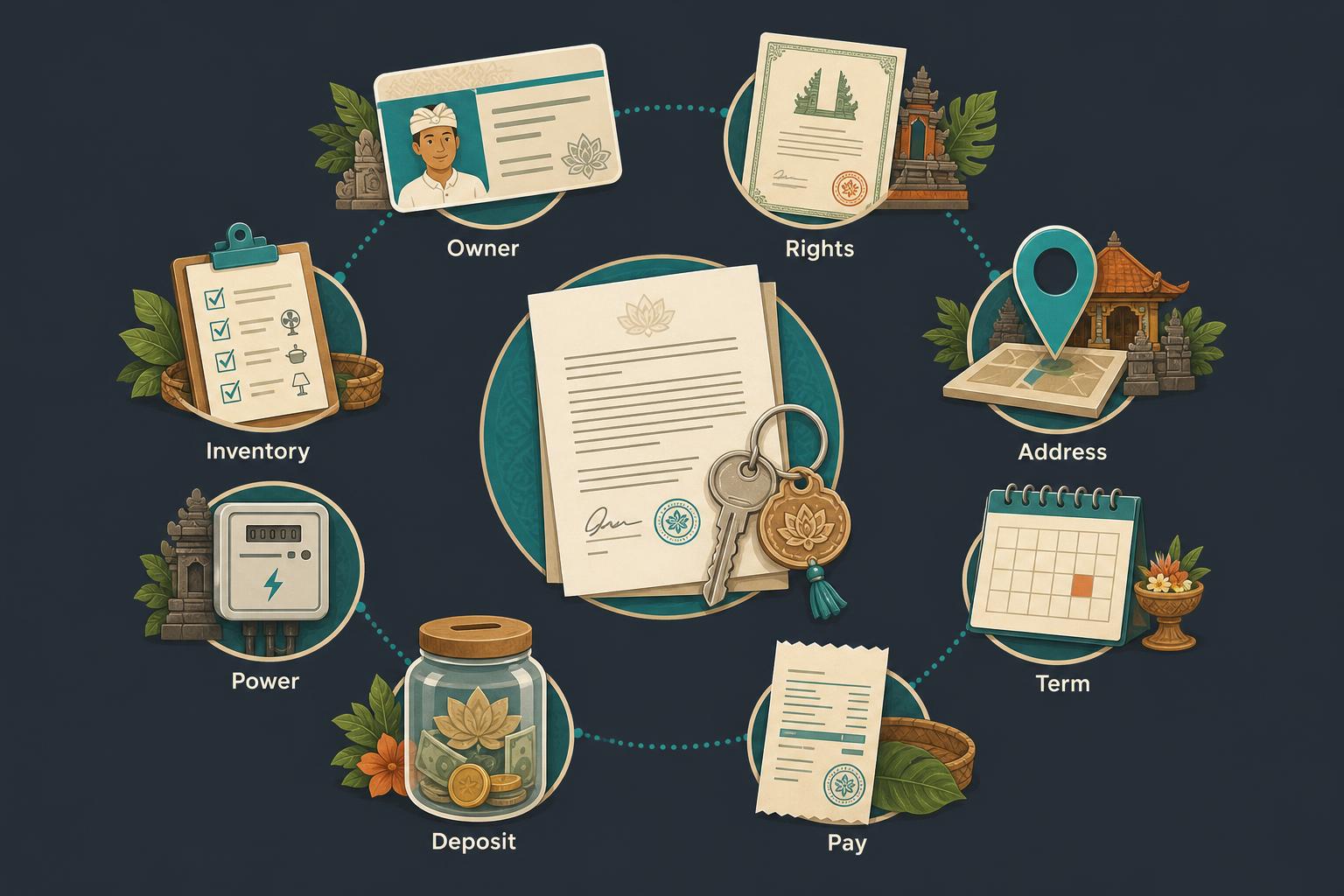
Obtain and retain the identity of the owner or authorised lessor, plus evidence of the land or building rights and the authority to lease. If you deal with a representative, ask for clear evidence that the representative can sign and receive payments for this property. Match the name on the agreement to the evidence you have been given.
This is especially important for a family moving from abroad: the property is where you will live, but a rental lease does not give you ownership rights. Indonesian freehold title, Hak Milik, is reserved for Indonesian citizens under Article 21 of the Basic Agrarian Law. Article 52 of Law 1/2011 expressly allows foreigners to occupy homes through rental rights (hak sewa) or use rights (hak pakai); renting is legally distinct from buying land.
Record an address that can be used consistently
Every foreign national must report a change in address, civil status, nationality, work or sponsor to the local Immigration Office. Ensure your signed lease states the complete address and landlord or host contact details, not merely an informal area name. Read the relevant immigration reporting rule in Indonesia’s Immigration Law.
Make the family rental agreement specific enough to use
Terms that should appear in a family-house lease
A workable agreement identifies the parties and property, then makes the practical arrangement testable. Obtain a signed copy and retain the supporting records. Article 31 of Law 24/2009 requires Indonesian in agreements involving Indonesian citizens or private institutions; agreements involving foreign parties must also use the foreign party’s national language and/or English. At minimum, include:
- Complete property address and lease start and end dates
- Rent amount, currency, payment schedule and payment recipient
- Deposit amount, permitted deductions and refund timing
- Utility, internet, service-charge and maintenance responsibility
- Inventory, condition record, keys and meter readings
- Repair reporting process and responsibility for different repairs
- Occupancy rules, pets, visitors and subletting terms where relevant
- Early termination, extension and handover arrangements
Do not let a deposit remain an undefined promise
The agreement should explain what the deposit covers, how condition is assessed at departure, what evidence supports deductions and when any balance is returned. Take dated photos and video at move-in, including existing damage, meter readings, appliances and outdoor areas. Share the record promptly so disagreements are not postponed until move-out.
On supported Livuma rental bookings, the payment schedule, deposit or balance rules, deadlines, cancellation rules and refund logic are shown before you commit, and digital agreement details and receipts are generated from the listing, booking terms and verified guest details. Payout to the host is not released until successful check-in under the booking terms; keep the digital agreement details and receipt with your own move-in record.
Visa, address and tax questions belong in the housing timetable
Do not assume one parent’s status covers the whole household
Indonesia’s official visa list includes E31B for a spouse of an ITAS/ITAP holder and E31E for an unmarried biological child under 18 joining a parent holding ITAS/ITAP. A relocating family should verify each person’s appropriate status rather than assuming one parent’s permit automatically covers everyone.
For E31B, verify the current stay duration, government fee, sponsor and document requirements, and entry deadline against the live application category and government invoice before planning travel or signing a lease around a visa date. Previously quoted fees of Rp6,000,000 or Rp8,500,000 have not been independently reverified. The official immigration service guidance identifies E31B for spouses of ITAS/ITAP holders. Immigration’s Global Citizen of Indonesia programme, launched on 26 January 2026, offers indefinite permanent residence to eligible diaspora, mixed-nationality families and qualifying family members—not all relocating foreign families. Its announcement also lists E31B, so the code alone does not establish eligibility for indefinite residence.
A lease longer than 183 days can have tax significance
A foreign national may be an Indonesian domestic tax subject by residing in Indonesia, spending more than 183 days in any 12-month period, or arriving in a tax year with intent to reside. A VITAS/ITAS valid for more than 183 days or a lease longer than 183 days can evidence that intent. PER-23/PJ/2025, dated 9 December 2025, also identifies documents showing relocation of family members as evidence of intent to reside. Review the Directorate General of Taxes guidance on determining domestic tax subject status with an appropriately qualified adviser for your circumstances.
This does not mean every long lease produces the same outcome. It means housing, immigration and tax planning should not be treated as unrelated tasks.
Check zoning if your family home will also support work
Separate home living from a home-business assumption
Remote work, client visits, staff, classes, retail activity or frequent deliveries can change the practical and regulatory suitability of a house. Before paying a long upfront lease, explain the intended use to the lessor and check whether it is permitted under the agreement. Do not assume a residential-looking home has approval for every commercial activity.
Bali’s spatial-planning framework uses district/city spatial plans and detailed spatial plans, known as RTRW and RDTR. The provincial Bali spatial-planning system is a starting point for checking whether the property’s use aligns with zoning.
Keep work permission separate from housing permission
A family visa should not be described as blanket work authorisation. The published E31B conditions prohibit work that does not match the stay permit and prohibit selling goods or services except where required for the holder’s work. Confirm immigration and work-status questions through official channels before making a business commitment based on a home address.
For families working remotely, Immigration’s visa classification includes E33G, a one-year, multiple-entry limited-stay route permitting work duties for an overseas company. Official guidance requires an employment agreement with a company established outside Indonesia, a minimum annual salary of US$60,000 and the preceding three months’ bank statements showing a minimum balance of US$2,000. It prohibits working for, or receiving payment from, individuals or legal entities in Indonesia. The published Rp7,000,000 one-year fee is attributed to a 2024-edition guide; the current payable fee has not been independently verified. Check the official E33G guidance and live application invoice rather than relying on old fee summaries.
Use a staged process from shortlist to successful check-in
Follow a family rental decision sequence
- Define the household routine, non-negotiables and lease horizon.
- Shortlist areas by the actual journeys your family will make.
- Compare live listings and request full payment and inclusion details.
- View the exact property, access road and surroundings.
- Verify lessor authority, address, condition and intended use.
- Agree the written lease, inventory, deposit and repair process.
- Pay only through the documented method stated in the agreement.
- Complete a recorded handover with keys, photos and meter readings.
Keep your evidence in one household file
Store the signed agreement, identity and authority records supplied by the lessor, payment receipts, inventory, handover photos, utility information and all repair messages together. This makes a difference if you need to report an address, query a bill or resolve a move-out deduction months later.
A good family rental is not the home with the most impressive first viewing. It is the one whose location, layout, terms and records still make sense after the first ordinary week of school runs, work calls, groceries and rainy-day logistics.
Renting a family house in Bali through Livuma
- Search live rental homes by area, stay length, bedrooms and amenities, including long-term rentals in Canggu. Compare availability, minimum stay and house rules against your household routine.
- Review the booking-specific payment schedule, deposit or balance rules, deadlines, cancellation rules and refund logic before committing, so your family budget rests on written terms.
- Pick dates and secure the request with a card reservation or held Indonesian bank-transfer prepayment before the host sees it. A decline, withdrawal or expiry triggers an automatic full release or refund.
- The host answers within a limited window; approval charges a card reservation and confirms a standard booking. For eligible monthly or yearly rentals, “view property first” secures only a small deposit: after an in-person or virtual viewing, pay the rest in the app to confirm, with no deadline or automatic confirmation, or cancel for free for a full deposit release or refund. Use in-app chat to record arrangements.
- Complete guest identity verification before the rental agreement is issued. Retain the generated digital agreement details and receipts with your inventory.
- Confirm arrival in the app or report a problem, which holds the host’s payout while it is resolved. Payout follows successful check-in under the booking terms; later rent follows the displayed schedule.