

This is for people planning a monthly or longer move who want the privacy and convenience of an apartment rather than a villa or a room. Renting an apartment in Bali works best when you treat the search as a housing decision—not simply an extension of a holiday stay.
Is renting an apartment in Bali better than renting a villa or kost?
Renting an apartment in Bali can be the better choice if you want a self-contained home with less outdoor space and fewer compound systems to manage than a villa. An apartment may suit one person, a couple, or a remote worker who values a practical layout, building access, and a simpler move-in over a private pool, garden, or multiple bedrooms.
A villa can provide more space and privacy, but it can also mean more systems to understand: water storage, pool care, garden maintenance, staff arrangements, parking, and separate utility accounts. A kost is usually the more room-focused option, often with a shared or limited-service setup. The right comparison is not “apartment versus Bali lifestyle”; it is the amount of space, independence, maintenance, and commitment your routine actually needs.
Ask each host or manager to identify the unit clearly: its floor, access route, parking arrangement, furnishing list, and the areas that are private versus shared. “Apartment” can describe very different homes, from a serviced unit in a managed building to an independent studio above commercial space. Do not assume a reception desk, lift, gym, cleaning, security, or backup power exists unless it is specifically included in the listing and rental terms.
Where should I start renting an apartment in Bali?
Start with the routes you will repeat, then search for an apartment within a workable distance of them. A beautiful unit is a poor long-term fit if the commute to your workspace, school, beach, gym, supermarket, medical provider, or social circle becomes frustrating every day.
Rather than choosing an area solely by its reputation, make a short list of non-negotiables: quiet evenings, walkability, parking, a dedicated desk, reliable mobile signal, proximity to a particular part of Bali, or a building with controlled access. Then test the route at the times you would actually use it. A street can feel very different in the morning, after rain, or when nearby businesses are active.
Use live inventory to establish what is genuinely available for your dates and stay length. On Livuma’s rental search, you can filter homes by area, rental type, price, stay length, bedrooms, and amenities, then review each listing’s photos, availability, minimum stay, house rules, and booking conditions. Keep a comparison note for every serious option rather than relying on saved photos alone; it makes differences in access, furnishings, and terms much easier to spot.
What does renting an apartment in Bali cost each month?
There is no reliable published Bali-wide series for long-term apartment or kost asking rents, so there is no defensible single “average apartment rent” for the island. Portal listings can help you compare individual homes, but they should not be presented as a market-wide rent index. Compare like with like: apartment against apartment, similar stay length, comparable furnishing, and similar inclusions.
The table below is historical area context, not an apartment-only price guide. It shows a September 2026 snapshot of long-term rental inventory across multiple property types, not current November availability or independently verified Bali-wide averages. Use it to frame a search rather than to value a particular unit.
| Area | Long-term rentals in September 2026 snapshot | Median monthly rent | Most listings fall between |
|---|---|---|---|
| Canggu | 196 | Rp42,800,000 | Rp21,300,000–Rp69,714,000 |
| Ubud | 43 | Rp35,640,000 | Rp14,040,000–Rp88,884,000 |
| Uluwatu | 62 | Rp36,990,000 | Rp12,744,000–Rp74,520,000 |
| Sanur | 6 | Rp22,500,000 | Not available |
| Seminyak | 36 | Rp35,000,000 | Rp21,800,000–Rp57,200,000 |
For broader context only, Bank Indonesia’s primary residential-property price index is a new-home price indicator, not an apartment-rent index, so it should not be used to predict your rent. Its Q3 2026 residential-property report, released November 6, recorded nationwide primary residential-property price growth of 0.58% year-on-year—not Bali apartment-rent growth.
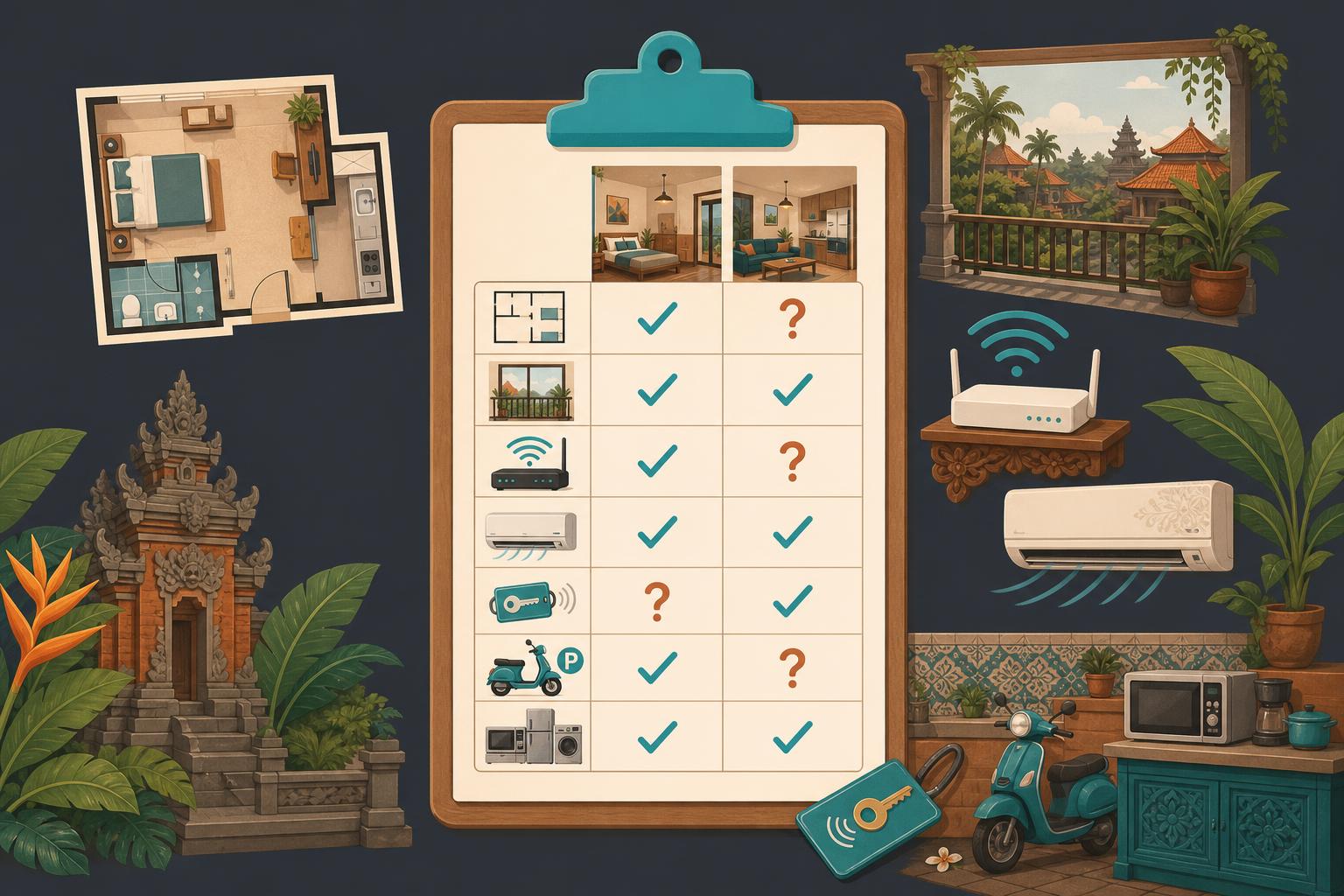
How do I compare apartment listings without being misled by the photos?
Compare apartment listings by the usable home and the written conditions, not by the strongest image in the gallery. First establish the exact unit: ask whether the photos depict the apartment being offered, whether the furnishings shown remain, and whether the quoted price applies to your intended dates and rental length.
Build a simple comparison sheet with the same fields for every option:
- private rooms, bathrooms, balcony, and work area;
- internet arrangement and where the router sits;
- air-conditioning in each room, kitchen equipment, storage, and laundry access;
- floor level, stairs or lift, parking, building entry, and delivery access;
- rent inclusions, separate charges, deposit, and payment dates;
- noise sources, construction nearby, and house or building rules.
Request a current walkthrough if you cannot attend in person. It should show the view from windows, bathroom water flow, appliances operating, entrance, corridors, and the immediate street—not only staged interiors. Keep the listing description, chat messages, and proposed terms together. A later disagreement is much easier to resolve when the promised unit, facilities, and dates were recorded before payment.
What should I inspect when viewing an apartment in Bali?
Inspect an apartment as a functioning place to live, especially the water, power, internet, ventilation, and access you will depend on daily. Arrive with your phone charged and test practical details rather than making a decision from appearance alone.
Open taps in the kitchen and bathroom, flush toilets, look below sinks, and ask where the water supply and any storage are located. Turn on each air-conditioner long enough to notice unusual noise or weak cooling. Check windows, curtains, locks, drainage around balconies, and signs of damp in wardrobes or behind furniture. In the kitchen, confirm which appliances remain and whether there is adequate food storage and preparation space for your routine.
Then leave the unit briefly. Walk from the entrance to the parking or pickup point, assess lighting in shared corridors, and listen for traffic, venues, pets, machinery, or construction. If you work online, test mobile signal and ask how internet service is supplied and who handles faults. For electricity, confirm the meter arrangement and responsibility for top-ups or bills; our guide to PLN tokens and rental electricity checks explains why this matters before move-in.
Should I choose a monthly or yearly apartment rental in Bali?
Choose a monthly rental when you are still learning the area or need the option to change homes; consider a longer commitment only after the apartment, commute, and terms have been tested. A longer agreement is not automatically better value or better protection simply because it lasts longer.
Monthly arrangements can be useful for a first arrival because they let you learn how the building works, whether the unit is comfortable in daily use, and whether the location supports your routine. The trade-off is that renewal, notice, payment timing, and any price change need to be understood before you rely on the home for an extended stay.
A yearly arrangement makes more sense when you are confident about the unit and can meet the financial commitment without assuming you can easily exit early. Read the end-date, renewal process, early departure position, and any process for the owner to enter the unit. Do not assume an informal promise made during a viewing will override the written agreement. For a focused comparison of commitment and flexibility, read monthly versus yearly rental contracts in Bali.
Can foreigners rent an apartment in Bali?
Foreigners can rent apartments in Bali, but a rental agreement is not an immigration permission and does not give the renter ownership of the apartment or underlying land. Keep the housing decision, visa position, and any future purchase decision separate.
This distinction matters because Indonesian rules on foreign ownership concern qualifying residences and specified land-right categories; they are not a shortcut created by signing a lease. If you are considering a purchase rather than a rental, seek qualified legal advice and review the statutory restrictions carefully. A renter should describe their position accurately as a tenancy or lease, not as ownership.
Before committing, provide the host or manager with the identification they reasonably need for the booking and ask what information they require for address reporting. Keep copies of the agreement, receipts, passport details supplied, and move-in communications. Those records are helpful for day-to-day administration, even though the property itself does not determine whether your immigration status is appropriate.
Do not let a property salesperson turn a rental conversation into an ownership claim. If you later decide to explore buying, begin with a separate review of Bali properties for sale and obtain independent professional advice on the structure that may apply to you.
What visa and Bali levy rules matter before I rent an apartment?
Your intended stay and permitted activities should be settled before you commit to an apartment term, because housing does not extend a visa or authorise work. As of November 10, 2026, a Visa on Arrival costs Rp500,000, permits a 30-day stay from arrival, and can be extended once to 60 days total; eligibility depends on nationality, with United States passport holders included on the official list. Extension applicants must register and upload documents online, then attend Immigration for a photograph and interview; the process is not fully online. See the official visa information and stay-permit extension procedure.
The C1 tourism visitor visa permits an initial stay of up to 60 days and extensions up to 180 days total, costs Rp1,000,000 for the initial visa—not an all-inclusive 180-day stay—and does not generally require a sponsor. However, C1 holders may not sell goods or services or receive salary, wages, or work or business compensation from Indonesian individuals or companies. It should not be treated as a general digital-nomad visa. Check the official C1 visa information and obtain immigration advice for your individual circumstances.
Bali’s foreign-tourist levy is Rp150,000 per person, payable electronically and separate from immigration visa fees; payment is valid during the tourist’s Bali travel until departure from Indonesia. KITAS and KITAP holders are exempt without an exemption application; Golden Visa holders and holders of other qualifying non-tourism visas need an approved exemption application through Love Bali. The official Love Bali exemption guidance explains the exemption framework.
Does my apartment address need to be reported to Indonesian Immigration?
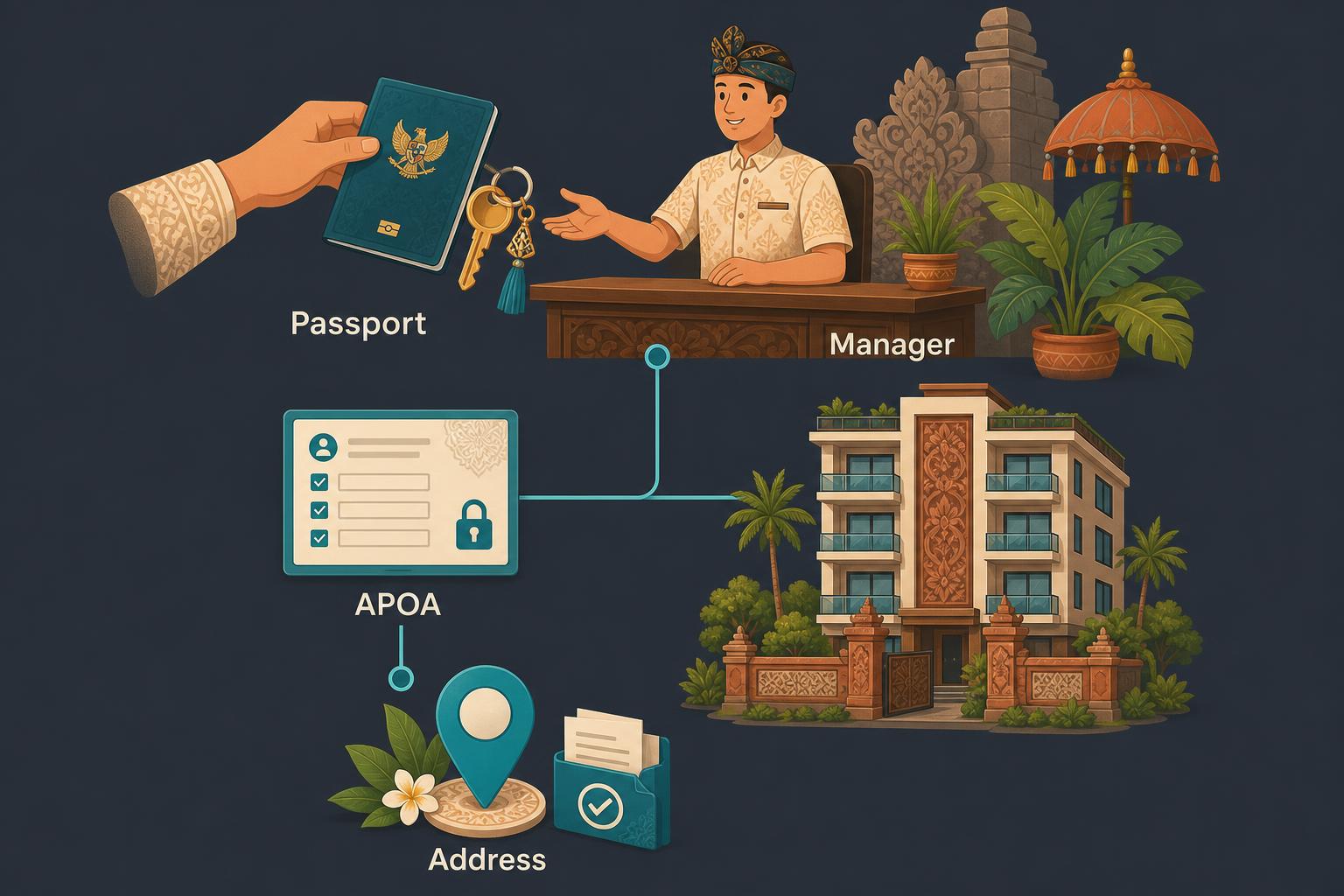
Yes, foreign guests staying in an apartment should make sure the owner or manager understands their reporting responsibility. Indonesia’s APOA system specifically lists apartments, condominiums, kost/indekost, and rental houses as accommodation types for foreign-guest information.
The owner or manager is required to provide foreign-guest information to Immigration. The official Bali Immigration notice cited through APOA states that non-compliance can potentially result in sanctions of up to three months’ detention or Rp25 million. That is a host or manager compliance obligation, but it is sensible for a renter to ask, before arrival, who will handle it and what passport and stay details they need from you.
Do not wait until there is an administrative problem to raise the subject. Send requested details through a traceable channel, keep a copy of what you supplied, and tell the manager if your move-in date changes. If you move from one apartment to another, raise the question again rather than assuming the first address remains relevant. Our separate guide to registering a Bali address through APOA, SKTT, and KITAS processes gives further context for longer-stay residents.
What must an apartment rental agreement in Bali say?
An apartment rental agreement should identify the exact unit, people involved, dates, price, payment schedule, deposit rules, inclusions, and handover condition in writing. The more specific the document, the less room there is for a later dispute about what was promised.
At a minimum, make sure it covers:
- the building name, unit or floor identification, and address;
- start and end dates, renewal process, notice, and early-exit position;
- rent amount, payment dates, deposit amount, and refund conditions;
- power, water, internet, service charges, cleaning, parking, and repairs;
- inventory, furniture condition, keys or access cards, and move-in evidence;
- house rules on guests, pets, smoking, noise, subletting, and shared facilities.
Clarity on extra charges is particularly important. Indonesia’s tax authority states that gross rental value can include maintenance, repairs, security, service charges, and facilities, even when charged under a separate agreement. That does not tell you what you must pay as a tenant; it is a reason to state plainly what rent includes and what is invoiced separately. See the tax authority’s explanation of gross rental value.
How can I pay for an apartment rental more safely?
Pay only after you know who is authorised to rent out the unit, the booking-specific terms are clear, and you have a record of the arrangement. Avoid treating a social-media message, a screenshot, or a verbal promise as a substitute for identifying the unit and setting out payment, cancellation, deposit, and handover terms.
Use a payment method that leaves a clear record, match the recipient details to the person or business named in the agreement, and retain confirmations. If someone pushes for immediate payment while resisting a viewing, current walkthrough, written terms, or proof of authority, pause rather than letting urgency decide the transaction. A full practical checklist is available in our guide to spotting Bali rental scams before you pay.
For supported rental bookings on Livuma, payment, deposit or balance rules, deadlines, cancellation rules, and refund logic are shown before you commit, and the request is secured with a card reservation or a held Indonesian bank-transfer prepayment before the host sees it. A decline, withdrawal, or expiry triggers an automatic full release or refund; host payout is not released until successful check-in under the booking terms and remains on hold while a reported problem is open.
What bills and building charges should I ask about?
Ask for every recurring and one-off charge in writing before choosing an apartment, because the advertised rent may not be the full monthly housing cost. “Included” should be defined item by item rather than accepted as a broad reassurance.
Ask who pays for electricity, water, internet, waste collection, cleaning, parking, building service charges, access-card replacement, and repair call-outs. If electricity is included, ask whether there is a stated usage limit and what happens above it. If internet is included, ask whether it is dedicated to the unit or shared, who contacts the provider, and how faults are handled. For furnished apartments, also ask what happens if an appliance fails through ordinary use.
Indonesia’s rental-income tax is a host-side issue in many ordinary building leases: income from renting land and/or buildings, including apartments and condominiums, is subject to final income tax of 10% of gross rental value. Accommodation-service income, including rumah kos, is excluded from this ordinary building-rental final-tax regime; that does not mean it is tax-free, so owners should take Indonesian tax advice rather than casually relabelling a unit. For renters, the practical lesson is simpler: demand a clear all-in quote and a written list of separate charges.
What should I record on apartment move-in day?
Record the apartment’s condition, inventory, keys, access, and meter status on move-in day before normal living makes later evidence unclear. A calm handover is the best time to resolve a missing chair, stained linen, damaged appliance, or non-working lock.
Take dated photos and short videos of every room, including walls, floors, ceilings, bathrooms, balcony, kitchen, furniture, air-conditioners, and appliances. Capture any existing defect closely and in context. Photograph meter displays where relevant, count physical keys and access cards, and note parking tags, mailbox keys, remote controls, and building rules. Send the record to the host or manager in writing and ask for acknowledgement.
Keep one folder containing the agreement, payment receipts, inventory, move-in media, chat history, maintenance reports, and move-out correspondence. This is especially important for monthly rentals that later become longer stays, when verbal arrangements can drift away from the original deal.
When should I renew, move, or leave my Bali apartment?
Start the renewal or move-out conversation well before the end date in your agreement, using the notice period actually written there rather than assumptions about local custom. Your next decision should reflect the apartment’s real performance: costs, comfort, access, maintenance response, and whether the location still serves your routine.
If you want to renew, ask for the proposed dates, rent, included services, and any changed rules in writing. If you plan to leave, arrange a handover time, clean according to the agreed standard, settle documented bills, and repeat the same photo-and-inventory process used at move-in. Return keys and access cards with a written acknowledgement wherever possible.
Do not leave the deposit conversation until after you have departed. Confirm the proposed inspection process, the account or method for any refund, and how any claimed deductions will be documented. If your home no longer fits—perhaps you need more space, quieter surroundings, or a different commute—begin a new search early enough to compare homes properly instead of accepting the first available option under pressure.
Renting an apartment in Bali through Livuma
- Compare live listings on the rental search, checking the property type, availability, minimum stay, house rules, and verified guest reviews rather than relying on photos alone.
- Read the booking-specific payment schedule, deposit or balance rules, deadlines, cancellation rules, and refund logic before committing, so the financial terms are clear.
- Pick dates and secure the request with a card reservation or held Indonesian bank-transfer prepayment before the host sees it. A decline, withdrawal, or expiry triggers an automatic full release or refund.
- The host responds within a limited window; approval normally charges the card reservation and confirms the booking. For eligible monthly or yearly rentals, “view property first” secures only a small deposit: after an in-person or virtual viewing, pay the rest in the app to confirm, with no deadline or automatic confirmation, or cancel free for a full deposit release or refund. Coordinate arrangements in the in-app chat.
- Complete identity verification before the rental agreement is issued. Supported bookings receive digital agreement details and receipts, keeping the written arrangement together.
- At arrival, confirm check-in or report a problem in the app. Payout follows successful check-in, automatically about 24 hours later, and never while a reported problem is open.
Frequently asked questions
Are apartments in Bali usually furnished?
Furnishing varies by unit. Confirm the actual inventory rather than relying on a category label or photos. Ask whether beds, linens, kitchen equipment, desks, appliances, curtains, and internet equipment remain for your stay, then include the agreed items in the written inventory.
Can I receive deliveries at a Bali apartment?
Usually this depends on the building’s access arrangement and the unit’s address details. Before renting, ask how drivers enter, whether reception or security receives parcels, where deliveries can be left, and whether there are any restrictions on parking or access to upper floors.
Is an apartment lease the same as buying a unit in Bali?
No. A lease gives you the right to occupy under its terms; it does not make you the owner. Foreign ownership of qualifying residences is subject to statutory restrictions, including limits related to price, land area, unit numbers, and permitted residential use.
Should I use hotel occupancy figures to judge apartment availability?
No. Bali’s August 2026 star-hotel occupancy was 68.19%, but hotel occupancy is a tourism-accommodation indicator, not evidence of long-term apartment occupancy or apartment-rent levels. Use current long-term listings and direct unit comparisons instead.