

A good Ubud villa rental guide should leave you with more than a saved-listings folder: you should have a location brief, comparable written quotes, a documented inspection, and a lease you understand before transferring money. The search can be quick when you are already in Bali and flexible, but allow more time if you are arranging a longer lease remotely or arriving during a busy travel period.
Ubud is not one uniform rental market. A villa near the centre, a quieter property in Tegallalang, and a nature-oriented home around Payangan can suit very different routines. This walkthrough follows the order that reduces expensive surprises: define the stay, narrow the map, compare the actual offer, inspect it, put terms on record, then complete move-in.
- Decide your stay length, household needs and all-in budget.
- Choose the part of the wider Ubud area that matches your daily routes.
- Get like-for-like written quotes before judging value.
- View the villa and document its real condition.
- Confirm authority, lease terms, payment dates and permitted use.
- Pay only under agreed terms, then complete a careful handover.
Ubud villa rental guide: set your brief before you search
Start with the stay you can genuinely commit to
Write down whether you need a monthly arrangement, a longer fixed lease, or a short initial stay while you learn the area. This decision affects how much flexibility you retain, when money is due, and whether a property that looks attractive online is practical for you. Read the differences between monthly and yearly Bali rental contracts before treating a longer commitment as simply a cheaper monthly figure.
Have these basics ready before contacting hosts or agents:
- Your intended move-in date and preferred lease end date.
- The number of residents, bedrooms needed and any work-from-home requirements.
- Non-negotiable amenities, such as enclosed parking, a desk, pool fencing, air conditioning, reliable internet arrangements, or staff access.
- Your rent budget and a separate allowance for items that may not be included, such as electricity, internet, pool care, cleaning, rubbish collection, or a security deposit.
- Your passport or other identity document for a booking process that requires verification.
Keep immigration planning separate from the villa search
A rental agreement does not create immigration permission to remain in Indonesia. If you are arriving to explore before committing, check the stay you can lawfully make before building a viewing schedule. Official guidance states that an eligible Visa on Arrival B1 is issued for 30 days, can be extended once to a total of 60 days, and has an initial fee of IDR 500,000. The C1 tourist visitor visa allows an initial stay of up to 60 days and can be extended to a maximum total of 180 days. Confirm the current C1 fee on the application-system invoice before paying; extensions are separate. Check the relevant official visa guidance and your own eligibility rather than relying on a landlord’s informal advice. Since 29 May 2025, stay-permit extensions, including VoA extensions, require an online application followed by attendance at an immigration office for photographs and an interview, under the extension procedure.
People intending to work remotely should also assess the visa that fits their circumstances independently. The E33G remote-worker visa guidance refers to duties for an overseas company, an annual salary of at least USD 60,000, and an employment agreement with that company. It prohibits working for or receiving payment from Indonesian individuals or legal entities and is not general permission to undertake local business activity.

Choose an Ubud villa location by your actual weekly routes
Use Ubud District as the central reference point, not the whole map
BPS identifies Ubud District as Gianyar’s main tourism centre and notes that most of the regency’s star-rated hotels are located there. That does not make every Ubud street busy or every villa interchangeable, but it is a useful prompt to test the routes you will repeat: groceries, cafés, school, exercise, appointments, parking, and collection points for deliveries. The same BPS material identifies Tegallalang and Payangan as documented alternatives for nature-oriented villa and resort accommodation.
Think in practical trade-offs rather than labels:
- Ubud District: prioritise this if access to the town’s established activity is central to your routine. Check noise, vehicle access and the final approach to the property rather than judging from a pin alone.
- Tegallalang: consider it if a more nature-oriented setting is part of why you are renting. Test the route at the times you expect to use it.
- Payangan: put it on the shortlist if you want another nature-oriented alternative and are comfortable evaluating the practical distance from your regular commitments.
Test the lane, not just the listing photos
Before requesting a viewing, ask for the exact access description. Clarify whether a car can reach the entrance, where guests and deliveries stop, whether scooters are necessary for the final stretch, and who is responsible for maintaining access. Then visit at a time that resembles your normal day. A beautiful rice-field outlook is not a substitute for understanding rain runoff, lighting, construction noise, dogs, ceremonies, road width, and mobile signal at the house.
Browse Livuma’s long-term rentals in Ubud with filters for area, rental type, price, stay length, bedrooms and amenities to shortlist homes that meet your essential requirements. Live listings show photos, pricing, availability, minimum stay, house rules and booking conditions, making it easier to compare candidates before you spend time travelling to view them.
Ubud villa rental guide: compare quotes rather than averages
Treat an advertised price as the start of a comparison
No independently verified Ubud-wide long-term villa or kost rental-price series was located in the official sources reviewed as of 10 November 2026. Portal and agent asking prices are not a verified market average, so ask each prospective lessor for a written quote covering the same lease length, furnishing, pool, utilities and precise banjar or location before deciding that one offer is cheaper.
One useful dated inventory reference is Livuma listing data for September 2026: Ubud had 40 long-term rentals live, with a median monthly asking rent of IDR 36,720,000; most listings fell between IDR 13,736,000 and IDR 91,800,000, a middle range that excludes the cheapest and most expensive 10% of listings. It is a snapshot of platform inventory, not an official Ubud-wide rent average, a completed-transaction benchmark or a promise that a particular villa should cost that amount.
Seasonality is another reason to leave room in your search plan. Bali’s star-hotel occupancy was 66.42% in September 2026, according to the Tourism Ministry’s release dated 3 November 2026. These are provincial hotel figures, not Ubud long-term villa occupancy or rental yields. Hotel occupancy is not evidence of long-term villa rent movements, but it supports allowing extra time and having alternatives during busy travel periods.
Ask for one all-in quote sheet per villa
| Item to confirm | What the written answer should say |
|---|---|
| Rent and term | Total rent, payment currency, start date, end date and whether renewal is possible. |
| Upfront amounts | Any booking amount, deposit, first payment, balance and due date for each. |
| Included services | Exactly which services are included and how often they are provided. |
| Separate bills | Which bills you pay, how they are measured, and when they are due. |
| Pool and garden | Who arranges care, what is included, and how faults are reported. |
| Internet and repairs | Existing provider or equipment, response contact, and responsibility for repairs. |
Domestic residential rental transactions must use rupiah and prices must be quoted in rupiah, subject to specified exceptions under Bank Indonesia’s rules; a landlord’s preference for USD does not itself create an exception.
Do not use Bali’s provincial minimum wage as a villa-rent benchmark. The provincial minimum wage is IDR 3,207,459 per month from 1 January 2026, but it is local-income context, not evidence of an Ubud villa’s market rent.
Inspect an Ubud villa before you commit money
Arrange a viewing that tests the property as a home
At the viewing, turn on every air conditioner, run taps and showers, flush toilets, test appliances, open gates and windows, and check every bedroom at once. Look under sinks, around ceilings and at exterior walls for signs that need explaining. If a pool is part of the arrangement, ask who handles routine care, what happens when equipment fails, and whether the water condition is acceptable on the day you move in.
Also inspect the unglamorous essentials: drainage around the villa, outdoor lighting, electrical meter location, bin storage, water supply arrangement, locks, parking, and the condition of furniture. Ask to see the internet connection working from the room where you will actually work. If you cannot attend, a virtual viewing can still help you ask these questions, but request a slow live walk-through rather than relying only on edited video.
Document condition before it becomes a disagreement
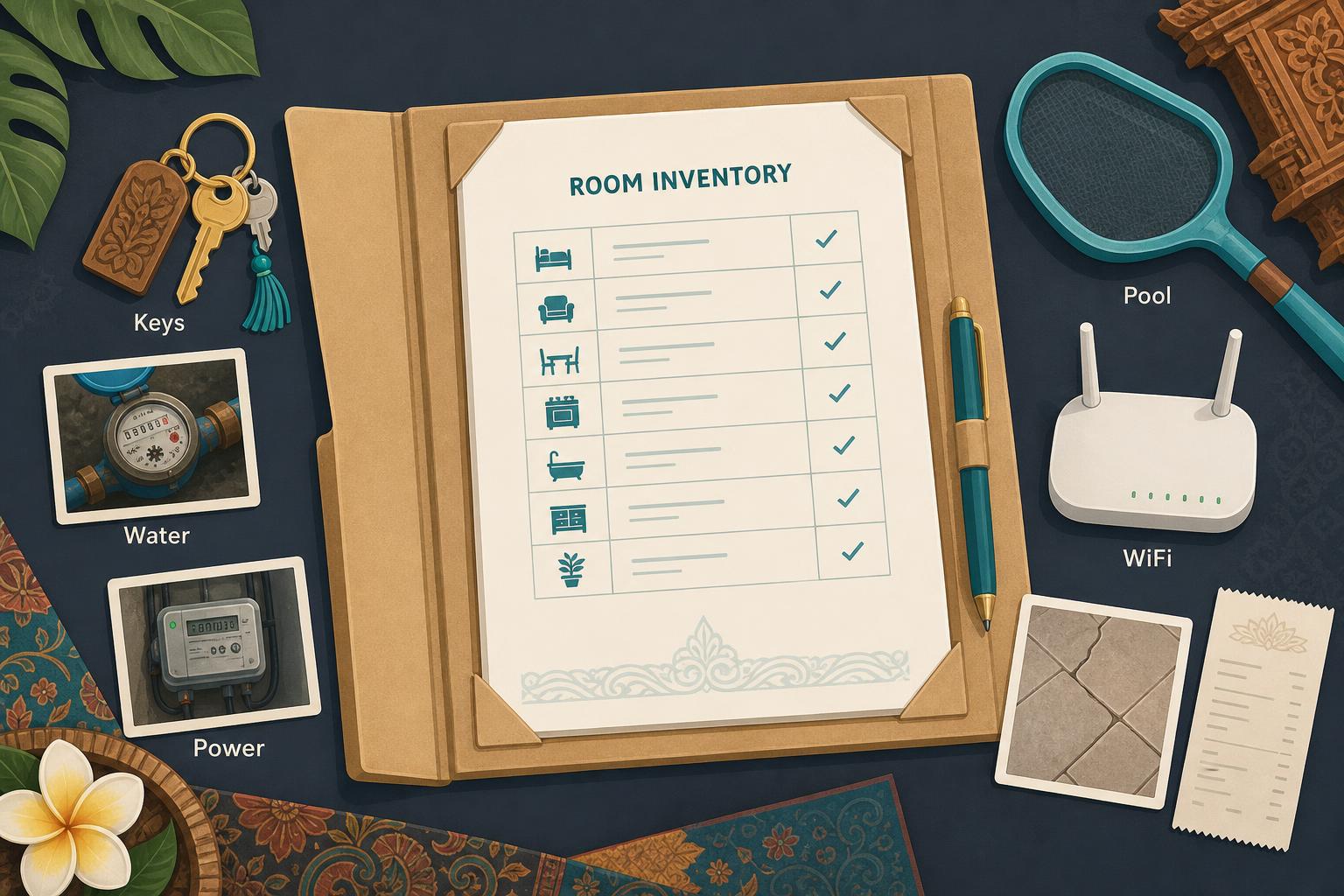
Make a dated room-by-room record of existing marks, damaged items, meter readings, keys, remotes, furnishings and pool equipment. Send the record to the lessor or authorised manager and keep their acknowledgement with the lease. This is especially important when a deposit is involved; our practical guide to paying, documenting and recovering a Bali rental deposit explains why the move-in record matters as much as the payment receipt.
Before any transfer, verify who is authorised to lease the property and whether the person giving instructions matches the agreement and payment destination. If the story, documents, payment account and person at the viewing do not line up, pause. Use this checklist of questions to ask a Bali landlord before you pay to close gaps while you can still walk away.
Put the Ubud villa lease, tax and permitted use in writing
Make the agreement match the quote and inspection
Read the agreement against your quote sheet and inventory, not in isolation. It should identify the parties and villa, state the term, rent, payment dates, deposit rules, included services, separate bills, repair process, owner or manager access, notice requirements, renewal wording, and what happens at move-out. Attach the inventory and condition record where possible. If a clause is unclear, resolve it in writing before payment rather than accepting a verbal assurance.
Ask whether the stated rent is inclusive or exclusive of any applicable tax, and ask for receipts. Indonesian rules provide that income from leasing land and/or buildings is subject to final income tax of 10% of gross rent; gross rent includes connected service, maintenance, security and facility charges, even under a separate agreement. This regime under PP 34/2017 has applied since 2 January 2018, rather than being a new 2026 rental tax. Where a tenant is an individual who is not a designated withholding agent, the landlord or lessor remits that tax; it is not an automatic statutory 10% surcharge separately payable by every renter. Lodging and accommodation services, including rumah kos, are excluded from this regime, but that does not exempt operators from all income tax. Monthly or annual payment, furnishings and the label “kost” or “kontrakan” do not alone settle the classification; the actual arrangement matters. See the Directorate General of Taxes guidance on rental income tax and confirm your particular arrangement with an appropriate professional if needed.
Do not assume residential renting permits tourist subletting
If you intend to host paying nightly guests, raise that before signing. OSS maps tourist-villa activity from KBLI 2020 code 55193 to KBLI 2025 code 55203, defining it as private houses specifically rented to tourists with facilities and owner management in its villa classification. It also distinguishes principally daily or weekly short-term accommodation from permanent monthly or annual furnished residential rental. The classification change alone does not require existing businesses to obtain new licences, according to BPS’s transition announcement. A residential lease should not be treated as automatic authority to run a nightly tourist operation; check the agreement, owner permission and applicable business requirements first.
For longer stays, keep your personal tax position separate from the landlord’s rental-income obligation. A foreign national can become an Indonesian domestic tax subject when resident in Indonesia, present for more than 183 days in any 12-month period, or present during a tax year with an intention to reside. Days need not be consecutive, and any part-day counts as one day under the official tax-residency rule. A residential lease exceeding 183 days can be evidence of an intention to reside, so tax residence does not necessarily begin only after day 183.
Request, pay and move into an Ubud villa with a complete record
Keep approvals, terms and payment evidence together
Do not let urgency turn a partial chat into a lease. Before paying, confirm the approved property, the exact dates, the schedule of payments, deposit treatment, cancellation terms and what you receive after payment. Save the agreement, quote, inventory, owner or manager contact details, payment confirmation and any messages changing the original terms.
For rental bookings on Livuma, the booking-specific payment schedule, deposit or balance rules, deadlines, cancellation rules and refund logic are shown before you commit. Payments run through Xendit by card or Indonesian bank transfer, and the host’s payout is released automatically about 24 hours after successful check-in under the booking’s terms, never while a reported problem is open.
Complete the handover on day one
Meet the person responsible for the home, count keys and remotes, photograph meter readings again, check the inventory, and report any mismatch immediately in writing. Ask how to report urgent maintenance and who can authorise access. Keep receipts for each payment and a copy of the signed agreement somewhere separate from your phone.
A careful handover is the final step in this Ubud villa rental guide, not an administrative detail. Once the paperwork, condition record and communication channel are organised, you can settle into the villa knowing what was agreed and how to raise a problem if one appears.
Renting an Ubud villa through Livuma
- Shortlist against your brief. Search Livuma’s live homes using area, rental type, price, stay length, bedrooms and amenities. Compare listing conditions and verified guest reviews alongside photos.
- Read the financial terms. Before committing, check the booking’s payment schedule, deposit or balance rules, deadlines, cancellation rules and refund logic against your all-in budget.
- Secure the request. Use a card reservation or a held Indonesian bank-transfer prepayment before the host sees it. Declined, withdrawn or expired requests receive an automatic full release or refund.
- Confirm approval and viewing terms. The host answers within a limited window; on approval, a standard card reservation is charged and the booking confirmed. For monthly or yearly rentals where the host and property offer “view property first”, only a small deposit secures the request. After an in-person or virtual viewing, pay the rest in the app to confirm, with no deadline or automatic confirmation, or cancel for free for a full deposit release or refund.
- Keep arrangements and documents together. Use in-app chat for viewing and move-in details. Complete identity verification before the rental agreement is issued; the platform generates agreement details and receipts for supported bookings.
- Record arrival. Confirm check-in in the app or report a problem, which holds the host’s payout while it is resolved. Payout is not released until successful check-in under the booking terms; later rent follows the displayed schedule.