

Your fever has dropped, so you cancel the clinic visit. Then severe stomach pain and repeated vomiting start, but you decide to sleep it off. With dengue, that delay can be the most costly mistake: serious warning signs can appear after the fever subsides.
Reducing your risk of dengue in Bali means building prevention into ordinary resident life: working at an open desk, checking the bathroom water bucket, opening terrace doors and arranging household maintenance. It also means knowing when prevention is no longer the question and medical care cannot wait.
“I only use mosquito repellent after sunset”
A bedtime-only mosquito routine leaves an important gap. WHO identifies Aedes aegypti, a mosquito that transmits dengue, as a daytime feeder, with peak biting early in the morning and before dusk. Exposure can happen at home or at work, not just outside after dark.
Think about your actual Bali day. Breakfast on an open terrace in Sanur, working beside an open doorway in Canggu or sitting in an Ubud courtyard are all situations where daytime protection deserves attention. These examples describe exposure settings, not a ranking of those areas by dengue risk.
The fix is to attach protection to your routine rather than to sunset:
- Keep an effective skin repellent where you get ready for the day, not buried with beach equipment.
- Wear long sleeves and trousers that cover exposed skin when practical.
- Check whether your usual desk has screens or sits in an open-sided room.
- Use a mosquito net, ideally insecticide-treated, for daytime sleep.
The WHO dengue questions and answers explain why daytime bite prevention and household barriers matter. A net used only overnight does not address time spent awake and exposed during the day.
If you are choosing a regular work base, add mosquito barriers to the practical checks in this guide to Bali coworking spaces and work settings. A comfortable desk and a good connection do not tell you whether the room limits mosquito entry.
“My repellent smells strong, so it must work”
A fragrance, a botanical label or an expensive-looking bottle is not enough to judge mosquito protection. Start with the active ingredient. WHO recommends repellents containing DEET, picaridin/icaridin or IR3535.
This is especially useful when shopping after a move: unfamiliar packaging can make it tempting to choose by scent or a prominent “natural” claim. Turn the bottle around and read the ingredient and use instructions instead. If you cannot establish what it contains or how to use it, choose something you can verify.
- Follow the product’s application instructions and age restrictions.
- When using sunscreen, apply sunscreen first and repellent afterward, allowing a few minutes between applications.
- Follow the label for reapplication rather than assuming an application lasts all day.
- Combine repellent with clothing and home barriers rather than asking a single product to do everything.
These application steps follow WHO’s public-health advice on dengue fever. For children, do not assume that an adult’s product or routine is appropriate; check the particular product’s age restrictions.
Make the habit easy to sustain. Keep the product somewhere accessible before school, work or errands, and check supplies before they run out. Long-term prevention depends less on buying an elaborate mosquito kit than on consistently using suitable protection.
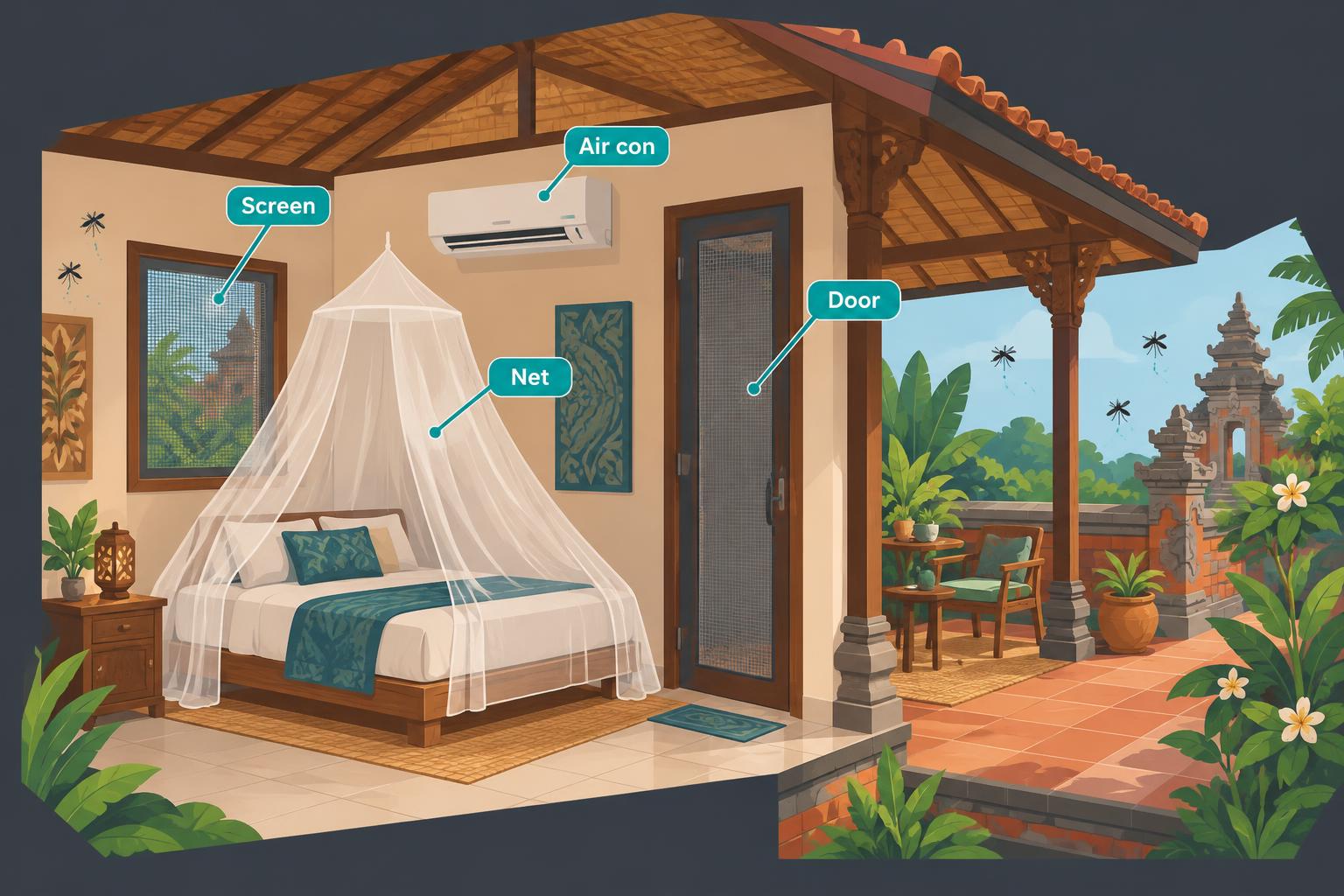
“The bedroom has air conditioning, but mosquitoes still get in”
Air conditioning and window or door screens reduce contact between mosquitoes and household members. But a cooled bedroom does not solve exposure in an open living room, and a screen cannot work as a barrier if the adjacent door stays open.
In a Bali home with a terrace or courtyard, inspect the boundary between indoor and outdoor space. Look at the room as you actually use it: doors open during breakfast, a window beside the desk, or household members repeatedly moving between the kitchen and garden.
- Check window screens for gaps, tears and edges that no longer fit.
- Check that screened doors close properly and are not routinely propped open.
- Prioritize barriers around sleeping and working spaces, including rooms used for daytime naps.
- Agree who will repair damaged mesh rather than leaving it on an informal maintenance list.
Inspect these details before committing to a home, but repeat the check after moving in. A property can look enclosed during a viewing yet function as an open house throughout the day. Conversely, a useful screened room only helps if the household actually uses it.
Do not treat screens, cooling or a net as a guarantee against dengue. They are layers of protection. Keep using appropriate repellent when exposed, and inspect the outdoor and bathroom water containers that barriers do nothing to remove.
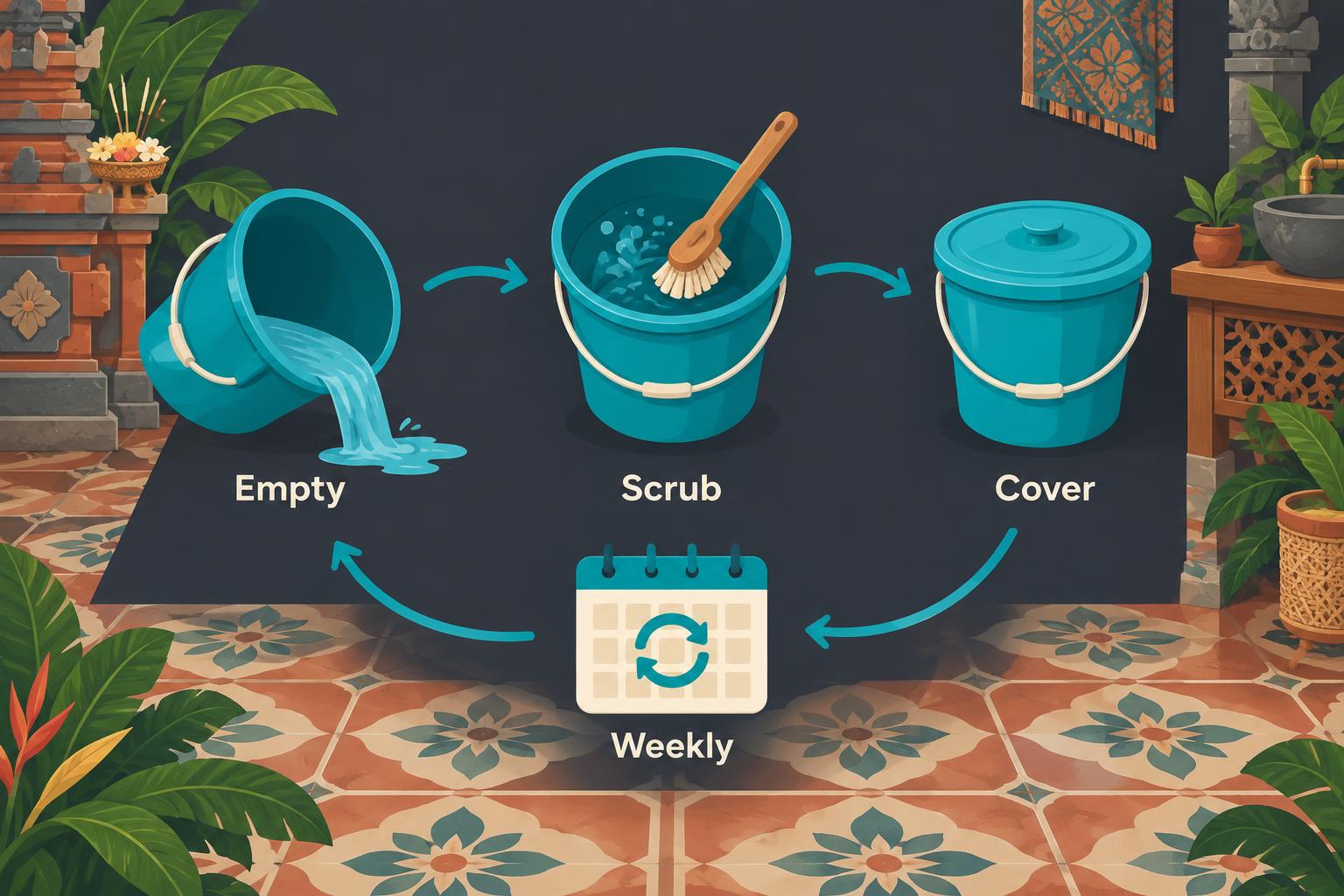
“I replace the water, but the mosquito problem keeps coming back”
Replacing water is not the same as removing a breeding site. WHO advises emptying, cleaning and scrubbing essential water containers at least weekly to remove eggs. Simply topping up a bucket or pouring fresh water into an unscrubbed container misses part of the job.
Indonesian Ministry of Health guidance identifies bathroom water reservoirs, buckets, flower vases, gutters and discarded rain-catching items as places to inspect. Water does not have to look dirty to be relevant. A clean-looking bathroom bucket should not disappear from your checklist.
Use a repeatable route around the home:
- Bathroom: empty, clean and scrub water reservoirs and buckets that remain in use.
- Living spaces: check flower vases and other containers holding water.
- Stored water: keep essential storage tightly covered.
- Roof edges: arrange safe inspection and maintenance of gutters.
- Yard and shared corners: remove, recycle or reuse discarded items so they cannot keep collecting rain.
These tasks reflect Indonesia’s 3M Plus approach: draining and cleaning water containers, tightly covering stored water, and recycling or reusing discarded water-catching items. The Ministry’s circular dated 18 February 2026 calls for year-round 3M Plus in endemic communities and weekly mosquito-larva monitoring.
Give the routine a named owner. If a housekeeper handles the bathroom, a gardener handles the yard and a manager handles gutters, make those boundaries explicit. This is a useful task to discuss when agreeing household duties with a housekeeper, rather than assuming “general cleaning” includes it.
Shared surroundings need cooperation too. Ask the building manager or neighbors about accessible common areas and unresolved water-catching waste. WHO identifies community participation as central to prevention; a well-maintained home is not a substitute for source reduction around it.
“The street was fogged, so I can stop the weekly checks”
Fogging can look like a decisive reset. Indonesia’s Ministry of Health explains that it kills adult mosquitoes; it does not replace removal of larvae and breeding sites. A visible cloud outside is not evidence that water containers inside your home have been dealt with.
Keep the same weekly routine after fogging. Do not postpone cleaning buckets or covering stored water while waiting for another treatment. The practical question remains: what can keep collecting water here, and who is addressing it?
Other products also need to stay in perspective:
- Coils and vaporizers: WHO says they may reduce biting activity, but they supplement rather than replace screens, skin repellent and source reduction.
- Repellent wristbands and sound-emitting devices: CDC identifies these as ineffective mosquito-bite prevention.
- Swallowed vitamin B and garlic: these are not effective ways to prevent mosquito bites.
- Pure lemon-eucalyptus essential oil: this is not equivalent to a tested, registered OLE/PMD repellent formulation.
The CDC Yellow Book’s mosquito-prevention guidance supports these distinctions. “Natural” does not establish effectiveness, and a wearable product should not displace a repellent with a recommended active ingredient.
Spend effort on the repeatable basics before adding gadgets: suitable repellent, covered skin, functional screens and weekly water-container care. None promises zero risk, but they address the actual routes of exposure and mosquito breeding described in public-health guidance.
“Cases are down, so my neighborhood must be safe”
Bali-wide surveillance helps describe reported disease trends. It cannot certify a particular address, establish a safe neighborhood or tell you that a season needs no precautions. This distinction matters when choosing between reassuring anecdotes and a year-round prevention routine.
The available reports describe different periods and, in some cases, different case definitions:
- 2024: Bali’s provincial health office reported 15,570 DBD cases and 25 deaths in an announcement published on 15 March 2025.
- 2025: ANTARA reported on 9 January 2026 that the health office recorded 10,391 DBD cases during 2025, down from the reported 2024 total.
- January–July 2026: ANTARA reported 1,588 positive cases on 11 August 2026. This is a partial-year figure, not an annual total.
The provincial health office’s 2024 announcement is a dated record of reported DBD, not a count of every dengue infection. Likewise, the partial-year positive-case figure should not be turned into an unsupported annual forecast.
In its August 2026 warning, the health office emphasized that cases occur throughout the year. Do not translate a falling aggregate total into “Sanur is safe,” “Ubud is worse” or “we can stop during the dry months.” These reports do not establish those conclusions.
Use the data as a reason to maintain sensible precautions, not to panic or seek a supposedly mosquito-free postcode. At home, the actionable checks are still your screens, daytime exposure, water containers and shared surroundings.
“It is probably just a fever, so I will wait”
Dengue can cause fever with headache, pain behind the eyes, muscle or joint aches, nausea or a rash. WHO says symptoms usually begin 4–10 days after infection. You cannot reliably diagnose dengue from a remembered mosquito bite or a checklist at home.
WHO advises seeing a doctor immediately if dengue is suspected. Indonesia’s February 2026 circular also promotes assessment at a health facility for high fever of at least 38°C. Do not wait for bleeding or for every listed symptom to appear before seeking advice.
Before illness, identify where you would seek assessment and how you would get there. Keep relevant health and insurance details accessible; this guide to healthcare access and insurance in Bali can help with that separate preparation. Sorting out paperwork should not delay urgent care.
WHO states that dengue has no specific treatment. Supportive care includes rest, fluids and paracetamol/acetaminophen for pain or fever. Follow medical advice and medicine instructions rather than treating a suggested home remedy as a substitute for assessment.
- Avoid aspirin and ibuprofen when dengue is suspected because they can increase bleeding risk.
- Protect the unwell person from further mosquito bites, including with a treated net.
- Do not assume a past dengue infection rules it out: infection with another strain remains possible and can be severe.
Bite protection during illness matters for others too. Mosquitoes can acquire the virus from an infected person and transmit it onward.
“The fever has gone down, so the danger must be over”
A falling temperature is not proof of recovery from dengue. WHO warns that severe symptoms often appear after the fever subsides. Judge the person’s overall condition, not just the thermometer reading.
Seek immediate medical care for these dengue warning signs:
- Severe abdominal pain or persistent vomiting.
- Rapid breathing.
- Bleeding gums, or blood in vomit or stool.
- Marked weakness or restlessness.
- Extreme thirst.
- Pale and cold skin.
Indonesia’s February 2026 circular additionally flags markedly reduced urine output over 4–6 hours, alongside signs such as cold hands, pallor and heavy sweating, as reasons for urgent assessment.
Do not wait for several warning signs to appear together, another fever spike or a reply in a neighborhood chat. If these signs develop, seek immediate medical care rather than relying on fluids and rest at home. Tell the clinician when the illness started, how the fever has changed and what medicines have been taken.
For long-term residents, dengue prevention is an ongoing household habit—not a seasonal purchase or a single fogging visit. Protect against daytime bites, scrub water containers weekly, maintain barriers and take suspected illness seriously, especially when the fever falls but the person feels worse.