

Choosing between international and local schools in Bali means matching your child’s next educational step with admissions eligibility, language needs and a school run your family can sustain. Start with the school pathway—not the house—and compare written offers rather than school labels or headline tuition alone.
International and local schools in Bali: what the labels mean
Negeri, swasta and SPK describe different things
Negeri means government-operated; swasta means community- or privately operated. These terms describe who runs a school, not a guarantee about teaching language, curriculum or suitability for a particular child.
SPK refers to Indonesia’s cooperation-school framework. Under Permendikbud 31/2014, SPK schools can enrol Indonesian and foreign pupils who meet applicable legal requirements. Do not treat “private,” “international” and “SPK” as interchangeable descriptions: ask each admissions office to explain its status and educational programme.
TK, SD, SMP, SMA and SMK explain the local pathway
Indonesian school-stage abbreviations are useful when reading admissions notices or discussing a transfer:
- TK: kindergarten.
- SD: primary school.
- SMP: junior secondary school.
- SMA: general senior secondary school.
- SMK: vocational senior secondary school.
Start by identifying the relevant stage, then ask how the school would place your child. A familiar-looking grade label does not resolve differences between previous learning, language proficiency and the receiving school’s expectations. Request a placement explanation before withdrawing from the current school.
How to compare international and local schools in Bali by curriculum
Choose a qualification pathway that fits the next move
Work backwards from where your child may study next. A family expecting another international move has different questions from one planning to remain in Indonesia through graduation.
Bali’s researched options include IB programmes, the Australian Curriculum and Cambridge examination pathways. Rather than asking which curriculum is universally “best,” ask which subjects, assessments and qualifications preserve your child’s intended options.
- Which programme is actually offered at the child’s entry level?
- What happens when pupils move into secondary or examination classes?
- Can the school explain how previous learning will transfer?
- What records will the next school or university receive?
Separate teaching language from required Indonesian subjects
An international curriculum does not remove Indonesian subject requirements. The SPK regulation requires religious education, Pancasila/citizenship education and Indonesian-language instruction for Indonesian pupils. For foreign pupils, it requires Indonesian language and Indonesian cultural studies.
Ask which language teachers use for explanations, assessment and parent communication, rather than assuming that a curriculum name answers everything. For families preparing to participate more confidently in school life, this guide to learning Indonesian in Bali can help parents plan their own language study alongside the child’s transition.
Which Bali schools belong on your initial shortlist?
Bali Island School and Canggu Community School
Bali Island School is in Sanur, Denpasar. The IB directory lists its Primary Years, Middle Years and Diploma programmes. It is a useful starting point for families specifically seeking an IB pathway across those stages; confirm availability and placement directly.
Canggu Community School publishes its campus address on Jalan Subak Sari, Tibubeneng, North Kuta, Badung. Its fee schedule includes Early Years through the IB Diploma in Years 12–13. Ask admissions to explain the programme at your child’s particular stage rather than inferring the whole curriculum from the senior qualification.
Green School and the importance of its actual location
Green School is in Sibang Kaja, Abiansemal, Badung—not Ubud town. That distinction matters when arranging visits and testing possible home-to-school routes.
Its published enrolment commitment also deserves attention: the minimum is 12 months, except Early Years, where it is one semester. Leaving before the minimum period does not trigger refunds of paid tuition, fees or deposits. Ask for the applicable terms before treating a temporary Bali stay as a trial enrolment.
AIS Bali and Dyatmika offer other curriculum pathways
AIS Bali states that it follows the Australian Curriculum and Australian schooling system. Ask how your child’s existing school records map into its placement process.
Dyatmika, in Banjar Tangtu, Kesiman Kertalangu, Denpasar, identifies Cambridge IGCSE, AS and A Level examinations on its admissions page. Examination-entry fees are paid separately by parents before examination registration.
These schools are comparison starting points, not a ranking. Neither a school’s reputation nor its published curriculum confirms an available place, suitable support or admission for your child.
Bali international school fees: compare the same cost categories
Published tuition examples for the 2026/27 school year
The figures below illustrate why headline fees need careful reading. They are published examples for specific stages, not equivalent year groups or all-inclusive quotations.
| School and stage | Published annual amount | What that figure covers |
|---|---|---|
| Bali Island School, Grade 1 | Rp234.627 million | Tuition plus capital levy |
| Bali Island School, Grades 11–12 | Rp330.265 million | Tuition plus capital levy |
| Canggu Community School, Years 1–2 | Rp162 million | Annual-payment tuition, before additional levies |
| Canggu Community School, IB Diploma Years 12–13 | Rp272 million | Annual-payment tuition, before additional levies |
| Green School, Grades 1–3 | Rp249,263,690 | Full-year-payment tuition, excluding additional charges |
| Green School, Grades 11–12 | Rp328,600,900 | Full-year-payment tuition, excluding additional charges |
Check the Bali Island School fee schedule and Canggu Community School fee page for the applicable categories and payment terms. Confirm all figures with admissions before paying.
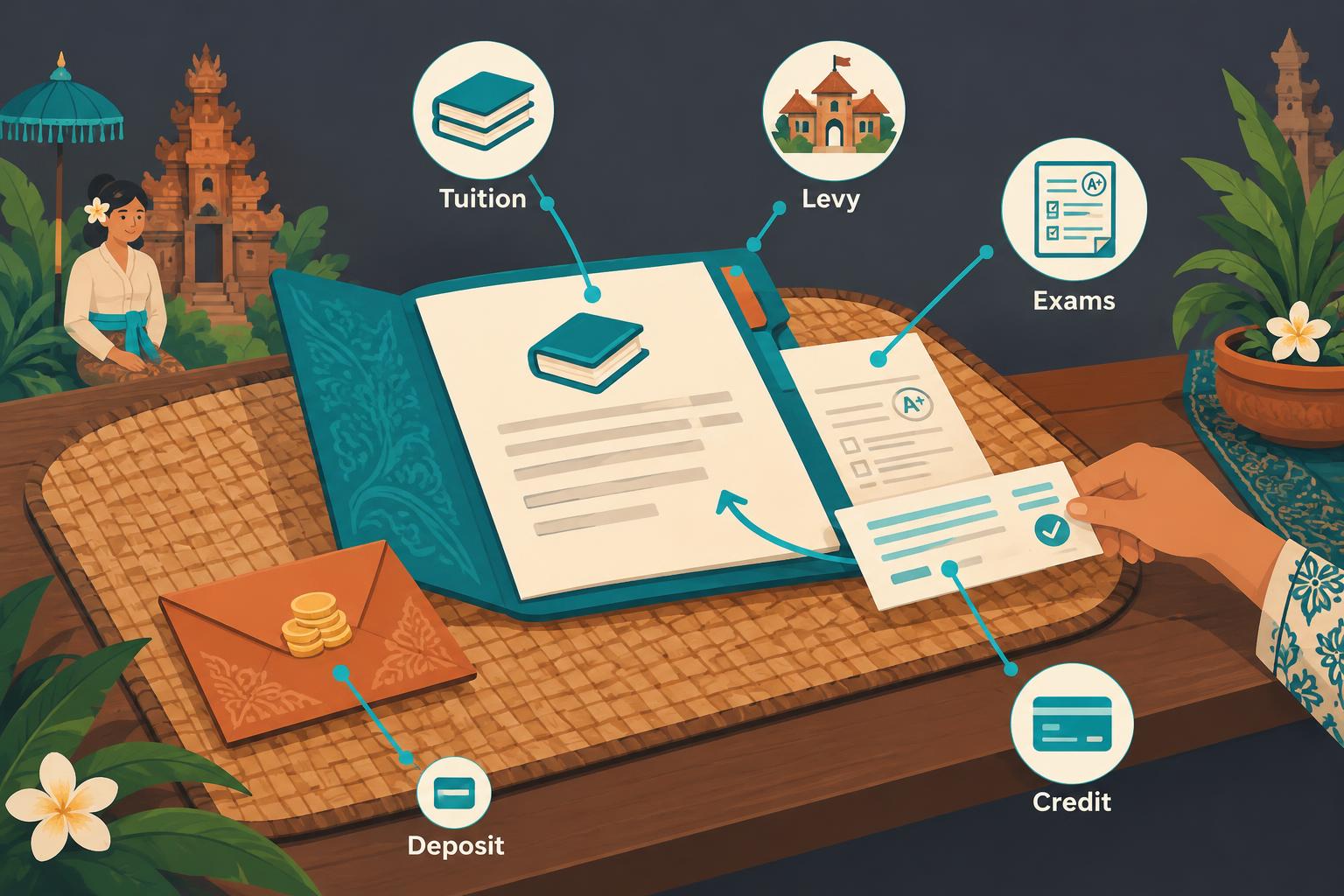
Separate levies, deposits and tuition credits
Canggu Community School publishes a non-refundable annual capital levy of Rp21.5 million for Early Years–Year 5 and Rp26 million for Years 6–13, payable for the first and second family members attending.
Bali Island School’s Rp15 million annual seat-reservation payment for returning pupils is deducted from tuition, not added as a separate annual charge. AIS Bali’s published 2026 upfront charges include a Rp2 million non-refundable application fee, Rp5 million non-refundable registration fee and Rp5 million conditionally refundable enrolment-notice deposit.
Request an itemised first-year quotation distinguishing charges, credits and refundable amounts. Ask whether meals, transport, uniforms, devices, activities, learning support and examinations cost extra; do not assume inclusion. Keep schooling separate within your wider Bali family cost-of-living budget.
Applying to a Bali international school without premature commitments
Request the admissions checklist for your child’s situation
Send an initial enquiry that states the child’s current school stage, previous curriculum, languages, intended start and expected length of stay. Disclose support needs early so that the school can discuss suitability before the family makes commitments.
Ask which documents are required rather than assuming a universal checklist. Useful questions concern school reports, identity documents, previous-school references, assessments and any translations. Treat these as items to clarify, not documents that every school necessarily requires.
Distinguish an enquiry, assessment and confirmed place
Ask admissions to explain its sequence in writing: what an application payment buys, whether an assessment follows, when a place is offered and what action secures it. A positive conversation is not the same as a confirmed place.
- Is there availability in the proposed class?
- What could change the proposed placement?
- Which payments are non-refundable?
- What happens if the intended start changes?
- What withdrawal notice and refund terms apply?
Read the offer, fee schedule and withdrawal policy together. If the family’s plans are uncertain, the minimum commitment and cancellation terms can matter as much as annual tuition.
Local school admissions in Bali: domicile and transfer routes
Why renting nearby does not establish domicile-route eligibility
For 2026/27, SPMB uses domicile, affirmation, achievement and parental-transfer/teacher-child admission routes. SPK cooperation schools are exempt from that framework.
The ministry’s SPMB guidance says the domicile route generally requires a Kartu Keluarga issued at least one year before registration. A newly rented address alone does not meet that published documentary requirement.
Before choosing housing around a public school, ask the relevant admissions authority which route and documents apply. Address registration and school eligibility are separate checks; the guide to registering your Bali address should not be treated as a substitute for an admissions decision.
Foreign transfer pupils need a specific admissions conversation
Ministry guidance for 2026/27 explicitly includes foreign nationals in school-transfer admissions, which take place outside the new-pupil intake process. That does not mean every local school must have a suitable vacancy or that admission is automatic.
Ask the school and relevant education authority how your child’s nationality, previous schooling and proposed stage affect the application. For local private schools, request the actual fee schedule too: do not assume that “local” or “private” means tuition-free.
Student visas for school-age children in Bali
E30A covers primary and secondary education
Indonesia’s visa classification identifies E30A for primary and secondary education. Immigration’s announcement describes residence-permit options of one, two and four years and permits sponsorship by an individual or the relevant educational institution.
Discuss the child’s existing immigration status and intended schooling with immigration and the school’s admissions team. A school offer and permission to reside are different matters; do not assume that one automatically resolves the other.
Keep government visa charges separate from school charges
Immigration’s published E30A charges are:
- One year: Rp6 million.
- Two years: Rp8.5 million.
- Four years: Rp12 million.
These are government charges, not school or agent service fees. Ask for any additional service costs to be listed separately and confirm the applicable process before transferring money.
Also establish who will sponsor the application, who supplies the supporting documents and who monitors the process. A permit duration should not be confused with a school’s enrolment commitment or refund period; each has its own terms.
Language support, learning needs and daily wellbeing
Ask what support looks like inside the classroom
“English-speaking” and “bilingual” are not sufficiently detailed answers for a child who needs language support. Ask how teachers assess comprehension, help new arrivals participate and communicate progress to parents.
For a child entering an Indonesian-language learning environment, discuss subject vocabulary as well as everyday conversation. For an Indonesian child entering an English-language environment, ask the same practical questions about access to lessons and assessment.
Where learning support is needed, request specifics: who provides it, how it fits into lessons, whether capacity is available and whether charges apply. Do not infer provision from a school’s international label.
Use the campus visit to examine care and communication
A campus tour should reveal more than facilities. Ask staff to explain:
- How a new pupil settles into an unfamiliar class.
- How bullying and safeguarding concerns are reported.
- Who contacts parents after an injury or illness.
- How allergies or medication needs are recorded.
- Who may collect a child and how changes are authorised.
For after-school arrangements, align the school’s collection rules with whoever provides care. Families considering household help can use this separate guide to hiring a nanny or housekeeper in Bali; school procedures still need direct confirmation.
School locations in Bali: test the journey before choosing a home
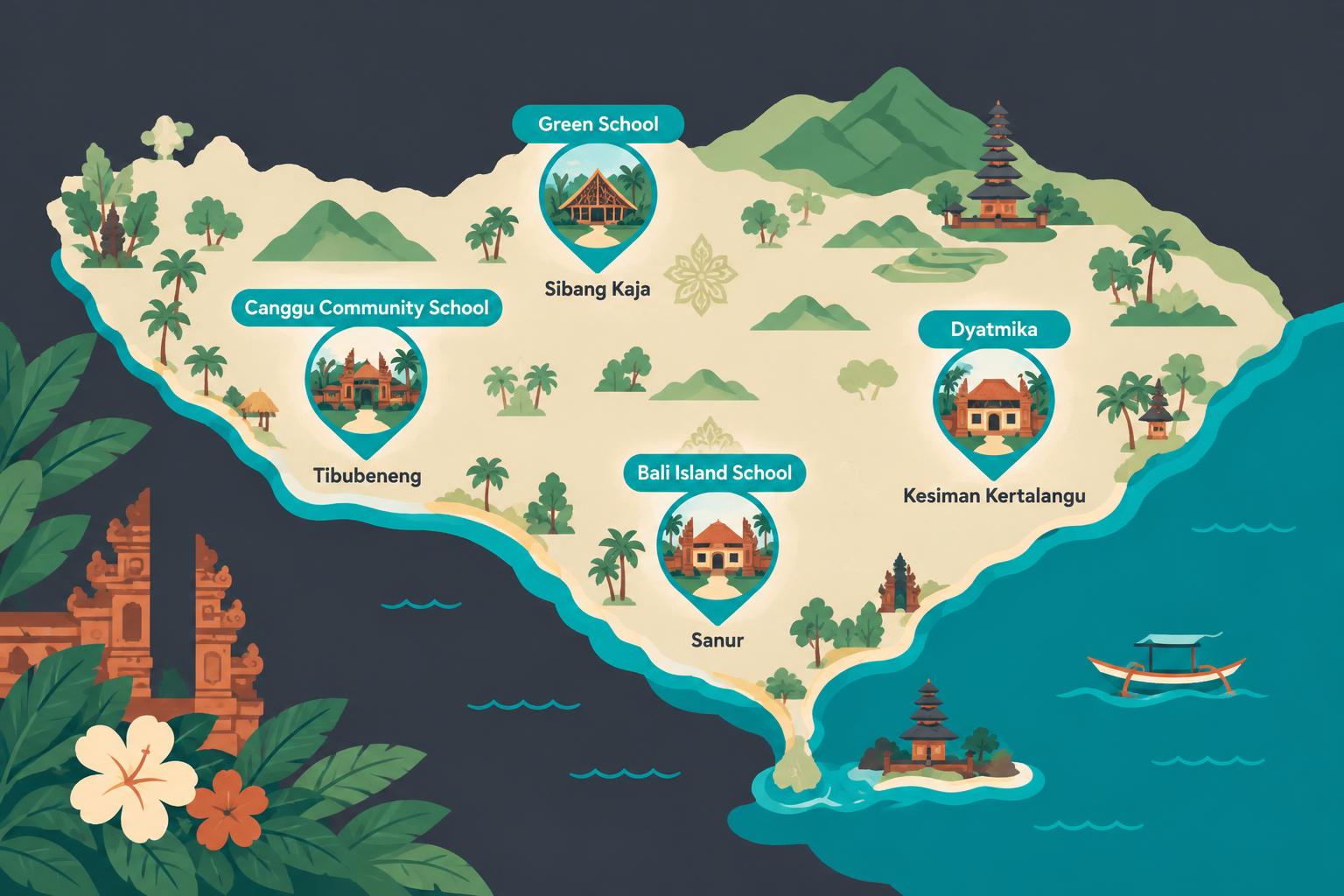
Use campus addresses instead of broad area names
Build your location shortlist from the actual campus:
- Bali Island School: Sanur, Denpasar.
- Canggu Community School: Jalan Subak Sari, Tibubeneng, North Kuta, Badung.
- Green School: Sibang Kaja, Abiansemal, Badung.
- Dyatmika: Banjar Tangtu, Kesiman Kertalangu, Denpasar.
In particular, do not substitute “Ubud” for Green School’s location or assume that every address marketed as Canggu creates the same journey to Canggu Community School. Pin the correct entrance and test the route from a specific prospective home.
Rehearse both drop-off and collection
Ask the school for current arrival and collection arrangements, then make the journey at the relevant times. Do not use an off-peak campus tour as your only transport test.
Check the walking approach, vehicle access, waiting arrangements and a backup plan if your usual driver is unavailable. If school transport is offered, confirm its route, availability, supervision and charges directly.
For siblings at different campuses, test the complete sequence rather than each journey independently. Only then move on to the practicalities of renting a family home in Bali. A suitable school place and a workable journey should shape the housing search, not be squeezed around it afterwards.
Making the final Bali school decision
Compare written answers in a family decision sheet
Give every shortlisted school the same questions. Record the proposed placement, curriculum, language support, total initial payment, recurring charges, minimum commitment, withdrawal terms and actual journey from your preferred address.
Add your child’s response to the visit, but keep impressions separate from confirmed facts. Attractive facilities cannot answer whether a required subject is available, support is appropriate or the family can leave without an unexpected financial commitment.
For local schools, include the admissions route and eligibility evidence. For foreign pupils, include the immigration plan. Mark unresolved issues clearly rather than filling gaps with assumptions.
Resolve these points before accepting an offer
- Placement: obtain the proposed class and educational pathway in writing.
- Support: confirm that the school can meet the child’s identified needs.
- Money: reconcile tuition, levies, deposits, credits and extras.
- Eligibility: clarify admissions documentation and immigration arrangements where relevant.
- Exit terms: understand minimum enrolment, notice and refund conditions.
- Daily life: test transport and agree collection and backup care.
The strongest choice is not automatically the most expensive school or the closest campus. It is the school that can demonstrate a suitable educational pathway, admit your child on clear terms and fit the family’s everyday life.