

A pool can be the best part of a Bali home, but it is also a working water system with recurring service, electricity, water and repair questions. This bali villa rental with pool maintenance explained walkthrough leaves you with a practical inspection list, a clear list of costs to allocate, and pool clauses to settle before you pay. Complete the first checks during one viewing, then use the written-agreement steps before signing.
- Read the listing for pool details. Establish whether the pool is private, shared, operational and included in the rental.
- Inspect the water and equipment in person. A blue pool is not, by itself, evidence that its chemistry and circulation are being managed.
- Ask for the service routine and records. Confirm who attends, what they do and how access works.
- Allocate every recurring and repair cost in writing. Do not leave “maintenance included” undefined.
- Record the pool’s condition at handover. Keep the same evidence for the day you leave.
Have these items ready before starting: your intended lease dates, the number of regular pool users, any children or non-swimmers in the household, a phone for photos and video, and a written list of questions. If pool use is central to your decision, do not treat the answer as a casual verbal promise.
Bali villa rental with pool maintenance explained: start by defining what is included
Step 1: Separate the villa rent from the pool-service promise
“Pool included” can mean very different things. It may mean use of a private pool, a gardener or technician visit, basic cleaning, chemicals, electricity for the pump, water top-ups, or only access to a shared facility. Ask the host to identify each element rather than accepting one broad phrase.
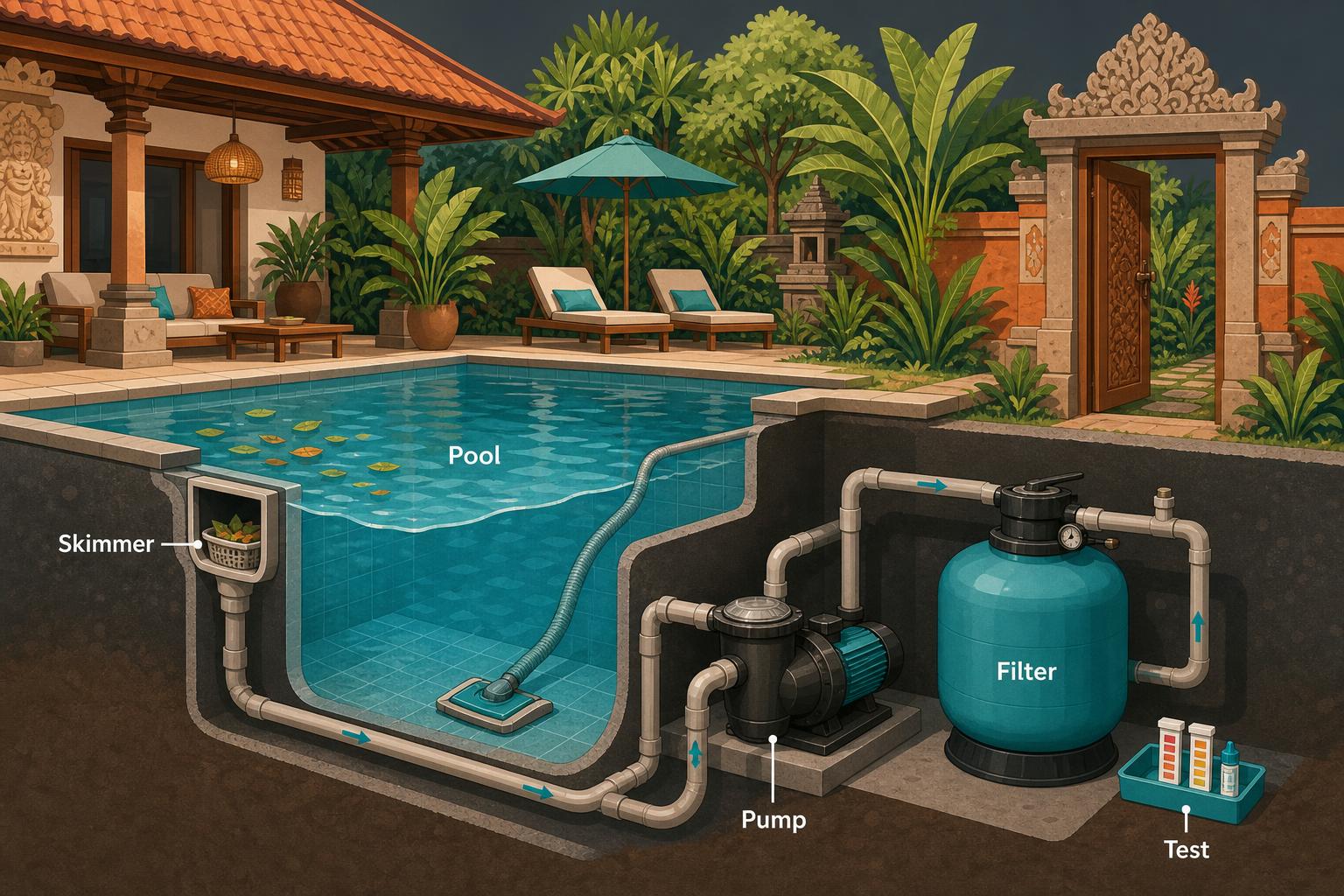
Routine maintenance is a package: skimming leaves and debris, vacuuming the pool floor, operating and cleaning the filter and pump, testing water balance, and dosing chemicals where needed. Adding chlorine alone is not a complete maintenance plan.
Start with the listing’s house rules and booking conditions, then ask follow-up questions before requesting the property. Compare area, stay length, amenities and rental type before narrowing the discussion to a particular pool and its stated conditions.
Step 2: Establish the rental type and the practical pool arrangement
For a long-term renter, establish whether the technician needs access through the villa, through a side gate, or only when you are home. Ask whether service can happen while you are away and whether the pool is ever unavailable for maintenance. These are operational questions, but they affect privacy and daily routine.
For more area context before selecting homes, see the long-term rentals by area guide. The useful comparison is not “which villa has a pool?” but “what exactly does this particular rental include to keep its pool usable?”
Bali villa rental with pool maintenance explained: inspect water, circulation and access
Step 3: Look beyond clear water at the viewing
Look for floating debris, staining, algae at tile lines, cloudy water, damaged grilles, loose coping, and signs that the water level sits below the skimmer opening. Ask the host or technician to point out the pump, filter, valves and any heater. You do not need to diagnose machinery; you need to know what equipment exists, where it is, and whether it can be serviced without entering private living areas.
Do not rely on appearance or smell alone. Indonesia’s pool-water health standards remain in the preserved appendix to Ministry of Health Regulation No. 2 of 2023, which defines pool water as treated water in a pool structure used for swimming, recreation or other water sport, indoors or outdoors. Effective March 11, 2026, Permenkes No. 3 of 2026 partially repealed the 2023 regulation but expressly preserved Articles 12, 21, 23, 29, 32, 39 and 45 and its appendix. The standards help explain why a visually clear pool can still need measured testing.
Step 4: Ask how testing is done, not merely whether chlorine is used
For chlorine-treated pools, the regulation gives a pH range of 7.0–7.8, alkalinity of 80–200 mg/L, and free residual chlorine of 1–1.5 mg/L for covered and uncovered pools, with a separate 2–3 mg/L range for heated indoor pools. It says pH should be checked at least three times daily; this is a water-testing requirement, not a requirement for three technician visits daily. For bromine-treated pools, pH is 7.0–8.0 and total bromine is 2–2.5 mg/L, also with pH checks at least three times daily.
The same standards specify odourless water, turbidity no greater than 0.5 NTU, a temperature range of 16–40°C, and a black-red Secchi disk that is clearly visible from 4.572 m depth. Read the underlying requirements in the Permenkes No. 2 of 2023 text.
At a villa viewing, the practical question is simple: who tests the water, what is tested, and can the host show recent service notes or readings? Do not attempt to adjust chemicals yourself unless the agreement explicitly makes you responsible and you understand the system.
Also ask whether the pool has circulation and recirculation equipment, whether there is a foot-wash facility, and how the area is protected from contamination and breeding sites. Those features are specifically addressed in the regulation’s pool-water provisions. The appendix requires recirculation; adding disinfectant alone does not satisfy that requirement. How every operator-facing testing, reporting and visitor-information requirement is enforced for a pool used exclusively by one residential tenant should be confirmed with the local health office rather than assumed.
Put pool visits, chemicals and repair responsibility into the lease
Step 5: Turn “maintenance included” into seven clear allocations
Indonesia’s Civil Code framework requires a landlord to hand over and maintain leased property so it remains usable for the agreed purpose and to allow peaceful enjoyment. A tenant must use and maintain rented property properly and pay rent as agreed. That baseline does not resolve the practical details of a villa pool, so the lease should do so expressly. Article 1550 establishes the landlord’s maintenance duty independently of an express lease clause; Article 1551 places necessary repairs on the landlord except those that are the tenant’s responsibility. Article 1583 generally assigns small everyday repairs to tenants, but retains landlord responsibility where those repairs arise from deterioration or force majeure. See the Civil Code text. The underlying landlord-and-tenant principles are discussed in this Supreme Court legal reference.
| Lease item to name | What the agreement should say |
|---|---|
| Scheduled visits | Who provides the technician, what tasks are included and when access is permitted |
| Routine chemicals | Whether testing and ordinary chemical dosing are included in rent or charged separately |
| Pump electricity | Which party pays the electricity used for circulation and filtration |
| Water top-ups | Who pays and what happens if the pool needs additional water |
| Equipment repairs | Who authorises and pays for filter, pump or heater faults not caused by tenant misuse |
| Tenant-caused damage | What counts as misuse, how it is documented and how any charge is handled |
| Technician access | Access route, notice expectations and whether a tenant must be present |
There is no verified national or Bali-wide rule in the available sources requiring a set weekly visit frequency for a private residential villa. Avoid treating “twice weekly” or any other schedule as a legal default. Choose a schedule only after the host explains the pool’s needs and both parties write it into the agreement.
For a broader way to assess wording before committing, use this checklist of questions to ask a Bali landlord before payment. It is particularly useful when the host says a cost is “included” but cannot identify the service behind it.
Step 6: Identify the variable costs without inventing an average
There is no reliable official Bali-wide published price schedule in the research for private pool cleaning, chemicals, pump repairs or water deliveries. Treat any quote as property-specific, then record whether it is included in rent, capped, reimbursable or paid directly.
Electricity is a real variable because the circulation pump needs power. PLN confirmed that tariffs for the 13 nonsubsidised customer groups remain unchanged for October–December 2026. Calculate pump consumption using the property’s actual tariff category. The applicable tariff depends on the customer category and connection, not on a Bali-specific “pool rate.” If the tenant pays electricity, ask to see the meter arrangement and read how Bali electricity bills and PLN tokens work before agreeing to an open-ended utility obligation.
For villas using bore-well water, do not assume refill water is unlimited or low-cost. Permen ESDM No. 4 of 2026 regulates business and non-business groundwater use, including applicable approvals, metering, recharge wells, environmental monitoring and reporting. That is a reason to ask the owner how pool top-ups are supplied and allocated, not a reason to make assumptions about a particular property.
During the tenancy, keep pool problems visible and documented
Step 7: Report a change early and preserve evidence
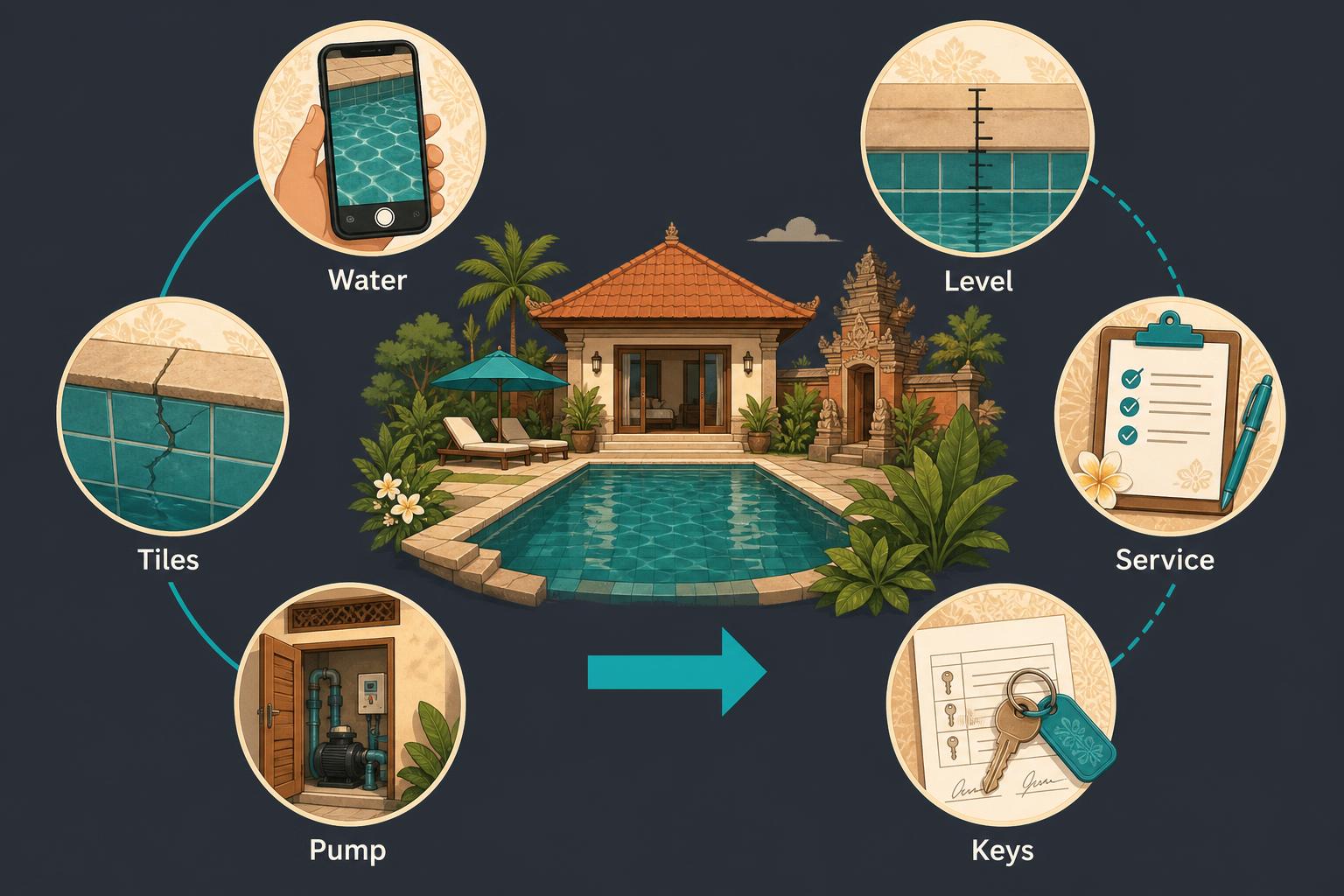
Report cloudiness, unusual odour, algae, persistent debris, low water level, a silent or unusually noisy pump, leaks, damaged drains or unsafe tiles promptly in the agreed communication channel. Send dated photos or short video, state when you first noticed the issue, and ask what action will be taken. Do not wait until checkout, when it becomes much harder to separate an existing equipment failure from later damage.
Be careful with the practical distinction between normal use and misuse. Normal use may still create leaves, sunscreen residue and day-to-day debris. Misuse can be defined in the lease, but it should not be assumed after the fact. Never pour unapproved products into the water or interfere with valves and equipment if you have not been instructed to do so.
For bookings through Livuma, in-app chat keeps pool-maintenance arrangements and fault reports between guest and host on the record. Digital rental agreement details and receipts are generated for supported rental bookings, helping both parties retain a record of what was agreed.
Step 8: Treat safety and water quality as separate checks
Water chemistry is only one part of safe use. Check that pool edges, steps, drains and surrounding surfaces are in sound condition, and make household rules for children and guests. If water quality appears questionable, stop using the pool and seek action from the responsible party rather than trying to make it look better for a few hours.
The national benchmarks also include microbiological monitoring: heterotrophic plate count and E. coli monthly, with an E. coli limit of less than 1 CFU/100 mL, Pseudomonas aeruginosa when needed, Staphylococcus aureus periodically, and Legionella every three months for treated water. These benchmarks reinforce the point that visual clarity is not a complete test of water quality.
Resolve faults and water-use questions before they become a rent dispute
Step 9: Use a written fault sequence
- Describe the fault and attach current evidence.
- Ask whether the issue affects safe use, circulation, water level or access.
- Request the technician visit and keep the proposed date in writing.
- Confirm whether the issue is routine service, equipment repair or alleged tenant damage.
- Do not approve a charge until the lease allocation and the reason for the charge are clear.
- After work is completed, record what changed and retain any receipt or service note.
This sequence is useful even when the relationship with the host is friendly. A written record reduces confusion about whether a recurring issue was reported, whether access was provided, and who authorised work.
Owners and investors should take a different view of groundwater obligations. Permen ESDM No. 4 of 2026, effective 22 January 2026, regulates groundwater use for business and non-business activities, including approvals or permits, metering, recharge wells, environmental monitoring and reporting where applicable. A commercial operator should verify its own obligations rather than passing unexplained water charges to a tenant.
Finish a Bali villa rental with pool maintenance explained by recording handover
Step 10: Make pool condition part of both inventories
At move-in, photograph the water surface, walls, tiles, drains, skimmer, visible equipment, pump-room condition and any existing stains, cracks or missing items. Note the current water level and whether the pump is operating. Attach the inventory to the rental record where possible. Civil Code Article 1562 uses the agreed inventory to assess return condition, excluding deterioration from age and unavoidable events.
At move-out, repeat the same route and compare like with like. This is more useful than a general statement that the pool was “fine.” If there is a claim for damage or an extra cleaning charge, ask for the condition evidence, the relevant lease clause and an itemised explanation.
Step 11: Leave with a usable record, not a verbal understanding
Your final file should contain the signed rental agreement, pool-service allocation, move-in and move-out evidence, reports of faults, technician communications and receipts for any agreed tenant-paid work. This protects both sides: the owner can show what was maintained, while the tenant can show what was present or reported.
For renters, the core lesson is straightforward: a private pool involves separate services and risks, with landlord maintenance and necessary-repair duties under the Civil Code alongside tenant responsibilities. Those details should be observed, asked about and written down. For hosts preparing a property, the hosting guide explains the account and listing process; the pool details should be stated clearly in the listing and aligned with the actual lease terms.
Renting a Bali villa with pool maintenance through Livuma
- Compare pool terms. Search Livuma’s live inventory by area, rental type, price, stay length and amenities. Read photos, house rules, booking conditions and verified guest reviews to establish what “pool included” covers.
- Read payment terms. Before committing, check the booking-specific schedule, deposit or balance rules, deadlines, cancellation rules and refund logic alongside pool-cost allocations.
- Secure the request. Pick dates and use a card reservation or held Indonesian bank-transfer prepayment before the host sees it. If declined, withdrawn or expired, the reservation is released or prepayment refunded in full automatically.
- Follow approval or viewing steps. The host answers within a limited window; approval charges a standard card reservation and confirms the booking. For eligible monthly or yearly rentals, “view property first” secures only a small deposit: after an in-person or virtual viewing, pay the rest in the app to confirm, with no deadline or automatic confirmation, or cancel for free for a full release or refund.
- Keep arrangements recorded. Use in-app chat for pool access and maintenance details. Complete guest identity verification before the rental agreement is issued; supported bookings receive generated agreement details and receipts.
- Check the pool on arrival. Confirm arrival in the app or report a problem, holding host payout while resolved. Payments run via Xendit; payout follows successful check-in, automatically about 24 hours later, never while a reported problem remains open.