
This is for new Bali residents who want to order lunch, explain a delivery address and speak with neighbors without relying entirely on English. It compares published language-course fees, study locations and working-adult schedules, then explains what to practice before paying for a package.
Should I learn Indonesian or Balinese first in Bali?
Learn Indonesian first if your immediate goal is handling everyday life in Bali; Balinese is a separate language to explore alongside local relationships and culture. Indonesian, or bahasa Indonesia, is Indonesia’s state language and gives you a practical starting point beyond Bali’s tourist areas.
Balinese, or bahasa Bali, is not Indonesian with a local accent. It also has socially differentiated speech levels, known as anggah-ungguhing basa, so choosing an expression can involve etiquette as well as vocabulary.
When contacting a school, ask explicitly which language it teaches. “Bahasa classes” alone is an ambiguous description: you want beginner Indonesian lessons if your priorities are shopping, arranging appointments and explaining where you live.
- Start with Indonesian: introductions, questions, numbers, food orders and directions.
- Add Balinese thoughtfully: ask a teacher or local acquaintance which expressions suit the person and situation.
- Keep the distinction clear: familiarity with Indonesian does not mean you understand Balinese conversation.
You do not have to choose between practical communication and cultural interest. Build an Indonesian foundation while approaching Balinese expressions with curiosity rather than assuming a memorized phrase suits every interaction.
Where can I start learning Indonesian for free?
The government’s BIPA Daring portal is a useful free starting point for beginner Indonesian before you commit to paid lessons. BIPA means Bahasa Indonesia bagi Penutur Asing: Indonesian for speakers of other languages.
As checked on November 6, 2026, BIPA Daring’s learning resources include freely accessible textbooks, audio, video and exercises, including Sahabatku Indonesia BIPA 1, published in 2019. The official Sahabatku Indonesia Tingkat A-1 resource has ten units and accompanying listening recordings.
Use the material to discover what you need help with, rather than treating downloading a textbook as a study plan:
- Listen to a beginner recording before reading the corresponding material.
- Say your own version aloud, using your name and everyday circumstances.
- Keep a list of questions for a future teacher.
- Return to material covering introductions, locations and daily activities.
The important limitation is that a resource library is not a scheduled, teacher-led course. It cannot listen to your delivery instructions and tell you which part was unclear. Free materials work well as preparation and revision; paid teaching can add correction, speaking practice and accountability.
How much do Indonesian classes in Bali cost?
Published options range from Undiksha’s IDR 1.25 million intensive group package to Udayana’s IDR 16 million listed course-related total, but these buy very different amounts and formats of teaching. Compare duration, group size and extras before comparing the headline price.
The figures below were checked on November 6, 2026. Cinta Bahasa’s quoted tariff is effective February 1–December 31, 2026; Undiksha’s page gives no effective date and says fees may change without notice.
| Provider and format | Published teaching package | Published fee | Main qualification |
|---|---|---|---|
| Udayana regular BIPA | Four months; weekday classes | IDR 16 million total | Includes listed enrollment and textbook charges |
| Undiksha intensive group | 18 × 90-minute meetings | IDR 1.25 million per person | Minimum three participants |
| Cinta Bahasa beginner group | 24 hours; three meetings weekly | IDR 2.5 million daytime; IDR 2.75 million evening | Confirm package duration in writing |
| Cinta Bahasa private or live online | Ten hours | IDR 2.25 million | Check scheduling supplements |
| Bahasa Bule group | 16 sessions; twice weekly | IDR 2 million | Four–six learners; session length needs confirmation |
| Bali Language School private | 90-minute lessons | Request a current written quote | Confirm package size and available teaching times |
Do not divide every package by its advertised “hours” without checking the definition. A session, a lesson-hour and a clock hour are not necessarily equivalent, and a group price does not buy the same individual speaking time as private tuition.
Are university BIPA programs practical for working adults?
University BIPA can suit residents with protected study time, but Udayana’s published regular timetable is difficult to combine with conventional daytime work. It runs Monday–Friday, with two classes daily, each lasting 100 minutes.
Udayana lists its BIPA address at the Faculty of Humanities, Jalan Pulau Nias 13, Denpasar—not the Jimbaran campus. Its published program expenses are IDR 15 million tuition for four months, IDR 750,000 enrollment and IDR 250,000 for the textbook. The resulting IDR 16 million total excludes living and immigration costs.
The published semester runs August 3–November 27, 2026, so it was already underway on the research date. Ask about the next available intake rather than assuming immediate entry.
For north-Bali residents, Undiksha’s language unit is at Jalan Udayana 11, Singaraja. Its published BIPA options include:
- Intensive: 18 × 90-minute meetings; IDR 1.25 million per person with a minimum of three participants, or IDR 3 million privately.
- Short course: 32 × 90-minute meetings plus cultural, cooking and outing activities; IDR 2.25 million per person with a minimum of four participants, or IDR 7.5 million privately.
Undiksha’s current intake dates and weekly teaching times require confirmation. “University course” does not automatically mean evening availability.
Which private Indonesian classes fit around a work schedule?
An explicitly scheduled evening group is easier to plan around than a course described only as flexible. Cinta Bahasa publishes an evening beginner option; Bahasa Bule offers fixed group schedules alongside private formats.
Cinta Bahasa’s published course fee chart lists a 24-hour beginner group at IDR 2.75 million in the evening, compared with IDR 2.5 million during the day. Classes meet three times weekly. Its beginner page advertises starts on the first Monday of each month and groups of three–seven students, subject to a group forming.
The beginner course description specifies 24 hours, with two-hour meetings on Monday, Wednesday and Friday for one month. Request written confirmation of the package and schedule before payment.
Bahasa Bule’s group package costs IDR 2 million for 16 sessions, with four–six learners meeting twice weekly on a fixed schedule. Its main package page does not clearly state session duration.
For either provider, ask for actual start and finish times, the teaching location and the rescheduling policy. An evening course is only work-compatible if you can reliably reach it after your final call—and still attend when work becomes busy.
Is a private tutor or online Indonesian lesson better value?
Private or online tuition can be better value when it removes an awkward commute or concentrates on situations you actually encounter. It is not automatically cheaper than a group course.
Cinta Bahasa lists ten private hours, including its live online private option, at IDR 2.25 million. Its 20-hour private packages cost IDR 4.1 million in the morning or IDR 3.9 million in the afternoon. Published supplements include IDR 15,000 per hour for weekday lessons before 8 a.m. or after 5 p.m., and IDR 50,000 per day for weekends; ask which apply to your quote.
Bahasa Bule’s regular private packages start at IDR 4 million for 16 sessions with a junior teacher, or IDR 5.6 million with a senior teacher. It advertises villa and office visits as well as live online lessons; confirm session length and any visit conditions.
Jembatan Bahasa offers another comparison: IDR 6 million for 30 advertised lesson-hours, each defined as 55 minutes. That is 27.5 clock hours, before separately listed extras.
For remote lessons, settle the schedule and test your connection before buying a large package. Our guide to checking home internet in Bali covers the practical connection questions that matter when your classroom is your desk.
Where are Indonesian language schools located in Bali?
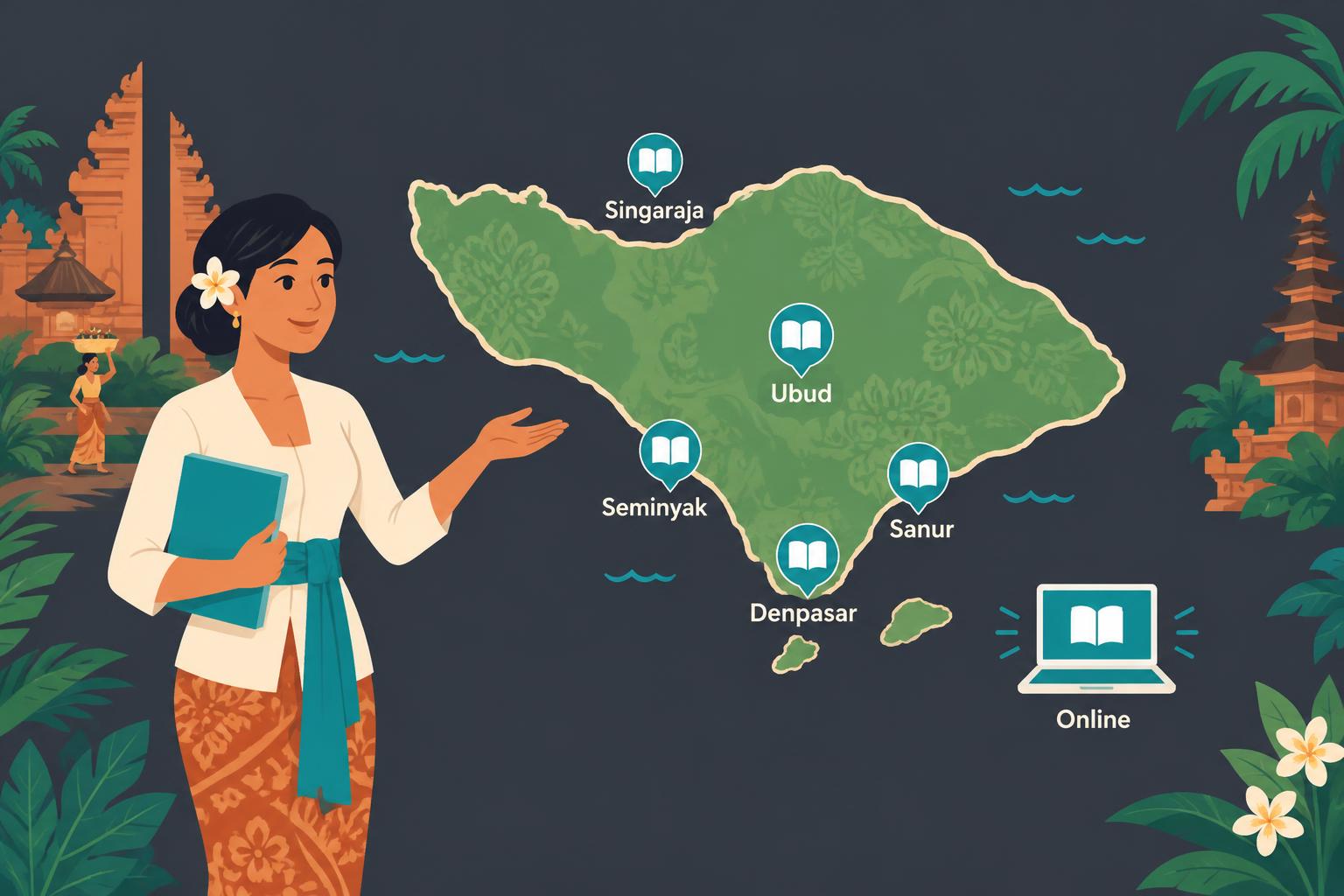
Choose the teaching location around your actual weekly routine, not simply the school’s Bali address. Denpasar, Singaraja, Ubud and Sanur are distinct study bases, and a provider’s office is not necessarily where every lesson happens.
- Denpasar: Udayana BIPA lists the Faculty of Humanities at Jalan Pulau Nias 13.
- Singaraja: Undiksha’s language unit is at Jalan Udayana 11, Buleleng.
- Ubud: Cinta Bahasa lists Jalan Raya Sanggingan 88X.
- Sanur: Cinta Bahasa lists Jalan Tukad Anyar 21/4.
- Near Sunset Road/Seminyak: Bali Language School lists its office at Jalan Gunung Athena 27.
- Home, office or online: Bahasa Bule advertises lessons in Canggu, Seseh, Ubud and Uluwatu, alongside visiting and online formats.
Before enrolling, request the exact classroom location and check the journey at the time you would attend. Do not organize your week around a general area name.
If you are relying on drivers or walking rather than riding, think through the return journey too. Our advice on living in Bali without a scooter is relevant to that decision. A nearby or online teacher may be the more sustainable choice even when another course has a lower advertised fee.
What Indonesian should I learn first for ordering food?
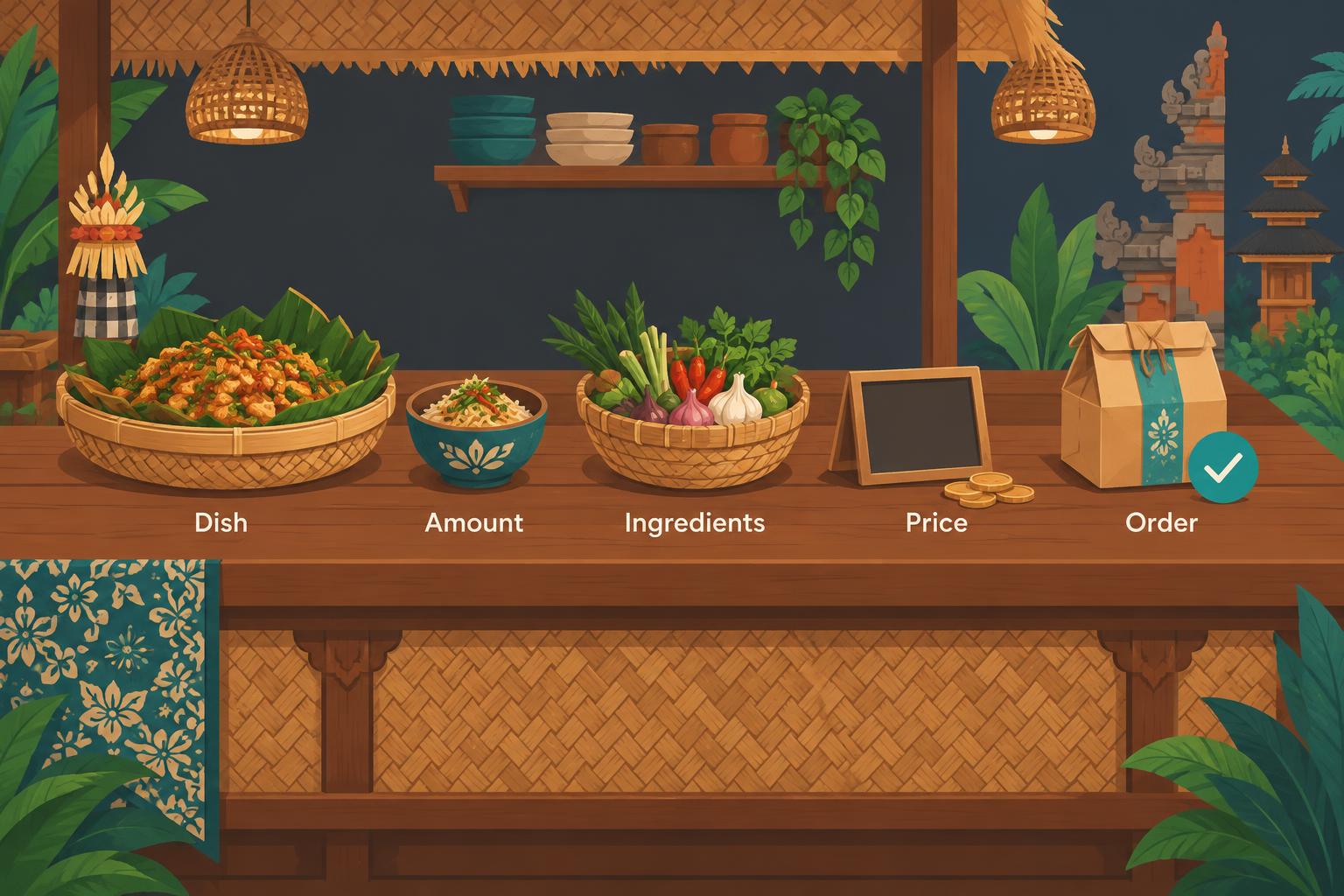
Start with naming dishes, stating quantities, asking prices and ingredients, expressing preferences and confirming the final order. These tasks are more immediately useful than memorizing an unrelated vocabulary list.
Restaurant ordering appears explicitly in Cinta Bahasa’s beginner syllabus. You can turn it into a practical lesson by bringing a menu from somewhere you actually eat and asking the teacher to rehearse both sides of the exchange.
- Choose: identify the dish and ask about an unfamiliar ingredient.
- Specify: state how much you want and explain a preference.
- Check: repeat the order and listen for a correction.
- Finish: understand the quoted price and ask a follow-up question.
Practice listening as deliberately as speaking. A perfectly rehearsed request is only half the task if you cannot recognize the reply or ask for clarification.
Take the same approach to shopping: bring your real grocery list to class and rehearse the questions attached to it. Our guide to grocery shopping in Bali can help identify situations worth practicing.
Where an ingredient matters for your health, do not treat beginner language confidence as proof that your message was understood. Confirm the details rather than guessing from a partial answer.
What should I practice for deliveries and talking to neighbors?
Learn to explain where you live, give a recognizable landmark, arrange a time and introduce yourself before pursuing more elaborate conversation. These are practical applications of the locations, directions, introductions and daily-activity topics in official beginner material.
Build practice around your actual circumstances, without sharing private information in public study groups:
- Deliveries: say an address, spell a name, describe the entrance and give a short arrival instruction.
- Neighbors: greet someone, introduce yourself, explain where you live and ask a simple question.
- Appointments: recognize numbers, days, dates and times, then repeat the agreed arrangement.
- Clarification: practice asking someone to repeat or explain what you missed.
Ask your teacher to vary the reply instead of following the same script every time. For example, rehearse a delivery where the caller cannot find the entrance, not only one where everything goes smoothly.
For neighbor conversations, keep the first exchange modest and let the other person decide whether to continue. A short introduction that you understand is a better learning milestone than a long memorized speech. Record useful new vocabulary afterward rather than turning every social interaction into an unsolicited lesson.
What should I check before paying for an Indonesian course?
Get a written description of the teaching time, schedule, full price and cancellation rules before buying a package. The largest comparison problems are often hidden in what providers mean by a session or what happens when you miss one.
- Language: confirm Indonesian rather than Balinese.
- Teaching minutes: request the length of each lesson and the total contact time.
- Full cost: include registration, books, travel, payment-method charges and scheduling supplements.
- Attendance: confirm the start date, classroom, minimum enrollment and evening or weekend availability.
- Teaching balance: ask how much time goes to speaking, listening, reading and writing.
- Changes: read the rules for cancellation, refunds, pauses and rescheduling.
- Outcomes: request specific tasks you should be able to perform, not a guaranteed fluency deadline.
- Certificate: establish whether it records attendance, completion or assessed proficiency.
Check definitions even when the headline sounds familiar. Jembatan Bahasa’s lesson-hour is 55 minutes, while Bahasa Bule’s main package page leaves session length unclear. These are different kinds of uncertainty and need different questions.
Keep the written quote and course description together. If the website and enrollment message disagree, resolve the discrepancy before paying rather than assuming the more generous version applies.
How will I know whether my Indonesian lessons are working?
Measure progress through everyday tasks you can complete and replies you can understand, not through a promised date for fluency. Finishing a package is evidence of completing study time, not automatically of unrestricted communication.
The official BIPA 1 benchmark concerns simple introductions and routine daily needs with a very cooperative conversation partner. That qualification matters: beginner success may depend on someone speaking patiently, repeating a question or helping you find a word.
Choose practical checkpoints and revisit them with your teacher:
- Introduce yourself without reading a prepared paragraph.
- Place a familiar food order and understand a clarification.
- Explain your entrance or landmark to a delivery caller.
- Agree an appointment and repeat the day and time correctly.
- Recognize when you have not understood and ask for help.
Keep a short record of what happened outside class. Bring the confusing reply, missed word or misunderstood time into the next lesson, then rehearse it again with a different response.
If your main difficulty is listening, another vocabulary worksheet may not solve it. Ask for more listening and response practice. The right course is one you can attend consistently and adapt to your actual communication gaps, whether it is university BIPA, an evening group or a private online lesson.
What else should I ask before my first Indonesian lesson?
Clarify missed-lesson rules, writing practice and how to bring your own vocabulary before the course begins. These details determine whether a package fits your needs after enrollment.
Can I reschedule if a work call interrupts my lesson?
Do not assume private tuition means unrestricted changes. Cinta Bahasa generally makes courses non-refundable and restricts rescheduling, including a minimum 24-hour notice requirement for eligible changes. Ask the provider what happens with late cancellations, missed group sessions and pauses, and obtain the policy before paying.
Will a conversation course teach me to write messages?
Ask explicitly. Cinta Bahasa describes its beginner course as conversation-led rather than emphasizing writing and grammar. If delivery messages or appointment confirmations are priorities, request written-message practice and feedback. A course can suit spoken interaction while still needing supplementary reading and writing work for your particular goals.
Can I bring vocabulary from my job or daily routine?
Bring examples and ask whether the teacher can incorporate them. A menu, an anonymized delivery message or a list of recurring appointment questions gives the teacher a concrete starting point. Agree which material belongs in the beginner course and which needs separate attention, rather than assuming a general package includes specialized instruction.