

The real Sanur rental decision is not simply which villa looks best: it is whether a flexible monthly home or a committed annual lease fits your stay, cash flow and daily routine. This Sanur long term rental guide settles that choice by comparing the two options across the points that change the experience after move-in.
For this article, monthly rental means a furnished home booked or contracted month by month, while an annual lease means a rental commitment for a year. Either can be a villa, house, apartment, guesthouse room or kost; the property type still affects privacy, maintenance and included services.
Sanur sits in Denpasar Selatan (South Denpasar), rather than being a separate regency. It is also changing: the 41.26-hectare KEK Sanur is designated for health and tourism activities, while Sanur Kaja, Sanur Kauh, Sanur Adat and Intaran Adat were formally launched as a Low-Emission Zone in February 2026. These are reasons to assess a specific address and your repeated journeys, not shortcuts for assuming rental prices will rise. Government Regulation No. 41/2022 sets out the KEK designation, and the City of Denpasar confirms the Low-Emission Zone coverage.
Sanur long term rental guide: compare monthly and annual commitment
A monthly rental buys you an exit route. It is the better starting point when you have not tested the street, your work arrangement may change, or you are still deciding whether Sanur is your long-term base. You can learn how the home functions in ordinary life before making a larger commitment.
An annual lease is for renters who already know their preferred pocket of Sanur, can commit the funds and have checked the home carefully. It reduces the frequency of renegotiating accommodation, but it also makes a wrong location, weak water pressure or unsuitable house rules much harder to escape.
| Decision factor | Monthly rental | Annual lease |
|---|---|---|
| Best for | Arrival, trial living and uncertain plans | Established routine and a known location |
| Ability to change home | Higher, subject to the agreed notice and term | Lower once rent is committed |
| Upfront exposure | Usually spread across shorter payment periods | Can involve a much larger commitment before move-in |
| What matters most | Clear renewal, notice and included-service terms | Detailed due diligence before funds change hands |
Do not treat “long term” as a substitute for a written end date. Record the start and finish date, renewal method, early-exit position, notice process and what happens to any deposit. For clause-by-clause preparation, use this guide to Bali rental agreement clauses that protect tenants.
Sanur long term rental guide: decide based on all-in cost
There is no verified public average for Sanur monthly or annual rents. A single number from an agent, social post or old listing cannot tell you what a comparable home costs today. Compare live asking rents only after matching stay length, bedrooms, furnishing, pool or shared facilities, cleaning, internet, electricity, water, tax and deposit requirements.
The September 2026 median monthly rent of Rp22,500,000 from 6 Livuma listings is a historical inventory snapshot, not a current benchmark, an official market average, a promised price, or a complete view of every rental in Sanur. It reflects advertised listings, not independently verified rental transactions; no independently verified November 2026 Sanur monthly or annual rent benchmark was established for this refresh.
| Area | Long-term rentals in snapshot | Median monthly rent | What the figure can tell you |
|---|---|---|---|
| Sanur | 6 | Rp22,500,000 | A small historical inventory sample from September 2026, not a current market benchmark |
| Canggu | 193 | Rp42,800,000 | A deeper pool of live listings in the September 2026 snapshot |
| Ubud | 40 | Rp36,720,000 | A separate area and property mix in the September 2026 snapshot |
| Uluwatu | 61 | Rp36,180,000 | A separate area and property mix in the September 2026 snapshot |
| Seminyak | 35 | Rp35,000,000 | A separate area and property mix in the September 2026 snapshot |
The comparison is useful only as context: it does not prove that any Sanur property is good value. A Sanur home with a different number of bedrooms, staff arrangement or utility treatment is not like-for-like with another listing.
Ask for an all-in payment schedule before agreeing. Ordinary rental income from land and buildings is subject to 10% final income tax on gross rent, including related maintenance, security, service and facility charges whether bundled or billed separately. Where an ordinary individual tenant is not a designated withholding agent, the landlord pays this tax themselves; it is not an automatic statutory 10% tenant surcharge. Accommodation services, including rumah kos, are excluded from this particular 10% rental-income regime. The contract should say whether the quoted rent includes applicable tax and who manages any withholding or payment. The Directorate General of Taxes explains the rental-income tax treatment here.
When comparing homes, Livuma’s live inventory lets you filter by area, rental type, price, stay length, bedrooms and amenities; each listing shows pricing, availability, minimum stay, house rules and booking conditions.
Beachside convenience versus inland routine in Sanur
Choose an address by the routes you will repeat, not by a broad “Sanur” label. Make two route tests before committing: one at the time you expect to travel for work or appointments, and another for your usual food, groceries, exercise or school run. Then repeat them from the exact gate of the property, not the nearest main road.
The Low-Emission Zone now covers Sanur Kaja, Sanur Kauh, Sanur Adat and Intaran Adat. If you rely on a scooter, car, walking or a particular pickup point, check the current practical implications for your own route. Read the local policy change in the explanation of Bali low-emission zones rather than assuming rules are identical across every Bali destination.
- Choose beachside convenience if reaching the promenade and nearby daily stops is central to your week.
- Choose an inland routine if the home itself, road access, parking or proximity to your regular cross-Denpasar journeys matters more than beach access.
- Choose neither until tested if the listing pin is vague or the host will not identify the access road and nearest landmark before a viewing.
For renters intending to live without their own scooter, the relevant test is whether the address works repeatedly, including after dark and with shopping, not whether a map makes it look close. This practical guide to living in Bali without a scooter can help structure that test.
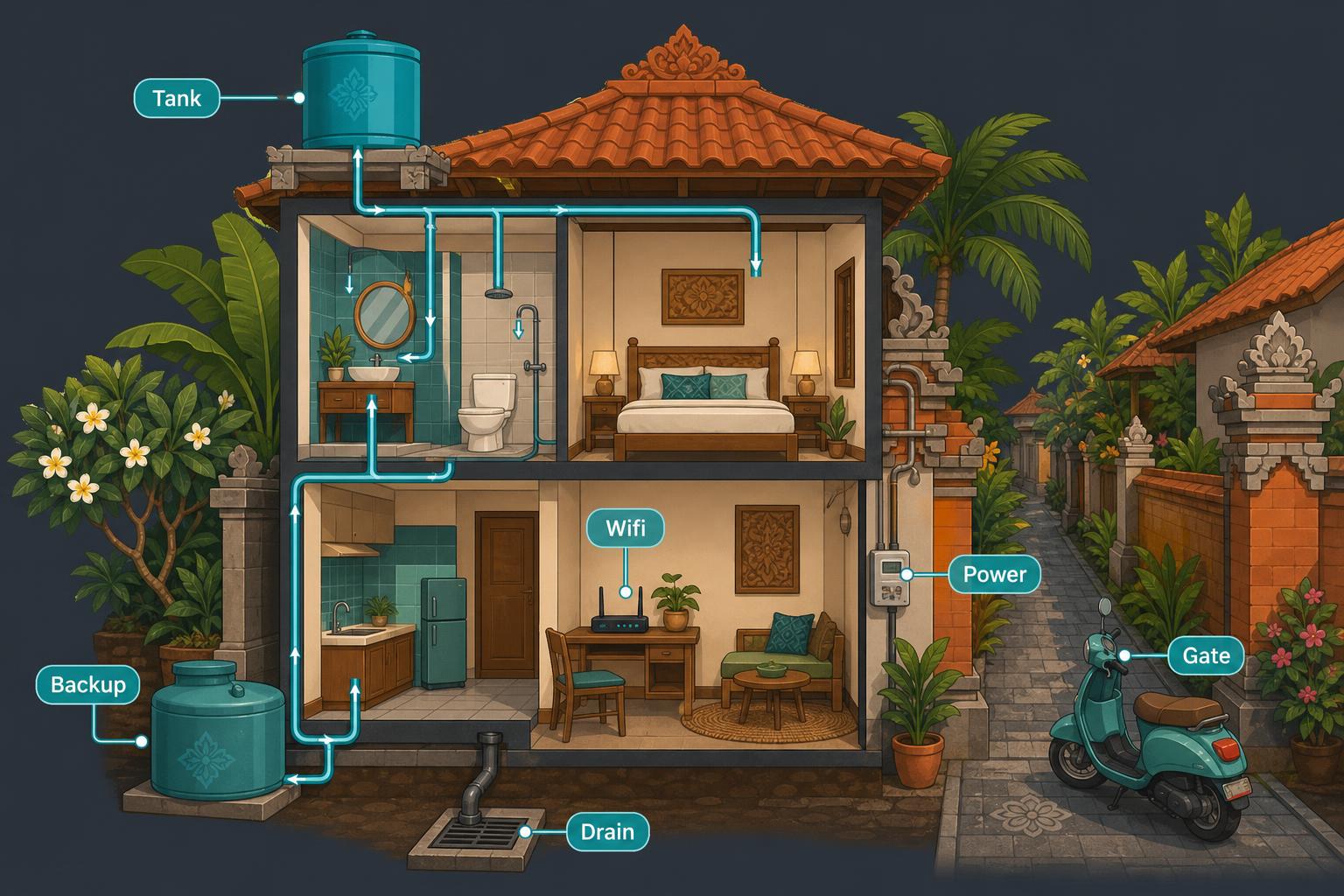
Water, access and home systems: monthly renters can test, annual renters must inspect
A beautiful listing is not evidence that the home is easy to live in. Sanur renters should verify the systems that determine whether the property works every morning: water, drainage, internet, electrical capacity, access and responsibility for repairs.
Water deserves a direct conversation. In January 2026, Denpasar’s legislature reported municipal water-utility coverage of only about 53% citywide. That is not a measurement of any one Sanur house, but it is a good reason to ask exactly where water comes from, whether there are storage tanks or a backup supply, how pressure performs and who pays for deliveries or repairs.
| Check at viewing | Question to ask | Why it changes the decision |
|---|---|---|
| Water source and tanks | What is the supply, storage and backup arrangement? | Turns a vague “water included” claim into a usable plan |
| Pressure and drainage | Can you test taps, showers and drains during the viewing? | Shows how the home performs, not how it photographs |
| Internet | Which provider serves the address and who handles faults? | Essential for remote work and streaming |
| Power | What meter arrangement, capacity and payment method apply? | Prevents assumptions about usage and bills |
| Access and parking | Can your normal transport reach the gate easily? | Affects daily arrivals, deliveries and visitors |
| Repairs | Who approves and pays for routine and urgent fixes? | Reduces disputes after move-in |
Monthly renters should use the first days to document the condition with dated photos and report issues in writing. Annual renters should perform these tests before payment, because testing after a year is paid is not leverage.
On Livuma, eligible monthly and yearly rentals offer “view property first”: secure only a small deposit, arrange an in-person or virtual viewing with the host in app chat, then pay the rest in the app to confirm, with no deadline or automatic confirmation. Alternatively, cancel for free and the deposit is released or refunded in full; this gives you an opportunity to ask system-specific questions but does not replace your own inspection.
Annual Sanur leases need stronger paperwork than a monthly stay
The longer the commitment and the larger the payment, the more precisely the agreement should identify the home, the parties and the rules. Do not rely on an informal promise that a family member, manager or agent is “handling” the property. Ask who is authorised to lease it and ensure that person or entity is named in the agreement.
- Full property address and the part of the property you may use
- Landlord or authorised representative’s identity and signing authority
- Term, handover date, renewal route and notice procedure
- Rent, payment dates, deposit, refund conditions and any late-payment consequence
- Included and excluded costs: power, water, internet, cleaning, pool or garden care, security and tax
- Inventory and condition record, including keys, remotes, meters and furnishings
- Repair responsibilities, access for maintenance and house rules
A useful digital trail is especially valuable when there are multiple payment dates. On Livuma, hosts activate with identity verification, legal details and an Indonesian bank account before accepting paid bookings, and guests complete identity verification before agreement issuance; booking-specific payment, cancellation and refund terms appear before commitment, with digital rental agreement details and receipts generated for supported bookings.
For any rental, preserve the signed agreement, payment proof, inventory and written repair messages in one folder. See the separate checklist on what to check before signing a Bali rental contract.
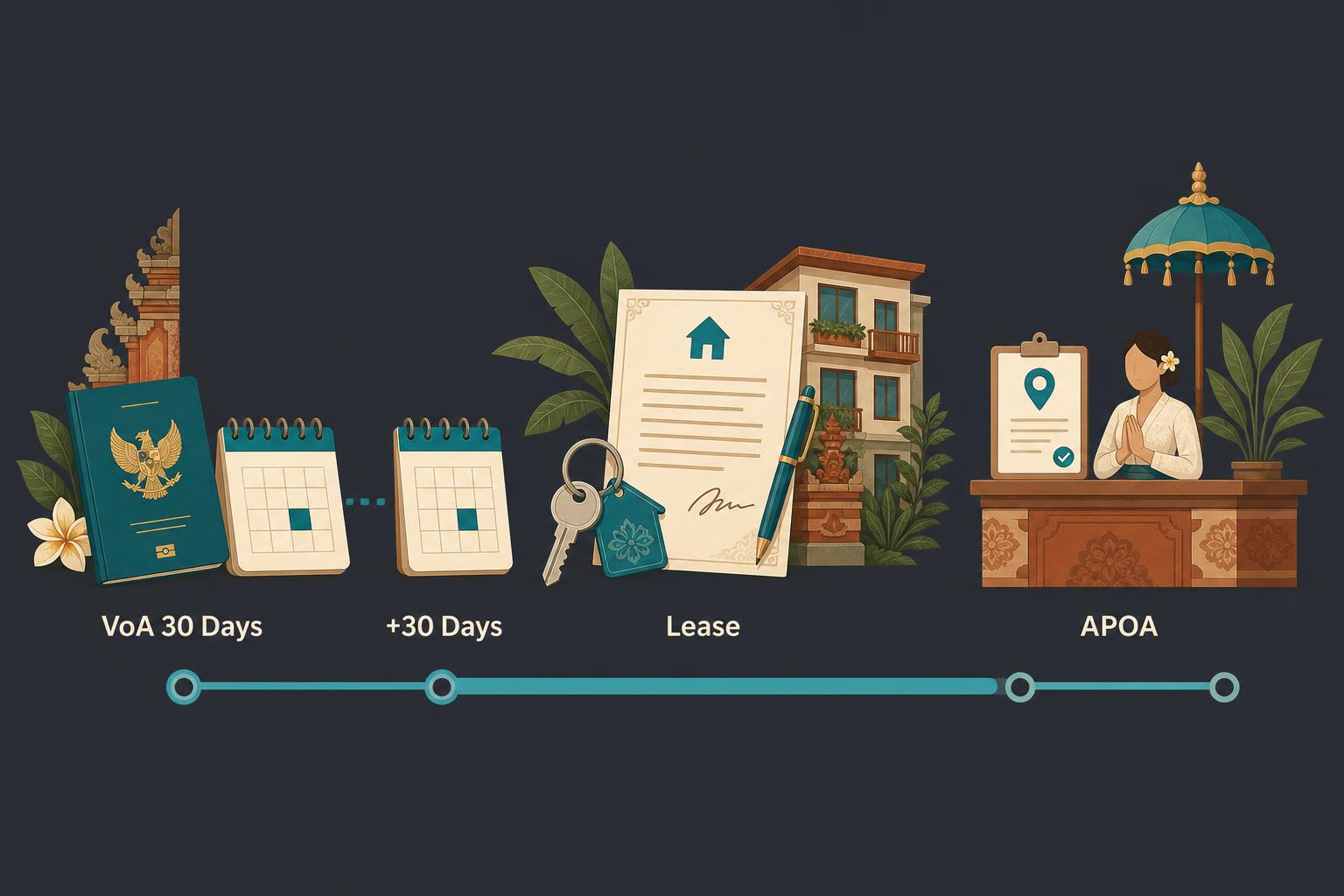
Visa, address reporting and tax residency do not follow the rental term
A one-year lease does not grant immigration permission, and a short rental does not eliminate tax or address-reporting questions. Choose the rental term after confirming that your immigration position supports the time you expect to be in Indonesia.
Visa on Arrival is 30 days and may be extended once for another 30 days, making a maximum 60 days. It is not a six- or twelve-month housing solution. Extensions require an online application followed by attendance at Immigration for a photograph and interview. Immigration guidance provides a one-year stay under E33G for foreigners working from Indonesia within an employment relationship with an overseas company; holders may not work for, or receive payment from, Indonesian individuals or legal entities. Eligibility details, fees and current requirements should be checked directly with Immigration before relying on it. Immigration explains the extension procedure, and Ngurah Rai Immigration sets out E33G eligibility.
Accommodation owners or managers must report foreign guests’ check-in and check-out through APOA. Confirm that the operator can make the report, then report a change of address or other relevant change to the local Immigration Office as required. The operator’s guest report does not replace your separate address-reporting obligation. Do not assume a rental contract alone completes either step.
For personal tax, residence, presence for more than 183 days in any 12-month period, or presence with an intention to reside are alternative Indonesian domestic-tax-subject tests under PER-23/PJ/2025; days need not be consecutive and part of a day counts as a full day. A qualifying long-stay visa/KITAS or a residential lease exceeding 183 days can also be relevant evidence of an intention to reside. A stay of fewer than 184 days is therefore not an automatic exemption from Indonesian tax analysis. Where someone is domestically resident in Indonesia and a treaty-partner jurisdiction, the applicable tax treaty determines treaty residence. Read the focused explainer on Indonesia tax residency and the 183-day rule, then obtain professional advice for your own circumstances.
Monthly renters should choose flexibility; settled Sanur residents should choose annual leases
Choose a monthly Sanur rental if you are newly arrived, your visa or work situation is still being confirmed, you have not tried the daily routes from the address, or you need the option to move after discovering how the home performs. It is the sensible choice for learning Sanur without turning uncertainty into a large upfront commitment.
Choose an annual Sanur lease if you already know the micro-location that serves your routine, have inspected water, power, access and internet, understand every included and excluded cost, and can document the landlord’s authority and all payment terms in writing. It is for stability, not for solving an undecided move.
Do not choose either yet if the address is unclear, the viewing is refused, the water arrangement cannot be explained, the contract leaves tax or deposit treatment vague, or the person taking payment cannot show authority to lease. Keep looking until those basics are clear.
Renting monthly or annually in Sanur through Livuma
- Compare the commitment. Search Sanur rentals by rental type, price, stay length, bedrooms and amenities; check availability, minimum stay, house rules and verified guest reviews.
- Read the financial terms. Review the booking-specific payment schedule, deposit or balance rules, deadlines, cancellation rules and refunds before committing.
- Secure the request. Before the host sees it, secure a card reservation, not yet charged, or a held Indonesian bank-transfer prepayment. Declined, withdrawn or expired requests receive automatic full release or refund.
- Confirm or view first. The host answers within a limited window; approval normally charges the card reservation and confirms the booking. Where available, “view property first” secures only a small deposit: after viewing, pay the rest in app to confirm, with no deadline or automatic confirmation, or cancel free for a full release or refund. Keep arrangements in app chat.
- Keep the paperwork. Hosts verify identity and legal details before paid bookings; guests verify identity before agreement issuance. Supported bookings receive digital rental agreement details and receipts.
- Confirm arrival. Confirm check-in or report a problem in app. Payments run via Xendit; host payout follows successful check-in, automatically about 24 hours later, never while a reported problem remains open. Later payments follow the displayed schedule.