

Sharing a Bali home with a partner now raises questions that a landlord’s approval alone cannot answer. This guide is for Indonesian, foreign and mixed-nationality couples assessing the criminal-law position and the practical checks before committing to a long-term rental.
Can unmarried couples legally live together in Bali?
Unmarried couples cannot treat marriage-like cohabitation in Bali as legally unrestricted, but sharing a rental does not automatically trigger prosecution. Indonesia’s Criminal Code prohibits living together as husband and wife outside marriage, with enforcement dependent on a complaint from a specifically eligible person and proof of the offence.
Law No. 1/2023 took effect on 2 January 2026. The official explanation to Law No. 1/2026 confirms that commencement date; references to commencement in January 2025 are incorrect.
The useful distinction is between three separate questions:
- Does the relationship involve conduct covered by the criminal provisions?
- Is there an eligible complainant who can initiate the required complaint?
- Will the particular property accept the proposed occupants?
A host accepting an unmarried couple answers only the property-policy question. Conversely, a property refusing unmarried couples does not establish that every joint rental is automatically a criminal offence.
The same national framework applies in Bali; the island’s tourism announcements should not be read as creating a separate criminal-law exemption. This is general information, not advice on whether a particular relationship or living arrangement satisfies the offence.
What is the difference between sex outside marriage and cohabitation?
Article 411 concerns sexual intercourse outside marriage; Article 412 concerns living together as husband and wife outside marriage. They are distinct offences, not interchangeable descriptions of booking a room or signing a lease.
The enacted Criminal Code sets out the offences and their maximum penalties:
| Provision | Conduct addressed | Maximum penalty |
|---|---|---|
| Article 411 | Sexual intercourse with someone other than one’s spouse | One year’s imprisonment or a Category II fine |
| Article 412 | Living together as husband and wife outside marriage | Six months’ imprisonment or a Category II fine |
| Article 79 | Category II fine ceiling | Rp10 million |
These are maximum penalties, not automatic sentences or standard charges. Both offences have complaint requirements, and the conduct alleged must still be proved.
For a long-term renter, the practical consequence is that the accommodation transaction and the relationship must be considered separately. A joint lease is not itself the conduct Article 412 describes, while a rental agreement cannot exempt an otherwise prohibited living arrangement. Equally, an allegation about intercourse is not automatically proof of marriage-like cohabitation, or vice versa.
Who can report an unmarried couple under Indonesia’s cohabitation law?
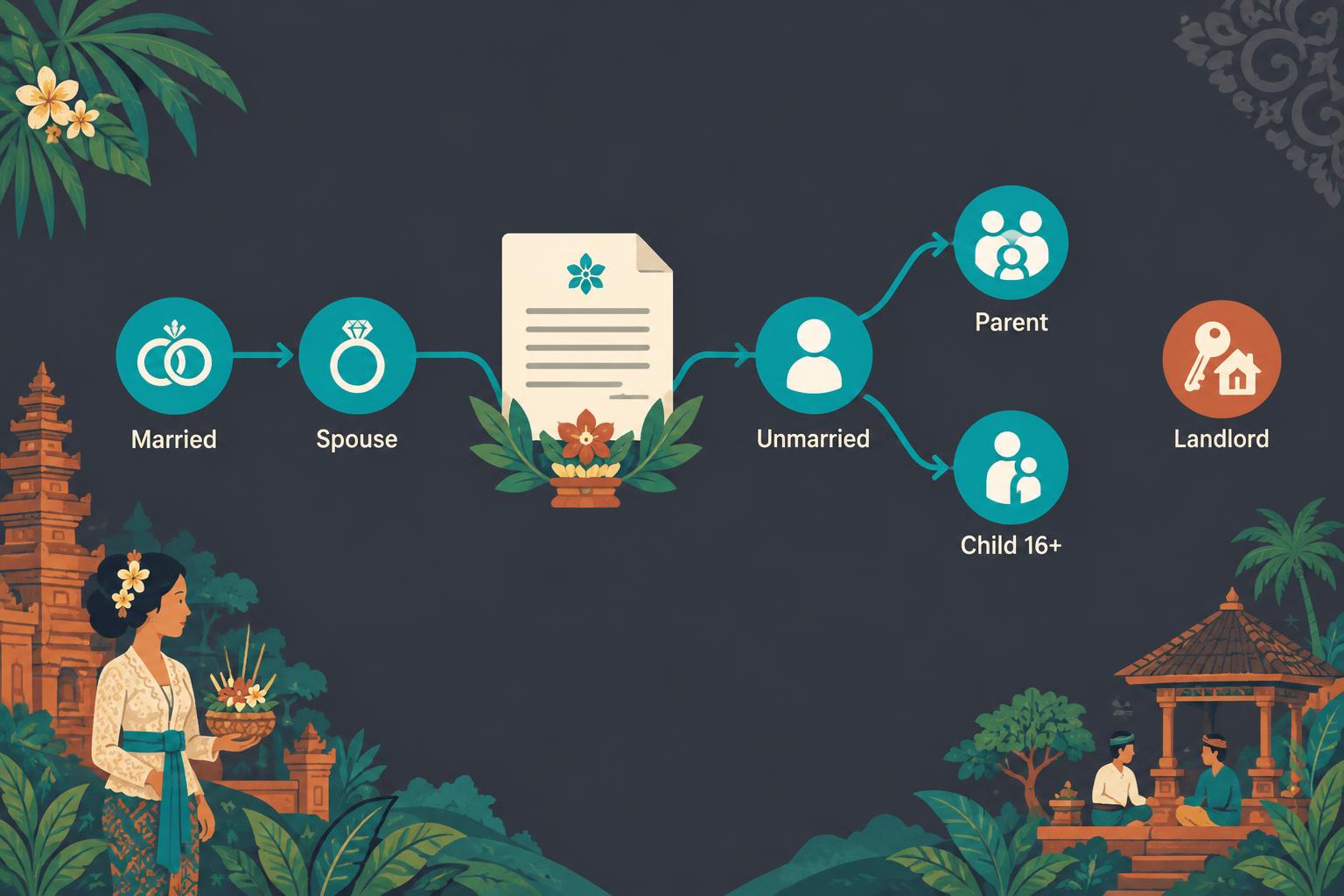
The required complaint must come from the spouse of a married person, or a parent or eligible child of an unmarried person. “Any family member” is too broad: the statutory list matters.
The Constitutional Court’s explanation of the complaint rules identifies the relevant relationships for Articles 411–412:
- If the person is married: their husband or wife.
- If the person is unmarried: their parent or child.
- For a complaining child: the enacted explanation specifies a biological child aged at least 16.
A sibling, neighbour, landlord, community organisation or banjar official does not acquire the required standing merely through that relationship or role. A landlord who is also an eligible parent would be a different situation: eligibility would arise from being the parent, not from owning the property.
A Ministry of Law legal counsellor has described cohabitation as an absolute complaint offence. That means an eligible complaint is a necessary enforcement condition, not that the conduct has been legalised.
It also does not mean that neighbours cannot raise concerns about unrelated matters. The restricted complaint mechanism for these offences should not be confused with an exemption from ordinary identity, residence or accommodation checks.
Does the law apply to foreign couples and mixed-nationality couples?
Foreign nationality does not exempt a couple from Indonesia’s cohabitation law, and a mixed-nationality couple does not need complaints from both partners’ families before becoming legally exposed. The complaint rules concern eligible relationships, not a special category of Indonesian-only defendants.
Consider the distinction:
- Two unmarried foreign partners: sharing a Bali home does not automatically result in prosecution, but an eligible parent’s or child’s complaint can engage the law. Relatives living overseas do not create immunity.
- An unmarried Indonesian and an unmarried foreign partner: the Indonesian partner’s parent can supply an eligible complaint. A separate complaint from the foreign partner’s family is not a prerequisite.
UK travel advice for Indonesia expressly refers to eligible relatives of either party. US government advice also states that the new code applies to Indonesians and foreigners.
The important caveat is that a complaint is not a conviction: the alleged offence must still be established. Nevertheless, “we are both foreigners,” “our families are abroad” and “only one family objects” are not reliable legal answers. Where family opposition is a realistic concern, obtain Indonesian legal advice before committing to the living arrangement.
Can parents complain about adult Indonesian couples, and what if someone is still married?
Parents retain complaint rights when their unmarried children are adults, while a person who remains married can face a complaint from their spouse. Being financially independent or describing a relationship as an “unmarried couple” does not resolve either issue.
BPHN’s official legal-consultation service explains that parents can complain even where both unmarried partners are adults. Such a complaint can implicate the parent’s own child as well as the partner; it is not simply a mechanism for taking action against a disliked boyfriend or girlfriend.
Existing marriages require a separate check:
- A person living with a new partner may still have a husband or wife.
- For that married person, the relevant complainant under these provisions is their spouse.
- The other partner’s marital status and eligible complainants must also be considered.
Do not assume that calling a relationship a separation settles the legal position. If either partner’s marital status is unresolved, a lawyer needs the actual circumstances rather than the couple’s preferred description.
The practical assessment therefore begins with both individuals’ marital status and the eligible complainants connected to each person—not simply nationality, age or whose name appears on the rental agreement.
How long can an unmarried couple stay together before it counts as cohabitation?
There is no reliable “safe number of nights” to give an unmarried couple planning a Bali stay. The difficult issue is whether the facts amount to living together as husband and wife, not whether a booking crosses a convenient rental-duration threshold.
ICJR’s legal analysis raises uncertainty about how that marriage-like living arrangement is to be identified. This guide therefore cannot turn a weekend, monthly booking or yearly lease into a definitive legal test.
The same caution applies to house-sharing. Unmarried friends sharing accommodation to reduce costs present a different factual situation from partners setting up a shared household, but the precise boundary should not be presented as settled. Shared premises alone should not be treated as conclusive proof of marriage-like cohabitation.
- Do not rely on an invented nights-based exemption.
- Do not assume separate names on documents settle the character of the relationship.
- Do not assume a joint lease conclusively proves the offence either.
For genuine roommates or an unusual household arrangement, describe the actual facts to Indonesian counsel. A lawyer assessing those facts is more useful than a booking platform, host or online commentator promising that a particular stay length is automatically safe.
Must Bali landlords ask unmarried couples for a marriage certificate?
Articles 411–412 do not expressly require landlords to collect marriage certificates from tenants. They define criminal offences; they are not a universal screening checklist for every Bali villa, apartment or kost.
Separate the sources of a document request:
- National criminal law: the offences themselves contain no express universal landlord certificate requirement.
- Property policy: an individual rental may state “married couples only” or require proof of marriage.
- Address-specific practice: ask what document is requested, by whom and on what basis rather than assuming every request has the same origin.
Bali’s governor announced on 11 December 2022 that marital status would not be checked at tourist-accommodation check-in, naming hotels, villas, apartments and guesthouses. That announcement predates commencement of the code and is an administrative assurance, not a legislative exemption or proof that every residential rental follows identical policies.
On Livuma’s rental platform, listings show house rules and booking conditions, and in-app chat keeps a host’s clarification about occupant acceptance on the record. Neither a host’s acceptance nor identity verification establishes that a relationship complies with criminal law.
If someone claims a universal certificate mandate, request the specific applicable rule rather than accepting the claim at face value.
Can officials still check a Bali rental if no eligible relative has complained?
Yes—identity and residence checks are distinct from prosecuting the cohabitation offence. A restricted complaint mechanism does not mean officials can never attend rented homes or ask for accommodation-related documents.
Bali Governor Regulation No. 57/2025, effective 23 December 2025, provides for checks on non-permanent residents at rented homes and kost, including identity and residence documents. Those administrative checks should not be described as automatic Article 412 proceedings.
Foreign-guest reporting is another separate issue. Ngurah Rai Immigration’s published guidance says accommodation operators must provide foreign-guest information when requested under Immigration Law Article 72; its APOA procedure uses passport information, rather than proof of marriage.
For a prospective tenant, ask:
- Which identity and residence documents are needed for this address?
- Who handles the accommodation’s foreign-guest reporting?
- Is an additional request a property condition or an identified administrative requirement?
The guide to registering a Bali address covers the separate documentation context. Do not interpret the cohabitation complaint restrictions as permission to ignore residence administration, or assume that providing passport details amounts to an admission of prohibited conduct.
What happens if an eligible relative files a complaint?
An eligible complaint can enable enforcement, but it does not establish guilt or trigger an automatic penalty. The complaint requirement and proof of the alleged conduct are separate parts of the legal position.
For both Articles 411 and 412, the complaint may be withdrawn before examination at the court hearing begins. That is the statutory withdrawal boundary; it should not be replaced with a vague assurance that a family can stop proceedings whenever it wishes.
If a complaint is threatened or made:
- Seek Indonesian criminal-law advice about the actual relationship and allegation.
- Distinguish an eligible statutory complainant from someone objecting only as a neighbour or landlord.
- Keep the complaint issue separate from any rental cancellation, refund or move-out dispute.
- Do not assume moving accommodation resolves alleged conduct that has already occurred.
Neither complaint-based enforcement nor a family’s current acceptance is a permanent certificate of legality. Equally, a threat from someone without the required standing should not be presented as proof that prosecution under these articles can proceed on that person’s complaint alone.
This is the point at which general accommodation guidance reaches its limit. A host or rental platform cannot assess the evidence, represent either partner or promise a particular enforcement outcome.
Does Indonesia’s cohabitation law apply to same-sex couples?
This guide cannot give same-sex couples a reliable categorical assurance of either coverage or exemption under Articles 411–412. The application requires individual Indonesian legal advice rather than an assumption based on another couple’s rental experience.
The unresolved question should not be answered by simply extending every example involving a man and woman to every other relationship. Nor should the phrase “husband and wife” be treated here as a sufficient basis for promising that a same-sex couple is outside all relevant legal risk.
For practical planning, keep the questions separate:
- How might the specific criminal provisions apply to the actual circumstances?
- What occupants and documents will the property accept?
- What identity or residence administration applies at the address?
A host’s willingness to rent answers only the accommodation-policy question. It is not an authoritative interpretation of the Criminal Code.
Before making a substantial rental commitment, seek advice that specifically addresses the relationship rather than relying on a broad “foreigners are exempt” or “tourists are fine” statement. This is a genuine boundary of the guide, not a reason to infer either automatic prosecution or immunity.
What should an unmarried couple confirm before signing a Bali rental?
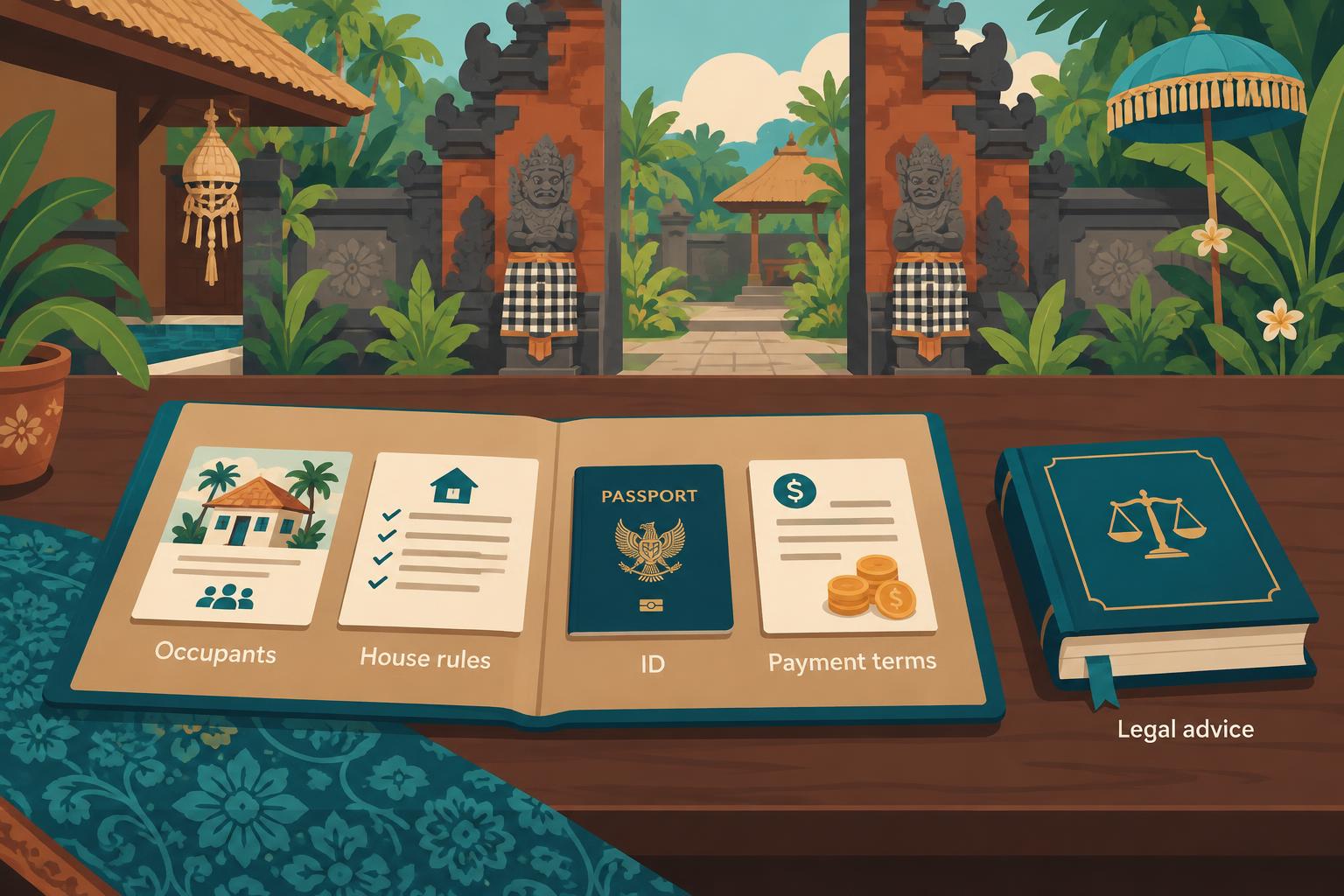
Confirm the property’s acceptance policy, required documents and financial terms before committing, while assessing criminal-law exposure separately. A clear rental agreement reduces accommodation misunderstandings; it cannot legalise conduct prohibited by national law.
Use a short, explicit checklist:
- Occupants: identify who will actually live at the property.
- Acceptance: ask whether unmarried partners are accepted and whether any marriage-document condition applies.
- Documents: distinguish identity and residence requirements from a property’s own screening policy.
- Money: read the deposit, balance, cancellation and refund terms before securing the booking.
- Legal circumstances: assess existing marriages, eligible complainants and any credible family objection separately from the lease.
For direct rentals, retain the owner’s written response rather than relying on a verbal “no problem.” The questions to ask a Bali landlord before paying provide a broader framework for checking the proposed tenancy.
Do not request or use inaccurate marriage documents, and do not mistake a lack of questions at check-in for legal clearance. If a property’s answer is vague, resolve it before committing rather than assuming an advertising photograph or a previous guest’s experience establishes the current acceptance policy.
How can an unmarried couple rent a Bali home through Livuma?
Livuma provides a documented rental process, not a ruling on whether a couple’s relationship complies with Indonesian criminal law. Use the booking process to clarify the property’s acceptance conditions and payment obligations.
- Find and compare: search Bali rental homes by area, rental type, stay length and amenities; read the listing’s house rules and booking conditions.
- Review terms before committing: the booking-specific payment schedule, deposit or balance rules, deadlines, cancellation rules and refund logic appear before you secure the request.
- Secure the request: use a card reservation, with nothing charged yet, or an Indonesian bank-transfer prepayment held by Livuma. A declined, withdrawn or expired request releases the reservation or triggers a full prepayment refund automatically.
- Resolve acceptance questions: use in-app chat to record the host’s response about the proposed occupants and documents. Host approval charges a card reservation and confirms a standard booking.
- Complete the booking record: guests complete identity verification before the rental agreement is issued; supported bookings receive generated agreement details and receipts.
- Confirm arrival or report a problem: host payout is withheld until successful check-in under the booking’s terms and is not released while a reported problem remains open.
These records address rental arrangements, not immunity from Articles 411–412.
What other legal questions should couples check before moving in?
Have constitutional challenges struck down the cohabitation offences?
No. On 30 July 2026, the Constitutional Court accepted withdrawal of case 228/PUU-XXIV/2026. On 12 August 2026, it declared case 280/PUU-XXIII/2025 inadmissible for lack of demonstrated standing. Neither outcome was a merits judgment invalidating Articles 411–412.
Does owning the Bali home create an exemption?
No. Article 412 concerns the living arrangement, not whether the occupants rent or own the property. Ownership does not remove the offence or its complaint mechanism. Likewise, a landlord’s permission concerns occupation of the property; it is not permission to disregard criminal law.
Did the national code abolish every local accommodation rule?
No. Article 412’s enacted explanation displaces subordinate cohabitation provisions, subject to its special-law exception. That should not be read as abolishing every accommodation, identity or residence-registration rule. If a document request is described as a local requirement, ask which specific rule applies to the address.