

Living in your Bali property, leasing it as an ordinary home, or operating serviced accommodation creates different annual costs—and different demands on your cash reserves.
Understanding what property owners in Bali must budget for annually starts with choosing the right operating model, not applying a generic percentage to the purchase price. This comparison separates the costs that follow the building from those created by tenants, guests and staff.
The options are:
- Owner-occupied home: budget for your own consumption, property upkeep and ownership obligations, without assuming rental income will cover them.
- Ordinary residential lease: budget for rental-income tax, owner-retained expenses, repairs and gaps between tenancies.
- Serviced accommodation: budget for the operating business as well as the property, including staffing, guest-related consumption and the applicable accommodation-tax treatment.
A kost needs its own classification check: monthly billing does not automatically make it an ordinary property lease. The comparison below explains where the budgets diverge and which model fits your capacity to fund and manage the property.
What property owners in Bali must budget for annually: property tax across all models
PBB-P2 property tax belongs in every ownership budget, whether the building is occupied by its owner, leased to a household or used for accommodation. The starting document is the property's current assessment and bill—not the seller's recollection of what they paid.
Badung's published local-tax schedule, effective January 1, 2024, lists PBB-P2 rates of 0.1% for NJOP up to Rp1 billion and 0.2% above Rp1 billion. These are assessed-value bands, not purchase-price bands. They are not enough, by themselves, to establish your final bill.
Badung's NJOP amendment took effect on March 24, 2025, not at the August 2025 council meeting about objections to increases. The calculation applies an assessment percentage to NJOP after the non-taxable allowance, rather than multiplying the headline rate by the purchase price. Consequently, carrying an old bill unchanged into your annual forecast can understate the obligation. Confirm the property's 2026 assessment, applicable treatment and any relief directly against its records.
Relief also differs by jurisdiction. Denpasar's 2026 programme runs through November 30, 2026, with qualifying PBB-P2 principal reductions reaching 37.5% for noncommercial residential properties; new tax-object numbers issued in 2026 are excluded. That is conditional local relief, not an exemption for every Bali property.
- Keep the assessment, payment evidence and property identifiers together.
- Record relief separately from the underlying obligation, so a temporary concession does not become a permanent budget assumption.
- Check which ownership or tenure arrangement you actually hold before assigning expenses.
For foreign buyers, that last point matters: foreign individuals cannot hold Hak Milik land title. Our explanation of Indonesian property titles for Bali buyers helps distinguish the interest being acquired. Any contractual allocation of expenses needs checking against that specific arrangement.
Annual income-tax costs differ between a home lease and serviced accommodation
An owner-occupied home does not generate rental income merely because it has a potential rental value. Once you earn income, however, the nature of the activity becomes central to the budget.
| Property use | Income-related budget treatment | Main budgeting trap |
|---|---|---|
| Owner-occupied home | No rental-income line unless the property actually earns rental income | Using hypothetical rent to offset real ownership bills |
| Ordinary land/building lease | Generally 10% final income tax on gross rent; nonresident recipients require a separate Article 26 check | Calculating tax on profit after expenses |
| Serviced villa accommodation | Determine the applicable business-income treatment; Badung lists 10% PBJT on hotel services | Assuming ordinary lease tax and accommodation tax are interchangeable |
| Kost or lodging business | Check business classification and eligibility for any concession | Choosing the tax category from the payment interval alone |
For an ordinary property lease, DJP's rental-tax guidance generally specifies a 10% final tax on gross rent. Maintenance, security, service and facility charges connected with the lease enter that gross base, even under separate agreements. Repairs and management spending therefore cannot simply be deducted before applying the rate. For rent paid to nonresident taxpayers, DJP separately lists PPh Article 26, generally 20% of gross income unless treaty treatment applies, so 10% is not universal for offshore owners.
An ordinary individual tenant who is not a designated withholding agent generally leaves payment responsibility with the landlord. Qualifying corporate tenants generally withhold instead. Budget the liability and track who settles it; withholding is not a reason to lose the supporting evidence.
Lodging services, including kost, are excluded from that ordinary rental regime; that does not make their business income tax-free. In Badung, the published 10% hotel-services PBJT is separate from the operator's income tax. Qualifying villa accommodation services are excluded from VAT under the hotel-services rules, so do not automatically stack VAT onto the accommodation charge.
DJP's 2026 explanation also describes a possible 0.5% final business-income tax for eligible individual taxpayers, subject to the Rp4.8 billion turnover condition, with the first Rp500 million of qualifying annual turnover excluded. That Rp500 million concession does not apply to ordinary property rent taxed under PP 34/2017. Do not build a kost's forecast around this until eligibility under PP 20/2026, effective April 22, 2026, is checked. The separate rental-income tax explainer covers these distinctions in greater depth.
Electricity and water budgets depend on property use and connection class
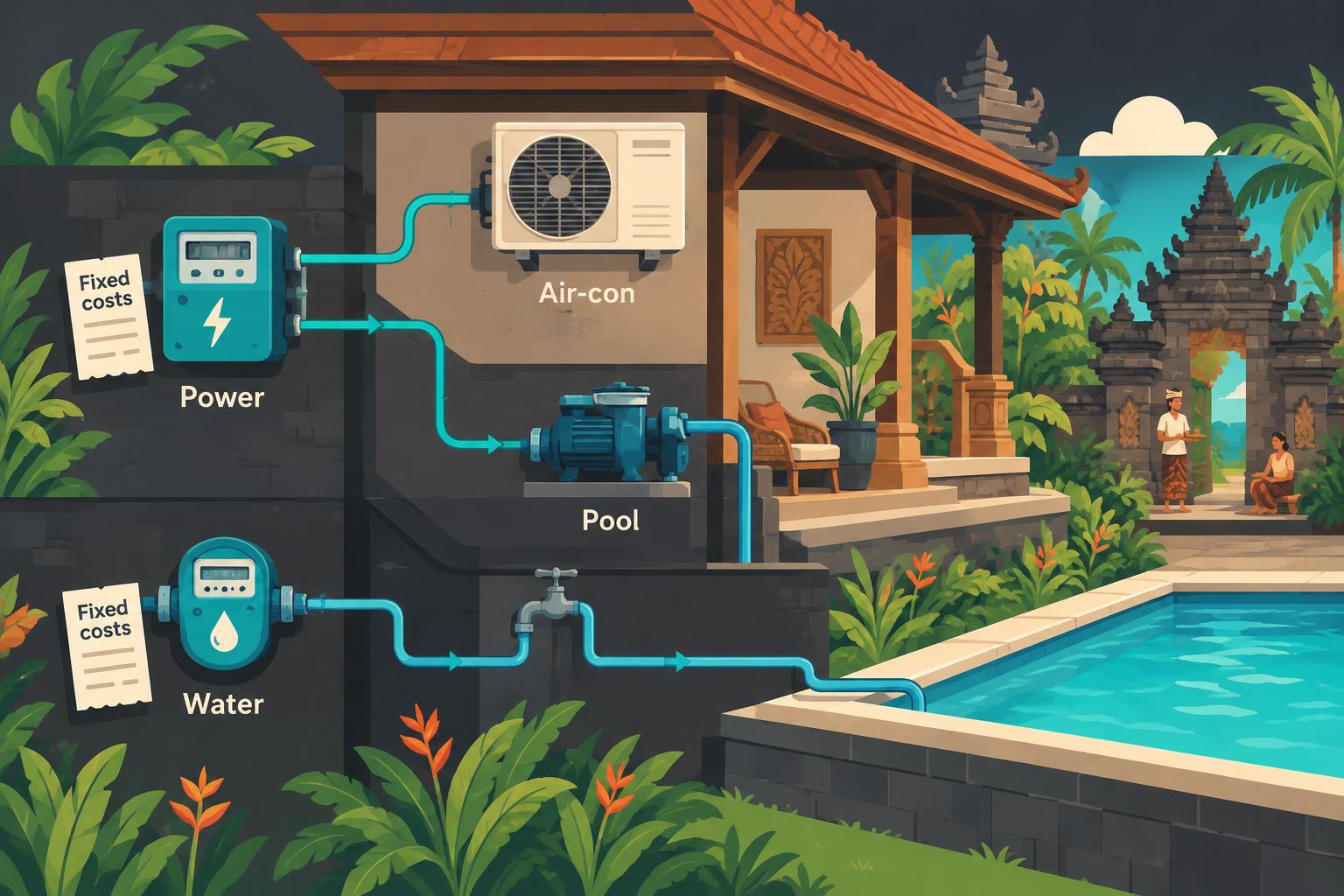
An owner-occupier pays for personal consumption. An ordinary landlord may transfer specified bills to the tenant. A serviced-accommodation operator must account for whatever consumption is included in the guest price. In every case, use the actual meter classification rather than a neighbouring property's bill.
| Budget component | Published reference | What to verify |
|---|---|---|
| Residential electricity, 1,300–2,200 VA | Rp1,444.70/kWh | That the connection is in this residential class |
| Residential electricity, 3,500 VA and above | Rp1,699.53/kWh | The property's actual connection class and consumption |
| Relevant postpaid minimum bill | 40 hours × connected kVA × usage tariff | Whether the minimum applies to the account |
| Badung R2 household water | Rp3,073/m³ for the first 10 m³; Rp6,941/m³ for the next 10 m³; Rp8,569/m³ above 20 m³ | That R2, the household class with 1,300 VA electricity, is the correct classification |
| Badung water fixed charge | Rp13,000 monthly; Rp156,000 annually | The charge alongside consumption on the bill |
The November 2026 published rates supply the electricity references above. PLN confirmed on November 4, 2026 that tariffs for October–December 2026 remain unchanged from July–September 2026; that does not promise an unchanged tariff throughout a future budget year. Badung also lists 7% PBJT for ordinary electricity consumption, separate from the base energy tariff.
The water figures come from Tirta Mangutama's 2026 Badung schedule. It distinguishes household and business classes: Usaha I includes accommodation businesses with fewer than 10 rooms, charging Rp6,532/m³ for the first 10 m³, Rp8,492/m³ for the next 10 m³ and Rp8,832/m³ above 20 m³. A commercial rental should not automatically be costed at household rates.
Build the forecast from historical consumption, then adjust for the chosen use: air-conditioning, pool equipment, laundry and guest turnover. Include internet, waste collection and any water-delivery arrangement from actual invoices or quotations. During vacancy, fixed charges and applicable electricity minimums can remain payable even when consumption falls.
Staffing makes serviced accommodation a different annual commitment
A home with occasional contracted maintenance has a different cost structure from a business employing housekeeping, gardening or other staff. Outsourcing does not eliminate the expense; it changes the invoice and the scope you need to examine.
The following are 2026 statutory monthly minimum-wage benchmarks, effective January 1—not verified quotations for villa staff:
| District or city | Monthly benchmark | Budget interpretation |
|---|---|---|
| Badung | Rp3,791,002.57 | Not an all-inclusive employment cost |
| Denpasar | Rp3,499,878.78 | Not a quotation for a specific role |
| Gianyar | Rp3,316,798.48 | Check the applicable employment arrangement |
| Tabanan | Rp3,287,678.87 | Add applicable employer obligations separately |
Qualifying company employees with at least 12 months' continuous service must receive one month's wages as THR; those with one to under 12 months' service receive proportional THR. Under the 2026 labour circular, it is payable in full no later than seven days before their religious holiday. Budget the cash before it falls due rather than treating it as an unexpected bonus.
For employees in the PPU category, JKN contributions are 4% employer-funded and 1% employee-funded. BPJS Ketenagakerjaan lists employer contributions of 3.7% for JHT, 2% for JP, 0.3% for JKM, plus risk-based JKK of 0.24%–1.74%, subject to eligibility and applicable contribution bases or caps.
Do not add these rates indiscriminately to every contractor invoice. Establish who employs the worker, which programmes apply and what the service quote includes. For serviced accommodation, also obtain a practical plan for staff absence and workload during guest changeovers.
Maintenance and management costs depend on the building, not its asking price
There is no dependable Bali-wide annual allowance in the available evidence for repairs, pool servicing, gardening, pest control or management fees. A percentage of purchase price can look precise while saying little about the condition of the roof or pool pump.
Separate the maintenance budget into:
- Routine service: agreed pool, garden, pest-control and equipment-servicing visits.
- Consumables: cleaning supplies, pool chemicals and replacements included in the operating model.
- Repairs: known defects and failures identified in maintenance records.
- Replacement reserve: ageing air-conditioners, pumps, appliances, furniture and building components.
An owner-occupier can choose personal comfort priorities. An ordinary landlord needs a functioning rental and funds for owner-retained repairs. Serviced accommodation adds guest-facing furniture, linen and changeover demands. Obtain separate quotes rather than assuming a gardening agreement includes equipment replacement or storm cleanup.
For a pool property, our explanation of pool-maintenance responsibilities in Bali rentals helps identify the work behind an apparently simple service inclusion.
Distribution costs also belong here, separately from hands-on property management. Livuma charges hosts a transparent platform fee, typically 7%, only on successful paid bookings; guests pay the rental price shown, with no separate guest service fee. Its hosting guide explains the booking tools, but those tools are not a substitute for budgeting property care.

Insurance and compliance reserves must match the building and its use
Insurance is not a single interchangeable annual premium. Obtain a quote that describes the actual building, its contents and whether it is owner-occupied, ordinarily leased or operated as accommodation.
OJK's insurance guide excludes earthquakes, volcanic eruptions and tsunamis from standard fire-insurance coverage. Do not assume a basic premium includes those hazards. Ask for the relevant cover, exclusions, deductibles and insured values in writing.
- Compare equivalent coverage, not just the lowest premium.
- Check whether the declared use matches the property's real operation.
- Keep funds for deductibles and expenses the policy does not cover.
- Revisit insured contents when equipment or furnishings change.
Compliance has a different timing pattern. SLF validity is generally 20 years for single or row houses and five years for other buildings. Renewal is therefore a periodic reserve item, not an automatic annual licence charge. Confirm the building's category, existing documentation and next required action before assigning a renewal budget.
Keep initial acquisition expenses and major renovation projects separate from ordinary annual operating costs. If a tenure arrangement has a future renewal payment, record it separately too. For banjar or community charges, request the property's actual obligations and payment history; there is no supported universal annual figure to insert.
What property owners in Bali must budget for annually: cash reserves versus headline rent
An annual cost total is not the same as the cash needed to keep the property running. Bills, repairs, staff obligations and booking receipts can arrive at different times.
For an owner-occupied home, reserve funding comes from outside the property. For an ordinary lease, distinguish the rent received from the amount still needed for tax, owner-paid expenses and the next vacancy. For serviced accommodation, model income alongside occupancy-sensitive spending, while retaining fixed costs during quiet periods.
Listing prices provide context, not a revenue promise. These are asking-rent indicators across different inventories, not verified earnings for your building. Use the October rental-market comparison to understand that context, not to multiply a median into guaranteed annual income.
Payment timing also matters on a platform: Livuma does not release the host payout until successful check-in under the booking's terms, and pays it automatically about 24 hours after check-in, never while a reported problem remains open. Later payments follow the booking schedule, so a confirmed booking should not be treated as immediately spendable cash.
Build a payment calendar alongside the annual budget:
- Place recurring invoices and payroll obligations where they fall due.
- Schedule tax, insurance and periodic compliance costs separately.
- Keep planned maintenance distinct from emergency repair funds.
- Test whether the property can meet obligations during vacancy or delayed receipts.
Do not substitute Bali hotel-sector occupancy statistics for a property-specific forecast. Use the building's own operating history where available, and label assumptions clearly where it is not.
Choose owner occupation for personal use, an ordinary lease for lower turnover, or serviced accommodation for active operation
Choose owner occupation when the property is primarily your home. Budget its full carrying costs without relying on occasional rental income to rescue the plan.
Choose an ordinary residential lease when your objective is rental income without running a guest-service operation. Fund gross-rent tax, retained maintenance and vacancy, and make sure the model remains workable after those costs—not just before them.
Choose serviced accommodation when you are prepared to fund and manage an operating business. Its budget must accommodate staffing, guest consumption, property care, appropriate tax treatment and cash reserves. Do not choose it solely because a nightly asking price looks attractive.
For a kost, settle the business classification before adopting either rental-tax assumptions or concessions. Across every model, the defensible annual ownership budget is the same kind of document: current assessments, actual bills, written quotations, a replacement plan and a calendar showing when the cash is needed.